AEROFLOT 1492 : Incroyable Séquence d'Evènements
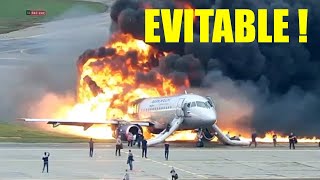
First-person narrated reconstruction of the Aeroflot Flight 1492 accident (May 5, 2019 near Moscow). The speaker explains the aircraft (Sukhoi Superjet / fly-by-wire), adverse weather and improperly-set weather radar that led the crew into thunderstorm cells, resulting in systems failures and an automatic switch to direct law. The crew struggled with trim and flight-control behavior, performed a troubled landing with multiple hard bounces, leading to landing-gear and fuel-tank rupture, post-crash fire, and a chaotic evacuation in which many passengers retrieved luggage. The account includes casualty figures, seat-specific survivor details, and commentary on crew training, aircraft maturity, air traffic control response, and legal/social aftermath.
Questions this video answers
May 5, 2019.
78 people on board.
37 dead and 41 survivors.
Seat 10C (row 10).
Good morning, my friends. I never liked the accident of Aeroplane Flight 1492, which I'm going to tell you about today. Quite simply, it was a crash that undermined the most unshakable faith in air safety. It was May 5, 2019. Around Moscow. There was a certain weather, rain, thunderstorms and vertically developing cloud cells that gave us a bus that was moving everywhere, in all wind sectors, even gusts of wind at times. A signet had been issued that afternoon it was 6:30pm we have a superjet aircraft, superjet jet. You can see it as a small Airbus 319 in shape, of course, the exterior right at 318. It was an aircraft built by a consortium of Russian manufacturers, but also with the intervention of conventional aircraft. We'll find Rockwell Colis in the cockpit, we'll find landing gear manufactured by Safran in France, the same ones that manufacture for Airbus. And it's a fly by wire type aircraft. That's a very important detail. It's an aircraft that has electric flight controls. So that means there's a joystick in the cockpit, a joystick on each side that sends to computers and then orders are issued from there. That's normal. Of course, this aircraft has to go to Murmask, that's to the north. It's a two hour flight and there were 78 people on board that day. There was a small problem caused by the weather, a small operational problem. That means that normally when the planes took off from the Runway that day, they wanted to go north. There was a departure route, what's called a sid. It's a standard departure route. And in fact, this route required him to climb along the axis of the Runway for many kilometers before he could turn right and head north. The problem was that thunderstorm cells had developed exactly in line with the Runway. What were the planes doing that day to follow this route? So what they did was shortly after takeoff, they asked the air traffic controller for permission to turn right. The controller, knowing that of course there were thunderstorms, systematically authorized them to turn right well before reaching the published turnpoint, which allowed them to avoid the brunt of the thunderstorms. Our pilots in their superjets weren't going to do that. They were going to program it and then take off and go straight. So they had weather radars, but they had set them incorrectly. That means they had set the radar scan radius to be very short. And since it was very short, it didn't allow them to see the cells until they were technically inside. So they took off, started climbing and flew straight ahead. After a while the turbulence increased. They decided to take their turn, but it was too late. They were inside an area that, if the radar had been configured correctly, would have been displayed in red. They went into it, they got really shaken. There were electric shocks, there were flashes of lightning, all that stuff. And then they came out the other side. Uh, they were alive, but the plane took a hit. What does that mean? It means that the plane already had one. And this is perhaps the most insignificant problem, is that One of the VHFs, VHF1, the radio they were using, had failed. It had blown its circuit. Another thing, and this is worse, is that some of the aircraft's computers are not working. Two of them are burnt out. Since they are burnt out, what will the aircraft do? It will switch to a so called direct law. This means that instead of having the joystick communicate with computers that develop the actual movements of the flight surfaces, which in reality allows the aircraft to be artificially stabilized and makes it easy and enjoyable to fly. Well, what happens is that this is outside the loop and we are going to connect. There is a system that will automatically connect the joystick directly to the electronic circuit that manages the hydraulic cylinders. And in this case, the movement of the joystick is simply accompanied by a proportional movement of the flight surfaces. As is sometimes said, the system behaves a bit like a conventional aircraft, like a 737. People often say, yes, the Orbis isn't the orbis here, but we understand each other. The Orbis, when it's in direct law, behaves like a Boeing 737. The problem with this analogy is problematic. It's not entirely true, but it has another problem. The problem is that we instinctively assume that pilots all know how to fly a 737, or they've had experience with it, and that this experience is current in the sense that this experience is recent enough, fresh enough in their minds for them to Levert to Boeing 737 type reflexes, which is a conventional aircraft with valves, cables, switches and so on. So the problem is that our captain, now sitting on the left, is going to find himself with an aircraft that behaves differently from what he's used to seeing. It no longer has Autotrom, because, for example, on a classic 737 aircraft, pilots are constantly adjusting the trim. They have two buttons on the stick and are constantly adjusting the trim. This action is very important to keep the aircraft balanced at its speed. On fly by wire, Airbus or superjet aircraft. This is not available. The Tram still exists, but it is managed automatically by the system, so that mentally it will disappear, it will leave the pilot's mental world. This means that they can almost forget about its existence, whereas in reality it is there. It is just as important as on a Boeing 737, but it is done automatically. The problem is that in the event of a switch to direct control, as happened to this superjet, this time it is no longer automatic. You have to use it yourself, you have to do it yourself. There are buttons, you have to manage it yourself, so the pilot will forget to manage them. There is a phase, there is a moment for 12 or 13 minutes, he doesn't even touch the trim and he starts fighting the plane with the ministic to try to fly straight, while he doesn't think of touching the trim, to balance his plane, to be able to manage things properly. So another thing I would like to say is that when the superjet came out, the manufacturer said that switching to direct law is an extremely rare event. It's not something that happens on our plane. Yes, it's theoretical. It can happen. If we can't stay in normal law anymore, because we have computers that are broken and everything, we could potentially end up in direct law. But there are pilots, if you take the bus, for example, there are pilots in their entire career who have never actually seen direct law in real life. It doesn't exist. It's a figment of the imagination. Even if it's practiced in a simulator, it's not something that most pilots won't see. They'll go until they retire without ever having seen it. But the problem with the superjet jet is that, given the kind of conversation I just told you about the airline aflot and the other companies that used this aircraft said to themselves, there's no need to train our pilots excessively to manage this mode, which in any case only has a theoretical existence. So the pilots weren't properly trained in this mode. Reality later showed that the superjet had a rather unhealthy tendency, for various reasons and on various occasions, to switch to direct law mode. So between the theory and the assumptions that had been made and the reality, we see that there is a big gap. It was quite frequent, by the way, to tell you, this is an aircraft that was not very successful in export, because the companies that bought it quickly canceled the rest of their orders because it simply broke down all the time. There were constant errors, and we had to wait forever to fix it to get the parts. So it was an aircraft that, let's say lacked maturity at that time. So our pilot, who also lacked the implications were they could almost have reached their destination with it. It's not the end of the world, really. You just have to get the hang of it. On the Airbus Simul, when the plane goes into direct mode, the only thing it does is it goes, oh, it's a bit surprising. The plane becomes a bit more aggressive. You can feel that the same movements are now a bit more brutal and you just have to go slowly. It takes a minute or two to get used to it and then it's fine after that. It's just a matter of changing the way you work on it, that's all. But except that here we clearly heard a loss of confidence and panic, ah, on their radio. At first they had a lot of trouble communicating because they didn't realize that the main radio, the first one, was dead and that they had to switch to others. So they ended up switching to other radios. They managed to talk to the air traffic controller and then he declared what is called a pan pan situation. This means there is an urgent situation that requires us to come back and everything. But it is not a distress situation like the one in the beginning, a MA situation, which means that the situation is much more, much more serious. The air traffic controller asked them if they needed the firefighters to meet them on arrival. The pilots said no. And here we will again find a poor assessment on the part of the pilots, but perhaps potentially on the part of the air traffic controller, because even on this channel you, you will see there are often cases where the pilots declare that they want to return to the field because they have a problem. And the air traffic controller treats the aircraft at the procedural level, treats it as a made flight, even if it was not formulated by the pilots, because they know that sometimes pilots tend to underestimate the seriousness. Perhaps sometimes just because of some sort of psychological barriers, they do not want to say to themselves that we are in a mayday situation, so there is no way out. In this case, it is the air traffic controller who will take the lead. And it is better to send the firefighters to the Runway, even if it is not absolutely necessary. They turn around, they return. Then to have an aircraft that comes crashing down and the firefighters are not there. So our pilots somehow managed to align the plane with the Runway and then wanted to land at all costs. The problem was that during the landing phase, the system signaled to them to wind down. This meant that there was wind shear coming. The captain decided to continue anyway because he simply had an extreme desire to land and didn't want to go around and end up having to pilot this plane for even longer, which he didn't understand and which he was having trouble keeping up with because throughout the entire flight, pun intended, it was a constant rollercoaster ride. It was constantly banked sideways, very abruptly, and sometimes it pitched down, sometimes it pitched up and it couldn't maintain altitude. It was an extremely, extremely difficult flight for its occupants. So it continued to go through the wind shear ahead, and then the plane sank. Since childhood, he is starting to have increasingly disproportionate reactions to the mini mange. He puts the throttle a little to compensate for the shear in front. And the reality is that this aircraft is going to pick up too much speed. So when it reaches the landing zone of the Runway, it. It is really too fast. It has a lot of energy. It is going to be very, very difficult to land it. One of the things that will happen when the aircraft goes into direct law is that the aerofins, when they are armed, when the lever goes to the armed position, the spoilers. Well, normally in normal times, when the aircraft touches the ground, the landing gear touches the ground, the spoilers extend. Huh. Which means that they will pin the aircraft to the ground, start the braking procedure, degrade its lift. Well, in this case, since they are in direct law, this system is not functional. That means that they're still going to put the lever in the armed position, but it won't come out. That means they should have come out manually themselves, but they won't. So the plane arrives and it hits very hard. Here we're at almost 3G. It hits the Runway very hard. What does it do when it hits hard? Well, it bounces. Let's imagine a plane coming in fast. It hits the Runway hard. The spoilers don't come out. Logically, you have a robot on this type of plane. What the manufacturer recommends in the event of a bounce is two things. First. Well, in flying clubs, everyone knows that in the event of a nice bounce, it's a go around. It's really a go around because it's much easier to go back around than to try to save a landing that's going wrong. In any case, on the superjet jet, there are two options. This means if it bounces a little bit to recover it. Well, I want to say you shouldn't do anything. This means what you have to do is keep the side stick where it was during the first impact. The plane will lift and it will keep the throttle up. It will lose a little speed. And it will come back to touch down. Do nothing. Otherwise. If the bounce is too high, it's like in the flying club. Put the throttle back on full and then go around again. Now, there is one thing that you should never do. Whether you're in a superjet jet or a Cessna 152, there is one thing, and everyone at the flying club level, it's this. What is the worst mistake you can make on a bounce during landing? And by the way, it's a mistake that is very instinctive. It's pushing on the stick. That's the worst thing that can happen. Why? Because we have an airplane that is perhaps too fast. Yes. But at the same time, aerodynamically it is quite slow. It is flying. It still has lift because it is very nose up. If you push on the stick, it will quickly pitch down and it can hit the nose wheel. In fact, very often in airparks, this is how we find airplanes in hangars with a broken nose wheel and a propeller that has hit the ground. It's simply because the guy arrived, he hit it, the airplane lifted, and then he did this to try to bring it back down to the ground. And when he does this, what he will see is that suddenly the ground or the Runway completely fills the canopy and the next moment it impacts. So this kind of thing is rarely fatal in general aviation, but it can be. It can cause injury or something. So what happens is that after the impact, our pilot pushes on the stick, on the side stick. So the plane takes a very sharp dive and crashes. This time we're talking about almost 5G. So here our plane crashes very sharply. Since it still has energy, what does it do? It bounces. Especially since our pilot, when he sees the impact coming at high speed, what does he do? He pulls on the stick because he says, oh my. So he pulls all the way back. So he turns the steering wheel all the way to the ground to slow down this fall. But when the crash occurs and there's a big impact, the plane bounces. What does he do? He sees that his plane is bouncing. He wants to bring it back to the ground, so he applies it, which means that in reality we have what are called pilot induced oscillations. This means that he is acting one hundred and eighty degrees from what he should be doing. He is doing the opposite of what he should be doing. And in fact, in the long run, he is making the situation worse. This means that he is making it worse every time. So when the plane hits the ground and is about to bounce, he pulls the stick all the way back. So he is going to help it bounce even higher. And when it gets to the top, well, what does he do? He starts to fall. He dips with the sidestick, and then he accelerates the fall even more. So there are videos from surveillance cameras that show this sequence of events that are truly worthy of a club plane, worthy of a pilot who went solo too early. And in fact, after three or three hits, the plane ends up breaking. That means that on the last hit, we, we are experiencing an impact force of over 5G. The pilot pitches down, and then the plane goes towards the ground. And then the landing gear breaks. They rip open the tanks. It's been a long story. It's a long story that I can't write about until now because in terms of certification, it shouldn't happen. But hey, once a plane breaks, it's extremely difficult to predict what will break first and everything. Even though there are designs that are made so that normally the landing gear breaks without ripping open the tanks, in real life, it can happen. That's what's going to happen. So the plane will hit hard one last time. The landing gear with its lugs will pierce the tanks. These will start to sink, and then a fire breaks out. The plane is still sliding on the ground while the fuel is burning behind it. The pilots are not there. If they had been there, they could have immediately started to pursue the plane and intervene. But they are not there. We told them not to come, so we didn't inform them, in fact. So the plane continues to slide. Then what will happen is that it stops. When it stops, the fire inevitably gets worse because while it is sliding, the fuel burns behind it. But when it stops this time, the fuel continues to flow because it lands with full tanks. So the fuel continues to flow around it, forming a big puddle. And of course, the fire increases in intensity. Another reason why the fire increases in intensity is that the pilots take more than a minute to shut down the engines. That means that what they're doing is that they're in their cockpit and we're wondering what they're doing, because despite all this impact, the engines are still running. They're blowing air on the flames. So the rear part of the plane is going to catch fire very badly, very strongly, because two engines are blowing on it instead of just slamming, uh, stopping them, stopping the engines. It could have taken a fraction of a second, but no, they wait a good minute before doing it. He doesn't give any evacuation instructions. It's an air marshal who decides to open the door. And then people start running and running and running and running. So what's going to happen, unfortunately, is that they're going to lose almost half of their passengers. If we look at it, we had 78 passengers. We have 37 dead and 41 survivors. So half of the passengers were never going to be able to get out because the flames were too strong. There were also reports that people were taking their luggage. And these reports are corroborated by videos from surveillance cameras and images where we see passengers getting out with their suitcases. These suitcases were most often on the locomotives, on these things. We open them, we get up, we open them, and we start looking for their luggage. What they did, while others were stuck behind, they were looking for their luggage. And in fact, each piece of luggage will condemn a human life. We take a suitcase. This suitcase may represent one or two people who were unable to get out. There was also a guy who was at the center of all this, because if we look where he was, where he was sitting, he was attacked a bit in the media and in the Russian social media. So this guy was sitting in seat 10C. Seat 10C. So there, row 10, seat row 10, the 10th row, that's the last row where there are survivors. Behind that row, there are no survivors. The people who managed to get out of that plane said that they had. I don't recommend this, but I'll tell you what they did. They had unbuckled their seatbelts and started running forward before the plane even stopped. It was still sliding, and they had already unbuckled their seatbelts and were already running toward the exit. The problem is that when the plane stopped, people got up, opened the containers where the luggage is, and started taking their luggage out, blocking the people behind them. The guy in particular I'm talking about, it's just to give you an example. But he wasn't the only one who behaved in this way. He took his luggage, he left, and then he went to the terminal at Aeroflot to ask for a refund for his ticket since the plane had crashed, that it was there in a mess, burning and all that. He considered that as a customer, he had reason to refund it. The Aeroflot employees saw things differently and considered that, well, he had boarded the plane, that the plane had taken off, that from that point on we could consider that the ticket had been used. In any case, time went by very quickly. There was an argument and all that. And then what he did was he left in front of the journalists who had come to cover the crash. He went before the journalists to testify to how Aroflot's customer service is extremely bad and that he had not been reimbursed and he had his luggage on him. And that's what subsequently drew the media's attention to him in an extremely unfavorable way. But what happened next is that the firefighters arrived, they started to put out the fire, but it was too late for the people trapped inside. Uh, the captain and the last person, let's say that in his defense, and the last person to get out of the plane alive. That means he stayed on the plane until more people were coming out of the smoke. When he realized it was too late, that the heat was getting to him, that the smoke was too strong, he decided to leave the plane. He was the last one to get out alive. Later he was prosecuted. He lost his license. He was sentenced to two and a half years in prison. It's not that he should have lost his license. He should never have gotten it, because clearly he was someone who was not operational on that plane. He was not able to operate it and fly it in good conditions. But unfortunately, that that's what happened. So, my friends, thank you for watching this episode. As I told you, this is an episode that shakes the most solid faith in aviation, because here we have a crew that is not up to par, a plane that is not up to par either. We also have a controller who is in trouble. We have passengers who do not want to evacuate and leave their luggage behind. So I think that eventually we will need a law that states that in the event of an evacuation from an airplane, each piece of luggage that you take out with you costs, for example, five years in prison and a €50,000 fine. I think that would calm people down, since in briefings, let's say in the event of an evacuation, the doors are here, there, etc. And that in the event of an evacuation, leave your luggage behind. That each piece of luggage taken with you will be weighed, right? And then its owner will be sentenced to five years in prison and a €50,000 fine. That will help people, because today we have reached a stage, I'll end on this, where people are more likely to leave their luggage behind if they know that it could cost them €50,000 than if they think that it could kill people or other passengers behind. Thanks for watching this video so far and I'll see you in the next one. Sa.
More from Aldo



La FIN du Royaume-Uni ? L'Ecosse, l'Irlande du Nord et le Pays de Galles veulent partir !




Analyse Présidentielles 2027 : Marine le Pen remet ENCORE le voile sur la table !


Scandale "60 Millions de Consommateurs" : la France mange des pâtes contaminées au Cadmium !

2 dossiers : Accident d'autogyre en Italie & un pilote sauvé par le parachute du Cirrus