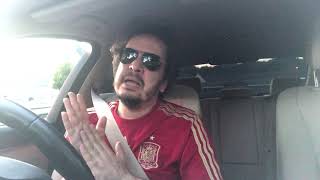
A single-speaker YouTube monologue reacting to the controversy over rapper Médine's planned performance at the Bataclan. The speaker contextualizes Médine's use of jihadist symbolism and controversial lyrics (including a 2005 album), criticizes perceived institutional failures during the Bataclan massacre (families filing a complaint alleging soldiers were ordered not to intervene), and argues that the Bataclan's emotional charge makes it inappropriate as an entertainment venue—proposing the state expropriate and raze it, turning the site into a memorial/green space. The tone is evaluative and critical, aiming for balance but visibly opinionated.
Questions this video answers
June 12, 2018.
2005.
Hello, my friends. Today I'm here to talk to you about the Medine affair, which is supposed to happen at the Battaclan. At first I didn't want to talk about it, but I received a lot of messages. I decided to give in to the pressure, let's say, to the request, and come and talk about it. Ah, I'd like to tell you first of all that as a blogger I feel that there is such passion and such emotion and I completely understand that regarding this affair in France, coming from outside, it's always difficult for me to talk because. Because you know, people, no matter what you say, no matter what you say, people won't be happy anyway. So I'm going to try to speak in a balanced and reasonable way, without being overly patient, of course, it's very important and try to be fair. And I assure you that this is my brief, or when I start this video, it's extremely difficult. So let me tell you something. There was a massacre at the Patoclean, okay? This massacre, an abominable killing. The French media have kept quiet about the details, okay, of what the victims suffered. And since then, since then we have stopped seeing events that come, let's say, to Sully, if I may say so, the memory of the people who died and. And finally, beyond these people who died, perhaps to insult an entire people in relation to these things. For example, the host of the terrorists in question, who is flaunting his stuff on the Internet, he plays Xbox or PlayStation or some other device that I was unable to identify with one of Mr. Macron's bodyguards, excuse me for saying so. A bodyguard. A close friend. A close friend. A bodyguard. You entrust your life to him, the life of your family. I mean, he's someone who is very close to you, and in the end, he's like a shirt with the host of the Battaklan terrorists. So today, in this extremely tense climate, this programming of Medine at the Battaclan arrives so in parentheses, at the speed at which things are going, with the publicity that has been generated around this event, I think Medine will end up canceling the Battaclan and performing at the Stade de France. Hey, just to tell you, between us, between us, I am a little uncomfortable with this controversy. And I will tell you why, because I have the impression that in France controversies regularly break out, but which at the same time hide other elements or other events that perhaps deserved our attention more. That is what I am trying to say. For example, there was the Manelle affair, The singer from TF1 who ended up resigning from a show and then in. In any case, she would have ended up quitting at one point or another. I think that is the logic of these shows, if I understand correctly. So finally, there was this story of this mixed race woman who wanted to play Jeanne Dark. Also, there was an extraordinary outcry, but in the end it didn't change anything, let's say, about the events, about the most important elements in relation to the history of the Battaclan. What shocked me this week, I can tell you, is that the families of the victims filed a complaint against ex. They are targeting the army. The army which, as part of Operation Sentinel, had armed soldiers near the Battaclan. These soldiers allegedly refused to help the police, refused to shoot at foreign jihadists armed to the teeth with weapons of war more powerful than the weapons available to the police. So who were literally slitting the throats of French people, as the Marseillaise would say. The soldiers were ordered not to intervene. Again, according to this complaint, the soldiers were instructed not to lend their first aid equipment to the police so that they could use it to try to treat, or perhaps provide first aid and save, if possible, certain people who were bleeding profusely. So that's what I see in France also. Wait, I'll add the nail in the coffin. It was the military governor of Paris who declared that it was not his job or that the military were not to take risks to save hypothetical victims. That's when people are killed with weapons of war in Paris. Now to go and fight in wars, we don't even understand what they're for in Mali, Syria, Afghanistan, in extremely remote places, and bring back young people in coffins covered with the French flag. That's worth it there. The hypothetical risks for even more hypothetical wars are worth it. On the other hand, when there is shooting, killing with weapons of war, when there are wounded French people on the ground bleeding, the soldier at that moment, watch out. I'm going to say the regulations, okay? The regulations are long, they're 300 pages long. We're going to read them. We're going to try to ask what the orders and instructions are. There may be this word that I don't understand. We're bringing down the system, the French establishment, which is also made up of rotten, corrupt people, scoundrels who have been dragging their feet since before I was even born, okay? Those who drag their feet, you know, the stuff with a capital A, suddenly become the worst legalists, like civil servants when it comes to fighting terrorism. Oh, no, we can't expel the files. The terrorist is there killing people. But wait, I'm French, I'm a soldier, I have a weapon. But am I supposed to shoot him or not? The victim is bleeding. Can I give him my first aid kit or not? I. I'm not sure. Still, I would have liked a controversy to swell and challenge the authorities on this subject rather than regarding this singer. Well, regarding this singer that I don't know much about yet. I'll tell you a few things. He uses jihadist symbols, I think I understood he released an album called Jihad. He's shown with a kind of big saber on his T shirt that he's holding like this. So to tell you something, Price information. This album that is often highlighted in the context of the controversy so Attached was released in 2005. Okay, so the symbolism in question from 2005, it doesn't take away anything. It doesn't take away from its seriousness, but it does take away from its significance in the context of the history of the Battaklan. Okay, so he didn't publish this on the eve or the day after the Battaklan. Ah, one more thing. Ah, I saw on social media a song or, or rather lyrics from a song called Angled Attack, where white people are called ports and things like that. Very, very violent. So I read the entire lyrics, which I can give you the link to in the description of the video. Ah, Angled Attack, act one and Angled Attack, act two. So what's it about? It's about a story where they found a dead person, a charred corpse, and several people are going to talk and say who killed him. So there's the black guy who hates white people, so he's going to call them black people and say that he's the one who killed them. There's another one who's a racist white guy who's going to say it's the black people who killed him. And he's going to call them extremely harsh words. He's going to call them literally animals. He's going to say they're only good for having litters. Okay? And then there's another one. He's going to accuse the Arabs in the same song, saying it's the baals that did it. Okay, so basically it's three people holding forth around a corpse, each thinking that this corpse is from his community, but it's a community opposite that killed him. And so each one goes on to make extremely violent remarks about the community opposite. And in the end it would seem that the dead man is mixed race and that he's ultimately a combination of several communities. So to tell you that this is a song, I think in the guy's head he thought about living together despite the awkwardness of the words. So the people who relayed on social media that this part where they say look at Medina sings about white people without ports and all that, I think that these excerpts taken in isolation, did not allow readers or people who read this to understand the logic behind the entire song. So if it can reassure you, I can tell you that it was in this logic. Okay, let's continue. I think Medina uses jihadism like Snoop Dogg uses drugs. Sex rivalry between other gangs, even sometimes rivalry with the dea, you know, the specialized police force in the United States that debunks drugs. So he uses jihadist terminology and all that. Something about its terminology and references, I'm not sure that a music group that wanted to do that in Algeria or Morocco or Saudi Arabia, I'm not sure that it would have been accepted. Okay, I don't understand how in France, but. Well, I think that France is beginning to understand jihadism attack after attack, and that it is becoming more and more sensitive to its symbolism. Whereas before 10 or 15 years ago, many of us were already warning the French against the arrival of these symbols in French society and generally calling us, oh no, you're just paranoid and all that. There you have it then, the threats that are associated with these symbols. Anise, the Battaclan, A Treb and others, and others and others. And so today the French are starting to have quite knee jerk reactions to these symbols. So I can absolutely add that there is an important element as expectations grow. Because there is another question, another angle that I would still like to address. The video would not be complete if I did not address this angle. There are sometimes extremely bloody and serious attacks where we can really talk about massacres, such as the Battaclan attack. It's not just Marie Gillot who shoots a rival. It's not just a guy who blows himself up and kills three people. It's very serious. It's very serious. It's a massacre. It's something that in history deserves a black stone. At that point, does the Battaclan continue to be a performance venue? Because forgetting Medina, Medina or someone else, a performance hall is supposed to welcome artists, musicians of all kinds, people that the population as a whole can appreciate or reject. Some can be reverent, can play violent classical music or do covers of Brie or Brasson, that's okay. But others can Also use extremely graphic, even extremely pornographic lyrics, symbolism of that nature. Well, we can't stop them. How can this hall today combine or reconcile this genre with its vocation, which is to welcome artists? Do you understand? So in either it's a performance hall or it's a place of remembrance. If it is a place of remembrance, then you will have to go in, take off your hat, and only have very reverent music, perhaps religious or classical or of that level, or else ban everything else, all sorts of shows that would be considered in the culture, let's say, of this region of the world, France, as irreverent towards the dead. Okay? We will have to ban anything that is slightly out of the ordinary, or we will have to do something else. Okay? We can clearly see that it is not possible because beyond this controversy with Medine, I think that Medine himself would perhaps end up withdrawing and moving to another venue. I think that given the symbolism he uses, he must understand and the freshness, lets say, his expectations there, he must understand that this affects a lot of people. But beyond Medina, if tomorrow there is another group that comes from France or Navarre or the United States or elsewhere, and that has violent or other symbolism, can we allow it in this room? Okay, that's the thing. It's a room where there are people who lost their lives not so long ago, okay? And people are sensitive to that, okay? Their families, the French in general. So what should be done? Personally, I'll tell you my opinion. I think that given the seriousness of these attacks, given the number of mass murders that took place in this venue as a spectator, for example, if my favorite artist were to perform in this venue tomorrow, I wouldn't feel comfortable buying a ticket, going to sit down or dancing on a dance floor, or sitting in a place where I know that not long ago there were people who were dying there, abandoned by their condition to murderers who were in the process of killing them. Do you understand? There were rivers of blood in this venue. So I think that what should have been done is like they do sometimes in the United States when there is a house where a serial killer has lived or where there has been an absolute macabre, the house usually ends up razed to the ground. I think today that the French government should. There are many venues in France. There are many venues in Paris. I think that's something that wouldn't be missed. I think that the state should compensate the owners of the Battaclan. So the state has the right to do that. The state has the right to literally expropriate so it buys your property by force. You have no choice. The state should buy the Battaclan and Raze should raise it, turn it into green space, put up a sign or a memorial commemorating what happened, and then leave the place like that. Leave it vacant for a few decades, until a new generation comes along. Maybe it won't experience, I hope for its sake, the horrors that we are experiencing today, that passions will subside in relation to this attack, that the people who experienced it in their own flesh will no longer be there. And that at that point the people who will be in that future will find another purpose for it to open, I don't know, open a museum or a parking lot or a supermarket or whatever they want at the time. Because at that time the Battaklan attack will mean nothing. Either because we will have forgotten it, which is normal, or because there will have been so many other things by then that frankly, it will be seen as a. Well, that's not the option I hope for either. So I think what needs to be done, I think that no Medina. So to sum up, no Medina at the Battaclan, given its symbolism, given the freshness of the attack, I think that it is still there is still there. Is still there is still an insulting dimension in relation to the victims, while still saying, acknowledging and being fair. A good part of what was said against Medine was exaggerated, cut and distorted. He's someone like rappers, who uses very aggressive words. And when you use those kinds of words, you're very easily exposed to bad copy and paste, that's for sure. On the other hand, I don't think he had a vocation to perform in this venue. But in reality. In reality, when I think about it, it's a place that carries such an emotional charge that its destruction, in my opinion, its total destruction seems to me the most reasonable thing to do. Okay, I don't know what you think, but it seems to me that razing this place would be a good thing. There you have it, my friends. I'll leave you and come back another time. Mister.
More from Aldo



La FIN du Royaume-Uni ? L'Ecosse, l'Irlande du Nord et le Pays de Galles veulent partir !




Analyse Présidentielles 2027 : Marine le Pen remet ENCORE le voile sur la table !


Scandale "60 Millions de Consommateurs" : la France mange des pâtes contaminées au Cadmium !

2 dossiers : Accident d'autogyre en Italie & un pilote sauvé par le parachute du Cirrus