Air India 171 : plus sombre qu’un simple accident
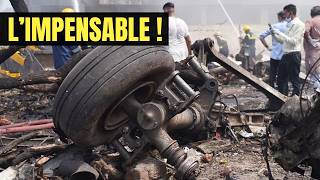
YouTube explanatory video (French) analyzing the preliminary report of the Air India 171 crash. The speaker reconstructs the takeoff: a Boeing 787 from Ahmedabad to Gatwick used the full runway, flaps were set to 5, the first officer was at the controls, and shortly after rotation both engine fuel-cut switches were manually pulled, causing loss of thrust. One engine could not be restarted; attempts and system behavior (FADEC, APU/VFSG, windmilling) are discussed; a 10–12 second delay in re-selecting the switches is highlighted as puzzling. The aircraft pitched to about +8°, descended, the empennage struck first and the fuselage impacted in a populated area with major fire. Fuel contamination is preliminarily ruled out. The speaker cautions against premature attribution of intentional pilot action without stronger evidence and invites viewers to contact him regarding immigration and scheduling.
Hello, friends. It's more sinister than we thought. Let me tell you. You'll notice that the environment around me has changed. The palm trees, the birds, all that. I live in Mauritius now. I left the United Kingdom. My next videos will be from Mauritius. If you want to talk about it, you want to discuss a personal or professional immigration project. My schedule is in the video description and the pinned comment. In India it crashed for a month today. We know more because preliminary report has been released, has been made public by the Indian authorities. So a preliminary report, to be clear, is not a report that will try to put the pieces together. It is not a report that will try to provide hypotheses or explanations. It is a report that will provide facts. What do we know at this stage? And I want to tell you that we know almost enough, unfortunately. Here we have our plane that was supposed to go to Gatwick from Ahmad Abad, that was supposed to go to Gatwick in the United Kingdom. In fact, it's a 787 that leaves the terminal. It's going to taxi, it's going to reach the Runway, it's going to go up it. It's going to go to the racket, to the place where the Runway widens, it turns around and lines up. I emphasize this point because at the time there were hypotheses in the media that the plane used part of the 1900 meters Runway instead of 3505 meters. We now know that it used the entire Runway. It's the co pilot who's doing the leg, which means the co pilot is at the controls and the captain on his left is the monitoring pilot. The report at this stage does not say whether or not there is a third person in the cockpit. Nothing is mentioned. We'll see later. Now the plane is properly configured for takeoff. The flaps are set to five, which is typical for Boeing 787 takeoffs, although other settings are possible. But typically it is 5 degrees GR. I emphasize this point because at the time American channels in particular said that an attempt was made to take off without flying them. This was a hypothesis that generally has its merits. But on an aircraft as modern as the 787, it is borderline bizarre. And it was supported by the media which reported it today. We have a photo of the flap lever set to five. It is on screen five. Even though it is burnt, we can see that it was indeed there and the flaps were properly extended. In addition to that we have images of the destroyed wings and we see that the flaps were also extended. The plane begins to accelerate. It accelerates, it accelerates, it accelerates. It's heavy, it's hot. So it's going to eat up a lot of runways. That's normal. Then we reach the announced decision. Speed v1. The co pilot, let's imagine by procedure, lifts the throttle control hand, holds the stick with both hands. The rotation speed arrives just one or two seconds later, starts pulling on the stick to make the plane take off. The landing gear leaves the ground. And then we have time to count to three seconds. One, two, three. And then tap, tap. We have a hand. Someone who is going to stop the two engines one after the other. There are two big switches located on the center console below the throttle. And in fact they are going to be operated manually at one second intervals. So it goes tap, tap. These are described switches. We can describe them. They are babble switches. They are stable in the open position, in the closed position. But between the two positions there is a roller with a spring inside the mechanism. You have to pull them afterwards to get past this roller. So you need to do something, a fairly determined gesture. You can't do it by mistake. You can't just touch them while trying to find something else and then activate them. No, they are heavy, they are fine. There is a spring that prevents them from moving easily. So they have been stopped. These are switches that cut off the fuel supply to the engines. So they cut off the supply and at that point the plane is deprived of thrust. So it will be pitched up. It has reached 8 degrees GR. It has reached 180 knots and that is the maximum speed it will reach. And from that point on it will start to lose speed and altitude. Inside the cockpit there is one who says to the other, probably the co pilot who says to the other who says, because the report doesn't indicate who told the captain why you cut them. Who answers? It's not me. So it's a pretty crazy situation. But it's very difficult to know why someone, what incentives someone could have to commit such an act during takeoff. I can just tell you without making any judgments that if I'm in an airplane, no matter how big or small, it could be a 16, not 2, and I take the red throttle lever and bring it back to zero during takeoff. If I do that in an airplane during takeoff, once it has left the ground, I expect the engine s to stop. I expect the airplane to return to the ground with high energy and I expect there to be obstacles. I expect to take them and I expect to die. So That's a little bit of what I can tell you at this point. The plane has actually started to come back towards the ground. Technically, what's going to happen is that the rotor is going to open. There's a picture that was taken from another angle that was included in the report. It's hard to see. It's not a rotor, it's not very big. There's the rotor that opens, it's a small propeller that will be driven by the relative wind. And it's going to generate hydraulics, it's going to generate hydraulic pressure for the vital circuits, meaning the flight controls, nothing else. So the rotor is going to turn and at the same time we have the PU that detects that there's no more engine that detects that we've fallen in this case to zero. How do we say zero? VFSG and what it's going to do, the POO is going to start its start up sequence. This channel was the only one, the first one, whether in English or French or elsewhere to tell you about it. That is to say, when we looked in the debris, there was something. It was the poo flap that was open. Now this flap, a mechanism that prevents it from opening on impact. It does not close on impact. It has a system. It opens it to allow air to enter and go to the poo. It is a small turbine that is located at the very back of the plane that drives the VFSG that provides electricity. It never had time to start because it takes a minute and 40 seconds to start. And so the plane had already been down for quite some time at the virtual moment right when it would have finished its gate cycle. So what is happening in the cockpit? We have 12 seconds, 10 to 12 seconds after closing these switches, they went to the open position. That means someone is going to put them in the open position. So what is surprising, and the report doesn't say anything, but they probably have something, is why did they take 12 seconds to put them back? Why? So if they hadn't identified the problem, but someone stopped them without the pilots knowing, and the pilots didn't realize, and they took all this time to see that the switches were stopped, then we can understand it took time to investigate. Except that at the moment when the switches stop, one pilot says to the other, why did you do that? That means that it was identified right away. But if we identified the thing right away, why did it take 12 seconds to put them back? You see, it makes no sense. So something happened during this interval. The one who has them for Example, potentially the one who stopped them prevented the other from opening them, or something of that nature. Right. So now once they are open, here is technically what will happen is that in the engines we have what are called the fadecs. These are electronic systems that manage the engine when it senses that the fuel has been added. The fadec does not really know the position of the plane, does not know what the plane is doing all that. It only knows the engine. The fadec looks at the engine rotation speed because the reactor is not like a diesel engine or a gasoline engine that stops with a quarter turn of the crankshaft. You turn off the key, you cut off the fuel and it goes bang and stops dead. No, that's not. Is launched at full power. So it turns very quickly. When we cut off the fuel, it won't slow down right away. It will continue to rotate very quickly while of course losing speed. Also remember that the plane isn't stationary. The plane isn't on the ground. The plane itself is going at a certain speed. And so the relative air will keep the engines rotating a little bit without preventing it from slowing down, of course, but it will keep it going a little bit. So here's what's going to happen when the switches are turned back on one of the engines, it's N2 coupling. So what we call the high pressure coupling, it's the. It's made up of the compressors and the high pressure turbines will turn fast enough for it to fall within the fadec regulation curve. And the Fedeck decides to start injecting fuel into it and the speed of the ladder, Therefore of this N2 coupling will start to increase. So we had an engine that was in the process of starting the other engine. Well, the engine core speed had dropped too low and so it was no longer possible to restart it. Even if the switch arrived, the fade could not restart it. And despite everything. So despite the switch being put back on, the engine was in the process of shutting down to restart it. We would have had to wait for the PU to arrive. And like that, the PU supplies the electricity to power what are called VFSGs, which are VFSGs. There are two per engine. There are two in the PU which are a kind of electric generator starter, if you like. They are electric motors. When you drive them by the reactor, they provide you with electricity. When you inject electricity into them, well, they turn. So they are the ones that drive the reactor during startup, once it starts, well, it starts to drive them itself and they become generators. There are two per engine, only one is enough to start the reactor, but. Except that it will start more slowly. In this specific case, once the engines stop, there is no way to restart it if you are in flight, if you are not able to. Or you can restart it by windmilling, but you need much more speed. I don't have the document in front of me. Windmilling means starting the aircraft using the relative wind. Except that I doubt that at the speeds reached by this aircraft there was enough air to do windmilling. But in any case, one of the engines had not shut down sufficiently, so to speak, and was therefore restarting on its own. So one thing, don't try this at home, of course, But I'll tell you why this 12 second delay is essential here to understand is that imagine, I say, just imagine, don't do it. You take off with a 787. Once it leaves the ground, you grab the switch, click it, you turn it off and a half minute later you turn it back on. You have your chances. Why? Because since the engine has been cut off from fuel, but it is still running at high speed, once you put the switch back on, what the fadec will do is see that the speed is high. It will start injecting fuel and the engine will start again. That's what almost happened with the 787, except that with Durindia 171, except that the time, the time that passed 12 seconds. The time that passed. Well, it was too late for one of the engines and the other engine, its speed had dropped low enough that it needed a lot of time to come back. And so that time it didn't have it. They crashed, as I said, nose up at 8 degrees GR. The rear was hit first. So the impennage, the part where the impennage is the tail fin was torn off and therefore the aircraft was destroyed by the building. It scattered on the roof of the building and in the surrounding area. Major fire. All this for information. The fuel has been analyzed. There is no problem with the fuel. It was analyzed on the pumps. It was analyzed on the distribution circuits of the airport. I am not talking about the aircraft. The fuel that was on the aircraft burned for the most part. A few crumbs or a few drops were recovered, but a laboratory is currently analyzing them. But I think that is a possibility that can be ruled out out at this stage because we know that someone manually stopped the engines. There you have it, my friends. So I told you at the beginning of the video that it was much more sinister than we thought. The theory that the pilot caused the accident intentionally is a theory that is never addressed in this channel. A priori, always after the fact and with elements that justify it. The reason is that from an epidemiological point of view, it is a theory that is completely empty. It has no epistemological content. The reason is that it applies to any accident. We can take almost any accident that there is on this channel and prove that it was the pilot who did it on purpose. And because it applies to all situations, well, it has no real value unless we have solid reasons that it could apply in this particular case. There you have it. My friends, thank you for watching this video so far. I remind you that the calendar is open. If you need to talk to me, just close it and we'll talk. I'll see you in the next video and see you very soon.
More from Aldo



La FIN du Royaume-Uni ? L'Ecosse, l'Irlande du Nord et le Pays de Galles veulent partir !




Analyse Présidentielles 2027 : Marine le Pen remet ENCORE le voile sur la table !


Scandale "60 Millions de Consommateurs" : la France mange des pâtes contaminées au Cadmium !

2 dossiers : Accident d'autogyre en Italie & un pilote sauvé par le parachute du Cirrus