Air India 171 : Un 787-800 en partance vers Londres s'écrase
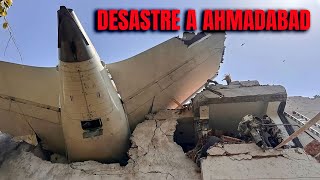
Video monologue (French) analyzing the June 2025 Air India 787-800 crash after takeoff from Ahmedabad to London Gatwick. Speaker estimates ~242 people onboard, notes ambient temperature near 40°C, runway length of 3,500 m, and that the flight lasted about 27 seconds. The commentator reviews two videos (a phone clip of the final descent and a zoomed surveillance camera covering the full takeoff), describes appearance of asymmetric thrust (right engine appearing weak), landing gear remaining down, slow descent rate (~475 ft/min reported by FlightRadar analysts), and significant ground casualties. The narration avoids firm conclusions and frames many points as provisional pending official data.
Questions this video answers
Approximately 242 people.
Close to 40°C.
About 27 seconds.
Approximately 3,500 metres.
About 475 ft per minute.
It looks like this air India Boeing 787 didn't have enough power. Good evening, my friends. Taking off from Ahmedabad in India. We're heading south, ambient temperature close to 40 degrees. We have this Boeing 787 taking off to go to Gatwick. It's not at the edge of its range. It can go much further. I don't have the documents in front of me, but I think it would be able to go to New York non stop. In any case, it's going to go to Gatwick. It's full of passengers. Roughly Speaking, there are 242 people on board. So people B. That's a lot of humans. That's heavy. That's also a lot of luggage, right? The more people you have, the more luggage you have. The tanks were maybe half full, right? And so it's going to line up for takeoff. It takes off roughly to the southwest. Questions have been raised by the online community saying it may have taken off from the middle of the Runway. Because if you want, you have the plums where the planes are parked. And then when they want to go back to the end of that Runway, they can't do it directly. There's no taxiway that allows them to do it. So what they have to do is go onto the Runway, go up it, get to the end of it, turn around on a paddle. It's just a wider area of the Runway, turn around, and there they have the entire length, which is 3,500 meters. It would seem that it took off from the beginning of the Runway, even though Flight Radar 24 shows it taking off from the middle of it because the coverage is simply not very good. Sometimes the DSB coverage is not very good. So there are points that are missing. And for a flight of such length, it would have been crazy for the pilots to take off from the middle of the Runway because it would have only been 1900 meters. But I mean, we still have a plane that crashed, so we still have something that was not optimal, that was not nominal. So obviously we have to analyze all the angles. So another thing that we see is that there are some videos that have come out showing this aircraft struggling in the sense of having trouble gaining altitude. The flight in all lasted 27 seconds. We have an aircraft that I would say took off, but perhaps that is a bit of an exaggeration because when you have an accident that occurs within 30 seconds of takeoff, it means that the aircraft never really took off, never really caught on in the air, never really had the ability to Climb to take off. It was just on a roll, on an almost ballistic trajectory. It was able to tear itself off the ground. Right, that's easy. With the ground effect and all that, it can always gain a certain height. But it stopped there. It was not in a sustainable flight and so it moved forward and crashed. The toll on the ground is very high because the area is heavily populated. And so we have an aircraft with 242 people in it. Apparently everyone died. We are talking about one survivor, but that is something that will have to be verified in the coming hours. The initial toll is around 50 people killed on the ground. So we are not far from the 300 victims for this tragedy, which is still a major tragedy. It is quite a big deal. We have perhaps lost the habit in our time, thanks to it perhaps not being the time to talk about it, but thanks perhaps to the development of air safety, which means that we no longer have these tragedies. Whereas in the 70s, for example, we had two or three per year, today we are less used to this kind of thing. It happens once every few years, incidentally, for their abyss. The Boeing 787, this is the first accident since it was put into service that was not easy. It had quite a few problems with batteries that overheated, batteries that caught fire, software and so on. It did have its moments of difficulty, but it never compromised its safety. It's an aircraft that is generally considered very safe. So what do we see? As I was saying, we see an aircraft taking off. It pitches up, leaves the ground, so it rises a little, not much. We'll see later, but I think we're talking about probably 200, 300ft or more. And then it will come back to the ground and it won't come back quickly. It won't come back in the sense that it stalls, it falls like a stone. That's not. Will come back in a relatively slow movement. Uh, we're talking about about 475ft per minute. That's the figure given by flight radar by their analysts. Less than 500ft per minute. So it's a gradual fall. Landing gear down, the nose up plane is horizontal. It impacts against a building, the cafeteria where there were these cafeterias, the hotel where there were these students. And that's where it's going to cause a lot of damage on the ground. So the Indians are only at the beginning in assessing the extent of this human damage. So what stands out? What can we say today? So listen, I was watching the videos, two videos that seem critical to me. Maybe others will come out later and certainly others will come out. But there are two videos that are very interesting from a technical point of view. There's one that shows its last seconds of flight. It's someone who filmed from a building and we see the plane nose up, slowly coming back to the ground. This video is interesting even if it doesn't tell us much that we don't already know because we can simply see that the plane has crashed. So we know that it's not a specific piece of information. But the noise is interesting because we can hear a few cracks at one point and the noise isn't very loud. Yes, the Dreamliner is an aircraft that isn't very noisy by nature, but not that loud. We can hear the noise of the engines, but it seems relatively quiet. So that's something to keep in mind. Another very interesting video is from a surveillance camera. It's a fairly poor quality video. Why? Because it was zoomed in. It was zoomed in to see the plane because it's probably a wide angle camera and we had to zoom in to get the plane. So the quality is very average. What do we see? We see this aircraft accelerating on the Runway. Normally at this point it rears up to take off and this video will follow it. This camera will follow it until the crash. So this one will film the entire flight if you want. And what are we going to see? We're going to see something interesting is that I'm going to share with you some steals that I took. I took, what do you call them, screenshots of the video. I put them in my Photoshop and I started playing around with the filters, with color filters. There's something that we're going to see that can be seen in the video, huh? By the way, because I started from one of these observations, right? And when we watch the video, I'd like to compare you. You see that at the moment when the plane lifts off, there are two things. There's a cloud. There's a cloud of dust behind it, okay. Because the Runway, the Runway area is dusty, right? And we also have a sort of heat pattern that can be seen behind all the planes that take off behind the engine of this. Now I'd like you to compare the left engine and the right engine. What do we notice? What we notice, what we notice is that it seems, I say it seems like the left engine is kicking up dust. That means when the plane pitches up and this engine is pointing towards the ground, there is dust that is kicked up. We also see once the Dust starts to disappear because the meat is gaining height. We start to see a little bit of heat, right? A little bit of heat swirl behind the engine. But on the right, on the right engine, we see nothing like that. So the right engine seems to be generating less thrust or no thrust at all. Maybe it broke down. By the way, the dust billowing, which is very strong, usually occurs if an aircraft pitches up but doesn't climb fast enough, that means it's going to hang around the ground for a few more seconds because it doesn't have enough power to climb very quickly. So what happens is that it's framed so the engine that provides power is now pointed towards the ground and close to it. And what it's going to do is that it's going to have the opportunity for a few seconds to blow up a lot of dust and create this phenomenon that we see in the video. So, of course, of course, I have to take all the semantic precautions. I'm just looking at appearances with the little data that we have now, I'm not suggesting that there was an engine failure or anything like that. I'm analyzing the elements available at this stage. Uh, later on, it could be confirmed, it could be denied. And I wouldn't have told you that anyway. In any case, our plane is pitching up, it's gaining a bit of height. And so if we assume that there was an engine failure, assuming that the right engine, as the images seem to suggest, was out of order, well, what can we say from that? We can say two things. The landing gear was not retracted. The landing gear remained down. Now, in the event of an engine failure, the main concern of a pilot who has an engine failure is that the landing gear must be retracted to reduce drag. Especially since today we're not taking off from an airport where it's minus 5 degrees, it's almost 40 degrees. The hotter it is, the lower the density of the air, if you like. And in this case, the air carries the wings much less, so there is less lift, all things being equal. And secondly, since it is hot, the reactors are less efficient. So if we lose an engine and we are also loaded and all that, it is true that we are gradually pushing our cursor towards a zone where we may lose our stability. Do you see what I mean? So potentially, the plane pitches up. The pitching up of the plane means the nominal rotation. It means it seems to be a rotation that we could observe on a normal day, taking off on two engines, whereas here we are probably taking off on one. So probably here we have a Slightly pronounced aggressiveness of this takeoff. And then we do not have the landing gear retracted. And at this moment we are lacking energy. So our aircraft remains very nose up at the start. It leaves the ground because it benefits from the ground effect. It remains very nose up and it will not be able to gain height, it will not be able to gain speed. And what does it do well, while being nose up to the maximum? Well, it starts to gently return to the ground and at that moment we have an impact situation with an urban area. There have been hypotheses that have been suggested by some who mean taking off without the flaps. So it is a possibility it existed. It was quite common at a certain time we had the spanner which was mentioned on this channel. Ah, we had other planes, but they were rather older generation planes. But it is very difficult to make that mistake with a 787 because it has an electronic checklist. This checklist knows how the performance was calculated. And if the flaps are not exactly where they should be, it will be displayed as incomplete. Plus there is a takeoff configuration alarm that will sound loudly if the levers are advanced for takeoff while the flaps are retracted. So it's not an error that could happen. But in my opinion, I associate it with probability. It's like all errors, we can put them all on the table and then we associate a factor which means we associate a probability. This error here, in absolute terms is not impossible, except that given the access barriers to this error that make it difficult to access, we will associate it with an extremely low probability at this stage, unless there is other information, especially since we see in the video taken by someone with their phone, where we see life moving away before the accident. Well, we see a shadow. We see a shadow on the front of the wing. We see that. We see that the leading edge slats seem to be extended, even though in reality it is very difficult, at least from this distance, to assess the position of the flaps during takeoff. Because between an aircraft that has the flaps retracted and one that has them extended to five, for example, in position five from a distance of a few hundred meters, the difference is practically invisible. It is very, very difficult to see for both takeoff and landing. We can clearly see them because they extend. They extend really properly. As for takeoff, they are relatively little extended and therefore very, very difficult to judge from pixelated videos like the one circulating at the moment. In any case, my friends, that's pretty much what we can say. What we can say tonight, with the information available. I'll come back in the coming days. If more information comes to light on this tragedy. Thank you for your loyalty to this channel. Don't hesitate to subscribe and like to get notifications when updates arrive. See you soon.
More from Aldo



La FIN du Royaume-Uni ? L'Ecosse, l'Irlande du Nord et le Pays de Galles veulent partir !




Analyse Présidentielles 2027 : Marine le Pen remet ENCORE le voile sur la table !


Scandale "60 Millions de Consommateurs" : la France mange des pâtes contaminées au Cadmium !

2 dossiers : Accident d'autogyre en Italie & un pilote sauvé par le parachute du Cirrus