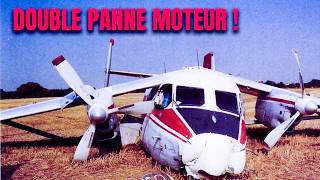
A 1993 Antonov 28 near Oxford lost both engines and nearly all lift when the pilot retracted the flaps at 500 feet. A single grounding point in the electrical system allowed current to backfeed relays and trigger the engine-feathering and spoiler circuits at once. Everyone survived, but the plane was destroyed.
Questions this video answers
1993.
Near Oxford, United Kingdom.
19 (17 parachutists + captain + first officer).
The 13th flight of the day.
About 500 ft.
Good morning, my friends. Today we're going to talk about an absolutely extraordinary aviation story. There's an accident that happened in 1993, but it's unique in its kind, let me tell you. In Oxford, there's a parachuting association that's more or less dependent on the army. It's going to rent an Antonov 28. It's a wet Antonov 28, which means it arrives with its pilots, and then the association brings the parachutists back. They're going to rent it in Hungary. You have to know one thing. It was originally a Russian plane that was registered in the Soviet Union. This was in 1993. So the Soviet Union had recently collapsed, and a lot of these planes with their Soviet crews, ended up on the Western European market. The Antonov 28 arrived in late August 1993, in the summer. So it arrived in the United Kingdom, and the next day it began parachuting operations. So here again to describe it briefly, it's simply a clean twin turbo. So it's an aircraft, two engines, its turboprops, and in reality, someone could describe it as the poor man's twin turbo. All day long it rotates, so it makes fairly short flights. 10, 15, 20 minutes to go, and drop parachutists. So each time it takes on parachutists, takes off, gets into position, they jump in free fall, and then it comes back and lands. This is the 13th. I'm not going to make this up. This is the 13th flight of the day. The plane lines up on Runway 38. Well, Runway 38, Runway 36. There's no such thing as Runway 38. I don't know why I thought of 38. And in fact, on board there are 18 people, 19. There are 17 parachutists, and we have the captain and a first officer, a co pilot. Both are Russian, so they came with the plane. They're the ones who brought it back from Hungary to the United Kingdom the day before. They're experienced, there's no doubt, there's no problem with their skills. That is to say, they're very competent people, as the rest of the story will amply demonstrate. So he lines up on Runway 36, accelerates and takes off naturally. So far, there's no problem. They arrive at 500ft. And what do they do at 500ft? Up to 500ft, they will flatten the trajectory a little to gain speed and retract the flaps. The flaps are the surfaces that come out on this plane at the back of the wings that allow the aircraft to fly at low speed. So they are extended for takeoff and landing, but then they have to be retracted. So in this case, the two pilots realize that it is high time to retract the flaps. One of them takes the lever. He has switched to flaps up. On this aircraft there are electric flaps. So it's a bit like in a Cessna 2. So there is a small lever, you push it, and then there is a small electric motor that will arrange to retract or extend the flaps. What will happen there? At the moment when he retracts the flaps, he touches only one lever. Something terrible will happen. The flaps will not move. But what's going to happen is that both the left and right engines are going to stop. It's as if a hand had stopped the fuel valves for both engines. So both the intakes for both engines are closed. They're going to shut down and the propellers are going to feather. So they're going to go into the wind to offer minimal resistance. Better yet, or worse still, I was going to say the air brakes on both sides are going to come out. I'm going to say clearly a situation for the future. Very difficult to know prosperity from an airplane that's loaded, that's at 500ft. Both engines stopped, the flaps extended and the air brakes fully deployed. An absolutely terrible situation. What's going to happen? The plane is going to drop like a stone. So the pilot. The pilots are going to try to glide. Yes, but how can you glide with the air brakes extended? So they're going to nose dive. There's a field in front of them. Luckily there are no buildings or anything. There are fields and fields and they miraculously manage to land right there. So it's more of a moon landing than a landing. The plane is completely dented. The wings are broken. In fact, it will never fly again. It's completely gone. It's been written off by the insurance company. It's over. But everyone is okay and they're going to get out. The firefighters are coming all that. Well, that's it. It's over. There's been an accident. Now we're on the accident post. The authorities have been notified and they're going to start an investigation. One thing you need to know is that while the authorities were coming, the pilots, who were well trained in the Soviet way, were a little worried. They wondered what was going to happen. Are we going to end up in a gulag? Are you going to be arrested? Did they take the S Bompet beam? They did it like that. Hypocritically. Huh? They went to Hitro airport, took a plane, bam, disappeared. They were there. We don't know where they are anymore. So the pilots fled. So the investigation is going to be a little difficult for the British authorities because they simply didn't know this type of plane. It's the first time They've had an Antonoo 28 lying around in a field. Plus it doesn't have a black box. Plus the pilots aren't there. So you can imagine how difficult the investigation is. Nevertheless, they're slowly going to go back over the history and they're going to discover something absolutely extraordinary. They're going to discover a flaw in the construction of this Antonov. There's one thing you need to know before you throw stones. Antonov. Antonov is basically a bureau, an aircraft design bureau. It's a Soviet bureau created in the Soviet era with offices based in Kyiv, Ukraine. So if you want, they design the planes, but they're not necessarily the ones who build them. They draw them, prepare the plans, prepare the documentation, all that, and then the planes are manufactured under license. You can see some being manufactured under license in Kazakhstan, Iran, Poland. Incidentally, this particular example was manufactured in Poland. They don't just manufacture that. They don't just make drawings for that. They also make drawings for frames, trains, rolling stock and all that. In any case, there's one thing. There's a gap between what the Antonov bureau had designed and what the Poles had built, particularly regarding the electrical circuit. Why? Because that's often the case. The office that sells the construction license, that sells the know how, does not really have any control over how the construction plant will ultimately interpret, or sometimes even coldly modify, brazenly modify its plans. And in that case there is a modification. Let me tell you, in the electrical circuit of the Antonove, we have most of the ancillaries. So the air brakes, the flaps, the lights, the radios, the engine control, everything is electric and in direct current, as is often the case with Soviet planes. Right? But like in the summer at the time, a lot of planes, even Western ones, where we had a good number, we had a mixture in reality of alternating current and direct current. The problem with direct current, unlike alternating current, is that it has chemical effects. It has chemical effects. That's why it was abandoned, because it tends to create what is called carbon deposits. That means it tends to accelerate corrosion at certain contact points, it tends to degenerate a certain number of connection points, and so on. So we prefer alternating current, but on this plane it was entirely direct current. Now when we look at how it works on this aircraft, well, on each service, we have a cable that arrives with the positive. So the positive goes to, for example, the flap. On the flap motor, we have a positive that arrives. But what does the negative do? The negative. So the negative does the same thing in cars. It doesn't necessarily go back to the battery. The negative goes to the ground, to the sheet metal. So the sheet metal will serve as a common ground, will therefore serve as a negative pole for all the devices in the plane. For all the devices. So the battery has its negative pole connected to the sheet metal, and then everything else is connected in the same way to the sheet metal. Okay, we do that. We also find that in car electricity. So here's the problem. In order to connect to the sheet metal what the Antonov office had done, they had designed several ground connections. This meant, for example, that the engines each had to see their fuel management and regulation system and the propeller governor and everything. Everything had to arrive individually at the sheet metal. So each one should have had its own ground. The office in Poland, or rather the manufacturer in Poland, wanted to keep it simple. What did they do? They connected all the cables, the negatives, and brought them back to a single point on the sheet metal. So on paper, it works very well. We start the plane, everything works. It's fine, except that we've created a single point of failure. This means we've created a single point of failure. We don't have any redundancy in this. What's going to happen over the years? We're going to have this single nut and this single bolt that go into the sheet metal to create the ground, which are going to start to undergo several things. First, corrosion, carbonization, and then it starts to move more and more. What will happen at that point? The resistance. The resistance will increase. The resistance of this ground point will increase. So the day when the pilots reach a fateful point, when the pilots are going to retract the flaps, what happens at the moment they retract the flaps? So we have a circuit of the flap pump and the flap motor that is open, or rather closed. So the electricity must return through the sheet metal. But when it reaches the sheet metal, what will it encounter? It will encounter resistance at the ground level. There is a high resistance. So since there is a high resistance, what does it do to the electricity? Electricity, remember, always looks for the path of least resistance. So the resistance, which should normally be extremely low, is high. The electric current will start to go up. The other circuits that are connected to the same place. So it will start to reconnect the other circuits and in particular the engine management circuits. So the relays that allow the propellers to feather receive electricity in the wrong direction. That means the electricity will go back up in the wrong direction. Except that these are direct current relays that had no polarity. If you like, they had no polarity. They could act in the same way whether they received electricity in one direction or the other. So even if they received electricity in the opposite direction, they still worked. So the two relays closed as if they had received electricity. And what did they do? So they sent both propellers to feather in one second, one after the other. So that's the first point that was done. Secondly, on the Antonov, we decided to install a device that limits the loss of symmetry in four engine failures. So what did we install? We installed an automatic system that detects, for example, that the left engine has feathered. Okay, the engine is feathered here it stopped. What do we do? We extend the lateral air intake, or lateral air intake on the other side, so on the right to reduce the asymmetry. But the system wasn't intelligent. It's an automatic system that thinks, left engine failure, right spoiler extended. Right engine failure, left spoiler extended. Since both engines failed, it extended both air intakes. So you see, we have a bad design that isn't followed by the manufacturer. We have poor maintenance, probably an aircraft that has suffered corrosion and all that. So we have all these problems that will accumulate, accumulate that day. And the net result, the net result is that, well, there you have it, a lever that is detached and activated, two engines that stop the spoilers that come out and the plane goes to the ground. So they could have, and they should have, at the time, they had widely installed unidirectional diodes too. That means they are unidirectional diodes. You can think of them as a one way valve in a hydraulic circuit. It allows all electrical current to pass in one direction, but not in the other. That was not done. If it had been done, it would have prevented this accident. But it was not done. The cables were simply connected. And if the current went back up, well, it went back up. There you have it. So there you have it. It was an accident that allowed this very particular flaw to be discovered. So later on, this aircraft was sold again. And it had this model of aircraft, not the aircraft, because the aircraft that crashed went to the scrapyard, but the aircraft had another life. Uh, they called it the Coyote. And it was sold to the US army and in fact, there are pictures of it. It's no longer in service. The last one was retired a few years ago. But for 10 to 15 years, there was an aircraft called the Coyote, which was a clean twin turbo which was operated by the US Army. In reality, it was a modernized version of the Antonov 28 that was slightly restyled. Its passport was changed. It suddenly became Polish instead of Soviet or Russian. And then it was sold to the US Army. So there you have it, my friends, thank you for watching this video. Of course, any similarity with recent events would be purely coincidental. See you soon.
More from Aldo



La FIN du Royaume-Uni ? L'Ecosse, l'Irlande du Nord et le Pays de Galles veulent partir !




Analyse Présidentielles 2027 : Marine le Pen remet ENCORE le voile sur la table !


Scandale "60 Millions de Consommateurs" : la France mange des pâtes contaminées au Cadmium !

2 dossiers : Accident d'autogyre en Italie & un pilote sauvé par le parachute du Cirrus