Armavia 967 : Le pilote a perdu confiance dans son Airbus A320
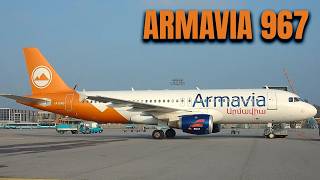
A single-speaker YouTube monologue recounting the crash of Armavia Flight 967 on May 3, 2006 (Yerevan→Sochi). The speaker narrates the flight timeline, deteriorating weather, pilot decisions under operational pressure, the approach and unusual controller instructions, the Airbus A320 automation and mode changes that preceded loss of control, and the investigation and aftermath (113 fatalities, company decline).
Good morning, my friends. I can't believe what I'm about to tell you, but it's absolutely true. This is exactly how it happened. It's May 3, 2006 and we have Armavaya Flight 967, which will connect Yerevan in Armenia to Sochi in Russia. It's about a one hour flight from there. The plane is scheduled to take off at 2:00am, 1:45am in the middle of the night. This is a time when the pilots are already extremely tired. One wonders why, for such a route they are forced to organize a flight in the middle of the night. It makes no sense, but there you have it. That's how it is. There are 113 people on board this French made Airbus A320. When it takes off, the weather in the region is absolutely appalling. Just to give you an idea, to make the approach to Sochi, visibility was required at 2,500 meters. The actual visibility at the time they took off was 2,000 meters. And the visibility forecast by the weather services, the one that was on the job, was 1500 meters. So the situation was deteriorating. There was no ceiling. That means the clouds were extremely low. Below the ceiling, a ceiling of 170 meters was needed to be able to land. The clouds very often go below that value. Our school pilots go to Sochi from there and then along the way they contact the controller at their destination to get a final weather update. They knew it was bad, so they asked about it and that's why they made this contact. He tells them that the situation is completely cloudy. He gives them the weather values. He watches them in real time. He has weather radar, he has some photoelectric cells outside that give him real time information. He gives them the information and then decides to turn around. He realizes that given what he's telling them, there's no point in going all the way to Sochi and then not being able to land. So they're practically in the middle of their flight and then they decide to turn around. So they turn around and they're going to go back to Ireven. The story could have ended there. They could have landed, gone to the hotel and then cooled off. That's often a very good idea, except that then after a quarter of an hour he contacts the controller again and then they try to put pressure on him. They'll tell him, we have very important officials on board the plane. In some parts of the world, these kinds of arguments carry weight. They just want to worry him a little by saying, okay, we have VIPs so you better check your weather forecast carefully somewhere. If you look at the accident involving the Polish president's meat, which landed in fog with almost zero visibility during an approach in Russia as well, it happened pretty much along these lines. We have officials who don't want to accept that the laws of physics apply to them. In this specific case, there were no officials in the aircrew. It was just an idea by the captain to try to add a little pressure. At that, the controller replied, well, listen, visibility is 3600 meters. I don't know where he got that from, maybe a hat. But suddenly the controller came back to his senses. Since the controller came back, well, they also decided to come back. So they turned around and took off again immediately. It was clearly a bad idea, regardless of everything else.
Why?
Because once the pilots turned around and did a second turn, that night started to feel a little crazy. Let's imagine, just to give you an idea of the psychological pressure, let's imagine that they managed to jump, that they couldn't land, and that they had to return to Revan that night. There would have been phone calls made to company officials saying, listen to the Airbus thing, it belongs to you. Take a look at flight radar. It's doing something crazy. So the pilots were on the verge of starting to do something crazy. So that's why they're now putting themselves under enormous operational pressure to land at sti. They arrive in the airport area and want to start their descent. When they start a managed descent, it means the descent profile is managed by the fmgc, managed by the system, by the Airbus's onboard computer. When they press the button, what the Airbus does is descend at 1,000ft per minute. It goes to 1,000ft per minute and starts an extremely slow descent. The captain starts to get a little annoyed and there's more and more anger in the cockpit. In fact, he starts to get annoyed with the Airbus. In reality, the pilot had seen the mistake. The mistake is that a navigation point was added to their circuit, which artificially lengthened the distance. And so indeed, for the Airbus system, since we have a long way to go because of this point, so of course I'm going to descend slowly. That's why the captain started this. He starts to get a little confused with the Airbus systems, and then he ends up starting a faster descent. But the speed will increase and in reality he will be constantly, throughout his journey, he will always be too high and too fast, which is annoying because planes have to lose energy as they descend, and they have to make sure they are in the right place at the right altitude at each point. And so if they arrive too high and too fast, it will disturb them more and more as they get closer to the airport. And that will be the case, by the way. So now, despite everything, despite all the. Despite all these setbacks, they still manage to position themselves on the approach axis. There is an ILS approach which is always made from the sea towards the land. By the way, departures from Sochi airport are always towards the sea, and arrivals are always from the sea towards the land.
Why?
Because behind the airport there is a lot of relief. And so it is not possible to operate in the direction of the relief. You cannot take off facing that relief, nor arrive from the relief and land. So it is always towards the sea. So they position themselves on the approach axis, they manage to capture this ils, start to descend, extend the flaps, extend the landing gear. They are completely configured, despite everything. So normally in the next few minutes they. They will land. They also receive landing clearance from the controller. So up until now, everything is going well. And suddenly, suddenly the controller comes on the frequency and he no longer wants them to land. He tells them the ceiling has dropped below 170 meters. Well, let me tell you something. There is a way of working in Russia that is completely different from the rest of the world. And to be honest, some of their practices may have a justification. Even if we don't agree with them, they have a certain operational plausibility. So we can always defend them out of intellectual honesty, show them their advantages a little bit. But in this case, in relation to the authority that the controller has, it makes absolutely no sense. It's really hard to find an argument for it. In fact, in Russia, the controller has a lot of power. Literally, at times you get the impression that the pilots are under his supervision, whereas in the rest of the world he is there to facilitate air traffic, avoid conflicts and so on. But in Russia it's different. So what happens is this. Normally, if you're doing an approach, I don't know, in Lyon or Algiers or wherever, well, what happens is that the controller gives the weather the authorization to land and so on. But then it's up to the pilot themselves. When you do an ILS approach, to descend along the is right to the decision height. Once the plane reaches the decision height, if it sees the Runway, it continues. If it doesn't see the Runway, it goes around. So in reality, once the plane is on an approach, the next important decision point is what we call the decision height. It's at that height that he decides whether I have visibility, whether I have the Runway or the lights on it, whether I should continue or whether I should stop. In Russia it's different. In Russia, controllers are constantly looking at the ceiling. So they have a device with photoelectric cells. I was saying in the tower, they look at the ceiling in real time and then, well, every few seconds a new reading arrives. And if a reading arrives that is below the minimums, they require the pilots who are already on the approach path to do a go around, which makes absolutely no sense. No sense, because the pilot is at the beginning of his approach. Well, he goes around and then what? That means that maybe 30 seconds later we'll have a reading that will be within the minimums. So it makes absolutely no sense in reality. You see. Secondly, the order that the controller gave, from that moment on, because he was going to give them the order to go around, even if he didn't use the word go around, it was going to create a bit of confusion. He was going to ask them to climb to 600 meters and turn right. That's what he was going to tell them, which in reality corresponds to the published go around procedure. But he didn't say the word go around. The thing is, the order that was given to them was illegal.
Why?
Because in Russia. Well, there are Russian laws that apply, but there are also the rules of the icao. So for local flights. For local flights, that means flights of Russian airlines arriving from Russian destinations. But Moscow Sochi at that time, the Russian rules of the Russian Federation apply for international flights, controllers cannot apply Russian rules, but they do apply the rules of the ussr. So in reality, since it was a flight coming from Armenia, it was an international flight, it wasn't a Russian airline. The controller hadn't given this order. And besides, in reality, the pilot could have refused it. The pilot could have said, we are operating according to OCI rules. I will continue to the decision height. If I see the Runway, I will land, period. If you are not happy, you can report it later. And the pilot would have been right, except that in this specific case, when the pilot received this order from the controller, he decided to comply. Except that he had a small problem, let me tell you. He was only at the beginning of his approach, the height he was asked to reach in the event of a go around, 600 meters is relatively close. It is quite close. Now, what is a go around on an Airbus? Same thing on a Boeing. You take the throttle and put it in what is called toga. That means putting it on maximum really pushing it all the way. The engines accelerate and under that condition, what will happen when the throttle reaches gar, the aircraft systems, the navigation, all of that. Now goes into go around mode. Problem. There is a problem. Next problem is that it is very annoying to do a go around when the distance between where the aircraft is, the difference in altitude between where the aircraft is and the place, the altitude to which you have to go for the go around are very close.
Why?
Because the engines are very powerful and when they reach maximum, the aircraft takes a very nice climb rate and can quite quickly break through this ceiling and go above it. Okay, so that's what is a bit annoying. So in this specific case, Airbus recommends in these situations to go quickly towards toga. Anyway, some call it a toga tap. So they go towards toga, at most just long enough to mentally count until they can then reduce the throttle. But the system has already registered that we are in a go around logic. That's not what the pilot is going to do. The pilot is going to do this. The pilot is going to take a button. There is a button that allows you to select the vertical speed. Normally there is nothing displayed in terms of vertical speed on this button.
Why?
Because the aircraft is in approach mode. So the vertical speed is calculated automatically and it is dynamic, it varies according to the speed and all that that. So there are no set vertical speeds. But if you tap this button, the aircraft stops descending. The aircraft will do a level off, which means it will stop descending. So when you tap it, several things will happen. First, the approach mode is cancelled, so the plane will stop descending and relative to the axis, in which direction will it go now? Well, it goes into heading mode. It goes into heading mode. That means the orbis has this logic in if the approach is canceled in this way, the altitude will be fixed and then the direction it will be neither a route nor a Runway axis, nor anything at all. It will simply be a heading. Okay, so he presses hit, bam. Now he decides to climb. The captain decides to climb. So he goes to the altitude window. He will select an altitude higher than the go around altitude. So instead of 600 meters, he will select a much higher altitude. He will select 2100 meters. We work in meters, we are successful. And in fact, to reach this altitude, what is he going to do? He will press another button called open climb. It's the climb, one of the most brutal climbs on an Airbus. There's something even more brutal than that by pressing an XP button. But it's not available on all airbuses. But to tell you, he did something completely unimaginable. He canceled an approach. And while he had the flaps fully extended in landing mode, he had the landing gear extended and he was going to put open club. This is not something that Boeing engineers had thought of, because it doesn't exist in normal operations to go from landing to open climb. What does exist is that during landing there's potentially a go around, but open climb is a little surprising. What's going to happen? Several things are going to happen very quickly in a very short succession. And that's what's going to end up completely losing the captain's mind. This is what's going to happen. The engines accelerate, the plane pitches up very abruptly to 21 degrees. There are 1.3 GS marked in the open climb box.
And why?
Because normally the erbus uses and adds 0.15 grams when the open climb is pressed. In other words, it goes to 1.15 grams maximum. That means it will do a nose up, which is sharp and all but relatively reasonable. However, by Airbus's programmatic action, logically, if the open climb is pressed within a 30 second window after pressing the level off the first button, this time the nose up is much more aggressive. This time the autopilot has the right to go to 1.3 grams. Okay, so it's much more brutal this time. So when he presses bam on the open climb, the engines accelerate, the plane noses up to 21 degrees. So a very nice pitch up. Because internally in its algorithms, it's still algorithmic. It's going to look for 8,000ft per minute. So in reality, it's never going to reach that. It's not going to reach 8,000ft per minute. But it's a value, if you like. It's a value that's in the algorithm. It means we do the following thing. We're going to look for a virtual value of 8,000ft per minute. So that gives precisely this aggressive pitch up and the engines that accelerate suddenly. And then what do we do? Then we're going to reach what we can reach before 8000. So maybe 3500, maybe 4000, maybe 2800, it doesn't matter. It depends on the conditions of the day. And we monitor the speed. If the speed starts to drop, we go below a certain value. What we're going to do is start to flatten the trajectory. We're going to slowly flatten the trajectory, so we'll never reach 8,000. But it's a virtual target that's in the system's. Algorithm. That's why the pitch up is so aggressive. So something else is going to happen. What's going to happen is that when it does that, the plane pitches up, the engines accelerate, but the speed will drop back a little. At that moment, an alarm will go off in the cockpit. Speed, speed, speed. It's a man's voice that will start yelling, it's speed, speed. That actually means there's low energy. The erbus is in a low energy phase. So the speed alarm can sometimes go off when, for example, the plane is in landing configuration, flaps extended, landing gear down, the engines are not giving enough power, the speed has dropped, the angle of attack is high. And what does that mean? Roughly speaking? It means that it has pulled in. We can say that in general aviation terms, we are in a second gear logic. Quite simply, it means that the angle of attack is too high and there is no way to take off when you hear the alarm. There is no way to increase the angle of attack or obtain a positive slope in the IRB us by simply pulling on the sidestick. There is no way. It means that if the sidestick is already almost completely pulled out and if the pilot pulls on it more, the plane will not go. It could potentially pitch up a little more, but it will continue to descend. It will not be able to climb back up without adding more throttle. Tests were carried out in a simulator by ABUS subsequently and by investigators from the B. Because there will be an investigation, because you can imagine it's happening now, and they'll find that systematically when you're in landing configuration and you do what this pilot did, it means you go directly from landing configuration to open climb. There's a transitional phase during which the speed alarm will go off. Yes, there's this transitional phase. However, the plane won't crash. There's no zero risk of the plane crashing or anything. It won't crash, it won't stall, it won't do anything at all. It's just going to do something that's quite surprising. And since the pilot went out of, let's say, what's normal, what's usual, he encountered a reaction from the Airbus that completely surprised him. So the plane pitched up suddenly and he was surprised right at that moment. At that moment, the aircraft was actually already starting to give orders to pitch down, meaning, yes, it had pitched up to 21 degrees, but the onboard computer was already sending pitch down orders up the chain, meaning to reduce that pitch up. It was in the process of reducing that pitch up, except that the pilot didn't wait for that moment. He didn't realize that it was happening. He lost confidence. There you have it. He acted like a man of few talents. He lost confidence and in losing confidence, he disconnected the autopilot. So he disconnected the autopilot and what did he do? He gave a pitch down order. Now he was going to apply it. He banked the aircraft to the right just to avoid the mountains. So he was on the axis of Runway 06. So he took that pitch up and initiated a climb in the axis and the turn too. So what was he going to do? He's going to increase the turn while starting to push on the side stick. At the same time he was making slightly strange movements that made no sense. No reason to use the rudder pedals. The rudder pedals are practically only used in the event of an engine failure or strong winds during the approach or something. But there was no reason to use the rudder pedals. But he's going to use them. So what he's going to do is he's going to start pitching the plane's nose down. When the plane pitches down, the speed increases, so he's overspeeding, he's retracting the flaps and then after a while the flaps even retract automatically because there's a protection on the Airbus to prevent damage. There comes a time when the flaps retract by themselves. If the speed exceeds a certain threshold, the landing gear will remain extended. He doesn't think about re entry, but he starts giving increasingly nose down orders while he's literally hovering over the Black Sea. At that point, the co pilot enters the loop. He enters the loop at the moment when the GPWS starts yelling. That means when the GPWS realizes that the plane is heading towards the water and starts yelling, pull up. Pull up. Pull up. They actually had the option to pull up and recover the flight, but unfortunately that wasn't done well. The co pilot comes up with his hand like this on the Mini mche and he does this. That means the plane is pitching up to the right, which wasn't even the most important thing, right? Because the pitching up on an Airbus, it's never going to go inverted because there's a limit. There comes a time when you won't go any further. But as if the pilot wanted to correct it first, to bring the wings back to horizontal, that was his first concern when they should have been pitched up instead. So what did he do? He took his arm and in a panic he made a semicircular gesture. He made a circle like this. To grab the sidesticks, Right, to grab the sidesticks. Let me show you something. He grabs the minim like this, right? Like this. To bring the plane back to the left. So his idea is to bring it back to the left, but he actually does this, I don't know if you can see it, okay, he does this and in reality he's going to go left, he's going to give a left turn and at the same time he's going to give a forward turn to pitch down. Okay? So he's going to reinforce somewhere the picket that had been initiated by the pilot. So he's going to add it because on the Airbus it's the algebraic sum of the two inputs that is added. And so if he's on the left, he's diving. And the other one also adds to the dive. Well, we're diving even more. So there's that on the protections of the ERB us, there's no protection to prevent him from going to the ground. There's a lot of protection, all that. But if the pilot decides to go towards the ground, he goes towards the ground, he hits the ground, the erbus won't stop him. Okay, now at this point our captain realizes that he's going towards the ground. He realizes that something's wrong. It's as if he's waking up a little from his torpor and his panic. He takes his sidestick and pulls on it so that afterwards. Except that since the co pilot's sidestick is forward, okay, what's going to happen? The two will cancel each other out. Remember in algebra when both were pushed, the plane went into a dive. But now what we have is a ministic that is pushed forward and another that is pulled all the way back. So the algebraic sum is zero, which means that the plane does not react normally in normal times. When there is a situation like this, when both pilots act at the same time on the Ministik, there is a voice, there is a man's voice that says dual input, dual input. It means that both are doing something. This voice will not resonate in the cockpit of this Airbus.
And why?
There is another reason. You know, we are constantly going from one logic to the other. We are in the middle of an algorithm. I often tell you, if it had been a 737, we would be talking about oil, fuel, cables, pulleys and gears. When it comes to Airbus we always follow logic. We always follow logic algorithms and so on. There is a reason which is that when there are several possible alarms, when a Given situation generates several alarms. So in this situation there are two alarms that should be triggered. It's the gpws because we are approaching the SGPWS should be triggered, should say pull up and so on. Okay, now we have a second alarm that should be triggered. It's the all input alarm. In this case the system is programmed to assign priorities and it is the highest priority alarm that will override the lowest priority alarm. So yes, everyone knows that in simulated all of this. Okay, you see, if I touch you, you do the opposite or if you touch, you do the same thing. It's dual input. It's nice, it's great. Yes, yes, but it's not in all cases dual input can't always be heard. If there's an alarm that has a higher priority than dual input, it won't be heard. And the GPWS has a higher priority. So Captain, put yourself in his shoes. He was sure he was going to land. He didn't have a plan B. The weather is rotten. He got mad at the plane, he got mad at the controller. Nothing's happening. Now the GPWS is yelling. So put yourself in his shoes. When he pulls on the minibus, nothing's happening. He doesn't hear God go for a break, but nothing's happening. So in his head he's saying but, but, but, but, but. This is devilish. He feels like the Arbus isn't responding to him. He feels like the Arbus isn't responding. So he pulls all the way back on the ministick and the Arbus continues to pitch down. See, he also thought that a few seconds earlier, a minute earlier he had already lost confidence when the plane pitched up too abruptly and it had a speed, speed, speed alarm for him. For him. He feels like this plane is doing something crazy tonight. And then he completely loses confidence. And the worst thing that's going to happen is when he pulls, nothing happens. The co pilot realizes his mistake. Three seconds before impact he pulls on the stick. He too, he pulls on the ministick. The plane slowly starts to pitch up. Bam. Impact between the water. It's been calculated that up to 5 seconds before impact the plane was salvageable. Up to 5 seconds before impact it was possible to give a sudden blow to the minimoshes and the plane would have pitched up. It would have taken off. It would have been, it would have just made it through. But it would have made it through. Except that this wasn't the case. Pam. 113 dead instantly. Everyone was killed. In fact the controller. In the seconds before impact, the black Box recorded the controller saying in his monotone voice, you can come back and land. The ceiling has just increased. I mean, it's too late now. The plane is crashing, it's not landing, quote. So when the plane stops responding, the emergency services leave at 4am they'll find a slick of oil or gasoline, floating objects, etc. At the same time, we'll wake up the Armenian president to tell him, well, look, Eremavia has been cleaned up. And so this investigation will begin with the Russians, the Armenians, the bee, all that. Then afterwards, there were a lot of rumors and so on. But aviation in this country is very political because in general, when you look at airline investors, they are politicians, military personnel, well connected people, financiers, all that. So it creates. It's true, it creates a slightly unclear background. Armavia did it in 2013, they had lost another plane. The day after this crash, an Arbus that caught fire. One caught fire in a hangar in Brussels. So it was a company that was doomed. So it continued to exist as best it could. It closed its doors in 2013, and today Armenian aviation is banned in the European Union. It is forbidden for them to come to Europe. They have tried to solve many problems. Many have been solved, but not all the time. Not, not, not everything, not all of them. Actually, many issues still remain open. And we can say that, for example, in the context of the captain's pilot who panicked, we can say that, for example, on an Airbus, given the protections that there are, it's really panic in a flip, we don't know what to do, we are completely disoriented, we are under emotional stress. Emotional is the word that was used in the report, right? They were under a huge emotional load, right? Panic, fear, annoyance, fear, all that. If we are in that situation and we feel that our neurons are starting to disconnect, on an Airbus, we can say that maybe, maybe we are more on the side of safety. If we completely shoot the minister, in any case, he won't stall, we shoot completely to death. If we want to put the throttle all the way up, even if we forget to put it in, it will put it in all by itself. So what the system will do is moderate our input, it will pitch the plane up, but it will not take it to the point of stall. So it will not stall. Either we put the throttle all the way up, but the plane will climb, or if we forget to put it in, it will reach the threshold of stall, it will put it in all by itself and the plane will not crash, just pull back on the stick as much as possible, push the throttle levers, or not even push it. It will do it all by itself. The throttle will go all the way up. And then we wait for things to calm down. Hmm? Okay, we can say that, can't we, when we look at the arm, because the pilot pushed it. Except that the problem is that the reasoning I'm giving you. We're on Air France447, okay? Uh, in a panic, I don't know what's going on. It's night, bad weather, turbulence. Life does weird things. I don't trust my instruments. I don't trust anything at all. I pull back on the stick, I put the throttle to full throttle, and the plane will save me. You know what I mean? There's no miracle solution. Unfortunately, there's no miracle solution because it's in France. That's what he did. He, he, he kept the plane completely, completely like that nose up on the Armavia. Well, he did the opposite. He went into a nose dive. He ended up in the water. There you go. Thank you, my friends, for watching this video up to this point. It was May 3, 2000, 2006, with 113 deaths. Most of the parts, we put the black boxes and everything back together, but most of the parts and all that are still at the bottom of the water because the Black Sea is very deep. 500 meters from the sides. 500 meters deep. Thank you and see you in the next video.
More from Aldo



La FIN du Royaume-Uni ? L'Ecosse, l'Irlande du Nord et le Pays de Galles veulent partir !




Analyse Présidentielles 2027 : Marine le Pen remet ENCORE le voile sur la table !


Scandale "60 Millions de Consommateurs" : la France mange des pâtes contaminées au Cadmium !

2 dossiers : Accident d'autogyre en Italie & un pilote sauvé par le parachute du Cirrus