Asiana 214 : il pilotait le BOEING 777 comme un AIRBUS !
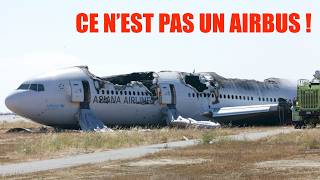
A French-language YouTube monologue analyzing the Asiana Airlines Flight 214 crash (July 6, 2013). The narrator explains how differences between Airbus and Boeing philosophies, airline training that favors automation, and specific ergonomic/system-mode confusions on the Boeing 777 (notably an autothrottle "hold" mode) combined with a failed glide-slope/visual approach to produce an unstabilized, low-energy approach. Key reported facts in the narration: the flight was a Boeing 777-200ER from Seoul to San Francisco (~10 hours), 307 people on board, the captain had ~10,000 total flight hours but only ~33 hours on the 777 (background on Airbus), the right-seat pilot was a newly qualified 777 instructor in line training, the ILS glideslope was out so they performed a visual approach, airspeed fell to roughly 100–103 kt with engines at idle, and the aircraft struck approach lights/structures short of the runway resulting in tail separation, three fatalities, multiple serious injuries, and wide media confusion after the accident. The speaker emphasizes human factors lessons and contrasts Boeing/Boeing ergonomics with Airbus automation.
Questions this video answers
July 6, 2013
Boeing 777-200ER (triple seven)
Seoul (origin) to San Francisco (destination)
307 people
About 10,000 flight hours
My friends, good evening. Thank you for being here. Thank you for being loyal to the channel. Today, before we start, I would like to show you something. A plaque. A plaque that was sent to me by YouTube to celebrate the 100,000 subscriber to the channel. So I would like to thank you for being here, for your support of this channel for all these years. I would also like to thank the pilots, the controllers, the mechanics, the ground crew, all the people related to aviation who help me with information, who help me with technical documentation, who also help me with their analysis, their experience that they make available to the channel. Thank you again. So today, before we start, I would also like to show you something else. I would like to show you a book that is very important for this channel. It is the Escre. This is what political ecology is doing today. It is destroying the industrial fabric in Europe. It is destroying the automobile industry. You have noticed that today the automobile industry has become a toxic sector. Their actions are toxic paper. And aviation is also in their sights. So that is why I invite you to read this book. I will give you the link to find it on Amazon in the description of the video. Now let's go into our story. The Asiana 214. It is July 6, 2013. Just to give you an idea of the date. It is a Boeing 77 extended range aircraft that took off from Seoul to go to the United States, to go to California, so San Francisco. About 10 hours of flight. On board we have a very special situation that is to say that there are 307 people. It is full to the brim, as Brasson would say. Right, right. But what we have is that in the cockpit there is a very special situation. The guy sitting on the left, who is normally the captain, is a guy who is extremely experienced with the aircraft. Someone who has experience and all that. That is not the case today. He is a guy who is experienced. He has about 10,000 flight hours. But the guy comes from Airbus. He is doing one of his first flights on a triple seven. He has roughly a few dozen hours. He has 33 hours of flight on the type. Before that he was on an ABUS 330. This is a very serious situation, a very serious one. Why? Because the two aircraft are not built according to the same philosophy at all. So, yes, he has 10,000 hours of flight on an Arbus, but here he is on a Boeing. It is not at all the same thing. It is very difficult to transfer experience between the two manufacturers. Now, on his right, you might imagine that we've Put someone extremely senior, extremely capable. Well, no, not really, since he's in line training. What did we do? Well, we put an instructor on his right. This instructor is, well, a guy who has just been qualified as an Instructor on the 777. He's doing one of his first flights as an instructor. So there you have it, a very delicate situation. The guy on the left is nervous. He's nervous for reasons because, well, he's new to the triple seven, which is a little less, to put it nicely, a little less user friendly than the ERB us. But also he's nervous because on his right there's a guy who's there to judge him. He hasn't seen a copy with three bars like, you see, you do what I tell you, you shut up, right? That's not logical. There he has an extremely serious guy on his right, someone who also has four bars. Someone who has more security than him and who is there to train him and also to judge him and fill out paperwork about him. So he is worried. Okay. Another element in this story, the Asiana company, which. Well, it trained its pilots according to a doctrine, according to a philosophy that was and is also very common among many airlines, which is to say you do not touch the plane. That's it. You manage the plane. You are not a pilot, you are a manager. You use the autopilot almost all the time. We do not want manual piloting. We want you to be there to feed the autopilot, but really minimize your interactions with the controls. What happens in this situation? Two things happen. First, the pilots, well, they lose control. They are no longer able to really get by manually. That is the first point. Secondly, I say they lose control. Well, yes, but I'm being nice. It's just that they've never had a handle on it. Because if we assume that we're training people not to fly manually but to be managers, well, we're going to train them from the start to be managers. So we're not going to put a lot of emphasis on manual piloting so that we realize it's not that they're losing it, it's that they've never really had it. This situation wasn't possible in the 60s or 70s. But the fact is that these companies prefer that we don't touch the controls. We arrive in San Francisco and there are several problems that are going to be added to this already not very bright situation to start with. The first problem is that the ILS doesn't work completely. So in fact the ILS is the Landing system for your instruments, which Normally, when it's 100% operational, provides an electronic track, there's a vertical part, a horizontal part, it crosses the aircraft systems are able to detect this rail and then feed the somatic pilot. And in reality, the triple S is even capable of landing automatically if necessary. The problem is that on that day, the glide or vertical guidance wasn't working. So the controller told them, I'm clearing you for a visual approach. Now, the problem with the visual approach is that it's visual, so you have to take external visual references, but it's also manual. That is to say, okay, we can imagine that one day in the future we'll install a camera on the nose of the aircraft. The camera will analyze the ground, it will find the Runway, and then it will feed the autopilot and we'll be able to have automatic visual approaches one day. Except that day hasn't come yet. So our pilot is a little annoyed because he has to make a visual approach or manual approach with an aircraft that he's not very used to, frankly. So this approach is slowly starting to turn into a bloodbath. And of course the passengers don't realize anything. And it's morning, a blue sky storm. Everything is fine, no turbulence, no wind, the plane is descending gently. No one realizes that this approach is extremely bad. It's not stabilized, the plane is already above ground. Flat descent. And then our pilot, struggling with the systems, is slowly starting to revert to his old Airbus habits. Why do people in general always try to come back or hang on? Because they know. Ah, let me give you an example. I arrived at a company, I was given a Mac. I'm used to using either Windows or Linux Mac. I lost you. Simple example. I go to the mouse, it doesn't have a right click, it only has one big button. Ah, let me explain. I ask how to do it. Yes. Okay. With your hands, you stroke it like this. You do three fingers, four fingers, you tap. No, no, listen, if I wanted to tap like that, I would have taken piano lessons. So what I did, I. I took a PC mouse, I plugged it in, so it does right click, left click. There you go. I'm starting to get my bearings. As for the rest, well, I open the terminal, I have the command line, the cursor there is flashing. Ok, now I start typing. So I was using a Mac, not like a Mac, but half like Linux from the command line, half like Windows. People always do that. If you're in a factory, in an operating room, anywhere, you bring something New people are going to want to use it like something they're used to. I'll show you a little graph. I'll show you a little graph. Let's imagine that I have a system. Let's imagine that I have a system. It doesn't matter what it is. Well, it could be an airplane, it could be a train, it could be anything. I'm going to draw a little graph, putting my system in terms of difficulty. It's here. There you go. I'll draw it with a single line. There you go. In terms of difficulty, it's here. That's the time, and that's the difficulty. Over time, you see, my system becomes easier for me to use because I'm starting to master it. I'm starting to really get the hang of it. Now the company brings me a new system. It could be a new printer, a new appliance, a new oven, a new truck, whatever you want. A Mac, for example. And they promise me that this system is simpler, that it will make life easier. There you go. This system is much simpler. But the reality. How. I'm going to see it at the beginning. I'm going to see it like this. Let me show you. I'll draw you a little picture. Do I have a pen of a different color? Uh, wait. In this channel, I spend my time looking for pens. It doesn't matter. I draw with them. Look, roughly speaking, this is how I'm going to see it at the beginning. At the beginning, I was here, okay? I had an ease of using the thing there. You put me here. You double the difficulty for me. So you can tell me, yes, but listen, it's easier and all that, but what I see, I see a system that is more difficult to use. So what am I trying to do? I try to find refuge here. I say to myself, come on, let's try to find how this system corresponds to this system. And I try to stick to that. You know, I'll tell you a little anecdote. When I slowly got back into aviation, after having stopped for many, many years, I found myself in the cockpit of an Airbus and an Airbus simulator, a cockpit on a hydraulic jack and all that. I looked at all the screens, all the buttons, all that, but I didn't know how to use it yet. What do I say to the instructor? Uh, listen, can't you show me an XI on the navigation display? And where is the rmi? Can't we have the needles of the. I would like to have a VOR1 and maybe an ADDF on the ADF needle on the NAF2 and so on. He laughed, he laughed. That's not how it is. That's not how you fly an Airbus. That's IFR from the 90s. No one does that anymore. That's IFR, where you look at your needles and then mentally you figure out where you are today. You have a nice map and all that. You have your plane there. When the system is not disrupted by, you know, nowadays we have attacks on gps, right? And that can cause. That can cause. And I'm afraid that one of the concerns today in aviation is that it could cause accidents because of that. Whereas with an HLSI and your two needles and all that, you can criticize it all you want. You're still fine. So you see what I mean? I wanted to go back to my old reflexes. Later on I even learned that it wasn't a company, it was rather an army from a European country that bought Airbuses. You know what? They used them, as I said, they used them like Boeings. They didn't know how to use them, so they started to configure them as if they were Boeings. People tend to get stuck in their old habits. So I'll tell you back to our Asian. We have our pilot at the controls, who is seated on the left, who comes from Airbus, and here he is on a Boeing T7. From the Airbus to the Boeing 77. It feels like we are in an old fashioned, old school world, that we are in a system with poorer ergonomics, more complicated to use, less, less user friendly. Okay? It's not the same universe. I happen to fly the Erbus 320 and the 737,800 or 900 in the same week. The Erbus is not the same thing. You are calm, you take the mini stick with your two fingers like this, you move the minimum and all that and it does everything by itself. On the bowing. You go out, your shirt is sticking to you. Al, it's not the same thing at all. These are two completely different philosophies. If there's no way to transpose, ideally we don't transpose. We forget everything and start from scratch in one or the other of the systems. Big problem. We have to go back to the history of Boeing and Airbus to understand what happened that day. I'll tell you at the beginning, when Boeing started developing these planes, they wanted, and it was instinctive, we can understand them. They wanted to be as close as possible to the everyday experience of pilots. For example, we keep the control column in the plane. And when the somatic pilot is at the controls, well, he moves the control column and we see the control columns move. We can have our hands crossed and the control columns move as if the pilot, as if an invisible human with invisible hands was piloting them. On Airbus, it's something else. The sidesticks don't move at all when the autopilot is working. Another thing about the throttles, Boeing said normally when a human pilots, what do they do? Take the throttles and push them to increase the throttle or pull them back to slow down. That's the normal classic gesture. We're going to try to mimic it as much as possible. They've placed brains like mini V1s in the center console that move the throttles so we can see the throttles moving. It looks like a transparent hand is moving them. Whereas on Airbus it doesn't move. But be careful. Ideally, we don't compare Airbus and Boeing, because when we start comparing, that's when we start to make mistakes. That's when we start trying to find common points and that's when we're going to go in the wrong direction. Look, there's another story I'd like to tell you about these throttle systems. That's a German car, right? It's a German car. I have these little click, click things under the steering wheel to control the gears. I can increase or decrease, I can go into second, third, fourth, there's an H gear or I can go down. Ok, the gearbox is automatic. But if I don't like what the gearbox is doing, I can force it to do something else myself. The last time I used them was over a year ago. Why? Because the automatic gearbox is so well made that there's never a moment when I want to do something different from what it's doing. I was in the United States renting an American car. I can tell you I spent my time clicking, clicking, clicking. Why? For example, when I arrive at an intersection, I can feel the light being green for a while. It's going to turn yellow. I want to get through this intersection quickly. I accelerate and what do the revs do? Oh, the revs are dropping because I feel like it's changed gears several times at once. It went into 67 like that, while my speed is low and I'm going to accelerate and my engine is choking and I find myself at. You know what I mean? So on 7, there's an autothrottle system that comes from the Boeing 747. Even the classic ones, even the Old ones. It's a system that's been taken over since then. Well, there's a huge ergonomic problem, that is to say, a system. To put it simply, if we want simple ergonomics, a system is either automatically managed, in which case I forget about it, or it's manual, I manage it. Now, the autothrottle on 777, well, it's set to Figma Raisin. Yes, it is automatic. It is engaged, except that the pilot can preamp and he is expected to preamp and he adds a little bit of throttle. He removes throttle and everything on top of what the autopilot does. So pilots who are used to doing it on a triple seven, it is not a problem for them. Except that ergonomically it is a problem. On Airbus, pilots never preamp on the throttles. They will not say, ah, okay, here I am, for example, I am descending, I am descending and descending, descending, descending. We are going to stabilize in level flight. The Airbus starts to stabilize in level flight, and the Airbus pilot takes the throttle and pushes it forward to preempt the power arrival. No, they cannot do that. On Airbus, practically the entire flight, the throttles are in a notch called climb clb. It stays there. Almost all the flight in the power and thrust are managed by the auto thrust system, which adds and removes power and does it very, very well. That's not the case on the 777. You see. Okay, so our pilot. We're going to get to our story nicely. Our pilot gets caught in a mode that's on the Boeing T7, but not on the Airbus. It's the hold mode. So the hold mode. Listen, in preparing this video, I'm going to talk to a lot of Airbus pilots, or rather Boeing pilots, and tell them about the hold mode. Can you tell me, and can I tell you something? I think I've never seen as much humility and modesty as among Boeing 77 pilots. I asked several people who don't know each other and they all told me quite easily and quite simply and quite modestly. You know what? It's a slightly confusing mode. I use it. Yeah, I see it. We're not the ones selecting them. It happens on its own in certain situations, it happens and it's announced. We see it. But deep down, deep down, the philosophy of this thing is a little bit confusing. And the documentation for the 777 is confusing, and it's even confusing in the minds of the people at Boeing. That is to say, there's a whole chain of confusion that's been going around all along. For example, the plane is descending. It's for example, at level 200,000ft, and then it has to descend to 10,000ft. It starts descending. The system brings the throttles back, it brings them back, it brings them back to idle, and at some point, bam, they reach idle, the throttles go into hold. At that point, the pilot, when he has the system in hold, has to put his hand on it. Hands on lovers, huh? As they say, they have a memo system. Hold Ho. Must have said hands on lovers, dude. There you go. That's what it means to keep your hands on it. Keep your hands on it. On Airbus, this whole thing doesn't make sense. It doesn't make sense at all. You can't keep your hands on it, you can't bother with it, you can't look when it's id, you can't take it. It doesn't exist. So the problem is that our pilot of the Ziana was too high on the glide path. He was too high. So at one point he took the controls and brought them back to idle, to zero. When he brought them back to zero, the system goes into hold mode. In hold mode, it will stay in hold mode until the stall, up to and including the crash, without ever coming out of it. There are no alarms that say, oh, watch out, the automation has stopped. No, no, no. It's just an automatic system that is built with this rotten ergonomics that goes into hold mode. That means. My. Means that now it is in quotes and manual, even if on paper or in automatic. Do you understand? I know that many people are already confused with what I am explaining, but the system is confusing at its core. So if you are confused, you are like everyone else. That is exactly it. It is designed to be confusing. So on Airbus, for example, we would expect, or on any other aircraft, let's say, built by a normal human, we would expect that if the system, inadvertently, by logic, by whatever means, were to exit the position where it is managed automatically to a position where manual management is required, we would expect an alarm, we would expect a cavalry charge that we cannot miss. But on the triple seven, when it goes into hold mode, yes, there's a small green hold sign that is displayed, yes, on the mcp, but that's all. While it is not sufficiently prominent what's happening. Our pilot is there and at one point he goes under the glide path, the throttles are still on hold and he's flying and the engines are on idle. At that moment, when he sees that he's going under the glide path because there are lights that appear there. On the edge of the Runway there are four lights, Four cleverly oriented. When he's on the glide path, two are red, two are white. When he's below there, there are three reds, one is white. If he goes below there again, there are four reds. That means things are really bad. Then the guy sees that he has three reds, white, one is white. So what does he do? Instinctively, he pulls back on the stick. The plane pitches up a little to slow down the rate of descent. That's good. But now he has to warm up a little. He needs to use the throttle. He doesn't touch the controls. He leaves them on because in his head he thinks that it will handle it for him. But it doesn't. Let's continue. He sees that now he has four red lights. So he pulls back on the stick. Another detail in the black box we see that he is not using the elevator trim. He is pulling back on the stick without ever compensating. So the stick is getting heavier and heavier. It is not compensating. Why? Because on Airbus there is no trim system. Well, there is, but it is in Autotrum and it is done automatically. Boeing pilots spend their time moving the controls and always confirming with the trim. On Arbus there is no such thing. The trim is done automatically. So the guy is really becoming an Airbus pilot in a Boeing 777. Another thing, when he was on Herbis, he probably developed a bad habit, which was not to look at the speed. Why? Because when Airbus pilots, let's say he's on an Airbus at 330, he's doing his approach at one point. There are two minutes left before landing. And what does he do? He's going to disconnect the autopilot. So he presses. He has the cavalry charge B. He brings it back to silence and then he's piloting with his mini stick. The levers don't move, he's not supposed to move them. And the auto thrust system remains engaged. He's the one who manages the approach speed. So the guy, he's there when the system sees the speed coming for the flaps, well, he extends the flaps. The system will go to another. Another power. It will trim the plane all by itself as the flaps extend. If the landing gear is extended, it will automatically add power. Not the human pilot who does it. It's managed automatically for him. So a bad reflex on Erebus. I'm not saying it's a good reflex on your abus because it's not supposed to go like that. But a bad reflex on Erebus consists of not looking at the speed, saying well, if it's managed for me, and it's always managed perfectly, I'll forget about it, I'll look at the rest, but I'll ignore the speed, thrust, speed, all that is not my problem. That's a very bad reflex. He probably had it on arbitration. So in his Boeing T7 he used this strategy and he forgot the speed, which was about to go off the rails. So he finds himself at a given moment with an aircraft in a very low energy situation. That means we have an aircraft that is close to the water. We are on an approach to the water, above the water, very close to the other, very low altitude, very low speed, and the engines are idling. It's very difficult to thrive in a situation like this. It's a situation where you could potentially crash. So something else that's strange and this probably shows that it probably comes from their lack of experience with flying manually. He has a very nose up, very slow plane. At one point the speed is barely around 100 knots, 103 knots. When you consider that the triple seven flies very fast. In fact, at one point the air traffic controller asks them to slow down. And very often it happens that the air traffic controllers ask the 777 to slow down because they are faster than the other planes. A Triple seven flies faster, for example, than an Airbus of the same size. So if it's behind an Airbus, it tends to catch up. So we're going to ask it to slow down. So it doesn't realize that its plane is about to stall. That means he doesn't realize that the plane is very soft, that it's pitched up really high, that the controls require increasingly large movements to control it. That's not something that strikes him. And at one point when he feels it literally 30 meters above the ground, that's when he understands, comes in a flash. There's also a co pilot who's sitting behind him, who's watching, but who hasn't done his job properly either. He was a little too soft too. That's when he realizes there's a problem. They say to themselves, let's go around. They should have gone around a long time ago. Their approach wasn't stabilized a long time ago. They push their hands to the throttle, the engines slowly start to accelerate and after the impact they're going to hit the approach system, the approach lights with these, these, these, these, these systems. This is a metal System placed on concrete pilot houses. So it's an extremely tough system. When he hits it, there's a very quick sequence. The rear of the plane is torn off, the entire tail section. The rear seats are torn off. Passengers are thrown out, crew members who were sitting there and stewardesses are thrown out. The landing gear is torn off, the engines are torn off, and the plane spins around. There's a video from a surveillance camera that he filmed. The plane spins around very abruptly and then skids for hundreds of meters and stops. Then after a few seconds, a crew member, a steward, arrives. Uh, so we evacuate. It's very surprising that he asks this question because, I mean, here you have half the plane. Well, you have 300 meters, 4, 400 meters between the two pieces of the plane. The engines are on the grass over there on the green. The landing gear is torn off, there's smoke. You're like an undertaker. And then you wonder if you should evacuate or if you want to. Well, we ask for something so that he can pull us towards the terminal so that we don't see anyone. And the pilots say, oh, uh, no, wait. Which proves that we're in a situation where there's a lack of awareness, a lack of awareness of what was happening and the seriousness of the situation. A minute and a half later, he asks for an evacuation. Very ugly. Because normally, according to the certification rules, after a minute and a half, the plane must be empty. Everyone has to get out. It's not a minute and a half to talk, discuss, and figure out what to do. I mean, you broke the plane. You broke it. It's not like by asking for an evacuation, you're going to make the situation worse. I mean, it's screwed just like that. The guys, they're evacuating during the evacuation, there are trucks that arrive at the same time as the evacuation. Fire trucks start throwing foam. This is a problem, and this is a problem that remains true to this day. It can happen anywhere. You have trucks throwing large quantities of foam in a situation where you have passengers who have been thrown out and others who are in the process of evacuating. What's the risk? Well, the risk is that a truck hits someone. So a passenger was crushed by a fire truck. There were some crashes at the start, and we said it was the fire truck that killed him. Later, after a re autopsy, they said, no, he was dead. He. He was thrown. He died. In all, there were three deaths. There were three deaths. There were serious accidents. The plane was destroyed, as you can understand, by pranksters, because the company did not have a great reputation for safety. Pranksters called the media and gave false names for the crew. And the false names were widely broadcast by the American media. For a while it was mysterious correspondent who called to give the names. They were clearly names to make fun of them. Ots, who are the flight they are captain. And bang. And then they realized, well, they withdrew them, they apologized, but the damage had been done because it had been widely circulated. In any case, it was a very complicated accident. I have half an hour of video here and I'm just mentioning them. I didn't want to go into detail about how the five modes of the 777 joystick system work compared to the Airbus. But in reality we can go even deeper into this story and we could practically do a study, a scientific study of the human factor just on the 2014 ZN. It's so rich in lessons. In any case, 307 people, three deaths, it was a miracle. And once again, I think that the 777 is one of the most solid planes flying today. It's probably one of the best planes manufactured by Boeing because it's not the first time British Airways has broken one. One of them hit the ground very brutally. I have to tell you about it sometime. Uh, it remained intact, it didn't kill anyone. Uh, Emirates Airlines, they also broke one. You know, by the way, there was also confusion with the joystick. Confusion with the joystick. The guy pressed the go round button, left the throttle on idle and then he started to fly away and then bam, he crashed. Uh, on the Airbus, would this same crash have happened? Very hard to say. The Erbus has a system. If we're talking purely about stalls, the Erbus has envelope protection. So if it gets to the point where the system feels it's going to stall regardless of the configuration of the autopilot, the auto thrust system, the position of the throttles, and it doesn't matter at all. It will directly send an order to the jet engine to go full throttle and it will display a gallop alert. All that and it will go around in the situation as you see it, 150. On the other hand, would it really have prevented a crash like this? That's debatable. Maybe yes, maybe no. The reason is that there were two events that were practically simultaneous. There was a stall and bam, the impact with the ground. The Erbus envelope protection system does not protect against impact with the ground, it protects against stalling. So for example, if he was on the bus at 330 and then he had forgotten his throttles at idle. Then he had continued to lose speed and pulled the sidestick more and more. He could have potentially hit the ground in that way without ever having been slow enough or with a high enough angle of attack to trigger the Alpha Alpha protection system, which would have precisely put the throttle to full throttle and all that. So that's debatable. And to be honest, Airbus pilots don't fly with that in mind. They don't think I'm stupid. And anyway, if I ever make him stall, he'll take care of it all by himself. That's not how he flies. This is not something that normally happens in a career where from time to time we have a triggering of this system. In any case, there you have it. Three deaths out of 30,307. It was a close call. It could have ended with a much more catastrophic outcome. Thank you, my friends, for listening to this video up to this point. Thank you for your support on Patreon, and thank you to everyone who helps me make these videos. See you soon.
More from Aldo



La FIN du Royaume-Uni ? L'Ecosse, l'Irlande du Nord et le Pays de Galles veulent partir !




Analyse Présidentielles 2027 : Marine le Pen remet ENCORE le voile sur la table !


Scandale "60 Millions de Consommateurs" : la France mange des pâtes contaminées au Cadmium !

2 dossiers : Accident d'autogyre en Italie & un pilote sauvé par le parachute du Cirrus