AZER Crash : Confusion à Grozny : lls l'ont pris pour un DRONE ukrainien
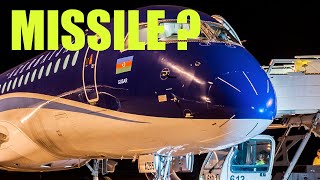
A December 25, 2024 YouTube commentary analyzing a crash of a Brazilian-made R190 regional jet that departed Baku for Grozny and diverted toward Akto after failing to land in very poor weather. The speaker reports known facts (bad low cloud ceiling/near-zero visibility at Grozny, concurrent Ukrainian drone strikes and activation of Russian air-defence "Plan Carpet", reported GPS jamming) and offers an expert-leaning reconstruction: the airliner was likely misidentified amid drone activity, struck by a surface-to-air missile (fragmentation damage noted in cabin and to a left-wing fairing), suffered hydraulic/control failures, entered a growing fugoid instability and crashed short of the runway after sliding several hundred metres. Early provisional figures mentioned: ~67 people on board and ~32 dead; many survivors and a rapid rescue response.
Questions this video answers
December 25, 2024
R190 regional jet (Brazilian-made twin-engine regional transport jet).
Origin: Baku (Azerbaijan); Intended destination: Grozny (Chechnya, Russia).
Akto (diversion airfield on the other side of the Caspian Sea) — spelled variously in the video ("Otto Atro", "Atco", "Akto").
Approximately 67 people on board; provisional toll reported ~32 dead.
My friends, good evening. A dramatic story this Christmas 2024. It's December 25th and a few hours ago an R190 type aircraft, a Brazilian made twin engine regional transport jet, crashed at Otto Atro airport, which was not its destination, but was an alternate airport for the main flight, or the main destination, if you like. So what we have is that this is an aircraft that took off from Baku in Azerbaijan to go to Groznishany. Groznishani, Baku. We're talking about about 500 kilometers, so roughly one hour of flight, all inclusive. The aircraft is arriving at Grozny to land in Grozny. The weather is very bad. And these are things I'm using in this video. Only factual elements that we can almost. Because, you know, it's very early and it's a very dangerous exercise to comment on the news and try to analyze an accident that happened only a few hours ago, Right? Because what we don't want to do is to suffer. We don't want to say something that later turns out to be completely false. So what I'm trying to do in this video is to take the elements that are truly guaranteed, that we can confirm or validate by independent sources and that are not likely to change in the coming weeks or months. So the weather in Groznet is very bad. That's a fact. That's not something negotiable. What's going on big time. When we look at the weather forecasts, the weather observations at the location, we see that there is overcast. It is overcast up to a few hundred feet. What does that mean? Roughly speaking, there is no wind, variable 1 knot, the wind is zero and there are clouds that are practically touching the ground. That means that for an aircraft that is going to arrive, it is calm, there is no turbulence and everything in places like that. But on the other hand, there is no visibility. If there is no visibility, it can compromise the landing, depending on how it is done. And in this specific case it compromises it. So he tries to approach. It was said three times, we will see later. Maybe it was once, maybe it was twice, it doesn't matter. But in any case it's true that it's entirely credible when we say that the plane couldn't land at Grosseni. Moreover, the proof is that the images that you see, the images of the crash were filmed in Otto, not in Grozny. So the destination was Grozy. So we can clearly see that it couldn't land. This is something that we can already confirm today. So another thing in Grozny. If we look at today's news, we see that there was a drone attack, Ukrainian drones that landed on Grozny. And there was even a woman who was killed. You know, just between us, in parentheses. There was a time when there was a truce. During Christmas, the war was having a truce. Today. No, today Christmas is yet another reason. It's an opportunity, an opportunity to escalate even more, to show our determination and make the situation worse. Okay, when drones strike Grozna, several things happen. Plan Carpet has already been triggered in Russia. It's an emergency plan that was put in place a long time ago, not long before Ukraine's history, but which is in fact a plan that is triggered when there is a flying object, an enemy aircraft, drone, etc. That arrives on Russian territory and is uncontrollable, unresponsive and hostile. So what do they do? They ask all other aerial objects, they ask all other aircraft, helicopters, etcetera, to move away, to land, to get out of the way, basically. And then the object in question is shot down, potentially shot down. So the doctrine is to either ask it to do so or arrange for it to leave or to shoot it down. There you have it. Uh, today they were shot down by rocket propelled missiles. Okay, now our plane, as I was saying, is arriving in Grozny. In the meantime, it's arriving at a time when things are a bit tense, right? There's panic, things are a bit tense because of the drones. Another thing, there's GPS jamming. There's GPS jamming the plane. The pilots already have a problem, so you can imagine they want to approach in a situation, but really it's full imc, right? You have the Runway that's completely in the fog and all that. And on top of that they're losing GPS reception. That means GPS jamming means that they either lose the GPS or they give them false information. But in any case, they detect it and they're going to report it. They're going to tell the air traffic controller that. So there's no way to fly this plane with precision. There's one thing you need to know before today. Today, navigation is mainly done by gps. GPS makes navigation easier. You have a screen that's typically called the ND navigation display that shows you the plane and then it shows you the surroundings. Well, it shows you the cities, the airports, the reliefs, all that. You have everything drawn nicely on your screen and then the plane moves. As you move away, as you progress in your flight, well, the plane moves. It's very simple. When there's GPS interference, the plane either jumps or it's in the wrong place. And sometimes it's not always visible. You know, there are people who almost got hurt because the plane was in the wrong place. They didn't know it. How did previous generation planes fly? Well, there was no concept of a navigation display. The main navigation instrument was what is called an hsi, an HSI platform, a magnificent instrument that was typically calibrated on a vore, but which could also draw its source from other things such as an inertial unit or something else. But broadly speaking, it was the navigation instrument. And next to it was what is called the rm. So you have two needles, right? You have two needles inside. And these two needles, one was calibrated on another vore, another omnidirectional beacon on the ground, plus another one that was calibrated on a beacon, for example, an NDB on non directional beacon. And then all that gave you a, it gave you a, a platform and then you had to interpret that mentally to know where you were, where you were going and so on. So it was a bit more difficult to navigate. Today it is more user friendly. But unfortunately, with everything that is happening with gps, well suddenly we realize that it is more fragile because navigation by precisely different beacons and everything, it is a little harder. Even if we can imagine beacons being jammed or destroyed or sending a false signal, still when we fly with these beacon systems, there is a natural integration of checking the distances between several beacons, all that. It is very, very hard to falsify that. There you have it. But unfortunately we find fewer and fewer technicians for this type of instrument. Now our plane, while it is circling Grozny, it flies a little haphazardly. So potentially, potentially, it was mistaken for a drone. Potentially, why? Because since it doesn't have gps, it's not following the paths it should follow. It probably strayed a little bit. There are systems called mz. These are missile engagement zones, not systems where if you pass through there, the missiles launch automatically. And yes, that's the problem. These are missiles that are there to fight drones. So these are missiles of all sizes except that it was tested. We're going to get hit by a missile? Well, it wasn't the mega missile in case it would have split in two in mid flight. So this is probably a small missile designed for drones. It launches automatically or semi automatically? Semi automatically. That means there was an operator. But honestly, between us, what day are you going to find an operator in Groznet? Right. One morning, Christmas Morning. I mean, well, even if you correct me, those who know a bit about the culture of the region, I don't get the impression that Christmas is celebrated on the 25th in this area. But, hey, you can tell me a little later in the comments what you think about that. Now the aircraft decides to leave for its diversion airfield. So the diversion airfield is Atco on the other side of the Caspian Sea. So Akto, rather Akto, on the other side of the Caspian Sea. So it's still an hour of flight, but the weather is good. There's visibility and everything. Probably leaving from Grossi. Leaving from Grossi. That's where a missile hit him. So what we see, we see a video taken inside where there's a bit of panic on the plane. Not much panic, really. People are relatively calm. Let's say there's a man praying all this. Olsen. Allahube. Allahube. 20 goobic ala. And in fact, we see oxygen masks that have fallen. Not all of them, but at least two or three masks that have fallen. But there's a detail because at one point, for a split second, the camera shows at the level of the power, at the level of the floor of the plane, at the level of one of the feet of one of the passengers. There are several holes in the plastic so that it looks like on the left side something has exploded and fragmentation impacts have entered the cabin. So that's a very interesting indicator. The video also shows at one point or another video shows at one point the wing, and it shows a fairing. You know, under the wings of airliners, there's a fairing. And this fairing, it's broken. What's inside when you unscrew it, Typically there are rails and worm screws inside. That means it's used to extend the flaps, the big worm screw with a big nut on it. The flaps are attached to it and you have an electric motor or sometimes an electric and hydraulic motor or hydraulic. And in fact, it turns, and when it turns, it drives the big. The big threaded rod and the ball travels. Huh? It's going to translate. I don't know if that's the right word. It's going to translate along the rod pulling the flaps with it. So this is a fairing to protect this system. This fairing on the left side has a piece, and on the most aft, most distal part, there is a piece missing. So it probably got caught on something on the left side. But be careful. In this video, we see that the plane is flying stable. Apart from what I just told you, the Meat is flying stable, which will not be the case later. So what happened? Probably when this missile exploded, all the hydraulic circuits were affected and they started to lose oil. But it is not an instantaneous immediate loss. It can leave, depending on how it can leave, several minutes of normal or almost normal flight, until things gradually diverge and the plane becomes completely out of control. So when we watch this video, there is also the noise. So my blood test does not work. Does not work on Christmas Day. Okay, we'll see that another time. But to the ear, it doesn't sound like the engines are stable. To the ear, it sounds like there's a reactor making a strange noise with a change in speed. So probably one of the engines, potentially the left one, potentially the left one, seems to have suffered. There you go. Probably in the same impact. Now, let's continue. A little later. A little later, we are at Akto Airport, and we have technicians from an electrical company who are working. And he sees this plane coming. He feels strange. He starts filming. What do we see? We see the plane initiate a movement called a fugoid movement. It's an aerodynamic instability that exists in all planes, but which is generally compensated for instinctively by the pilots without them realizing it, or by the autopilot programs for it. And in fact, we see the plane starting a roller coaster movement. This is typically a movement that, if not managed, will increase like this. To get this movement, you take the plane, put it in a straight line, stabilize it, release the controls. Release the controls, and then it will gradually start doing this. And if you don't correct it, it will become larger and larger. This is a movement. When you see this, it is a movement that generally indicates that there is no control, that the pilots cannot control this plane, in which case they would have stopped this movement. Of course. In fact, the plane is in a nosedive. It picks up speed, and then there comes a point where the lift increases and it starts to rise again. There you have it. It has excess lift. It starts to rise again. It starts to rise again. Then when it starts to rise again, well, it inevitably loses speed. And then once it loses a lot of speed, the. The lift goes down. And what does it do? Well, it tends to dive again. And as it dives again, it accelerates, it picks up speed. And then when it picks up speed, it gains lift, and yet it increases the square of the speed. And then boom. And we take off again. It creates this movement there. If you want to see a video where I explain this in a little more detail, watch Japan Airlines123 on this channel, Japan Airlines123 as it was hit by a missile, it was rather an explosive depressurization following an old repair. And then it destroyed the impennage. It had no more control. And indeed that is exactly what it did for a long time. So I was saying that we see a fugoid movement and we are probably facing pilots who are trying to fight to land this plane, to try to save their skin and the skin of the passengers. So the aircraft makes a sort of big figure eight that we can see on the radar. It's worth what it's worth. Again, be aware that GPS is disrupted in the region. So take the trajectories on these maps with a grain of salt. Whatever this figure 8 is, I tend to give it some credibility. It made an eight, it seems logical. It wants to lose altitude. The vision is good. Here we have a clearly defined ceiling. We are in broad daylight. So here it has vision. The aircraft boards at one point, makes a final dive, it is banked to the right and then it heads towards the ground and touches down. So when it touches down, there is an explosion. But be careful, it doesn't stop there. Yes, there is probably an impact. A wing is torn off, the landing gear is down, a wing is torn off, an explosion, and then the aircraft continues on its trajectory for several hundred meters, which is a good thing in itself, a really good thing. Why? Because what happens if you like, what we don't want is an impact, and then it stays there. Imagine there have been accidents. You have a plane that arrives like the Ethiopian Arise, 737 Max, for example, while it falls at a speed almost at the speed of sound, and bam. Everything stays in the same place. That means that there is a huge impact, several hundred G, and everyone is killed instantly. In this specific case, we have a fairly violent first impact. Moreover, at this stage we see that the cockpit literally disappears. I think. I'm not sure that there is conflicting news regarding the crew, but honestly I'm not very optimistic. The cockpit disappears completely and then the plane continues to slide for several hundred meters, which is good because there is a gradual dissipation of energy, which will explain why half of the passengers survived. There were about 67 people on board. Provisional toll at this point, 32 dead. At this stage we will see later in the coming hours, but roughly speaking, we will say 50% of the passengers were saved, which is practically a Christmas miracle, given the circumstances. So what we have, we really have an aircraft that was. And we see it from when we look at the images that are coming out more and more, we see impacts, we have, we have, we have a close up view of a little bit of, a little bit of the impacts. Some of them look like impacts from ammunition bullets, others look like impacts from missile fragmentation. So did it receive anti aircraft fire? Did it get hit by a missile and anti aircraft fire? All of that is pretty ugly in any case, but there you have it. It crashed and gradually lost all its hydraulic circuits. It had zero control and ended up impacting the ground. Not far from the Runway, the airport firefighters came. So they were the ones who started to save people, get them out of the rubble, put out a little bit of water on the fire and then there was a very, very rapid intervention by many, many rescuers. What I would also like to tell you is that unfortunately this is a fear that we can have today. It has always been, I won't hide it from you. Every time I was a passenger on an airplane I always had this afterthought when the plane flew over a slightly hot area, unfortunately it happens. You know, you can start from point A, point B. The two countries you leave from and arrive in are two countries at peace, all that, but you fly over a cross in the middle. It can happen. For example, there was the Malaysian Airlines 777 that was shot down over Ukraine a few years ago. In 2020, a Ukrainian 737800 was shot down by Iran, by the Iranian army and it took off. They mistook it for an enemy. You know, you have automatic systems, you have poorly trained guys, you have guys who see double all that. Pam, they launched a missile and then they shot down the plane. In 2015 in the Sinai, there was an extremely serious incident. There was an extremely serious incident where you had a Thompson fly plane, a British plane that was going to Shamshire, a seaside resort. The pilots had to make an evasive maneuver to escape a missile that they estimated had passed within a few hundred meters afterwards. Well, an investigation was launched and then the Egyptians said, yes, you're in trouble. There was no need to get so worked up about it. Yes, we launched a missile, that's true, but it's not a ground based missile. It's a ground based missile. And well, we knew what we were doing. It grazed the 737. We had planes, including Air France flying over Iran. When there was this a few weeks and a few months ago when there were these missiles that were launched by Iran on Israel and the passengers were filming these things, it was coming towards them today A lot of people, I say a lot of people. I think that practically everyone is avoiding Iran, right? There was a time over Syria. There was a missile that avoided a plane. And then everyone, all the airlines avoided Syria at the time. So, you know what I mean? There's always this risk that you're flying in a dangerous region. You don't know it, but you're going to end up as collateral damage, like these poor people today. So once again, to summarize, the plane probably takes off from Baku, goes to Groznio, completely rotten. It loses the GPS signal, does several go rounds, then goes around, tries to land, does a little bit of everything in terms of navigation. The guys who take care of the missiles, the neighbor, what is this thing? Who take care of the drones, Take it for a drone, especially since it had just been attacked by a drone. It launches a missile, huh, Like a Pumil type, and it explodes. The aircraft is disabled above the Caspian Sea on the other side. Except that along the way, things deteriorate. It completely loses its hydraulic circuits and ends up out of control in a fugitive manner. And then the rest is that it ends up impacting the ground. And there you have it. Thank you, my friends, for watching this video. Up to this point, of course, this is a video made in the heat of the moment, huh? It's a few hours after the accident. And we'll see later. I don't have much. I don't do Russia bashing, you know, me. But I think they talked about it. You must've heard that they talked about a bird strike. I think it's a somewhat desperate attempt to tell you the truth. Clumsy. To hide the reality a little bit. Because when a country is at war, you know, communication is very important. You have to give the impression that you're in control. You have to give the impression that you're in control, that you're there. The problem is that when you start shooting down civilian planes by mistake because you didn't see it, and then everyone sees that, you're just firing at them haphazardly. You're just firing missiles haphazardly. It's true that it's a rather distressing image that the Russian authorities won't necessarily want to send to their population. You know what I mean? It's a question of morale. So they're going to do everything they can. They're already trying to deflect the tension and then try to find another explanation, you know, because the explanation of saying, oh, yes, by mistake, we shot at a civilian airliner means that. Well, we have no control at all. We're doing anything. There you have it. Thank you, my friends. Thank you to all those who still support me on Patreon. And I'll be back soon with another video. I was working on another video when this story broke. See you soon.
More from Aldo



La FIN du Royaume-Uni ? L'Ecosse, l'Irlande du Nord et le Pays de Galles veulent partir !




Analyse Présidentielles 2027 : Marine le Pen remet ENCORE le voile sur la table !


Scandale "60 Millions de Consommateurs" : la France mange des pâtes contaminées au Cadmium !

2 dossiers : Accident d'autogyre en Italie & un pilote sauvé par le parachute du Cirrus