Démo Mortelle : CFIT à Java - Il arrête le EGPWS !
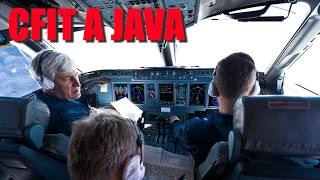
A Russian Superjet crashed into a Java mountain in May 2012 during a promotional flight, killing 45 people. The captain disabled the terrain warning system after repeated alerts, then flew into cloud-covered terrain. A wrong flight plan entry and incorrect heading inputs put the jet on a collision course it never recovered from.
Hello, my friends. In May 2012, the Russian manufacturer Suro was launching a promotional campaign for its public transport aircraft, the Superjet jet, the SU1. It should be noted that Suro is mainly known for KBA aircraft, but here, with a consortium of foreign companies, they had built the superjet jet and were promoting it particularly during that season in Asia. So they sent sea pilots, technicians and sales representatives with order books. They sent them to visit six countries. Laos, Pakistan, Vietnam and Indonesia were part of this series of demonstration flights. So one thing, they arrived in Indonesia, but in reality it was not the plane that had originally left Moscow. In other words, the plane they used at the start caused them quite a few technical problems as they progressed through Asia. There were breakdowns, oil leaks and so on. So at one point they decided to quickly return to Moscow, take a second aircraft and return to continue their tour. It's just a detail, but it's an important detail because this kind of situation will erode trust. It means that we have an aircraft that has just left the factory but is already acting up. So we're a little bit scalded. We're careful. There you go. They arrive at an airport near Jarda and plan their flights. The flight plan is not filed by the pilots, but by a ground handling company. There are many companies that are present at different hubs and they take care of everything. They can take care of catering the flight plan, fuel, taxis to the hotel, all that they do all the logistics involved in flying such an aircraft. So they give the flight plan to a dispatcher from this company who goes to the ramp office to file it. What does the dispatcher do? They receive the plan, they go to their computer, they type tap, tap, depart Jakarta, return, etc. They have a problem when entering the aircraft model. When they enter supul, the system suggests 30su 30su doesn't exist. They're starting to scratch their heads. What's this? They're messed up in the system. I only have SU30. Okay, I validate. Let's go for SU30. So they're going to enter S30. The system didn't know about SU because it was an aircraft that had just been released, but probably also because the system wasn't completely up to date. What's the net result? The thing is, the ATC service, the air traffic controllers who will be handling this aircraft at various times will communicate the fact that it is a military aircraft, that it is a fighter jet. And that is a minor blunder at the outset, but it will be important later. They could have they should have entered something like an Airbus 320 or a Boeing 737 or whatever, but not an SU30, because then it completely changes aircraft category. So our pilots make their first flight and on the return something bothers them. Nothing serious really, but it appears, according to the air traffic controller's vectors, it appears too close to the Runway. So this gives them a descent slope during the approach that is quite steep for their liking. So it forces them to make an approach with the landing gear extended, the spoilers extended and all that. It is not very comfortable. There is nothing serious. It is not a safety issue, except that they are there to demonstrate the comfort of the plane, among other things. And since they have decision makers, potential customers and airline managers on board, they would like to make slightly more elegant approaches. It's just a minor detail. So on the second flight of the day, the pilots say to themselves, we won't get caught out like this morning. I want to make a gentle approach, okay? So they take off, do a few turns here and there, a short half hour flight to the base. They have 45 people, there are 45 in total on the plane. There are four airlines represented who, who have sent chief pilots, who have sent managers, pilots and so on. And they also have journalists. The journalists came because. Well, this kind of thing is marketing. You have to allow journalists to film, take photos, visit the cockpit and so on, because all that creates publicity. So at one point, our pilots are at about 10,000ft, they are in the cockpit and they have a pilot from the region with them. So he is a pilot from a local airline and also represents a potential client. So with this pilot, they are talking about the aircraft. And so the pilot, who is a test pilot at the base, an experienced test pilot, is demonstrating the systems to him. He is showing him different fuel pages, how to hold a plane, how to manage this or that system. So he is showing them that the plane is easy to fly. It is a modern plane that does not consume much fuel and everything. The pilot in question, who is a local pilot, lets them understand in the conversation that the region is flat. They said that it is a flat country, which is not true at all, which is not true. And either they did not understand each other or it was lost in translation or whatever, but it is not true, because, yes, the region is flat, but more or less it's a bit like those fields where there's nothing at all. Then you just have a plane tree in the middle, and that's usually where the motorcyclist or the car Ends up. Well, yes, the region is flat, except that there's a hill or, yes, there's a mountain there. There's a mountain in the middle. And this mountain, as is often the case, it catches the clouds. Of course, you have a relief, so you have a little belly. The air is pushed upwards, so it's going to cool down by expansion because the atmospheric pressure is lower at the top. So the air cools down as the humidity inside it cools down. What does it do? Well, it's going to start to saturate. For example, if you put it at ground level, you have a temperature of 19 degrees and a dew point of 13 degrees, a difference of 6 degrees. You have a wind coming. It's going to blow upwards 1000, 1000 meters higher. We've lost 6 degrees, 6 degrees on average, roughly speaking, we lose roughly 6 degrees per 1000 meters in the Earth's atmosphere. So what happens? Our temperature, which was 19, is now going to drop to 13, 12 and a half. Well, inevitably, the water it contains, the humidity is going to start to condense and that's going to create clouds. And that's why very often we have these mountains that catch the clouds. By the way, often volcanic islands. When planes fly towards volcanic islands, how can they be seen from a distance? Well, sometimes the ocean, the sky is blue. Above the ocean, there's nothing. And suddenly in the background over there, there's a big cloud. And it rarely fails. It's the island with its volcano or its mountain that catches the clouds in this way. So I was saying that this time our pilots wanted to make a more gradual, more beautiful descent. And they asked the controller for two things. They wanted to descend to 6,000ft and they wanted to do a 360. That means doing a complete circle. When you do a360, you enter on a heading and exit on the same heading. It was entering on a heading of 200. Well, it should exit on a heading of 200, but we'll see that that's not what's going to happen. So when the controller saw that this plane wanted to descend to 6,000ft, he had an idea. He guessed why. Because why below 6,000ft there? Why couldn't we go lower? Because, in fact, in this area below 6,000ft, there is a restricted military zone. And the controller was used to seeing aircraft of this type, for example, 30 belonging to the Indonesian army, usually arriving in the region, arriving at 6,000ft and then, boom, disappearing inside this zone, in this area where they had, where he regularly conducted exercises. So when he sees the aircraft asking him to descend to 6,000ft, for him it is consistent with his habits. And seeing that it is a combat aircraft, there is nothing that surprises him. It is something that everything will fit. And so his mental image is false. But it has elements that will come to confirm it. He authorizes them to descend to his feet. Now, how do you do a 360 degrees in a superjet type aircraft, but also on a 737 or an Airbus at 320? It is more or less the same thing. The thing is, there is no button to do a complete 360 degrees loop. What you have to do and what the pilots will do is put the autopilot in heading mode. In heading mode. At that point, when they put it in heading mode, the heading is displayed on the small window. In this case it is 200. Well, it turns and then the plane will go to the heading that is requested. Now, there is one thing that we cannot do. Pilots, no matter the plane, whether it is a super jet or something else, cannot take the button and turn, click, click, click, click, and go to 200 all at once. That means doing 360 degrees all at once. Why? If they do that? Well, the plane will not turn. It will pretend to turn, then it will come back. Why? Because it says I'm at 200. At heading 200, you ask me to go to 200. Well, I don't turn. Okay, so what should we do? The pilots turn the knob in the direction they want the turn to go by entering a small value, not to exceed 180 degrees. Otherwise it will reverse the direction of the turn. So it's a random turn, like 90 degrees, 100 degrees, it doesn't matter to the right. And then regularly as it approaches this heading that they have provisionally entered, well, you have to give it more turns and add it regularly, three, four, five times until you reach 200. That means you give the plane a provisional heading, and before it gets there, you add it, you give it another heading, and so on until you complete the loop. Okay, so that's how it's done. So our pilots are in their deep conversation with this visitor who is in the cockpit, and after a few pushes on the button, well, they forget. There's one step that they forget. The last push, they forget. That is to say they had started at 200. They had entered several times. They had entered headings three or four times, and at one point, the last one was 174. But before the life reached heading 174. They had to add another one to exit or 200. Well, they will forget because they are lost in the conversation. In that case, what does the plane do? Well, it comes out of the turn, it has its full trajectory and it continues at 200. And at 6,000ft it is heading straight towards a mountain. In fact, in the meantime, the aircraft enters the clouds and is completely in the clouds that hide the mountain. At that moment there is only one aircraft that will be able to save them. This is the gpws. In fact, the EGPWS is a system that has two things. It has the GPS feed so it knows where the plane is on earth. And it also has a map. It has a map with the reliefs around the world. So it has a world relief map. What does it do? It calculates the position and trajectory of the plane. It looks straight ahead here. It sees that in the next two minutes there is reason to believe that this plane is going to hit a hill. It tells the pilot and it is even intelligent enough to react even when turning. That means if the plane is turning well, it will see how many degrees per second this turn is making. And it is therefore able in this way to extrapolate and say, is this mountain, which is for example on the right or on the left, a danger given the turn we are currently making? So it is a very intelligent system. At that point the system tells them to pull up. So then the system asks them to pull back on the stick, pull up, terrain, pull up. So they're a little taken aback. They say what's this thing doing? Think about it. They've also lost confidence in the device since they had to replace the first one. So normally, normally in a situation like this, they're in the thick of things. They're in the clouds, an area they're not familiar with. In addition, their maps, they received en route maps. That means en route maps are made for high altitude cloud cover. They don't include relief. While there are other maps that are for lower altitudes that include relief. But in what they were given, they didn't have the maps with relief. So in reality these guys had no idea what they were doing. And so what they should have done is say, I have an EGPWS warning, my flight is not well prepared and all that. Well, they shouldn't have. In fact, you don't even have time to think about all that. If there is a GPWS warning, you, you don't think about anything at all. You think about it afterwards. The reaction is normally the ministic slams all the way down the throttle all the way forward. Just two slam gestures. And in fact, since it's a fly by wire aircraft, it means it's a fly by wire aircraft. It has envelope protection. Normally, in theory, on paper, if you go full throttle, suddenly it's not supposed to stall. So normally the system pitches it up enough to maximize lift, but without letting it go all the way to the stall. Our pilots won't react that way. They'll listen to the successive warnings. Pull up, pull up. There are six alarms that will sound. Then the system enters another mode. What other mode? It will tell them something. Avoid terrain. Why does it say that? Because initially, when it sniffed the mountain coming, it will send the alert. It will also show them the mountain in red on their screen. There you have it. Everything is square. And it will tell them to pull back on the stick, to fly over it. But since they don't react after a while, are too close to fly over it. That means there comes a time when the system, which knows the performance of the plane, knows that there is no point in pulling back on the stick because you won't fly over it. It tells them to avoid the terrain. That means turn left, turn right, figure it out. But here you have to avoid the terrain, not try to fly over it. Avoid the rain. Nothing is needed. What does the captain do? And what is extraordinary, just in parentheses, is that this captain, who is a test pilot, who is one of the first pilots to have flown the superjets, flew himself in the crowcase in the mountains with the superjet, specifically to test the GPWS alarm thresholds and validate their operation. It was part of the certification tests. They had to go into the mountains, of course, they. They go there on a stormy day with good weather, right? And they go to the mountain. They say to themselves, look, you see the mountain? It's there. And indeed the GPWS will show us the mountain, will alert us, and so on. So he is the one who validated the gpws. And even then he loses confidence. And it seems he is more influenced by this guy who knows neither Eve nor Adaman, by this pilot who had come to visit him, telling them that it is the flat country than the system in front of him. He's going to make a gesture. He's going to take the GPWS buttons, click, click, click, deactivate everything. He disables everything. There are companies that, in certain very specific situations, inhibit the gpws. For example, you look at Airboat who make approaches to what is an airport. To land there, you have to take an Airbus and go and fly into a canyon between mountains. And indeed, what they generally do is that at the entrance to the canyon system, they say their prayer and then they turn off the GPWs because they can't leave it there, otherwise it will ring until landing. And so precisely this reaction makes absolutely no sense. We are literally in an accident. It's like we're in the 70s and in the background we are in 2012 and it stops. Tick, tick. A few seconds later it has another alarm. Uh, it's because since it has stopped, the GPWS finished, there's no more GPWS that counts there. It's out of the equation. It has another alarm that says, too low gear, you're too low landing gear, you forgot the landing gear. In fact, it was the radio altimeter that had detected that they were less than 800ft. And in this plane there's this logic. If the plane is too low, well, we'll get an alert that says, well, the landing gear is not down, you're not in landing configuration. That means the plane thinks that we forgot to lower the landing gear. So it's this detail that stopped the gpws because it thought it was messing around, that the map was wrong or something. It's this detail that will wake up the captain and what he's going to do is take the mini stick and pull on it very timidly. He's going to pull five degrees on it. Why five degrees? G.R. no one understands. He pulls on it a little without even disabling the automatic throttle, which means he did it instinctively. He grabs the side stick and pulls back just enough for the autopilot to say, okay, there's an input on the sidestick. So what does it do? It disconnects. The autopilot doesn't like humans fighting against it, so it tends to disconnect. So it disconnects. On that note, the co pilot says, what's that? And in fact, probably when he said what's that? It was two or three seconds before impact because unfortunately we talk about these things. It was three seconds before impact with a vertical wall. The vertical wall had just appeared in its nublot, completely filling its nublaut. It has an inclination of 85 degrees. That means a human couldn't stand on it. And so the plane hits this wall. It explodes 45, dead instantly. The pieces, the crumbs of the plane, go down the mountain and then silence falls again. The air Traffic controller takes 17 minutes before saying, where is he? He disappears. Then we start looking. Then we realize that we were wrong. That it wasn't a fighter plane. But we say to ourselves, maybe it was. They probably didn't want to admit the obvious. They said, yes, it was hijacked. We think that there were pirates on board. They prayed. We are waiting for a ransom request. We are waiting for a mysterious correspondent to call us. Right? But in fact, the reality was much simpler than that. The weather was bad, they couldn't go because after the accident, the clouds just got thicker, the rain, all that. So they had to wait until the next day. The next day, the helicopter managed to approach the mountainside and took pictures of the pieces of the plane and we realized that it had crashed to go there, to go and look for them. Well, there were no more survivors at this point, right? That's not the equation here. Well, it took them a week, and it was very difficult because they had to walk along a river with ropes and mountain rescue equipment, in fact. And then afterwards, they had to climb and all that to get there on foot. And then, well, there you have it. They realized that everyone was dead. And then they had to try to recover the black boxes and everything from the impact. And what perhaps somewhat blocked the theory of hacking, or rather hijacking, we say, yes, hacking or rather hijacking. What validated the theory of hijacking during the first few hours was that we thought that if it had crashed, we would have had an alert from its distress beacon. It would have been triggered. In reality, the distress beacon was found, and under the impact, which is still a shock against a vertical wall, it was destroyed. Well, it wasn't destroyed, but was broken and then torn off. Its antenna was torn off and everything. That's why it hadn't been triggered. In any case. This is a story that is quite terrible because there are a series of small coincidences. The device that doesn't work, we have to take it back to Moscow. We lose a bit of confidence. Uh, the other guy, who doesn't know what he's doing, he fills in, he fills in. He puts an SU30 in the system, little things like that. The local pilot who tells them that it's flat. We don't know why he said that. Uh, the clouds that are there. Well, that day, There you go. So little. Little details that mean that if we had removed each and every one of these coincidences, the accident could have been edited out. But that day, in any case, we ended up with what is called a cfit, controlled flight into terrain, as in the great tradition of accidents from the 70s and 80s. In any case, my friends, thank you for watching this video so far. I also thank the people who support the channel on Patreon. Without them, this channel would not have been able to see the light of day and continue over the years. Thanks to them. And I'll see you in the next video.
More from Aldo



La FIN du Royaume-Uni ? L'Ecosse, l'Irlande du Nord et le Pays de Galles veulent partir !




Analyse Présidentielles 2027 : Marine le Pen remet ENCORE le voile sur la table !


Scandale "60 Millions de Consommateurs" : la France mange des pâtes contaminées au Cadmium !

2 dossiers : Accident d'autogyre en Italie & un pilote sauvé par le parachute du Cirrus