Garuda 152 : L’accident le plus meurtrier d’Indonésie expliqué
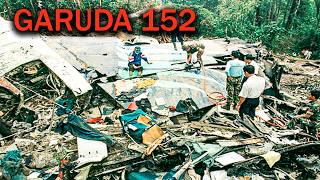
A French-language YouTube explainer about the Garuda Flight 152 crash (September 1997) that shows how a chain of minor errors, miscommunications, and degraded visibility from regional fires produced a catastrophic CFIT accident. The speaker narrates approach geometry, ATC radar vectors, voice-call confusion, instrument/automation differences, altitude-entry mistakes, slow radar refresh, inhibited GPWS, and the final impact with 234 fatalities. The video is analytical and aimed at showing how small causes can produce disproportionately large consequences.
My friends, good morning. When you finish watching this video, you might say that all this for this reason, small mistakes can cause biblical disasters. And yes, when we look at the law of cause and effect, my friends, there is a detail that may not be obvious, but which is terrifying when you think about it. It is that this law never says, does not say that there is a proportional relationship between the cause and the facts. It does not say that at all. That is to say that we can have a very small cause causing a small error or a series of very small errors. They will not necessarily give us small consequences and that it takes big mistakes to have big consequences. It does not work like that in life. There is no such thing. Even if sometimes some may intuitively think that this is the case, it is not true at all, okay? There is no relationship between the proportion or the size of the cause and the size of the consequence that will result from. It was September 1997 in Indonesia on an Airbus 300B4 belonging to the Garua company. It was going to be Flight 652, or rather 152. It was going to go more or less northwest. It was going to go towards the city of Medain, a city located northwest of the capital Jaquir. So at that time of year, at that time, in fact in 1997, practically all year round, there was a kind of smoke in the region. Smoke? Yes, that is to say trees were on fire, entire forests were on fire. It was one of the biggest fires of the last century. We could see it from space. And then the smoke that was released by this fire was carried by the wind. And then it covered Singapore, it covered Borneo, the island, it covered Indonesia and all that. And in many countries visibility was sometimes around 100 meters for weeks in a row. People would sometimes put their hands in front of their faces, they couldn't see it. So there was this slightly surreal atmosphere where it wasn't really the weather that was the issue anymore, but the visibility due to the incessant smoke that wouldn't go away. So that day, during the approach, visibility was 500 meters and it had been 500 meters for a very long time and nothing new. That wasn't a surprise in itself. In the cockpit of the Airbus there was a captain and a co pilot. Both men were experienced, maybe just a small detail about the captain. There were, if you like, several airbuses. There was the original version, the first ones, the first airbuses that came out, they had instruments with needles, you know, needles everywhere, all a bit old fashioned. You know, there you have it. The cockpit looked like a glorified 737. Now, the Erbus that there were, there were other types of erbus that had cockpit glass. So we had optimized the erbusa a little bit, and we had added a cockpit glass to it. Our captain was trained on airbuses that had cockpit glass. But the airbus he was flying that day had the old instruments. So that played a role. The thing is, when there is a tragedy, everything played a role. Now, what is the extent of that role? That's another story. But the fact remains that the old model he was flying, with, which he wasn't very comfortable, well, the navigation on it is a little. A little less intuitive, let's say. Even if I think the guy was more than capable, Even if I think the guy was more than capable, right. Of navigating with the instruments that were available to him. So they arrive in the vicinity of the Medellin airport, and of course, they are coming in from the southeast. And I'm going to draw you a little picture. A picture is very important. Why? Because I know that there are people who listen to my videos who don't watch them, so I podcast. Unfortunately, these people make an effort and are perhaps not prepared for this type of consumption, because precisely, you have to see the picture to understand what happened. Otherwise it's going to be very, very difficult. Look, let me tell you about the Runway. Here we have a Runway, roughly speaking, right? Like this, it's 23.05. So in this direction it's O 5.5, and in the other direction it's 23, okay? On that day, departures and arrivals are in the direction O 5.5. So look, in the direction O 5.5, we have arrivals and departures, okay? So the planes that are landing are going roughly, you can see it towards the northeast, okay? And the planes that are taking off are the same. So in this situation, what the controller is going to do, the planes that are arriving, it wasn't even a published approach, right? It had nothing to do with the controller. It was this. The planes that are coming from the south. So I'll show you. Like this. Well, what do they do? They do this. They arrive at a vore, which is here. So an omnidirectional beacon, right? Then what they do is they do a sort of good. It's not very pretty, but we understand each other. They do a sort of magnifying glass. So they leave like this, okay? They do a sort of loop, right? Elongated. And during this Loop, they lose altitude, and they align themselves with the axis of the Runway and they intercept the ils. So they arrive there, then they intercept the isls and they land on this Runway. So far, there's nothing bad. Okay, so far, it's something pretty simple. So. Except that on that day, there was a small. Not a problem, but just a triggering event. So sometimes the sequence of an accident begins with a triggering event, which is an incident, something abnormal, an oddity, a strangeness, something that happens like that. Sometimes it's even a. In the following case, it was this. We have a plane, a pilot who arrives there and asks the air traffic controller if he can't take off like this. So everyone comes like that, asks him, since there's no wind, asks if he can't take off in this direction. So given the visibility, given that there were planes approaching, the controller shouldn't have authorized it. The controller should have said, no, not possible. Given the situation, we have too many planes we're approaching. Given the very limited visibility, it wouldn't be reasonable. So he should have said no. And he's good. He would have taken off at 0.5 like everyone else. The controller is going to authorize it. So since the controller is going to authorize it, he's going to end up with a problem. It's because he has our plane from Garua. So the Garua 152 is approaching like this, to make this approach, and he has a plane that is going to take off in this direction. H Conflict. You see now his job? What is the constant concern of a controller? It is precisely to avoid conflicts between planes. So he has to find a solution. What is the solution? He will decide to correct it. So since he has a radar, he will decide to give radar vectors to correct the approach, to try to make an approach in a different form. Okay, so here's what he's going to do. I'm going to show you with a different color, a green pen, right? I'm going to show you what the controller had imagined. I'll maybe draw it and show it to you. This is what the controller had imagined. You can see it in green. So the controller thought to avoid a conflict between the two planes, So I let this one go, and this one, instead of continuing and coming into conflict with the plane that's following them, while I make it turn here to the left, then I make it turn to the right and then to the right to intercept the Runway axis, right? And land normally. So it's just instead of intercepting the Axis of the Runway axis on the left, as it's published, it's going to intercept on the right. That's all. It's just this small change. And since it turns here, because it turns early, well, it's going to spend time moving away, right? And that will give the plane taking off time to take off and gain altitude and all that. So far everything is okay. There's nothing serious, but there will be communication problems, small problems that are nothing at all. But they're going to pile up. The first problem is that while our Garua 152 is there somewhere here, right, the controller will pick up the radio and say, Marpat 152, you are going to turn left to intercept the Runway axis on the right. He waits, he waits, he waits. No response. And then he would have liked to be on the Garua 152 frequency. Did you hear it? The problem is that the guys from Garua152, well, they didn't hear it. Why? Yes, they heard it. It was on the frequency. Yes. But since it started with Marathi and another company, there was another flight S152 that was in the area. Since the controller mixed up the flights. The guy from Garua, when he started hearing a call that didn't start with his call sign, yes, he entered that way, he left that way. He wasn't going to take a pen and actively copy the text and all that stuff that wasn't for him. So he ignored it. The controller waited a few seconds and then he self corrected and then he acted as if the Garoua was the one who was guilty. Garuar152, can you hear me? Garuar152 said yes and the controller said yes, but please repeat. So Gurur152 understood that there was a call sign error and told him to repeat it, please. At that point the controller said okay, Garuda152, turn left and then gave him the heading. I think it was 235, turn left, left heading 235. It's not the same message he gave before. It's not the same message at all. Before he said he had described that the interception of the Runway would be done this time. The Runway axis would be done from the right and not just from the left. But that message didn't get through. He had ignored the Garoua and he was right to ignore it. It's not for him. But now that he's repeating it, he. He doesn't have Enough saliva to repeat the message in full. And he says, well, you turn left, okay? At that point there's a deviation that's going to happen, an extremely serious deviation, which means that the vision of each other, the vision of the pilot and the air traffic controller is going to get misaligned. And that's extremely serious. In particular, we're at low altitude and we have 500 meters of visibility. We're in a mess somewhere. So our pilot, right, our pilot is actually going to turn left. So that's true, huh? It's going to turn left. Yes. So since we tell it to turn left and it's under radar vector, well, you want me to turn left, I turn left. That's all he gives it. And he goes on the autopilot on his console. Tack, tack, tack. He turns the button and then the plane turns left. So the plane goes like this. It's dead, that one. It's already dead. Okay, let's try to find another color, the red one, which was the pen, right, for this story. Well, it doesn't work. I assure you that I just unpacked this a few seconds ago. So look, I used the blue one. If the blue isn't very visible. That's how things happen. Little things, little details here and there. It can go very quickly. So fortunately, today, here we are, we are among ourselves, we are sitting quietly. Look, I'll show you. By the way, subscribe to this channel anyway, because There are some YouTubers. They spend half a video explaining to you why you should subscribe. They have more subscribers than me because I never spend my time telling you to subscribe. Please show me that you appreciate my work. Most people who watch my videos are not subscribed. So please subscribe, click on the new button. All that you understand. Because for me, it's not for my ego, but it gives me the impression that people appreciate my work. There you go. That's all. Okay, let's get back to our story. What is mental lag? And there, there's nothing worse than mashed chickpeas. And then on top of that, having a mental shift. That's very serious. Look, your life is at stake. I'll tell you right now. Look, our pilot turned here. Yes, he turned left, didn't he? Except that he imagines that he's doing this approach there. He imagines that he's turning left there. So instead of turning left there, at the controller's request, he imagines that he's turning left there. Why? Because during their approach, before the approach, the pilots did a Briefing. They looked at the published approach, all that. So he would say, okay, here we go, we're crossing the Runway center line, we're turning left after the thing. So when the controller tells them to turn left, well, he imagines that it's a left turn that came right. Yes, but then you say, but he still should have. But hey, yes, if you start to think he should have and all that, well, there's no accident. That's the story. It went wrong there, right? It was going to go wrong quickly. What he should have done is he should have cross checked. That means when he gets there to turn normally, what happens normally if he's on the ils, normally he would be on the SHE platform. He's set to the ils. And what we're going to see, we're going to see the Runway centerline do this. Bam. Right. The Runway centerline would be horizontal in this case because we're practically crossing the Runway perpendicularly. So the Runway centerline, the Runway centerline bar would be there and it does this. There you go. So we cross the Runway centerline from one end to the other. So that's a signal to turn. Another thing, the RMI needle would be pointing at this vore. And when it arrives, so it's pointing at the vore. And when the plane passes over the vore, it does this. Okay, it's going to, it's going to, it's going to turn around. So there are still two very strong signs that we've just passed this vore and that it's high time to turn. Except that somewhere, once they are under radar control, it's as if the pilots didn't do anything. They let themselves go and followed the controller 100%. And we understand them today with today's planes. Because I know that there are people who are a little afraid of the plane watching. It would be a little more difficult to do this kind of thing. Why? Because before you had instruments like I just described to you, the she, the sharpener beacons and all that. And the pilot had to imagine his situation on the plane, on the plane in 2D or 3D. So he had instruments. But the image, the image of the plane on the planet, well, he built it mentally from all these instruments. You see, today he doesn't need to do that anymore because today you have moving maps. That means today you have a map and you have the plane on the map. So you see the little plane moving. I mean, yes, you have the equivalent of the instruments that I just described, the beacons all that you still have them to a certain extent, but at the same time, the information is swallowed up for you. And then it is often represented by a moving map and a plane on it, you see? So that simplifies the task a lot. Okay, so let's go back to our story for a little while. So look, the pilot continues to arrive here. Once he arrives here, the controller tells him, Garua 152 to turn right. So what he wants is for him to turn right so that he goes like this, so that he goes towards the ILS axis. Okay? Because he wants him to gradually get him to intercept the Runway axis, he says turn right, except that the captain, he hears a turn to the right. But in his mental scheme, he should turn in which direction? To the left. Look here. Huh? In what? He should turn to the left, which is what he's doing. He's expecting a left turn, so when he's told to turn right, it surprises him, but it's as if he's correcting himself. So instead of turning as the controller tells him, he's going to do the opposite. That means instead of turning right, as the controller told him, because the controller wasn't wrong, he's going to turn left. Okay, you see? So now he's going to turn left. Now he's really moving away and descending. And what's more, the pilots made a mistake. When they were authorized to descend, they put an altitude on the radio on the autopilot window for altitude hold, instead of entering the altitude that the controller had given, which was actually the altitude for intercepting the ILS glide path. Well, what they entered was 200ft. They were soaked because I think they had to go. They had to go, I think, to 2,200ft to intercept the. The glide path, the descending part of the ILS. Well, instead of entering 2200, they entered 200, something like that. And so? Well, the plane continued to descend. Okay, so the plane continues to descend. So we have a lot of errors. I'll add one more detail. I told you at the beginning about an accumulation of small errors. The other detail is that the air traffic controller had a radar that was a little haunted by the Louvians. That means that this radar had a scan, a scan frequency that was very low, because the radar has a rotating antenna that scans the azimuth, and this antenna was very slow. So in reality, the antenna made a full turn every 12 seconds. What does that mean? It means that the controller's screen refreshed every 12 seconds. 12 seconds. When you Have a low altitude aircraft that is skimming between the mountains. 12 seconds is a long time. It doesn't go very fast. So at that point, at that point the controller says, because he realizes that there is something abnormal, he says, confirm that you are turning, you turn right. And then the captain says, we turned left. And the controller says, keep turning right or something like that. I mean, there was a mix up of left, right, left, right, where it felt like a conversation. No one understood anyone in a situation like that. With the aura of the ground, high speed, mountainous area, mountains that go up to 3,000ft and more, while he was well below 3,000ft. I mean, if there was any doubt, any misunderstanding, he. It was just full throttle, pitch the plane up, do another go around, praying that it would go through. So they continued, they continued. So what they did was they did this, they did that, right? A sort of little loop that doesn't mean anything. And then suddenly they appeared towards the hill. The hill, when it suddenly came out of the window, was completely filled. And of course, with visibility in the smoke of around 500 meters, that didn't leave much time. It was extremely fast, right? The time it took the guys to pull back on the stick, to push the levers, that was the impact. So the plane, it appeared the next moment it hit the trees. There were impacts, there were broken trees, which were the first trees to have been hit. So that shows a little bit where it started. And then it ended up brutally against the ground. It fell into a rice field, a very, very muddy place. By the way, some of the fires were caused by people burning the jungle so that they could later reclaim the land for the rice fields. So it was an extremely muddy place. The impact was extremely violent. The plain was largely destroyed. The damage was enormous. There were two hundred and thirty four passengers on board and two hundred and thirty four people died. It was one of the most serious accidents in civil aviation. It's in the top 10. It was an extremely serious accident that happened due to a series of minor errors and minor inaccuracies on the part of everyone. And the reality is that it ended up with 234 people dead. The black boxes were found a month later while we were on the ground. In fact, since there was mud, it was extremely difficult to recover parts because when it hit, a lot of objects were buried under the mud. Then you have to go and get them using radar. Then you literally have to do geological work to recover them. So this tragedy, if you like, it went down in history and in people's Memories as yet another cfit, huh? Cfit controlled flight into terrain. That means that the pilots had control of the aircraft at all times. They never lost control of the aircraft, but in a controlled, conscious manner they went towards the ground because they lost, if you like reference with the ground and then until it was too late, they hit. Was equipped with a gpws. So this is a device that is supposed to detect this type of situation and report it, but it didn't. It didn't report it because probably you have to know that as soon as you start to extend the flaps, the landing gear and all, that there are certain GPWS modes that are inhibited. Because in fact, the GPWS doesn't want to trigger an alert every time an aircraft is about to land. Because otherwise as soon as you approach the ground to go towards a Runway, it triggers. So if there is a relatively low gentle descent rate like it was here, a very, very gentle descent, and then the aircraft is configured for landing, it can, it can inhibit certain modes. And then we are. We stay just below, if you like, the bar beyond which it would have reported, but here in. In this specific case, it did not receive any alarm before the. Before the impact. So there you have it. My friends, thank you for watching this video. I invite you to add up all the possible and imaginable mistakes that have been made, but small mistakes, you know, which in themselves are not worth 235 deaths. But hey, the reality is that it's not a question of merit, you know, here's my book s crogie and subscribe to the Astrology Channel, which can be found on Amazon in Kindle or paperback format. There you go. See you soon.
More from Aldo



La FIN du Royaume-Uni ? L'Ecosse, l'Irlande du Nord et le Pays de Galles veulent partir !




Analyse Présidentielles 2027 : Marine le Pen remet ENCORE le voile sur la table !


Scandale "60 Millions de Consommateurs" : la France mange des pâtes contaminées au Cadmium !

2 dossiers : Accident d'autogyre en Italie & un pilote sauvé par le parachute du Cirrus