Gijón : un F-18 manque de s’écraser sur une plage bondée !
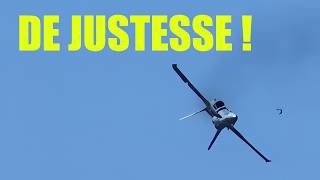
A French-language YouTube monologue analyzing a July 2025 near-crash of an F-18 during an air display over San Lorenzo beach in Gijón, Spain. The pilot executed an unexpected rightward/inverted departure at very low altitude but recovered; the Spanish army offered a public explanation attributing the move to bird avoidance, which the speaker disputes. The video presents two main hypotheses: (A) an attempted 270° deceptive maneuver that was aborted due to insufficient speed/entry, and (B) a flight-control-law-induced departure while flaps were extended at low speed (angle-of-attack vs G-law interactions, asymmetry, spoiler deployment). The speaker references F-18 manuals and flight-control behavior to support the technical analysis.
Hello, friends. A story that we love ends well. This is a very serious incident on the beach of San Lorenzo in Spain. It almost caused widows and orphans. An F18 aircraft was performing an air display as part of a festival that has been held annually for a number of years. The beach is normally packed with people. I'll show you a photo from a previous edition, look at the number of people on the beach, and I'll ask you to look for Nicholas. As I was telling you, the aircraft was coming from the north, facing the beach, and at one point it made a maneuver that probably wasn't in the script. So what it did was it arrived and we expected it to turn left. It was the only option. Why? Because during this type of demonstration, these planes are not allowed to fly over the public, nor over cities, houses, etc. So normally the terrain, let's say where it was supposed to happen, was completely over the sea. So the only way to get out of where it was without breaking the rules that I just mentioned, was to make a sharp left turn. And here, instead of making a sharp left turn, well, what do we have? The plane goes off to the right, it's on its back. At one point, almost on its back, it manages to recover miraculously and really well done to this pilot. He managed to recover and then he went off to the left, wasn't he? Which was the original intention before this strange departure, and then he disappeared. If this aircraft had not been able to recover in this way, it could have either ended up in the water or in a more dramatic alternative, ended up on the beach, causing the widows and orphans that I mentioned at the beginning of this video. So what happened? So the Spanish army released a press release. Now, this press release is problematic in more than one way. First look at what they say. Our pilot acted normally. He wanted to avoid the birds. Indeed, there are birds. Birds always represent a danger for this type of low altitude operation. Nothing new. So there were birds, seagulls in particular. He wanted to avoid them. And so there you have it. He. He followed his training. There's nothing to see here. Of course, this version doesn't hold water. The other detail that slightly undermines the credibility of this statement is when they say, we have trained our pilots to react in milliseconds. Of course. I would like to see someone show us how in Spain they train their pilots to react in milliseconds, which generally exceeds the response capacity of a normal human being. So there you have it. And then they're elite pilots and so on. So I was saying that what is happening here is that this is a statement to calm the public a little. All the more so I'll tell you in parentheses. According to the information I have from Spanish contacts, the pilot was nevertheless subjected to the questioning of Brother Ponce. So this was not something normal, it was not something that was programmed. And in reality, even if we follow their logic and say that they wanted to avoid birds, how can an aircraft that sees low altitude already try to avoid birds by diving towards the ground? It makes absolutely no sense going inverted at very low altitude in a place where there are people just to avoid birds. I mean, take the birds, you know, hit them. We can understand birds, these issues and all that, but it's less problematic than hitting the public or hitting the ground. Okay, so there. There's something that absolutely doesn't hold water. Strictly speaking, they could have avoided birds from above. I'm willing to. And they used one. They used another image which was in the minds of a certain public, which is that about two weeks ago, there was in Spain a Euro fighter that hit birds. He hit a truss. And in fact, there were spectacular images that circulated at the time with the broken canopy. So literally, there's a side canopy, there's a big hole in its place. We imagine that the pilot is covered in blood, feathers and all that. And so this plane here, we can clearly see that it suffered. And so we can say that, we can use this memory to say that, well, well, this pilot tried to avoid the same thing. It makes absolutely no sense. So it's very possible, I would say 99%, that this gesture, this movement that the pilot made, or that the whole thing wasn't something intentional, it was something that wasn't intended. So that leaves us with two options, broadly speaking. One option is when you want to do this type of trick or this type of demonstration, when you want to make a left turn, for example, if you bank the plane 90 degrees to the left and take off, there are two options for doing so. There is the simple option, which is to bank 90 degrees to the left and off you go. The other option is to achieve the same 90 degrees bank to the left while you can turn 270 degrees to the right. That means a right turn. So here and here. What is nice about this trick is that it deceives the audience a little bit. You see the plane turning to the right. You know, when you start a tight right turn, you have the impression that it is going to go to the right, and in fact, it goes out and goes to the left. So. So it does 270 degrees. So potentially we can say that, for example, one of the causes is that the pilot wanted to start such a maneuver. So he says to himself, I'm going, I'm doing 270 degrees to the right. The problem is that once he goes on his back, something goes wrong. This means he feels that he didn't have enough speed, that he didn't prepare the entry into his maneuver well, and that then he sees the sea, he is very low and he feels that he is going towards the ground, towards the water. So at that moment he cancels his maneuver. And so it makes this very ugly. Start with the meat going to the right and then coming back. But it's not intentional, it was an aborted maneuver, if you like. So he tried a maneuver, then he cancelled it. That's one possibility. I'm going to show you in the editing a figure performed by an aerobatic plane. And you see it take off in one direction, you see it take off in one direction and then it takes off in the other. That's exactly what he probably wanted to do. The other option, option B is perhaps a completely controlled departure. Why? Because we have a plane arriving with its flaps extended. There are some photos that are quite close up. We can see that its flaps are extended. So it has its flaps extended. It's an aircraft that is controlled by an FCC flight control computer. So what we have in this aircraft is like an Airbus, we have a C type law, which means we have a flight control law. So it's electric flight controls. So if you want the pilot, he has the control stick in front of him, but this control stick is not connected to anything at all in reality in the form of a rudder on a mechanical level. So there are two computers that are called quad redundant, that will take the pilot's orders and then act on the plane via 12 moving surfaces and that will arrange to mix the moving surfaces to make this plane controllable, aggressive, to give it its flight characteristics. The F18 without an onboard computer. For example, if we had, imagine that we put cables and all that, what would it be like aerodynamically? Aerodynamically, it's a plane that is neutral to slightly unstable. Ok, but then we're going to add software to it. We're going to add fly by wire controls that will manage everything. Just a simple example to show you the type of things that fly by wire controls can do. For example, when you see it taking off from an aircraft carrier. Well, you have both rudders. It has two rudders, right? You See them both folded inward. That's not controlled by the pilot. It's not the pilot who speaks. The rudder pedals or something, a special button to do that. He's going to pull on the stick. And what's going to happen is that if the plane's speed is slow enough, well, since the rudders are tilted, what we're going to do is we're going to pivot. So it's the onboard computers that are actually going to decide that they're going to take the two rudders, pivot them inwards, so that if you look, they're going to help the elevator. That means because they're going to create a vertical vector that's going to push on the rear of the plane. So you see that in this case we have the rudders that can act as elevators in certain flight stages. So this is something that is not consciously managed by the pilot, but it is the system, the computer system that will manage this aircraft, which is capable of flying slowly, as we can see in the south at place Plage de Saint Lorenzo, but which is also capable of reaching Mac 1.8. So it is a very versatile aircraft. And for this versatility, well, you need this fly by wire system. Now, why am I describing this? I'm not describing it just like that. There is a reason. It is the same system that is on the ERB us. In reality, the Sea Star Law is open source. It was developed a long time ago and it is open source, it is described and so on. Anyone can use it in their aircraft. It is whether civil or military. So if we look at the F18, this high speed law will command. It will control GS. This means that the force that the pilot will exert on the stick will translate into a number of GS. So the more he pulls, the more GS he will have up to the maximum G, beyond which the plane cannot go. Finally, it is the flight control system that does not allow you to go any further to avoid destroying the plane. We will talk more about this in a moment. And if the plane is slow, it will be more of an angle of attack control. An angle of attack control. This means if the plane is slow, pull back on the stick. We will ask the system to increase the angle of attack. It will be more of a G control, but in terms of angle of attack, there is a speed from which we switch from one to the other. And in reality, the change is not abrupt, it is a gradual change. At some point the two laws merge and one becomes increasingly dominant. As you slow down, which is the angle of attack, when you accelerate, the G law begins to become dominant until the angle of attack law disappears completely. What other aircraft works like this? The Erbis, the Orbis works exactly as I just described. It has a part of its flight where when it is slow flower, for example, when landing, it is more at an angle of attack, it is more at an angle of attack. A movement on the ministic will give the angle of attack and when the aircraft is fast, a movement on the monistic will give the load factor or a number of GS. So you see, it is exactly the same law. But what is the difference? The difference is the limitations that were placed on the Airbus and the F18. The following situation is that in an airliner, what are we trying to achieve? We are trying to improve passenger safety and comfort. So safety, comfort, of course, we also want to protect the plane, we want to stabilize it, we want to give it certain characteristics, sometimes artificially. And so we use fly by wire controls. In a fighter plane, what do we want to do? We are not really there for comfort. The concept of comfort will be removed. We do not have passengers anyway. These are planes that take either a single pilot or in the EF version involved in this story that I am telling today, where we have a pilot, but we can also have an instructor or a student pilot and an instructor. So we can have two people. So comfort is not really what is sought. So the law mainly seeks aggression, seeks to give the pilot maximum control, maximum potential over the aircraft. That is to say, you take an Airbus at 300W, you bring it back towards you, you are very slow, and then you have to make a sudden blow like that on the sidesticks. Are you going to, for example, exceed a critical angle of attack? No, that doesn't work on an Airbus. Why? Because it has laws of anticipation. If it sees that the aircraft is pitching up too quickly, it will lower the critical angle of attack to which it will go. So it has this notion of anticipation. Why? Because safety takes precedence over everything else. On an FA1 type aircraft, we are not going to start anticipating, we are not going to start limiting the aircraft, because sometimes it can go there. If we are in a real combat situation, if we have the F18 and the pilot makes a very sudden move and there is an anticipation factor that is introduced into the control chain and the plane does not react as well as it should. Remember the Rapsoim accident? That was it, right? Uh, it's just that there was the. There was captain aslan who sharply pulled back on the mini mange. And this introduced into the system, into the control chain, introduced a factor of an attenuation factor, a factor that meant that, well, there you have it. We are going to anticipate an angle of attack and we are going to block the plane before the critical angle of attack. And in that case, well, when the plane actually hit the forest, watch the video that I made on the subject. It was not at the critical angle of attack. It still had 2 or 3 degrees that it could have added. OK, let's get back to the story of the F18. What I've been trying to tell you for a while now is that since the F18 is designed for maximum aggressiveness, despite the fact that it has electric flap controls, there are possibilities for overshoot. Yes. Which don't exist on the Airbus. The possibility of overshoot is that if the pilot is too brutal, if he's really on the edge and he's too brutal, he can exceed the authorized G number. So he can do what's called an overshoot. Okay, he can do it. He can go beyond the authorized G number. So put a load factor that's too high on this plane. In the same way they can make it stall. Eunerbus, in normal law you can do whatever you want. It's very hard to make it stall, if not impossible. I haven't managed to stall an Airbus in a simulator, but with an H18 it's possible to stall it because the law of fly by wire controls again is more permissive than the same law used on the Arbus, which has higher safety factors. I'll show you a document in the description of the video. And this document. Well, you simply have to go to the page. I think it's page 467 that I printed out. Right. It's a document of a thousand pages for the F18. We're going to the flight characteristics and then. Well, here we go. We're going to look at paragraph 11. Okay? And it's very simple. They clearly explain that if you're in an airplane with the flaps down, which is 100 times, the flaps are either half or full down. So they're half or completely down. In this specific case, the flaps are down because he wants to do his maneuver at low speed. Of course, because he has people in front of him, he won't get to Mach 2 because if he gets there at full speed, what's going to happen? He'll never be able to make that left turn that he intended to do. He'd end up crossing the city, right? Flying over the city. So it's a maneuver, even if it sucks. It seems to be going fast. Look, he's very slow. So he has the flaps down. He's very slow. And what the system explains here is that if ever, if ever, two sudden inputs are given on the stick at high incidence, it is possible to have a departure precisely. To have instability, and the plane can tip over. In particular, if it is. If it has an asymmetry. Huh? If, for example, it is more loaded on one side than the other, for example, more fuel or. Or a weapons system or a pod or whatever, on one side than the other, the plane can tip over. And if we look at the images a little bit, what will we see? We will see that our plane arrives and there is a concomitance. Well, not even a concomitance. A very rapid succession of events. The plane calms down and then it goes to the right. So we've already seen this loss of control on civilian aircraft where we literally have the stick. When we pull the stick, we tilt the plane. It looks pretty crazy. Where we have the angle of attack that will control the tilt. Why? Because it's not even that the plane is tilted at first. No, it's not tilted horizontally. But in reality, if the plane. Well, well, is not in purely symmetrical flight, like, there's a little bit of a tap on the. There's a little bit of a tap on the rudder pedals, or there's one tank that's heavier than the other or whatever, and we're very slow and we pull a little on the stick. What are we going to do? Well, at that point, we risk having a wing that will stall and then the plane will sink to one side. So what we do is we do this, and the plane will go to one side, and what we're going to see from the outside is the nose of the plane pitching up a little and then going off to the side, which corresponds a little to what we're seeing. So potentially, it could be this story that is widely documented in the manuals of this aircraft, where it was probably slow and then at one point it pulled a little too hard on the stick. While it had a high angle of attack, the aircraft tilts. What it does is it pushes the stick all the way back to recover, to lower the angle of attack. It recovers its aircraft. We see at one point, by the way, it has small spoilers. It has small spoilers that have two positions, 0 to 60 degrees, which are controlled by the fly by wire system. In some cases, if, for example, the angle of attack is too high, if we are in a situation where the spoilers. If the angle of attack is too high and the pilot pushes the stick all the way down, he can extend it to help the plane lower its angle of attack. And that's what we see. At one point, if you watch one of the videos, there are several circulating. Well, there is a given moment for a fraction of a second, maybe a frame or two, where we see something rising above the plane. So it's probably one of these, the electric flight control system, that decides to raise one of these spoilers. So I've given you two possibilities. There may be a third, there may be a fourth. It's entirely possible. In reality, we never know because the Spanish army does not traditionally publish. They have lost aircraft of this type and others in the past. They don't have a tradition of publishing detailed reports or anything like that. So will we ever know what happened to this plane? Really? We'll know. We won't really know. So there you have it. Everyone puts their money on a theory, a theory, and that's it. Thank you for watching this video so far. Thank you to those who support this channel on Patreon. Without them it would never have been possible. Because you can imagine that with a channel like this, we can't really have an airline that comes and sponsors Aldo Saren Aviation. And like I'm telling you, this airline travels without a hitch. Thank you. My clothes. And I'll see you in the next ones. Oh, yeah.
More from Aldo



La FIN du Royaume-Uni ? L'Ecosse, l'Irlande du Nord et le Pays de Galles veulent partir !




Analyse Présidentielles 2027 : Marine le Pen remet ENCORE le voile sur la table !


Scandale "60 Millions de Consommateurs" : la France mange des pâtes contaminées au Cadmium !

2 dossiers : Accident d'autogyre en Italie & un pilote sauvé par le parachute du Cirrus