Jeju Air 2216 : Les Familles Empêchent la Sortie du Rapport d'Enquête
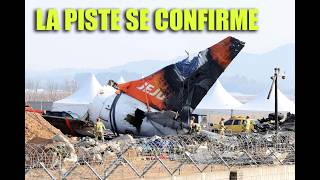
YouTube monologue by Sam summarizing the Jeju Air Flight 2216 crash (Dec 29, 2024). Flight — a Boeing 737-800 from Bangkok to Muang, South Korea — reportedly hit a flock of birds on final approach (~500 ft), performed a go-around, then returned and landed at high speed without landing gear, overran the runway, struck an earth mound supporting an ILS antenna, and unsurprisingly suffered heavy casualties (179 of 181 died; two tail-seat survivors). Sam explains a working theory: bird strike damaged the right engine (No.2) and pilots mistakenly shut down the operating engine, leaving no thrust. He also details that investigators prepared a factual/progress report stating the wrong-engine shutdown, but its release was blocked by grieving families and lawyers at a press conference, delaying public findings.
Questions this video answers
December 29, 2024
Boeing 737-800
From Bangkok to Muang, South Korea
181 on board; 179 deaths; 2 survivors
About 500 ft
Hello, my friends. We know more about Airlines Flight 2216. A quick recap of the facts. It was a plane that crashed on December 29, 2024. A Boeing 737800 was flying from Bangkok to Muang, South Korea. There were 181 people on board. Just as the flight seemed to be about to end. The plane was on final approach at about 500ft. At that moment, it flew through a flock of birds. It is important to know that these birds are often attracted to the vicinity of airports by garbage dumps or other industries that tend to attract birds. This then constitutes a real hazard, which is called an aviation hazard. The plane flew through it and then went around, tried to turn around, and returned to the qfu. That means it's not going to come back and land on the same Runway that was initially planned, but it's going to go around the other side. It comes back to land, and then it lands at very high speed. Pause. It's going to slide on the Runway. It didn't have its landing gear down, so it's going to slide on the metal against the bum. It's going to slide at high speed. It goes off the Runway, and it's going to hit a mound of earth. It's a mound that was built to support an ILS antenna. You have to know that sometimes some runways aren't completely flat. They can have dips in the middle. And if you place the antenna too low, the planes might not receive it at certain times during landing or takeoff. So what do we do? We raise the IS and the antennas a little bit. In that case, instead of choosing fragile, breakable mounts and all that, what did we do? We brought in a bulldozer, created a mound of earth, placed a concrete platform on top of it, and used that as a support for the ils. And of course, that was just waiting for the day when a plane went off the Runway at high speed and caused the disaster that followed. So I was saying that on impact, there were 179 deaths out of 181. Two survivors. Where were the survivors? Well, for once, it seems to justify this theory that says that the safest places are all in the back. Well, these were two high flyers who were not sitting in the seats at the very back, but even further back. That means they were sitting literally at the level of the tail. You know, when you step on a 730 in a 737, you go to the end, you arrive at your last row of passenger seats, then you have the toilets, and then you have another area where usually during the flight you have the cabin crew who go and get food or the trolleys with the duty free or the drinks and so on. Well, that's where they were sitting. And they survived. And everything else, well, unfortunately they died. So at the time on this channel, the theory that was put forward was that one of the engines had failed, engine number two. So the right engine had fail. When I say failed, it's a generic term. Let's say it was damaged, it was damaged by the bird's jump. And then the pilots stop the engine by mistake. They stop the wrong engine. We'll talk about that in a minute. It would seem that what the South Korean authorities are saying confirms this theory. Okay, so just to tell you again, in parentheses, the tests you see on this channel are really exclusive to this channel. That's comes from analysis. It also comes sometimes from informants in the field who don't want to be quoted. So sometimes I tell you it's an analysis or based on the photo or something else. While sometimes it wasn't the photo, sometimes it's just me trying to cover up an informant. Just to tell you, I'm not saying in this case it was like that, but sometimes it is like that. So that's why this channel often goes completely against what you hear in the French or English media or others. So that's totally different. So at the time the theory that was put forward was this, no engine on the number two engine is on the right. The pilots shut down the number one engine by mistake and ended up with nothing at all. That's the theory adopted by the investigators at this stage. Now there's a problem which is that when the investigators tried to talk about the problem, they tried to release their report. So how does it usually happen? Well, there's a sort of conference with the press, with the interested parties and then with the investigators, because it's important to know that these are collegial investigations. For example, the engines are French engines, cfm. So of course we're going to have the B, the accident Investigation Office, who's going to go to the scene with one or two specialists. We're going to have the NTSB because it's a Boeing, so they know the Boeing very well. We're going to ask them for help. That's what's done in the context of 13. So what we have, we have a panel of experts, but it's the locals who speak, not the foreigners. They come here, they're there to help, but they're not the ones who actually formulate the report. It's formulated by the local experts. So that's what happened is that when the investigators started talking about the content of their factual report and wanted to make it public once again. The factual report is not a final report. The difference is that the factual report is much shorter and has no section, there's no analysis section. It's a report that just contains the effect as established up to now. We have status reports. Sometimes we have one, sometimes we have several as the investigation progresses. So there was no attempt at all to provide probable cause or anything, just facts. While they were listing the facts, the story descended into a frenzy. That meant the families of the victims began to cry foul to interrupt the investigators intervention. And then finally they all stood up. And then they literally opposed the continuation of this conference and the release of the report. So the investigators ended up canceling the conference and they canceled the release of the progress report or the factual report. So the problem is that we know that they said during this conference that the pilots shut down the wrong engine, but we don't have any more details at this stage because they took the report with them. There you have it. So why did the families of the victims oppose it? Well, I'll tell you something. Uh, you have to know one thing. When there's a plane crash, sometimes even before all the bodies are removed from the scene of the tragedy, you already have lawyers who specialize in litigation with airlines, manufacturers and all that. They come with their briefcase, their contract and their scanning. They always have fixers with them, and they're searching. Okay, this person is crying. Hello. And anyone from your family on the plane, who is it? Your dad, all that, Come on, do you want a tissue and all that? What do you want to sign here? And in fact, what these people do is they want to get contracts to go and sue the airlines and manufacturers for the families on behalf of the families. And I've spoken to these lawyers many times. When you meet them, you have a drink with them, they say, yes, oh, yes, Boeing, we've already worked with them all that, yes, Airbus, we know, we have lots of contacts there. We've already worked together. And when you say they work together, it means they've managed to secure a certain number of millions of dollars for their company. And in reality, they have a whole pressbook on each company, each engine, each manufacturer, each aircraft manufacturer, each company. They have binders this big. And sometimes they even know more than airline pilots. These guys are very good. You can't afford to be shy. These are people who are very, very good. So what they do, they have the fcom, they have the ad, and it goes even further. They often have access to documentation that even pilots don't have, sometimes even confidential manufacturer documents, engineering documents. They paid, they managed, they used the courts, all that to obtain them. So these are people, even if their profession is difficult to defend itself from a certain vulgarity. Right. They are still very good technically, and if you like what they don't want. And it's in this sense that, in short, the families who brief their clients, they don't want it to be the fault of the pilots. Well, yes, because if it is the pilot's fault, well, imagine that the pilots are dead. What are you going to do? You're going to run after the pilot's widow? I mean, he has a car paid for in installments, a TV bought on a credit card. It's not his widow and his children who are crying, who are going to give him the money. So the ideal situation for these lawyers is that it is the fault of the most solvent party. That means the fault of the manufacturer. So Boeing's fault or the fault of the company, but ideally Boeing, because companies sometimes do not have solid financial resources, many companies are flying by on a dime financially. And so, well, when they have a plane crash, you notice that many small companies have a major accident and then they don't hold out for long. You know, a little while later they close and the accounts are empty. So there you have it. So ideally it's good. So that's why there was this blockage. But unfortunately, unfortunately, the investigators cannot adapt the report to the economic interests or legal proceedings of each party. The families said yes, he didn't tell us all this, but the problem is that he wasn't going to hold a referendum. I mean, it's a report, There are only facts in it. There are no analyses. So I just wanted to tell you this in parentheses. So the problem we have in aviation today is that if an engine fails, and I'm a passenger in an airplane and an engine fails, you know what? What's my first fear? My first fear is not even that engine has failed, because the airplane can fly for hours with the other engine. Look at the certified airplanes and the tops, they can fly easily. Many of them can fly three hours on a single engine without any problem. They can even fly more. In reality, it's the certification that requires three hours, if we're talking about the top 180s, for example, but there are longer than that. So I was saying that flying on a single engine in itself is not the end of the world. But the first fear I have is that pilots will shut down the right engine. Because when an engine fails, what happens? Well, it can vibrate, it can spit flames, it can sometimes send smoke into the cabin, all that. So what are we going to do? Ideally, we want to cut off the fuel. So cutting off the fuel means stopping it. On an airliner, it's a single action. Right, There you go. Snap. Remember the Air India €160. One click, it's over. So the fear or the risk of error here, because normally, if you wanted to work like this, the vision I want to share with you is that what is the risk at each moment of an aircraft's flight? If an aircraft is flying normally with both engines running, the risks of a pilot shutting down one or two engines by mistake are extremely low. Although since India, once again, we have had to revise this vision of things. But when there is no engine, what is the pilot going to do? The pilot will therefore be required or called upon to stop the engine that has failed, that is malfunctioning. What is the risk there? Well, the risk is that the action he is going to take is extremely crucial. This action is to turn off the engine. It is dead. However, many pilots, it seems, have not sufficiently integrated this in their training. It is extremely critical now that there are two buttons. You turn off the wrong one, you are dead. As simple as that. That is what happened in this plane. I mean, let me tell you a story. I did some Airbus simulators with a pilot friend of mine, and I can tell you something. It's that when you simulate engine failures just on a simulator, I'm not even talking about reality, I'm talking about a simulator. It means you have less psychological pressure. Even if sometimes you forget yourself, you really feel like you're in a real plane because it moves, it vibrates, the noise and all that, that's an immersive aspect. The plane is launched on the Runway. I hear a big boom. It goes in one direction, I correct it. You have alarms, you have noises, you gently pull it off the ground and all that. I can tell you that at that moment, you know that an engine has failed. But in the heat of the moment, in the stress, I can't answer you like that in a second, tell you it's the right or the left, not something intuitively obvious at the time. You need to slow down in your head and think. However, very often in certain companies, especially Asian ones, in certain schools, the emphasis is placed in these situations on speed of execution. This means that there are people who seem to want to become Bruce le Cockpit. The thing has to be done like in a simulator. I'm accelerating. Boom. And engine fails. Click, click, click. There you go, look. I did it. I'm done. Unfortunately, in reality, with stress, with the Flip and the Traxxor, you can do things quickly, but do them badly. You stop the wrong engine. What happens once you stop it? Well, then you're in an extremely delicate situation. Why? Because it doesn't restart like that afterwards. Because once the engines stop, the batteries are still there. The batteries themselves are not enough to start an engine. The batteries don't have enough power. In a car or a truck, it can start an engine. But airplanes don't start on a battery. Jet planes don't start. So jet planes, what they have to do is, when they start the engines, it's either with a ground power unit that's possible, or with the pooh. Except that the poo is stopped during landing. It started afterwards, but it stopped during landing. That means if they cut both engines. Well, this time, they can't start them like that. This time, what you have to do is turn on the poo, wait for it to come on. It can easily take a minute and a half. Once it's there, just start the engines. So when you stop them, it's very difficult to get them going again. See? You know what I mean? So it's stopped. It stopped. The pilots could have, and I almost want to say should, have landed on the water, because there is sea all around the airport, and sometimes a landing on the water, if done well, can even result in zero fatalities. Remember the Lutzen case? It could be something that was done very gracefully. Life was at stake. People, people were evacuated, and then, uh, you might have someone injured, you might have someone shaken up, all that, but no more. While it landed at high energy on a narrow Runway, it was a guarantee of everyone's death. So we are, I want to say, once again, in a rather suboptimal performance on the part of the pilots of this plane. So we will see when the final report comes out, if they let it go, if people let it go. Because as it is, I think it will be very, very difficult to have an investigation that is conducted calmly so it seems to be compromised. So we'll see when the final report comes out with the analyses, we'll say, but clearly we're moving towards an engine failure followed by the shutdown of the wrong engine. Thank you, my friends. For watching this video so far. Just to let you know, I won't end without telling you that there's another video on this channel where you can see exactly this story. I'm going to embed it for you. Go watch it. Because this story tells you exactly, gives you the dynamics that sometimes happen in cockpits when an engine fails and the wrong one is shut down. Thank you, my friends, and see you soon, Sam.
More from Aldo



La FIN du Royaume-Uni ? L'Ecosse, l'Irlande du Nord et le Pays de Galles veulent partir !




Analyse Présidentielles 2027 : Marine le Pen remet ENCORE le voile sur la table !


Scandale "60 Millions de Consommateurs" : la France mange des pâtes contaminées au Cadmium !

2 dossiers : Accident d'autogyre en Italie & un pilote sauvé par le parachute du Cirrus