Korean Air 801 : Le Crash (CFIT) Tragique de Guam en 1997
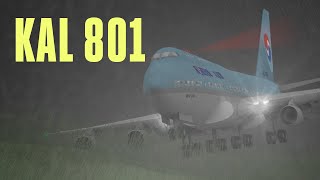
Narrated documentary recounting the crash of Korean Air Flight 801 (Boeing 747-300) on the night of August 5–6, 1997 near Guam. The narrator describes a fatigued captain (Captain Park) and a military-style cockpit hierarchy, poor weather (night IMC, storms), and a failed instrument landing system (the glide/vertical beam reported out). Faced with a non-precision VOR/DME approach whose DME reference was on Nimut Hill (about 5 km before the runway), the crew became confused about distances and descended below published minima. The airport radar alerting system (MSO) was inactive, and controllers did not catch the unsafe descent; the aircraft struck Nimut (Nimut) Hill around ~01:40–02:00, broke apart, and burned — about 229 people died, roughly two dozen initially survived the breakup. The narrator and investigation assign contributing factors to pilot fatigue, sterile cockpit/hierarchical culture, misused/announced-broken ILS glide, incorrect mental references to DME, inactive MSO, and late/insufficient go-around command.
Questions this video answers
Night of August 5–6, 1997
Korean Air Flight 801
Boeing 747-300
Around 1:40–2:00 AM (local)
About 229 dead
Hello, my friends. It's August 5, 1997 in Seoul, South Korea. Captain park is about to board a flight to Dubai when the dispatcher realizes something. Looking at the flight times and rest hours for this captain who has had an extremely busy week, he realizes that according to regulations, he. He can't take such a long flight. So he's going to re dispatch him on something shorter, a faster mission. A 4.5 hour flight. Graham. Graham is in microasia. For people who go there, it's almost a 4.5 hour flight. From there you have to go almost due south, deviate slightly to the east, and then you arrive at Grome, which is under American control. That day they're going to give him a 747,300. It was one of the flagships of the Korean Airlines fleet. In fact, at that time it even appeared in their advertising. This 747,300 I was saying, will take off at the end of the day. On August 5, it takes off, heads towards the Pacific Ocean. And then we have a crew of three people. The captain, the co pilot and the flight engineer. The 300 still had a flight engineer who will disappear with the 400. So I was saying these three men are all military personnel already. They all come from the Air Force. They all have excellent service records. But the problem is that sometimes they come with them or they bring with them into the cockpit of a civilian aircraft the practices of the military. This means we will find an extremely authoritarian system. We will find an extremely strong and cumbersome hierarchy. We are not in a cockpit of collaboration and horizontal relationships, but rather there is one who will lead. Especially since Captain park was considered one of the heroes of the Korean Airlines company. He had even been decorated by the CEO of the company. Following an incident where a plane had lost an engine and then he had managed to land it, he had this quote where he heroically fought the merciless forces of gravity. In any case, this would add an aura to him so that somehow he would unintentionally concentrate all the authority of this cockpit towards the left seat. That evening Mr. Park was exhausted. He said, so it is written, or rather it is transcribed from the cvr from. From the black box. If we talk about a black box, it is because you know that this story is going to end extremely badly. During the flight, he says several times that he is tired, that he would like to sleep. In reality, what he wants. Captain park, and we understand why, is a human. The only thing he thinks about during this flight is the bed at the hotel in Guam. But before getting to bed, he still has to get to the airport. So it's flying. The weather is in the middle of summer. There are a lot of storms, there's turbulence, it's shaking, there's rain storms. So the weather isn't very nice, which means we're really starting to accumulate a few mandates here. We have a tired captain, he wanted to go to Dubai. We're going to change plans for him. He's flying and then the weather is rotten, it's dark, he wants to sleep. Do you understand? And it's really, we almost want to say it's one flight too many for this man. He's very experienced, by the way. Once he reports on the frequency for GOM airport, bad news arrives. The controller tells them the glide. The glide, it's not working. There you have it. It's broken, period, if you like. The ils, the instrument landing system is made up of two beams. There's the lock, which is the vertical beam that gives the Runway axis and tells the pilot whether he's to the left or right of the axis. It's what allows him to maintain the axis against the wind and tide, I'd like to say. And there's the glide. The glide is what defines the descent path and lets him know if he's too low and precisely. The pilot, aided by the autopilot, most often stays at the intersection of these two beams until the Runway materializes in front of him. Those are normal days, but that day it wasn't a normal day. Well, the glide was broken. That means that it was possible for the pilots to know whether they were to the left or right of the Runway. That's good, that's the easy part. But on the vertical plane he had no guidance, so he had to figure it out. At that point they're going to go on a somewhat, I would say, funny approach if it hadn't ended so badly. This means that normally, if I go back to the standards of that time, there were precision approaches such as those made with a fully functioning ils. Otherwise there were so called non precision approaches. In that case, typically what we had was that vertical guidance was non existent. And so at that point, what do we do? The plane has to follow a sort of staircase. This means we have to look at a reference point, for example, what we call a dme. It's a beacon that is generally located with a vor and then it will give the distance from the airport from any other point. We'll talk about that in a second. And then we say to ourselves, at such a distance, must be at such a height. And then it forms a sort of staircase. It forms an approach that looks like a staircase. So he decides to take a non precision approach. But be careful, non precision approaches have much higher minimums. This means that when you have a functioning ils, you can land with extremely low visibility and a cloud ceiling. If you are on a VO DME type approach, for example, it is different or the OCCDME is different. In that case, you have to respect much higher minimums. There has to be much better visibility and a higher ceiling to be able to follow this type of approach. In reality, the weather that day was night emc, that is Night imc. This means that we are practically in weather that would have required a fully functional ils. The VO dieme was not a very good strategy. Secondly, there is another problem. Our pilots are used to making approaches where the dme, which stands for Distance Measuring equipment, is located at the airport. What does that mean? It means that the beacon they are used to is located at the airport. That means that when they reach the Runway threshold, it indicates zero, almost zero. We understand each other. It indicates zero. There are crumbs left, okay? A few hundred meters from the beacon. That's what they are used to doing. However, that day at Graham airport there was a small subtlety. The beacon they are going to align themselves with is 5km before the Runway. They are approaching on Runway 06L. While the beacon is located on the hill called Nimut. It is a hill called Nimut Hill. It is about 200 meters above sea level and there is a beacon on it. So in reality we have to calculate that this marker is not on the Runway. So a plane that lands, using it as a reference will go towards it, fly over it, then leave it behind and move away from it before arriving at the airport. So we have to mentally change the reference. Except that our captain is very tired and in terms of mental plans, he has changed them several times already. And in reality, let me tell you something. Humanly, when we think about the plan, we have plan A, let's say, and we have Plan B. So if plan A fails, it's not practicable. We drop it and apply Plan B. But in the field that's not always true. Look at what we do on the ground. We have plan A. Plan A doesn't work. What do we do? We will find ourselves on a plan that I will call ab, which is actually the average between Plan A and Plan B, which is a hybrid Of A and B. This means that we will keep what we can keep from our plan A. We will do some mental recycling and we will take elements from plan B and we will create a plan that is a bit intermediate between the two. This is where the danger lies. The Captain Pak will therefore begin this approach and then mentally, he is already confused. This means that mentally, when he looks at the distance that is displayed remaining to him in relation to the airport, he has the impression that this distance is in relation to the airport, when in reality it is in relation to the beacon, which is 5km before the airport, you know? Secondly, there is a terrible thing when they put the frequency of the S in order to capture the lock, because I told you that the ILS is made up of two beams, but on the other hand, there are two frequencies in reality, but they are paired in a way that is hidden from the pilot. In reality, it means we enter the frequency, he we enter the frequency of the lock, it means of the beam that indicates the Runway centerline. And automatically the radio internally selects the frequency of the part that allows gliding towards the Runway. So they do not choose a frequency, choose only one. So they enter the frequency of the low or the S. If you want to speak properly. What they will see right away are two things. They will see the lock materialize, which indicates the Runway centerline, but they will also see the glide materialize, which indicates the glide path. And that will generate confusion in the cockpit. The men will start talking about it, saying, but you see, it's there. It told us it doesn't work, but it's there. This is frankly completely inexplicable. Why a device, whether it's vor, ils, whatever, is broken, not because we can't receive it, it's broken because the controller says it's broken. If the controller says it's not working, it's because it's not working. The controller didn't say we can't receive it. And the fact that we can receive it doesn't cancel out what the controller said. If the controller says it's not working, period, it's non negotiable, it's not working. We can pick it up here. Yes, but we can pick it up. But maybe it's intermittent, maybe it needs to be calibrated, maybe it's completely distorted, maybe it's just saying something. So the fact that we can pick it up and that it even passes internal tests in relation to the radio and everything, these are not tests that are there to validate the glide path or anything else. These are just tests that validate that the signal is okay. So if it picks up the signal, it will display the information, but this information is not guaranteed at all. So they will already assume that the glide is working. That's why I told you it's a slightly bastardized approach. Yes, it is following the void. It works. So it says, well, I'm going to follow the glide. And on top of that, the Vore that is on Nims Hill, 5km away, has the impression that it is at the airport. You see, there are several confusions in its head. So now it's starting to get too much. The plane starts descending and at one point, seeing the distance getting shorter, thinking that this distance is relative to the airport, the captain increases the rate of descent. So they start descending, descending, descending, and instead of descending towards the airport, they are descending towards the boundary hill. Normally the control tower and the controllers are Americans, but they are AFA controllers because Guam airport is under American control. So normally they have what is called an mso. It is a system that works with radar that detects when planes have strayed a little too far from their altitude and that they are threatening or at risk of hitting the ground. Well, this system normally sends an alert to the controller and the controller informs the pilots or checks with them that they know what they are doing. Except that on that day the MSO system was stopped. Why was it stopped? Simply because it had triggered a few too many false alerts. And you all know that's the thing about an alarm. If we're going to trust it, it absolutely has to be reliable. When it tells us there's a problem, there really is a problem. If we have an alarm that starts annoying us, so to speak, that starts sending alerts every time, what are we going to do? What's any normal human going to do? It's going to end up disconnecting. And that's what happened. They had disconnected the alarm. So the plane was approaching in the rain, at night, in the clouds, reduced visibility, turbulence. The passengers had their seatbelts fastened. They were expecting to land any minute because in any case they were going to crash. They were about three or four minutes away from landing. And then in the dark, suddenly the co pilot and the mechanic started to have doubts, started to express doubts. Yeah, it's not going well. We can't see the Runway. Why? Because they've reached the minimums. They've reached the minimum. So normally if we reach the minimums and we can't see the Runway, well, we go around the problem is that the captain didn't react. So the plane continued to slide below the minimums. In fact, he was already mentally in the wrong place, as I told you. And on top of that, they were going below the minimums. So they were literally in a Russian roulette situation. Keep going down. And normally the co pilot should have done what he should have done. He should have shown authority. That means at that moment, he gives them a go around and he pushes the throttles all the way, pulls back on the stick, stops the plane from falling, and then they go around. But he suggested it more than he actually took the initiative. At one point, the captain realized that maybe it was high time to do a go around. He started off slowly, but he hadn't really started. He was just starting to slow down the plane's descent. And suddenly there was the impact. The first impact wasn't very strong. It was just an impact like a heavy landing. Then it hits the plane a second time and it was very violent. It broke up. It went over a hill. So it hit the hill. It broke a pipe that was carrying fuel elsewhere. And then this time it went into a ballistic trajectory. It didn't fly anymore. It went through a sort of ravine and fell. On the other side of the hill. It broke into four pieces. And then almost immediately it caught fire. There were people who were thrown out. There were about two dozen people, roughly 25 or 26 people who were thrown out of the plane. There is a high flier who finds himself lying in his seat, not understanding what happened. He just has to remove his seatbelt and leave. He is free. Others are more or less injured, but thrown out. Those will be saved about two dozen people. The figures vary slightly because there are people who were rescued, they were alive, but who sometimes died some time later. So depending on how you count the toll, you will find differences of two or three people. In any case, these 25 people who were either thrown out of the plane or who were almost immediately able to get out of the plane on their own, those were saved. The others perished. Why? Because there was a huge fire that broke out in the fire. The fact that there was a lot of rain that evening and mud and all that, unfortunately, it did not stop the fire. By the way, there were more than 70 people who could never be identified. The toll was very high. We're talking about 229 dead that night. Rescuers took a long time to arrive because we were in Graham. It wasn't very organized. It was nighttime, it was cold, it was raining. And Everything. So the air traffic controller, the impact happened around 2:00am, 1:40am, roughly 1:40am There was an accident. So the air traffic controller had authorized the pilots to land. But then he didn't hear from them again. He waited, he called back. He called back several times on the frequency. Nothing at all. He spoke to his colleague. He said, do you see them? The other one said, no, I don't see them on the radar. But where are they? Ah, they crashed. That's the only explanation. He raised the alert. The first rescuers arrived on the scene around 3am, more than an hour after the accident. They were starting to get closer because the problem was that there was a problem with who owned the place. It crashed because the place normally belongs to the army. So was it up to the civilians or the military to intervene? Huh? There were some minor issues like that. So at 4am that's when they really started to reach the victims. They even had to cut their way through with machetes and machinery and all that to get to the victims. They didn't find many victims, you know, as I told you, two dozen people, it's over. All the rest are dead. The first victims arrived at the hospital at 5 or 6am for a crash that happened before 2am of course, the crew was decimated, the pilot, co pilot and everything, without fail. So this is a story that was taken over by the tsb. And at first it caused a lot of emotion because it was the first and only accident involving a 747,300. Later, we will share the blame a little because, you know, when there is an accident like this, very often everyone files a complaint against everyone else. We will hold the air traffic controller partly responsible because the MSO was not active. If he had been, he would have reported it and we would have avoided this accident. But since he was not active, well, he saw nothing. He. He saw nothing. He saw nothing coming. We will also remember the captain's fatigue and the fact that there was a gradient of authority. Plus the fact that, well, we didn't really know what we were doing in that cockpit. There was still a very, very big human error here where we were approaching, but we didn't really know. Were we using an ILS that was also announced as broken? Were we using a vor? And where was the vor? No one knew. And finally, well, the plane went straight down towards Nimeda Hill and that's where it exploded and killed 229 people. It was on the night of August 5 to 6, 1997, on the island of Gaam. Thanks for watching this video so far and thanks again. I keep saying it to those who support the channel on Patreon because it's thanks to them that this channel can exist. Thanks again and I'll see you in the next one.
More from Aldo



La FIN du Royaume-Uni ? L'Ecosse, l'Irlande du Nord et le Pays de Galles veulent partir !




Analyse Présidentielles 2027 : Marine le Pen remet ENCORE le voile sur la table !


Scandale "60 Millions de Consommateurs" : la France mange des pâtes contaminées au Cadmium !

2 dossiers : Accident d'autogyre en Italie & un pilote sauvé par le parachute du Cirrus