La Caravelle Ajaccio-Nice : enquête réouverte après 60 ans !
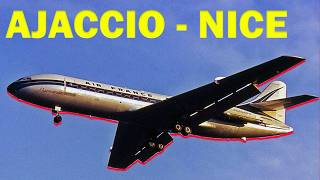
A single-speaker YouTube investigation revisiting the 11 September 1968 crash of a Sud Aviation Caravelle SE210 (Air France Flight/‘Ajaccio–Nice’ flight often called Flight 1611). The narrator summarizes the short scenic flight (takeoff ~10:09 from Ajaccio, 95 people on board), the in-flight emergency (pilot reported fire, last message: "we're going to crash if this continues"), loss from radar and subsequent recovery of debris and bodies. Forensic traces recovered from about 2,300 m depth and ~8–10 tonnes of wreckage indicate a powerful, brief cabin fire concentrated toward the rear; no clear evidence of a bomb, but ballistics found .22 and 9 mm cartridge/bullet fragments and at least one clean ~5.5 mm hole in a toilet panel. Investigators at the time considered multiple hypotheses (toilet/cigarette fire, electrical heater fault, missile strike, weapons/hijacking, passenger movement, smoke incapacitation) but left many questions open. French judicial authorities have reopened searches to photograph and lift remaining wreckage late this year and in 2026 to try to resolve outstanding questions and provide closure to victims' families.
Questions this video answers
11 September 1968.
Sud Aviation Caravelle SE210.
95.
Around 10:09 (local).
Level 160 (stated as cruising altitude).
Foreign hello friends. Many of you have contacted me regarding the flight of the Caravel Ajaxion Nice. It took place on September 11, 1968 and it is also known as Airfants Flight 1611. But generally when we talk about it, we say the Ajax flight and everyone knows what we are referring to. It is a flight that is very old but has not finished raising questions and even passions. So today we are going to come back to it for the following reason. The French justice system has decided to launch other searches in addition to those that took place at the time of the accident, other searches in the region off the coast of Nice, to try to photograph and potentially bring up pieces of wreckage. This research will take place towards the end of this year, depending on what they can find or not. It will also take place next year in 2026. So what is it really about? It is the morning of September 11, 1968. At Ajachu Airport we have a plane. It is a twin engine Caravelle SE210 from Sud Habilation. And in fact this plane is going to take off around 10:09 in the morning and there are 95 people on board. It is a twin engine public transport jet and on that day it is making a fairly short flight. We are talking about roughly 250 kilometers. So the school plane. So normally what is planned is for the training aircraft to arrive, it took off towards the south on Runway 21. It had to change its QFE today because there is a constant shift in the earth's magnetic pole, which means that the runways regularly change numbers because they are oriented, they are calculated or based on magnetic north, if you like. In any case, our plane was supposed to take off more or less towards the south, right? Then it climbs back towards the north in terms of altitude, it reaches its cruising altitude, which is not very high. We are talking about level 160,000ft. It stays there for five or six minutes and then it begins its descent towards Nichi airport. So these are extremely short flights that start and finish literally within an hour or half an hour for this particular village. And these are quite difficult flights for the pilots. That is to say, there are many things that follow one after the other. Takeoff, climb, preparation for landing, and also passing from one controller to another. So often on these flights the landing briefing in Nice is done before the takeoff and injection. So just to tell you it's a routine flight, a regular route, but at the same time it's a flight that puts a lot of pressure on the pilots. So everything seems to be going as normal as possible. At one point, the aircraft was descending, and we estimate that it was roughly between level 90 and 70, so it had already lost half of its cruising altitude. And then suddenly the pilot contacts the controller in Nice and says, I. I'm in trouble. There you go. I'm in trouble. And then the controller in Nice answers him. The pilot says, I want to land in Nice or wherever you want. I mean, just figure it out. Give me some vectors, something. I want to land as quickly as possible. So the controller asks him to descend to 2,000ft. So he allows him to descend to 2,000ft, telling him that he has full freedom to act as he wants. So he gives him complete freedom of action. He understands that there is an emergence frequency. The captain will respond by saying, we have a fire, There is a fire on board. So that is information that is communicated on the frequency. Later he adds something like, we are going to crash if this continues. And in fact, that was the last message received. So the controller in Nice will send messages, messages, messages for several minutes, but there will be no response. And the plane had already disappeared from the radar. And later in the hours, around noon, we'll start finding floating objects. We'll find puddles of oil drifting with their characteristic moire pattern on the ocean. So the flight had crashed, killing all 95 people on board. So there's one thing we need to know before we think about this accident. We're going to try to look at two or three theories. There's one very important thing to know. We don't think about accidents in the 60s with today's mentality at that time. Just to give you a figure, if we look at the Caravel, the Boeing 707, the DC8, the planes of the 50s and 60s, what we'll see is that the accident rate was very high. That means that literally, doesn't it? Literally, roughly one in four airliners were manufactured and ended up crashing in one way or another, sometimes with casualties, sometimes without, but they were destroyed. So the first generation of jets were extremely accident prone. And this was in 68, and the 737 wasn't even there yet. Okay, just to let you know. So it was a time when aviation had a different face. And if we had not taken the measure of the danger and had not made profound changes to aviation, whether it be aircraft design, pilot training, airline management, if this had not been changed, and in part thanks to the initiatives of the FAA in the United States, many initiatives related to safety standards, fire standards, come from the United States, come from the FA studies on CFIT and the requirement for GPWs and other equipment come from the FA in the United States, the case against impacts against mid air collisions. So planes that collide with each other also comes from the lighthouse. So frankly, without this I can tell you that today aviation would have died out by itself because it would be unacceptable in our time, wouldn't it, to have this accident rate. But in any case, if we go back to those times, it was something, let's say, quite common, first of all. Secondly, if we look at the statistics, the caravel, roughly 26% of the caravels built ended up on the ground. And of course the accidents, about 10% of caravel accidents were linked to fires on board. On the other aircraft, these fires were less frequent. Let's say, just to give you an idea, since we're talking about figures Today, well under 1%, less than 0.5% of the airliners built ended up damaged in one way or another in an accident or similar. Right? So you see, the proportion has nothing to do with the time. So let's go back to our story of the caravan. The rescue efforts begin. Well, there's nothing more that can be done for the people. There's some NATO debris that has been recovered, but most of the debris is at about 2,300 meters. We are about 22,000 nautical miles off the coast of Nice. And then we have to use cable lines and literally go and retrieve or scrape the seabed to try to recover what we can. So we discover that the plane is very fragmented. It hit the water after the last communication with the pilots, probably a minute, a minute and a half after the last communication, when the captain says we're going to crash if this continues. So the plane must have flown for between one and a minute and a half because it then disappears from the radar. It's very difficult to estimate the exact moment. And I'll give you a detail, because the radars don't see 360 degrees all the time, they scan instead. So there's an antenna that rotates and refreshes the screen. So an aircraft that will simply disappear at a given moment, it is there at the next refresh, it disappears. So it disappeared between the two refreshes, but we can't know exactly at what second. So I was saying, and this may have a role for the future, I was saying that when they bring up the. When they bring up the what they can he, the aircraft weighs roughly. Roughly. I don't have the Caravelle documentation, but roughly speaking, if we take it on the ground without passengers, without fuel, without anything at all. We are talking about a machine that is a little under 40 tons, probably in the. I would put my money between 37 to 38 tons, roughly. So in terms of debris in the water, we recover between 8 to 10 tons of debris. So we have recovered, let's say, roughly a quarter of the aircraft. So the three cases are still underwater, hence the search today. So what are we going to find in there? Well, we are indeed going to find traces of fire. That means that the pilot was not dreaming when he said there was a fire. There really was. That means if we look at the upholstery, the seat armrests, the tray tables, all that, we will find that there are a significant number of traces or traces of exposure to heat. So most of these elements, all of these elements exposed to the fire are located at the rear of the plane, towards the front of the plane. There are no parts that were exposed to fire or heat in the holds. There is nothing in the baggage recovered. And others, there is nothing to indicate that the fire had started in the holds. So we have a fire that was in the back and inside the cabin, potentially also outside. Again, we don't have all the elements. So they're going to find. They're going to find. So they're going to follow the trace a little bit, try to see which parts are exposed to the highest heat. So what they deduce, because they do tests like if they find a plastic panel that has a particular discoloration, for example, it's yellow in one place, what are they going to do? They're going to take the same one, a similar one, and they're going to start exposing it to fire at various temperatures under various conditions to try to see what temperature allows them to obtain roughly the same discoloration. So that gives them a little idea. For example, they find a carpet, a floor mat, it has a core, a metal frame. The rest is plastic. The plastic has partly melted. So they say to themselves, okay, what is the temperature that destroys the plastic at this level that we see? But at the same time, the internal frame remains more or less intact, so that gives a minimum and maximum temperature and so on. They gradually get an idea of the situation. So what they see is that there was a fire. Yes, this fire corresponds to a powerful and brief appearance of flames inside the plane. What the report says is a brief appearance. It's as if there was a sort of flash inside the plane and then it will destroy, of course, a certain number of elements inside, but they can't see elements that were exposed to an extreme temperature. Temperature, we're talking about a few hundred degrees. Whereas when it comes to other incidents, we've seen temperatures that were even on this channel, you can see that we saw temperatures that were particularly the one supplied by the fuel that wants to rise quickly. You need to know one thing. I'll just show you an example of an airplane here. This is a DC10. In airplanes, you have engines that can be in two places. This one is very interesting because it has two. Either under the wings. Okay, either under the wings that you can see here, or on the tail. The Caravelle has two engines on the tail. It's a bit like the same system as the D and the DC9, for example. And what happens is that the engines that are under the wings, their fuel comes directly from the wings. And typically the fuel is in the wings and then it will be pumped towards the reactor. That's simple. When you have reactors at the rear, uh, the fuel always comes from the wings or from the central tank. And in fact, it has to be taken to the rear. So what we have. We have fuel tubes. We have fuel tubes, fuel that will go up somewhere. So it can go up along the floor, it can go up somewhere and go all the way to feed the reactors, you see. So there is this obligation, isn't there, to run piping all along the fuselage, all along the airframe? And that doesn't exist in planes that have engines under the wings. There's no need to run fuel everywhere. So now, what does the accident report say? What does the accident report say? So they're going to evaluate several. Several possibilities, right? Of course, with the methods of the time, with the resources of the time, and in particular, the resources of the time. It's a black box that is already partly damaged. So that means the last flight is not readable. That's the first point. And the second point is that it doesn't have many parameters, right? These are boxes with typically four or five parameters. You have the heading, the altitude, the acceleration, you have the time, and that's it. We've already listed them. In fact, if you like, they themselves acknowledge in their report that if the black box had not been damaged, it would not have allowed us to determine the origin of the fire. And here we have to agree with them because these values could not have changed anything, unfortunately, to our knowledge of this accident. So as I was saying, they're going to go through a lot of hypotheses. For example, there's one hypothesis that was, will the passengers flee the fire? Will they flee the fire? Will they go towards the front of the plane? They're assuming a difference in centering, therefore a change in center of gravity, and that this could cause the plane to lose control and nose dive. They found that at the speeds at which, given the speed at which the plane was traveling, a deflection of only 3 degrees of the elevator surface would have been sufficient to balance all the passengers who are moving forward, knowing that it has a deflection of 30 degrees. So we can clearly see that a very, very small effort would have been sufficient to compensate for the mass movement of the passengers, for example, which alone could not have explained the loss of control. Because we are trying to understand why the pilots lost control, especially since when we have an emergency, it occurs, as I said at the beginning of the video. We enter at about 7,000ft, right? It will take them about three minutes to crash from 7,000ft, which is an indicator that we are not in a plane in distress, because a plane in distress means a plane that has completely stalled or is in a complete nose down attitude or something else. Generally it exceeds 10,000ft per minute. There are many cases in this channel. Generally we have more than 10,000ft per minute on the Vario. And at that point, huh, 7,000ft, as you can see, you cover it in 40 seconds, 45 seconds, you've already hit it. So here, the fact that it took him three minutes, we are talking about a sink rate slightly higher than 2,000ft per minute, which is not an unusual sink rate, huh. In any airliner during the approach, uh, the speed of 2,000ft per minute, it's something quite, quite normal. So. But the plane ended up crashing anyway. So he thinks that the pilots were perhaps overwhelmed by the smoke that entered the cockpit, potentially, huh. Which, because it would seem, but once again, he can't figure it out. Confirmed. According to the voice signature, it would seem that at least during the last message, the person speaking to the control panel was wearing an oxygen mask. So maybe they were wearing an oxygen mask, which is consistent with the fact that they reported a fire. But the oxygen mask won't protect against all situations. So it's possible that they were either blinded by very dense smoke or also intoxicated by smoke. Despite the mask. Many possibilities like this are being decided. Now they're going to say in the report that probably there was a fire that broke out in the toilet on the right at the back, because that's where the epicenter seems to be so fire report how at the time people smoked a lot on planes. Smoking was allowed. In the 90s, people smoked on planes. So when people were smoking, someone maybe went into the toilet, he threw a mo there, huh? It was seen. It was seen before this accident. It was seen after this accident. Right. A few years later, there was a Boeing 707 that landed on its way from Rio to Paris, which landed in a field. And all that because of a fire. Unfortunately, most of the passengers died. There were more than120 deaths in this story, again because of an MGO. Because in those days, smoking, you know, anywhere at all times was considered practically a fundamental human. Right. So I was saying that there is this. That's what people are thinking about, or they are also thinking about perhaps an electric water heater, a heater, you know, that has a resistor. And it has also been seen that in the past there was a plane that was destroyed on the ground because of this. That. Well, there is a runaway inside this system, that the circuit breaker does not realize that there is a problem. It continues to supply electricity, and then there is the whole thing that takes. So the commission of inquiry analyzed other options. For example, they took the. They took the upholstery, you know, a kind of foam. What is it called in English? Uh, in French, it's the foam. There you have it. It's the foam that the seat backs and the seats themselves are made of. They took this foam and they took X rays. So there are 3,1 0x rays. So it's literally a medical X ray. So on the X ray, one by one, so it's numbered, and we go to the X ray and we want to see what's inside. Why? Because when there's an explosion like a bomb, for example, well, there are fragments of metal that will end up in the foam. So they are projected, they will remain in the foam. And on the X ray we can see them in the foam. They will see plastic objects, glass, all that, but they will not see any characteristic signature of an explosion. Why? Because in explosions, there are pieces of metal in the foam. But these pieces of metal are not, in the event of an explosion, once again, placed randomly, it corresponds to. Because if I take, for example, this piece in place of cushions everywhere, and we explode, we detonate something. The pieces of metal would not be randomly placed in the cushions, but they would all. They would all have an orientation that converges towards a central point, towards a focus of the explosion. So the distance from each other, the angle at which they entered the foam correspond precisely to give an idea of an explosion. In this specific case, we do not have that. They also think about the missile theory. They say to themselves, did a missile hit? That's a possibility. So he rules out on the basis that around two times in fact. First when the rescuers went to the site, when helicopters, frigates, all that went to the site to explore a little, to try to see what happened. Well, they didn't see. They didn't see. They didn't see any soldiers who were playing with missiles. That's the first point. Secondly, they say that on the radar, on the radar we didn't see any trace of a missile. That said, once again, the radar, given its scanning and given the speed of the missiles, which can exceed which spoke at several times the speed of sound, well, the radar could potentially scan the plane. By the time the antenna makes a turn and comes back to all the radars of the time, the missile has already appeared, has already hit the plane. So the fact that he doesn't see it, not on the radar itself. Right. It doesn't rule out the missile theory. Especially since it would seem that there were some cover ups. For example, there was a French navy ship called the Soufre and it seems pages corresponding to September 11, one of them was torn out and others were patched up with pen and glue. All of this so that when you look at it, it would seem that there are clear traces of falcification. Especially since if you look at the modern history of missiles and aircraft, it's not something completely unusual. It's not completely like. It's crazy, it fell from the sky. You know, if you look at the triple seven of the Malaysian NH1, well, it was lit by a bomb over Ukraine years ago. I think it was around 2000 or 2014. Closer to home, I think it was around 2020, roughly when Iranian forces set fire to a Boeing 737800 belonging to a civilian Ukrainian company. It was flying from Tehran to Kyiv. It had barely taken off and was set alight by a missile. We are talking about nearly 200 deaths in this story. We also had the USS Vinson. At one point in 1988, the USS Vinson, an American ship in the Gulf, fired on an Iranian Airbus A300. Okay. And then? Well, everyone died. I think that made 298 deaths at that time. So in 2015 over the Sinai, we had a Thompson fly plane that came from United Kingdom, which was going to Sinai, which was going to Chilemeque. Right. Balny resort. Well, the pilot had to avoid a missile, he had to take an evasive maneuver because it seems that a missile had come within 300 meters of the plane. So then the Egyptians. Listen, it was just training. You weren't targeted. It's not personal. I mean, it wasn't intended for you. No one tried to hit you with a missile or anything. It was just launched as part of an exercise. You were there. Well, there you have it. More fear than harm. Okay, so if we look at the history of Egypt, for example, with public transport accidents, whether on trains, planes, ferries, etc. We realize that they are always extremely secretive about the reasons, the malfunctions that led to the accident and which led, as in this case, to the incident, extremely, extremely serious. By the way, a civilian aircraft, a missile in the same place, that's something extremely serious. In any case, to tell you that, it would seem that today we are trying to validate or invalidate, don't we? The missile theory. We will have to go and get chemical analyses. So long. Almost 60 years after the event, I don't think that could reveal anything, huh? Although there is still the rest three quarters of the plane that are underwater. And by bringing them up, perhaps they will finally be able to give the families reasons to. Reasons I almost want to say, to start their mourning, because. Because the problem here is that many families of victims are very affected by this and not having any answers. It's true that it creates obstacles that sometimes prevent them from closing or even to begin mourning, right? So there is this search for truth which is completely respectable. Now there are other elements which are in the report and which in my opinion have not been exploited, which in my opinion have not been given the light they deserved. In particular, there are numerous references in the official accident report and which mention that bullets and cartridges of 5 mm. 5 mm 5 were found. So this is a.22 caliber.22. And we also found cartridges and bullets of 9 millimeters, is that right? So at least two weapons. We have two weapons in the plane. Some bullets were fired. This is in the report, it's not mine. Some bullets were fired and in fact fired into the. They exploded with the heat, didn't they? And for example, in the toilets, the famous toilets on the right, at the back, where the fire seems to have started, it seems that there is a panel with a 5.5mm hole, a very clean hole. So there it's a bullet that went through it. There's another place where we'll also find a metal ball, 5.5 millimeters. So when they analyzed it with the ballistics laboratory, they discovered that this arsenal was probably in the toilets where the fire started. Okay. It's hidden somewhere after that. These bullets weren't fired through a barrel, but with the heat, right? Well, they exploded and then it started, of course, but with extremely low force. It can still find a plastic partition or a partition with nests, bees inside and all that, but that's as far as it goes. Now, when I look at this report, it seems like this story has been brushed aside. It means they say they did ballistic tests. These tests show that it wasn't fired through a barrel, so it couldn't have been involved in the accident. There's nothing to do with it. There's no logical connection. It means when we look at how the commission of inquiry erases or dismisses these elements, we don't see any logical connection. It seems like it was dismissed in a fairly summary manner, to be honest with you. So what can we say about this? We can say that, well, in what we've collected, in 25% of what we've collected, we've already found bullet holes, we've already found bullets, we've already found two types of weapons. So God knows, God knows what we would have found if we had had access to the entire wreckage and the remains. Okay, so just to let you know, we have two weapons. The five, the five and a half is probably also a makeshift one. That means when they took the cartridge, they took it to the company that manufactured those cartridges. They said, well, this more or less comes from us, but the metal ball, that's not ours. So someone put the metal ball on the cartridge. So clearly we're dealing with something amateurish, something makeshift. We're dealing with small calibers, small caliber.22s with some makeshift work and all that. So we're probably dealing with weapons that were concealed, right? We're probably dealing with weapons that were taken on board, right. And hidden right, in the toilets, as the report indicates. Hidden in the toilets with a view to perhaps hijacking or something. It was the heyday of hijackings. Although hijacking a plane that had left for a 20 minute flight, that was. But hey, it must also be said that hijackers are not always the smartest. So now there's also the 9mm. 9mm. We're talking about a real caliber, we're talking about a fairly serious caliber, we're talking about a law enforcement caliber and so on. So we're just wondering if there wasn't some shelling inside the plane, notwithstanding the fact that Some bullets, yes, Some bullets from the arsenal on board, burned and then burst on their own like popcorn. I agree, there's no problem. I'm not questioning that. But I wonder if there weren't others as well, right, who were shot at. Because you have to know that a flight crashes anyway, right? So we're thinking, well, a flight crashes, there are traces of shelling, there are traces of weapons and everything. And. Well, no, that's not it. We're going to look for a golden missile. Do you know what I'm going to say? I'm quite surprised that these weapons haven't received the attention they deserve. So we can imagine, for example, people who smuggle or hide or have hidden in the toilets, weapons of the type. So makeshift weapons, huh? Type 22, right? Huh? With metal bullets and everything, with the aim of hijacking the plane, which corresponds more or less to the practices of the time. And then when they want to get past the hijacking phase, remember that they don't have much time. The flight is very short. And, well, at that point we have people in front of them. So, for example, armed Philadelphia armed soldiers. We know that there was at least one general there in the plane. So let's imagine that there are armed soldiers or cops. And then there's a retake, you know, they shoot, for example. And then we can arrive, for example, with a shredded fuel pipe, right? Torn, you know, you have to be unlucky. And then go through a partition, and then, uh, then we have fuel spraying inside. There's fire and everything. And then what do you know, right. All the gravity. So, uh, it's something that I think we can't just rule it out like that. Uh, we have an accident, we have weapons. And in particular, the weapons are in the area where there was the fire. We also wonder, for example, in addition to having brought up weapons, you know, homemade weapons, 22s and all that, did these same people not also bring up, for example, incendiary devices or other devices that they wanted to use to threaten? Right. And then, well, in the heat of the moment, you know, it started, it really caught fire and everything. And that maybe it wasn't even a question of fuel, it was just maybe a question of an incendiary device shooting, all that, and then that it caused the accident that I'm talking about, you see? So these are possibilities, These are possibilities. But will we ever be able to answer the question? Will we be able to know if it was a missile that was fired by mistake by the French army, right? No. During a Test, a training session. And then, oops, we hit him on the airliner and then we tried to cover his tracks. Why not? It's entirely possible. Right from the Iranians when they, when they lit up the 737 at the start, they said it wasn't us. No, I don't know. It wasn't us. It's a time of a moment of tension and everything. Although the region is always under tension. I mean, that's it. So it's a possibility. Of course it's a possibility. Afterwards. Well, the people responsible are dead. The spirits, that's it. We're in a shadow theater today. Uh, we can't find anyone, huh? The people are all, are all more or less, more or less dead from the that time. In terms of rank, the people responsible, the ministers, the generals, the important people who could have hidden this, they're no longer with us today. So it's very hard to completely trace it. Now, what I hope is that by actually tracing what's in the underwater, maybe we'll be able to have a new element in one direction or the other. In any case, the theory of the fire is interesting, but given that the flight remained at cruising altitude for about five or six minutes, which is the only time when the fasten your seatbelts were, wasn't on, right? So that's the only time passengers could move around. So can we imagine that someone very quickly, during this level 160 phase, goes to the toilet, he wants to smoke one. You see the guy, he's just waiting for us to take off. We arrive, bam, he's going to smoke one in the toilet. Although at the time he wasn't required to smoke one in the toilet. He could have smoked right in their seat without any problem. But hey, let's imagine that he wanted to go to the toilet and smoke a cigar. There you go. You know what I mean? He arrives, he smokes in the toilet, he throws the cigarette in the trash can in the bin with the paper towels. So he throws it in there. He must be really irresponsible. And then, well, there are some irresponsible people, right? So he goes back to his seat, then fastens your seatbelts there. We have a fire in the toilets that is smoldering. But when no one goes into the toilets, no one goes because the seat belts are there. Well, we're going to miss the opportunity to detect the fire, because otherwise, in another situation, the fire could have been detected visually at a time when it would still have been possible to put it out. One last French translation to finish, because it's a fascinating story. I'll tell you the story of this aircraft, the Ajaxio. Nice. We could talk about it for hours. But just perhaps one disturbing detail among all the disturbing details of the story. It's when they found the fire extinguishers. They found them. They picked them up underneath. They were still attached to the partition where they normally are. What does that mean? I mean that we didn't have the opportunity to use them. And by the way, the report says, why didn't they use it? They don't understand. So they say either the fire broke out suddenly, maybe too quickly, in that case, where the smoke was too strong all of a sudden, it's hard to imagine that suddenly the smoke was so strong that you couldn't even get the fire extinguisher. Or maybe the passengers fleeing the part where the fire was, where the smoke was, were going to prevent the flight crew from going to the part where the fire was. Another possibility. Or since there was a shooting, people were more in hiding mode than going to the fire extinguishers. There's another possibility. Not all the bodies were brought back up. So it's not possible to do autopsies or X rays or whatever and say, okay, we found a bullet in this one, in that one. That's. Unfortunately, this way of investigating is not entirely possible given that the majority of the bodies, or at least a good portion of them, were not recovered. So, my friends, I know that I am leaving you with more questions than answers. And in fact, it is for this reason, it is for this very reason that the investigation was reopened. While 60 years later, the justice system is saying, we have to finish this. We are going to look, we are going to see what we can, what we can find, because there are too many open questions. Once again, in any case, my friends, thank you for watching this video so far. Ah, the next videos will be published exclusively on Patreon. I'll give you the Patreon link for people who support this channel. I'll come from time to time, especially for the news. But the other videos outside of the news from today will be published on Patreon and they will Never arrive on YouTube. I think that this is a. I have to go towards this action because it's the only way to ensure the sustainability of this channel. Otherwise, if I start publishing everything on YouTube, I'll explain it to you another time in detail. I see that this channel will not be able to survive beyond six to 12 months. The relationship between the work it generates, the investigative work it generates compared to the YouTube revenue it generates. Well, it's a relationship that is completely unbalanced and does not allow in the long term the continuity of this channel. In any case, thank you again to those who have supported this channel on YouTube since the very beginning without necessarily having exclusivity sometimes, and then we will meet again in a future video at some point in the future. Thank you and see you soon.
More from Aldo



La FIN du Royaume-Uni ? L'Ecosse, l'Irlande du Nord et le Pays de Galles veulent partir !




Analyse Présidentielles 2027 : Marine le Pen remet ENCORE le voile sur la table !


Scandale "60 Millions de Consommateurs" : la France mange des pâtes contaminées au Cadmium !

2 dossiers : Accident d'autogyre en Italie & un pilote sauvé par le parachute du Cirrus