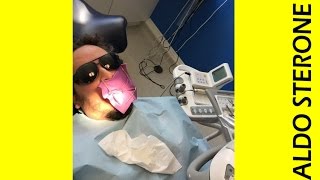
A French speaker documents their dental appointment, describing the anxiety beforehand and the actual experience with local anesthesia. They were diagnosed with pulpitis and warn that delaying treatment costs far more later. Finding a dentist who prioritizes your comfort makes a real difference.
Questions this video answers
Pulpitis
About three times
Lower example: about €200; higher example (saving the tooth): about €2,000; worst-case larger-scale cost example: £15,000–£20,000
Hello my friends, it's Saturday morning before 9am and I have an appointment with the dentist. So I'm recording this video for myself, so to speak, you know, because it's better to have a fresh memory to make decisions. I think we're better able to make decisions when we're close to the event than when we're far away. Decide what? Decide whether the dentist hurts or not, whether the dentist is terrifying or not, whether it's a bad experience or not. So what I'm going to do is in five minutes I'm going to go to the dentist. I'm already in the parking lot. And what's going to happen is that once all this is over, I'm going to make another video later and try to express myself a little bit that will allow me, when I have an appointment in three months, in six months, and for other people to try to get a first hand opinion on this experience. So I can't tell you that I'm extremely nervous. But I'll tell you something. Among Africans, among Africans, people who come from Africa, myself included, we instinctively know that we shouldn't have anything to do with medicine or the law. So those are two things that scare us more, let's say, than the average person. Than the average person. That's all. Do you go to the hospital? When you go to the hospital, the, there are patients who are in rooms and then I guarantee you that the patient who has 20 visitors is always an African. Because the whole family comes because we feel that the person needs someone there. We feel, we feel that the person needs help. Well, maybe the guy is there just for, I don't know, for an incarnate angle. Do you understand what I mean? There you go. Uh, so, yes, let's just say enough talking, enough joking, none of that will help make the pleasure last, as they say. So I'm going to go to the dentist right now. I've been toying with the idea of calling them for days now to tell them that I'm sick or that I have some kind of urgent work related matter. You know, there are days when we're in the process of confessing everything. There are days when I even called and said, listen, because I can't get an appointment on another day. Then she told me, listen, you have an appointment on Saturday morning. I got this appointment a long time ago. It's almost impossible to get and they're really booked up and if I let it go, it'll be very difficult for her to get an appointment, let's say during the week I said to myself, okay. I said, okay, I'll call you back. There you go. I didn't call back because the appointment is still on. There you go. I don't know why life is like this. I don't understand. I don't know. There are days when. Well, that's it. I say we have to stop this video and then go to the dentist, okay? We're not going to make it last 45 minutes, okay? That's not the goal of the game either, okay? It's. Yeah, I want to do so many other things, you know, I appreciate this moment. I even want to go to the forest and walk, you know, something I never do. But now it seems so interesting to me to go to the forest and walk like this. Watch the birds, look for mushrooms. Even if it's not the season, I don't care. It's not the 16th year. No, it's not 16 at all. Well, it depends on what you're looking for. Anyway, let's stop, let's stop, let's stop, let's stop, let's stop. Enough joking around, as they say. Ah. I'm going to the dentist right now. Now, as soon as I'm done, I'll make you another one. Another one. There you go. It's two hours later. I went to the dentist five minutes ago. The most painful part was the bill, as usual, halfway through, you know, when he sees that it's an Arab, he puts in the dose. You know, he put in the horse's dose. I'm completely. I can't even speak. Uh, that's just to tell you and to tell myself for the next time I go to the dentist. In terms of pain, the total pain I felt would be equivalent to this. I take my claws, I take my arm, I do that. That's all. It's practically a feeling. When the anesthesia needle is inserted, you can't even tell when it touched something on one thing. But below the normal injection, below the blood test, below all that, it's just a kind of feeling like that. And it goes to that of the kid who tests a battery with his tongue to see if it's charged, which is something you shouldn't do. And that's it. And after that, the rest, honestly, is just noise, you know, the rest is noise. It's vibrations. It's discomfort because you're sitting. Uh, I had a headache because my head was touching the seat like that for a long time. My head hurt a little bit there. I moved my head a little like that. Uh, you might be fed up with having your mouth open and breathing like that. But, I mean, honestly, I'm telling you a little bit about all the things that I've felt. But there's no pain, huh? There's no pain. Strictly speaking, it doesn't exist. There's not at all. At all zero. Zero, strictly zero. Because, I mean, the. The anesthesia is applied. It itself isn't painful because he did. I think, uh, I couldn't see, but I think he put a little bit of liquid anesthesia directly on the gum. And then he did it once, the first time. That's when I tell you, uh, you feel a little bit of okay, a little bit like that, huh? It's not. It's really nothing, you know, in terms of pain from 1 to 10, it's, uh. I mean, it's nothing at all. And then he put more anesthesia. He must've injected maybe four times. I don't know. But I can't feel the others anymore because the first layer of anesthesia has already removed everything. So I can't feel it anymore. So I know he's doing it, but I can't feel it anymore. And after all the rest, you're kind of a spectator, okay? You're a spectator. And honestly, it's worth it. I think it's worth going to the dentist. You have to find a dentist you trust. Uh, I had a very good dentist. I used to live there. Then I came to England. And since I came to England, it's true that I haven't been as careful about the health of my teeth as before. Uh, I mean, I brushed my teeth, all that stuff. That's for sure. I was very, very. I'm very particular about that. But I didn't go to the dentist very often because I've been maybe three times in like, seven or eight years. And each time it was a pretty good experience, okay? Until at one point, an emergency brought me to this dentist that people had recommended to me. He's extraordinary. He's a real artist. That means I feel that. Why I trust him because I feel that it's very important to him that the patient doesn't suffer. Right? You know, teeth hurt a lot because they're part of those parts of the body that are directly connected to the brain. You see, these are what we call the cranial nerve systems, right? That is to say there are nerves that pass directly through the skull and go to the brain without going through the spinal cord. Without going through the spinal cord. So there is a nerve called the trigeminal nerve, which is like this. It has three branches. Okay. More or less. And then in fact, one of the branches of the trigeminal nerve goes directly to the teeth, or two branches. I don't remember my medical classes. But in any case, the fact remains that between the tooth, if you like, between the tooth and the part of the brain that will cause the pain, and there is that much distance, right? I mean, it's next to nothing. And on top of that, it's directly connected, so by a highway, literally. So it's true that it hurts a lot. And I'm very happy that this dentist is interested in this part of the thing. Okay. The problem is coming across a dentist who doesn't care because at that point it's painful in the middle of the thing and so on. It's extremely uncomfortable. Right. That's why some people have become phobic of the dentist. And practically I. I almost touched it again. Well, no, it's not. It doesn't hurt. I understand. There you go. That's it. Do you see the thing? It's non. It's none. It's just. It's not painful. It just feels like it's swollen. I touch it and it feels weird. That's all. There's no. There's no sense of pain. So, in fact, this dentist is very attentive. So I think you should go see a dentist, maybe several, I don't know, and find one who is attentive to the patient's pain and comfort. Once you find the right one, honestly, they can do everything from Z to Z. There is 0, 0, 0 pain. There is no pain at any time. So I just wanted to share this experience with you. There you go. And it's important to take action. Why? Because the longer you wait, the more you risk having more pain in the future. And then it costs more and more. Let me just give you an example. What happened to me was that I had a tooth, a little. A molar that had been repaired years ago with a composite. Okay. With a composite filling. Right. And what happened is that, you know, the composite can develop cavities or other things under it over the years. And since it was close to the pulp, let's say the tooth, the central part of the tooth. Right. So it gave me what's called pulpitus. It's when the inside of the tooth becomes inflamed because dancing is like that. You have enamel, the enamel part, that's not very sensitive at all. The enamel is sensitive. There's no nerve in it. It's definitely more solid than that. Inside you have dentin, a part that's a little bit more solid, that's a little yellow in color, but very sensitive. And inside you have the pulp there. That's where the pain comes from. And so what happened is that I had pulpitus, as they say in the profession. And so. And so that's it. I was happy and pulpitous. Honestly, there's no way to mix it like I did, like codeine, clophenic, paracetamol, something like that. I mean, there's no chance. I mean, it doesn't matter. It doesn't change anything. So there you have it. I ended up at the dentist one day in an emergency, and that's the situation. So now this tooth was either I lose it, right? It's either I. Or he takes the pliers, he pulls it out, or someone would have charged me maybe 200, I don't know, €200 or something like that. Or he tries to save it and all that, and Now I'm out €2,000, okay? You see the thing? So it's really expensive. It's a tooth worth €2,000. Now, there's only one problem in all my teeth, okay? So, okay, I'm very happy about that. Now imagine that. I'm happy that life gave me this warning that forced me to go to the dentist. Because imagine you're just kidding. And then the day you go to the dentist, you have five or six teeth that are in this state. What do you do? Either you take them all out or you spit out 15,000 or 20,000 pounds on the couch. And if you don't have them, well, your mouth is empty and it goes in, and then suddenly you look 20 years older than you are. Hey, that's it. So I think it's important to go to the dentist. Fears of the dentist are justified mainly by the pain, which is very legitimate, because people have often been to dentists who may not have been very attentive. But we mustn't hide behind the fact that the dentist is not good or that the dentist we went to is not good and not go at all, because that would really be a disaster, because you'll pay dearly for it later. So you have to find a good dentist, and then, okay, I'll leave you my friends, and I'm going to go and rest a little, mister.
More from Aldo



La FIN du Royaume-Uni ? L'Ecosse, l'Irlande du Nord et le Pays de Galles veulent partir !




Analyse Présidentielles 2027 : Marine le Pen remet ENCORE le voile sur la table !


Scandale "60 Millions de Consommateurs" : la France mange des pâtes contaminées au Cadmium !

2 dossiers : Accident d'autogyre en Italie & un pilote sauvé par le parachute du Cirrus