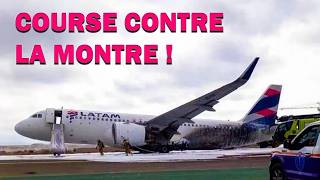
YouTube monologue recounting the LatAm Flight 2213 collision at Lima’s Hugo Chavez Airport in November 2022. The speaker describes how airport expansion and construction created jurisdictional and taxiway confusion; a firefighting exercise was poorly communicated across changing tower shifts; fire trucks entered/crossed Runway 34 as an LATAM A320neo (flight 2213, Chile registration beginning 'CC') was commencing takeoff with 108 people aboard. The aircraft struck a fire truck, lost an engine, and caught fire; all 108 evacuated, several were hospitalized, and four firefighters in the struck truck later died (three immediately; a fourth after prolonged hospitalization). The pilots were arrested overnight and released the next evening with no charges; the speaker argues systemic communication failures and safety-culture issues were central.
Questions this video answers
November 2022, Hugo Chavez Airport (Lima, Peru).
LATAM Flight 2213, an Airbus A320neo (Chilean registration beginning 'CC').
108 people on board.
Four firefighters died (three died shortly after impact; a fourth died months later after seven months in hospital).
They were arrested the night of the accident, spent the night in custody, and were released the following evening with no charges mentioned in this account.
Hello, friends, and thank you for following this channel. Today we're going to talk about LatAm Flight 2213. LatAm is a Chilean airline that operates mainly in Latin America and many countries. Today we're in Lima, Peru, at Hugo chavez airport in November 2022. We're around the time when Covid is ending and operations are starting to pick up again. Hugo Chavez Airport, and this is very important for this story is a mess. Why? Because historically it was an airport that had a single Runway, a single 3600 meter Runway, and facilities including terminals, hangars, fire stations and so on. But the problem is that once it started to grow in traffic, it had to be expanded and made bigger. So to the west of the airport, another Runway was added. Well, they were in the process of adding another Runway. So there were lots and lots of tractors, trucks and dump trucks, plus a sea of idiots that actually separated the part that we'll call the old airport and the new airport part that wasn't yet in operation, that was still under construction. So you'll see that this isn't a very promising situation because there are conflicts between the part that was in operation and the part that wasn't. The authority of air traffic controllers stopped at the coastal borders. In reality, it stopped at the old airport, since the new one wasn't yet in operation. So it was outside their jurisdiction. So this November 2022, I was saying the firefighters decided to conduct an exercise, conduct exercises regularly. Why? Because there was the following situation. At the time when the airport had only one Runway, they had a barracks. And then, well, they did regular training to be able to reach, let's say, the furthest point from their barracks in less than three minutes, stopwatch in hand. It was very important to validate this through regular exercises. Now, once the airport expanded, they couldn't keep their old barracks because this time the furthest point from the airport, if we take the end of the new Runway, was more than 5km away. So what did they do? They installed a new barracks somewhere between the two runways. So between the two runways in the middle, they installed a barracks that is roughly equidistant from all the Runway thresholds. Now, they regularly did exercises to see how long it took them to reach one of the furthest points from their barracks, and then timed everything and made reports and everything. So the day before, right, there was an exercise in the air traffic control. Today their supervisor called the air traffic control department to explain it to them. So he spoke to a supervisor and said, well, tomorrow we're going to do an exercise and all that. The two men discussed it. There was a sort of agreement between them. The next day, the day of the exercise, the guy we had spoken to the day before wasn't there. He was sick in the morning. Well, he didn't show up. So now we have people who don't really know that there's an exercise. In any case, to be on the safe side, the firefighter manager calls the control tower early in the afternoon to explain once again that there's an exercise. He gets a caller who says, well, I didn't know all that, okay. He explains once again that there will be an exercise and that there will be fire trucks that will go to the threshold of Runway 34. So the supervisor gives his approval and he explains this to the controller. So he explains it to the air traffic controller at the tower. He tells them later that we are going to have an exercise and everything, except that the day before, we had told them to ideally do the exercise between 3 and 4am why? Because we told them during this timeslot, well, that's when there is the least traffic. So if you want to cause as little trouble as possible, do it during this time slot. So they wait until after 3am to start the exercise. Except that at 3am what happens? There was a shift change. So several controllers will rotate and all that. So that the controllers who knew there was an exercise will suddenly be replaced by others who don't know. So we are really in a situation where the further we go, the more we don't know anything, as the tran said. So at one point, after three hours, just before starting the exercise, the fire chief takes his command vehicle, arrives at the cones. Remember, the cones are the jurisdictional limit. They arrive, they arrive at the coasts and they call air traffic control to say, yes, uh, hi. Well, it's for the exercise. I'm going to remove the cones. The other one replies, what cone? Well, yes, I'm at such and such a place, but where exactly are you? Yes, I'm in front of the building of such and such a company. But wait, tell me that again. Well, I can't. So what's terrible here? What's terrible is that we have a controller who is in charge of the facilities and we have a caller who is very vague and seems confused on the phone because the conversation, well, it goes back and forth. Even at one point, the air traffic controller takes out his binoculars and starts looking into the distance to try to understand where his interlocutor is and what idiot he wants to take out. But this is a conversation that doesn't help anyone. There is confusion on the controller's side and on the firefighter's side. But why is there confusion? Well, yes, there is a reason the airport is new. Yes, because previously the airport operated for decades with a single Runway and all that, and it had the same taxiways, the same runways, the same. So everyone knew the airport map or those who worked on the platform had it in mind. So when he talked about taxiways and so on, he knew exactly what he was talking about, except that now the airport has been extended. So we have taxiways that are not yet mapped, others that are on maps, but no one has studied them, and so on. So it actually creates confusion on both sides. And what's terrible is that we have this controller, I was saying he has a contact who wants to remove the codes, who wants to enter the facilities or bring in vehicles, and despite the fact that the message doesn't get through, he allows him to do it. So there we missed an opportunity, and probably the last, to avoid the tragedy. So at one point, one of the vehicles, the control vehicle, arrives at the threshold of Runway 34, and what does he do? He picks up his radio and calls his troops and tells them that there's an accident. Wavier is on fire on the ground of Runway 34. That was the best. That was the go to at that point. He had to start and get home to be in front of him in less than three minutes flat. So understand one thing, since we're in a race against time, we're clearly in a race against time. So you have to get there very quickly, which means that the firefighters will start off, they will start off with their truck, right, with their Panther, and they will start off with the accelerator to the floor. These are very heavy trucks, but they can still go at 140km per hour when they are really going. And so they don't have time to stop in their mental system, they are not there to stop, to brake, etc. So they have this impression, there is a general confusion. They have this impression that they have been authorized to go to the threshold of the Runway and also to cross the Runway or enter it. However, normally when you are on an airport platform, the runways are sacred, you know, to cross them. There are times, for example, when a plane lands, then it goes towards the terminal and it has to cross a Runway, it stops. The pilot switches to the tower frequency, he calls, he asks for permission to cross the Runway and it is given to him and he goes to the other side. He comes back to the ground. Entering a room is really sacred. You don't just go in like that. Except that it was various trucks that crashed into truck number three, which was in the lead. And clearly their drivers or their crews thought that things were clear to them. Now, at the other end of the Runway this time we are at N16 of this Runway there. And well, at this end we have an Airbus A320neo. The registration numbers start with CC Charlie. Charlie is a Chilean registration number. So it is LatAm Flight 2213. There are 108 people on board. So this plane is lining up. The pilots are talking to the control tower. They are on a different frequency than the one where the exchanges were made between the firefighters and the ground controller. And then they are authorized to take off. We tell them, there you go, the wind is calm, go ahead. So once the controller gives his blessing, the pilots apply the throttle and start accelerating. Visually, we are in broad daylight, we are in visual flight conditions. We are on day vmc, which means we are in visual flight conditions in broad daylight at 3pm and there is no weather phenomenon that reduces visibility. And at that moment the Runway is empty, except that at the moment when the pilots put the throttles forward to the takeoff position, at that moment, a group of aircraft from the fire station starts up and heads towards the same Runway. So the plane accelerates, hurtles down the Runway. It passes its speed of 131 knots. Okay, we are literally seconds away from tearing ourselves off the ground. And at that moment, suddenly the pilots see a dark truck with its flashing lights on heading towards the Runway and the speed it's going at. He realizes it's not going to stop. The truck driver, the plane is coming in from his left, except that he's focusing to the right because his intention is to enter the Runway, turn right to go to the other Threshold. Threshold number 16. Threshold 34. Sorry. While the plane is coming from the left, it's coming from threshold 16. So it was inevitable. That means there was no way to avoid this collision. There was no way to pull the plane off the ground. That might have been a very bad idea. Anyway, uh, there was no way to brake, given the speed. Yes, there was a way to brake, except that at that speed the plane might have to stop for 1km. So it was over impact. What happens is that the right engine hits the truck's cabin. In fact, it starts to turn. It was at about 45 degrees during its turn. And the right engine hits the cabin from the left rear and hits it the engine is torn off, the plane catches fire, the right wing catches fire, the plane starts to slide, the landing gear brakes, and then by some miracle, the fire, a huge fire, doesn't get inside the cabin. So the plane finally stops. And I almost want to tell you that the firefighters are there immediately. We won't say, fortunately, that they are there because ideally, we would have preferred that they weren't there at all. We would have preferred that there weren't any firefighters at all. But there you have it. There's a downside. A downside. He hit one of the trucks. But fortunately there were a bunch of other trucks arriving and they immediately intervened. So they started spraying foam on the aircraft. In the meantime, the pilots contacted the control tower. The controller told them, yes, you're on fire, There's a fire. There's a fire in the back. However, I see two trucks coming towards you at any moment. Quote, they ordered the evacuation. The slides were deployed on the side where there was no fire. And then people started evacuating the crew, yelling at them to evacuate, but also to leave their luggage behind. Of course, the captain was the last to get out. Everyone got off the plane. There were 108 people. So 108 got out. Even though some were injured during the impact, during the evacuation, and some were hit by the flames, there were still a few hospitalizations, some of them serious, requiring several months in the hospital. So even if there were no deaths on board the plane, it was still extremely serious. Like everyone else, the firefighters, one of the trucks went to see number three. I told you about truck number three. Unfortunately, there were four people on board. Out of the four, three died. One of them was between life and death. He was evacuated. He was in a coma. He remained in the hospital for seven months before dying. So the accident left four people dead. They were firefighters who were in truck number three. Now something scandalous is going to happen, namely that the police arrive and then the pilots are arrested. The pilots are immediately arrested. They don't even have the right to see a doctor, even though they've just suffered a shock. There's probably physical and psychological trauma. Maybe they've had one of them hit their head and breathed in smoke. And others were the last to get out. So they can't even be taken to the hospital or anything. You hit firefighters right away. You killed firefighters. It's your fault. They say they're going to the cell, so they're arrested. And this has caused a shock throughout the world. In fact, the accident is understandable, but the reaction to the Accident was something that goes against the safety standards applied around the world, which is contrary to ICAO standards and Peru is a signatory country. So they spent the night in prison and were released the following evening. No charges were brought against them. We learned later in the investigation that they were completely within their rights, that the Runway was an airstrip. It was not a fire Runway, and they were there like a hare in the soup. No, it was an airstrip that was operated properly and regularly. They had received permission to take off. They were taking off. There was no way, There was no malice, there was no way for them to avoid the impact. And the problem was the firefighters who rushed like a dog into a game of billiards or whatever. And in fact, they rushed into it and then they took the plane. The plane was destroyed, of course. Truck 3 was also destroyed. The airport was out of service for a day or two before business resumed. So there you have it, my friends. I wanted to tell you that in aviation, when you have a communication problem, that's where the accident lies. The bad fact of the accident is precisely hidden in confusing situations, right? Construction work, lack of knowledge of the terrain by some and others, changing figures. The guy who is sick but doesn't communicate before leaving emails that should have been sent to some people that weren't sent. All that. All of this created a foundation. And the mere fact that the pilots were arrested may give you a fairly accurate idea of the safety culture that reigns in those who enter this place. So thank you my friends, for listening to this video up to this point. I would like to remind you of my book, Escrow Logic, which you can find on Amazon. I would also like to thank the people who support this channel on Patreon. Without them, this channel would never have been possible. Thank you again and I will see you in the next one.
More from Aldo



La FIN du Royaume-Uni ? L'Ecosse, l'Irlande du Nord et le Pays de Galles veulent partir !




Analyse Présidentielles 2027 : Marine le Pen remet ENCORE le voile sur la table !


Scandale "60 Millions de Consommateurs" : la France mange des pâtes contaminées au Cadmium !

2 dossiers : Accident d'autogyre en Italie & un pilote sauvé par le parachute du Cirrus