Le PEARL Harbor Russe ! Attaque de drones au cœur de la Russie !
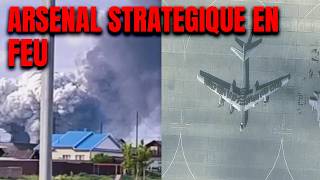
YouTube monologue (June 1) describing a large-scale Ukrainian drone attack deep inside Russia that struck strategic bombers across multiple airports (up to Vladivostok). The speaker details the alleged logistics (hangar in Kazakhstan border area, truck convoys, concealed quadcopters, mission‑planner software avoiding GPS), assesses material and psychological damage (estimates of dozens of aircraft destroyed, cost estimates), and warns the strike raises risks of nuclear escalation by degrading Russia’s airborne/second‑strike capabilities.
Good morning, my friends. I'm going to tell you the story of Ukraine's incredible attack on Russia. Right in the heart of Russia, planes were hit by drones as far as Vladivostok on the Sea of Japan. I'm going to tell you the technical details, what we know about this attack today, but also how it brings us closer to a potential nuclear conflict. Red lines have been crossed. Let me explain. Its June 1st. Russia is suddenly waking up to the fact that four airports across the country are being hit by swarms of drones. There are dozens of them. We're talking about 30 to 50 drones, each armed with two explosive devices that are falling and targeting what? Nuclear deterrent planes? Strategic bombers. The oldest ones that were hit were two polofov 95s. You can recognize them from old Cold War films. These are Relics from the 1950s, but we need to pacify them. These are aircraft equipped with four engines driving eight propellers, 15,000 horsepower per engine. They are capable of reaching 450 kilometers per hour and have the same range as an Airbus 350. So even though they are extremely old, they, they are still formidable. They are capable of carrying nuclear weapons or conventional missiles and then sprayed with even better ones. They were hit in broad daylight and a certain number were destroyed. We are talking about a bill on sources of 2 to 7 billion dollars. But the reality is that they are invaluable because we can't really put that in dollars of damage because these are not planes that are in the tank. You know, they are not planes that can be easily recovered. So some no longer exist. They will simply not be manufactured anymore. And other more modern ones. The most modern plane that was hit dates from 2022. These are also extremely modern planes that were all hit on the ground. So I'm going to answer a number of questions and give you the scenario as it stands today. What happened? So here's how it works. In the days leading up to June 1, attacks were carried out on airports that are not very far from the Ukrainian border. This was a psychological operation that forced Russia to move these planes there. They gave the order to their pilots to take these planes further inland. So they took them as far as vladivostok, up to 7,000 km from the Ukrainian border. So at that point they were safe. There were no drones that could come and bother them. Drones don't have that range. Another thing, another detail that may strike you is that these planes, which are invaluable, important, strategic and all that are parked outside with they are parked in parking lots in full View of everyone. Why are they not protected? Why are they not covered with camouflage netting? Why are they not stored in hangars? The reason is that Russia is obliged to keep them outside. That is to say, there is an agreement called Start 3 or New Start that dates from 2010. But in reality, the history of these agreements does not date from 2010, but from the Cold War at the time when things began to ease a bit. These are non proliferation agreements. These agreements oblige the United States, oblige Russia to keep these strategic bombers outside. That way spy satellites can pass by, count them and know how many there are because their number is limited. It's a non proliferation treaty and know whether they are armed or not. So there is an obligation to keep them outside. So we took advantage of this framework to go and strike them. That's the first point. Now the other point is how we were able to find them so far away, how we were able to strike with drones all the way inside Russia. So here's what was done. From what we know today, we rented a hangar. So there are Ukrainian operatives who rented a hangar for about €4,000 per month in a city that is not very far from the border with Kazakhstan. So Kazakhstan probably served as a rear base for this operation. So we rented this hangar and they claimed that it was a business that sells cabin doors. You know, those cabins that can be made of metal or wood, that are set up as temporary offices on the sidelines of construction sites and other events. So this is a company that claimed to sell this type of object. There you have it. What they did, they transferred it inside Russia. So by crossing the borders, probably remains to be seen. These are probably borders that are like sieves. It is probably possible to pay to get anything through. They brought back a lot of drones. They are quadcopter drones. They brought back drones. So they installed these drones there and they put them in the angar. After what they did in these drones, they installed software. It is a mission planner software, which is open source. You can download it without any problem. And then they also used an altitude plugin with was a plugin that allows the drone to stabilize its altitude. And in reality, the software plus the plugin that were deployed had one main reason. To create a drone flight that is stable and predictable while avoiding using GPS positioning. Because GPS in certain regions, and particularly near sensitive military airports is extremely disrupted these days. That means there is jamming of signals and all that. And so the drones could not count on it, which is what they also did. And this is where the situation really is. In addition to the impact, in addition to the material impact, we are talking about 34%. This is the Ukrainian side that says that 34% of the strategic equipment of Russian strategic aircraft was destroyed. The Russians will probably say it is less. It does not matter who is right or wrong. But in any case, the psychological impact is very strong. Why? Because these drones were apparently equipped with Russian SIM card GSM chips to be able to transfer data and be in contact with their operator, to be able to send images. Because these are drones that can be piloted remotely by sending images in real time. And this allows a pilot who could potentially be in another country to pilot them to their target. So the thing is that the hangar I'm talking about. I'll explain this a little later, but the hangar I'm talking about was located 4km from the FSB offices. You know, that gives you an idea of the psychological blow too, you know, because all military operations on Earth throughout the history of war always have a strategic aspect. It's the direct impact, the damage, the noise, the flames and so on. But they also have a psychological aspect of. On the psychological side, it's still very strong because as an outside observer, we have this impression that for the FSB, as long as we don't keep an Airbus 380 on Red Square and there aren't people killing people about it, they won't get anything done. Because Ukrainian operatives arrive, they rent a hangar two streets away from their premises. They bring trucks, they bring containers, they bring drones, they take 150 SIM lines and so on, and the FSB has seen absolutely nothing. We realize that perhaps we have this situation from the ussr. You know, it's the legacy. It's the dark legacy of the ussr, an administration that is very cumbersome, very inefficient, riddled with bureaucracy and all that. So it's true that they are impressive from the outside, but in terms of efficiency, well, there you have it. You see the result. So what happened is that from this hangar we brought five. We brought five trucks and we brought drivers. So the drivers have no business being involved. Right? The drivers are just drivers looking for work. We told them, hey, you're going to make a delivery to us. So what we did to them was we took semi trailers, we put wooden cabin doors on them, and we gave each one an address. We told them, go to this place, stand by, wait for the customer. The customer will come. I don't know, he'll come with a VAT number and then you'll follow him, he'll tell you where the construction site is. So they probably. They probably. It's not even probably. It's definitely they must have staggered or scheduled the departures of the trucks so that they all arrived in their area right at the same time. They all had to arrive at the same time because the goal was to launch the attack in one go to avoid the Russians realizing that an attack was underway and so on, and they could launch the bombers. So for the Ukrainian side, they had to strike everything at the same time. That's what they did. So they had to stagger the departures of the trucks, because some probably left two or three days before others. Because when you consider the distances that had to be covered by trucks, it was probably several days. They probably left at the end of May. So in the cabin doors, in the roofs of the cabin, there was a sort of false bottom that was organized. So inside this false bottom, the drones were placed. So the drones were loaded, programmed. Everything was placed in the false bottom. And then the truckers left. We told them what to do. You park, everyone has their destination. You wait, we'll call you, we'll tell you. We'll tell you what to do next. The parking spots were systematically roads or gas stations or other places extremely close to the target airports. So the targeted airports. Well, precisely, they looked, they chose places very close. So within a few hundred meters, that means that the drone now only had to fly by truck. It only flew a few hundred meters to hit its target. So the trucks arrived, the drivers parked, and suddenly they heard a huge explosion. What happened was that the roof of the cabin door itself was torn off by a pyrotechnic device. And that's where they lost the truck. Because in reality, there were five of them. That means the attack could have literally destroyed half of Russia's strategic arsenal. And so what they did was that there were five trucks. One of them caught fire when the pyrotechnic device was triggered, and so it caught fire and the drones were destroyed. However, the other four worked. What does that mean? It means that the drivers watched helplessly as swarms of drones, 30 to 50 drones per truck, took off and then headed straight for the airports. They hit the planes that were on the ground, so they couldn't even move. They hit one after the other, and then they caught fire and were destroyed. The images are quite impressive. These roads are frequented by trucks. Sometimes there are chains of trucks, literally for kilometers, one behind the other. That means that they chose roads where there wouldn't be a police checkpoint asking what's that truck with a far off license plate that's passing by? They deliberately chose roads with a lot of heavy truck traffic so that they knew that the risk of getting arrested was really, really, really low. The risks of arrest were low, and moreover, the papers were probably in order for the rest. So there is a scene near an airport, and this scene practically has a biblical dimension, to be honest, because what we see is that the locals are throwing stones but big rocks at the drones. So they are trying to bring the drones down. So I don't know if they brought any down. They could perhaps have brought down one or two using this method, but it is a fairly archaic method. This means that we find ourselves in a situation where we have an arsenal of deterrents, as we call it, which is covered by international treaties, starting with spy satellites that pass by every few hours, photographing it, cataloging it, analysts at Wire who are there, referencing in their Excel file each and every plane and everything. And then suddenly, by fairly rudimentary means, they are destroyed and the population is forced to protect them, as they did a million years ago, by throwing stones. That's the equation. Then later, as there are telegram channels and Ukrainian media that broadcast images of the hangar, even if they were partly blurred. Well, what happened is that the Russians managed to identify the hangar and they landed inside. It wasn't the fsb, because even after the attack, the FSB didn't know where it came from. It was through an indiscretion or carelessness on the part of the Ukrainian media that the hangar was able to be located. So they located the hangar. They knew who was behind it. The problem is that the guy or guys who really started the affair had left. They had been gone for two or three days. They hadn't been there since the 28th. We hadn't seen them again. So, of course, who are the police going to arrest now to calm their nerves? They're going to arrest the owner of the hangar. They're going to arrest three guys, the caretaker, the drivers, people who have no business being involved, who are just as much victims as everyone else. They're going to arrest them because they have to have someone on hand. But the real masterminds have disappeared. Now, it's also possible that this story was organized by Ukraine, but probably also with Western help, American help, potentially, perhaps. But I doubt that the Americans today are too keen to get their hands dirty in this story. They may not want to leave their mark unless it's three letter agencies and all that, which can sometimes be a Little uncontrollable that can get involved. The British, I would say, are perhaps more credible because they are pushing for escalation in 2022. Remember when they were about to sign in Turkey, there was a signing between the Russians and the Ukrainians that was going to happen, which was going to save lives and all that. Well, what they did was they sent Boris Johnson, who ran off to say, don't sign. Don't sign. She's gone to Zynska. And especially not signed because, well, we don't want any more war. Remember, there was. You probably don't remember me anymore. Most people have forgotten this story. There was a war recently between India and Pakistan. Do you remember that? It's coming back. That war no longer exists today. Why? Because work has been done. There has been de. Escalation work. Diplomacy, calls for disarmament, calls for mediation, calm, all that. The classics for calming down a war and preserving lives. Whereas in this story, everything seems to be done to further deteriorate. Now, speaking of deterioration, here's the problem. This system, these planes, are part of a more global system that involves planes, missiles that are in silos and so on, and also submarines. The problem is that today the Russian nuclear system is less operational because the airborne component has been destroyed or rendered unusable, at least in broad terms. And so this will create more tension within Russia and within the establishment to use nuclear weapons. Because in their. In their doctrine of nuclear deterrence, if their nuclear capability decreases, it means their ability to strike or respond to an attack decreases. Well, this increases the probability that they will use nuclear weapons. First, let me tell you a quick little story. Nuclear deterrence is not based on who has a weapon that is capable of striking. That's not it. That was the first three days of nuclear deterrence. Yes, it started like that. I have a nuclear weapon. I can light you up. Then the other one says, yes, I have a nuclear weapon. I can do the same. That's the beginning. That's the middle ages of nuclear deterrence. Today, nuclear deterrence is based on what is called the second strike capability. What does that mean? It means that we realized at the beginning, as Bruce Lee said, that the first one to strike wins, right? Because if two adversaries are both armed to the teeth with nuclear weapons, well, the first one to strike, the other wins because the other one is already off the map. So we realized that in terms of deterrence, it is not a real deterrence. It was more of an incentive to strike first. Okay, so what happened is that the two countries Involved in this story, we are talking mainly about the United States and Russia developed second strike capabilities. This means that a country that is technically wiped off the map is capable of retaliating and destroying the adversary. And that's where it gets interesting. That's where we really talk about deterrence. Because if one country strikes the other, the other can still use, for example, aircraft that take off submarines or other means to strike and take revenge and destroy the other country. The problem is that if Russia feels that its second strike capability or its nuclear capability in general is declining, for example, because they have ballistic missile submarines that are not operational, we don't know anything about it. What do we know about it? We don't know. We don't know at all. That's the part of the story that we don't know. It's possible that some of their nuclear powered ballistic missile submarines are not operational. So they're bluffing. Maybe they don't have them anymore. Maybe they're rusting away somewhere or they have parts or repair problems. We don't know about all that. So there's also the side that we don't know about. And now that their air force is in danger, has been partially destroyed and the rest could be destroyed tomorrow. If it happens next Friday, they won't have any planes left. Okay? In that case, the temptation to strike first will inevitably increase. That means in that case they're going to program their missiles that are in silos and so on, on capitals like Washington, Paris, London. And that's what they've apparently done. That's what the rumors are saying. I don't know if the sources are valid or not. I'll give you 15 quotes, but those are the messages that we see going around saying that Russia has programmed its missiles on European capitals and so on. We don't know their sources. We don't know if they're true or not. But one thing they make sense. Do you see what I mean? Yes, it fits into a rationale. If the air force is destroyed, the missiles must become even more operational because they are now much more critical. That's it. My friends, I just wanted to talk to you a little bit about what was called the Russian Pro bore. And let's keep our fingers crossed that it doesn't spiral out of control. See you soon.
More from Aldo



La FIN du Royaume-Uni ? L'Ecosse, l'Irlande du Nord et le Pays de Galles veulent partir !




Analyse Présidentielles 2027 : Marine le Pen remet ENCORE le voile sur la table !


Scandale "60 Millions de Consommateurs" : la France mange des pâtes contaminées au Cadmium !

2 dossiers : Accident d'autogyre en Italie & un pilote sauvé par le parachute du Cirrus