L'effondrement est proche : Parlons SERIEUSEMENT d'Economie !
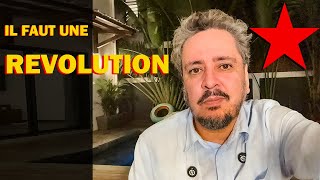
This is a YouTube video titled "L'effondrement est proche : Parlons SERIEUSEMENT d'Economie !" created in August 2025. The content is a monologue or lecture-style presentation discussing the economic collapse, capitalism, Marxism, and societal inequalities. The speaker critically analyzes the capitalist system, state power, and social issues primarily in Western countries, with references to historical and contemporary economic theories and events. The video is a detailed, reflective discourse rather than a conversation.
Hello, my friends, since we've been seeing each other for a while, it's high time we had a serious conversation about the economy. So I don't have a script, I don't have any paper, I haven't prepared anything, I don't have a promising candidate in front of me, but I'd still like to share a few ideas with you. When I look at the British, the French, the Americans, and God knows they're suffering, I don't think I need to draw you a picture. Rankings the middle classes who can't make ends meet, people who are being made redundant en masse, inflation, people who live in big cities who tell you that with a six figure salary they can't get by. The aging of the car fleet is reaching record levels. It has just passed 10 years in the United Kingdom, which means that households can no longer afford to change their vehicle. That means these are households that are struggling. Today the vehicle is just an indicator, right? Today it's the middle of August and vacation spots that are normally packed today they're empty because people can't afford to go on vacation. So people are suffering economically, that's why they're interested in economic issues. You've been talking to them about the economy for years. Well, people are interested in it, but today everyone is interested in it because they want to understand. Now, when I watch them on social media, I watch the French, I watch the British, for example. And what happens is that every time things go wrong, they say to themselves, yeah, that's it. That's the result of us living in a socialist country, or we live in a Marxist country, or even sometimes we hear communist in reality, what, what happened is that quite simply, while we were picking the pockets of Westerners, while we were impoverishing them, and we are only at the beginning, right? That's 2025. I mean, we will regret it when we look back on it in five years. Well, what happened is that we wanted to deprive them of the discourse, we wanted to deprive them of the intellectual tools so that they could understand what was happening to them. It's a classic, isn't it? All scammers and swindlers want to keep their victims in the dark, in the dark, so that they can't understand, find solutions and find directions. So people in the west generally haven't studied, even those who went to university haven't studied in detail what these words and labels mean. They use them in situations that aren't pleasant. It's wrong. Why? Because if you want to say it Implicitly or even explicitly, the capitalist system as we see it today is the quintessence of human evolution. It's the end of history. The history of humanity with a capital H ends here. We have evolved to such an extent that we can't imagine any evolution after what we are currently experiencing. This system is perfection. It will bring us happiness, it, it will bring us fulfillment, equality, development, all that. And anyone who criticizes this system is an enemy within. When it doesn't work, when it doesn't work, when we see the hardships, when we see the homeless, when we see inflation, when we see the standard of living collapsing, when we see poverty among the elderly, poverty among young people, you know, in the United Kingdom, for example, I'll tell you right away, we have a million children living below the poverty line. It's very simple. 4.5 million poor children in the United Kingdom. And you know what poor children mean? Very serious. Because you have the poor old man. When you have the 80 year old guy who is poor, he's 80 years old, he's poor. That means he might not be here in 10, 15 or 20 years. He won't be here anymore, won't he? And so he's going to be taken out of the equation like, except that the child who is poor, well, he has his whole life ahead of him, a whole life of poverty ahead of him. It's much more dramatic, isn't it? So when they see that, they say it's socialism, it's Marxism, all that. In reality, it's just a label. That's not what it means. But it's just a label that's placed on a situation that seems unacceptable to them. As soon as they see an economic situation that tells them it's unfair, it's not possible, it's unacceptable, it's intolerable, it's atrocious, it's something, it's unjust. Bam. They're going to put the Marxist or socialist label on it. Because they're conditioned not to blame what they're experiencing. The capitalist system. So the capitalist system, well, sometimes. And today it's behaving like, you know, some casinos I saw when I was a teenager. I saw illegal gamblers. And what they do is they give money when someone doesn't want to bet or is broke. They give them money so that they come to the table again. They do the same thing to an even greater extent in Vegas. They can send a limousine to pick you up from the airport. When you're a big gambler, they can give you a Free suite in a hotel. They can send you to a Michelin starred chef. But why do they do this? Are they doing it for your well being? Do they do it because they sincerely like you? No, they do it to recruit you into a system. In a way, they're corrupting you. They are corrupting you so that they can eat you later. So what we are experiencing today is the same thing with the Western capitalist system. It means that we have corrupted people with elements of ephemeral well being. Well, you have the car, you, you have the microwave, bought on installments, the car also bought on credit. Uh, you have the house, also paid for on credit. Uh, you have the vacations on credit card. Well, the credit card actually came later. In the beginning, uh, we look at the credit system in general. We did not lend to people, we did not lend to people. We lent to businesses, we lent to companies, we lent to entrepreneurs, we lent to shopkeepers, we did not take. We did not lend to people so that they could buy shoes, to buy a bag or something like that. It was not done. That is relatively recent in financial history. And in fact, what we did was that when people started to lose their status, we gave them credit, which allowed them, because some people outrank others. We know how it works socially. And so we lent them money so that they could maintain the illusion of their standard of living. But in reality, if we look at the standard of living in absolute numbers, in real numbers, if we remove credit, the standard of living is collapsing. So what did we do? We bribed them. How exactly do we bribe the compulsive gambler? We bribe them with a few pennies, with a few advantages, to show them that the system was great and that they could accept it and participate in it, even defend it. Today, what you are seeing in the west is not a socialist or Marxist system. You are seeing the path or the downward slope of capitalism. Capitalism is collapsing. In fact, it is not even really collapsing. It is functioning, functioning by design. It is functioning normally, as it should. As it should function. That means working for the interests of a microscopic part of society and then crushing, crushing all the others. All the others. Well, they become convuls. All the others must give everything so that a minority can benefit from everything. By the way, for a very long time we have accused the popes of capitalism, have accused Marxism of wanting to destroy private property. Say yes, they are against private property. They are for collectivism. Private property is prohibited. The question I'm asking you today is maybe 10 years ago, maybe 20 years ago, I wouldn't have been able to ask this question. But I'm asking you a question today. Look at your life. How is private property doing? Is it okay? Is it happening there? The question of private property. You have a lot of private property. In fact, what we're seeing is that the capitalist system is abolishing private property because most people have absolutely nothing to do with it. And the few things they have, well, are things that are simply bought on credit or things that are breaking under their hands. They have nothing. Okay? The capitalist system is actually a system that abolishes private property, but for the majority. So the corollary is that the existence of private property for a tiny minority means that private property must be abolished for the majority. So the majority must give up absolutely everything so that a minority can enjoy everything. And the further we go, the more inequalities widen. The widening of inequalities is not an accident. It is not a passing crisis. It is not something temporary that happens and then next year it will be better. No, no, that is not it. The system will increasingly reach its peak. It will reach its full potential. That means that more and more people, as I said, one or more children live in poverty in the United Kingdom. Well, in five years it may be half of them, and in ten years it will be two thirds and so on. It is part of the system. It is not an accident, it is not a deviation. It is really included in it by construction. So there is one thing to know. In the past, there were different economic systems that were organized, different forms of society that were in place. For example, there was fiality. And when fiality, well, it was, it was crushed. Because quite simply, there was. There was at a certain point, a capitalism was. Finally, capitalism was arriving. And then capitalism, which was driven more by the Industrial Revolution, brought it down. Feality. Even if all of that didn't happen everywhere on the planet at the same time and so on. But there were, there were struggles, there were, there were unrest, and everything that caused society to move from one system to another. And, well, if you look at fiality, there were a lot of people who said it was great, huh? At the time it existed. Uh, if you look at slavery, for example, slavery lasted for centuries and centuries. Generations saw slavery and slavery had, like any system, three types of positions, three types of postures. There were apologists for slavery at the time who said that slavery was something great. They didn't see any harm in it. Generally, it was either people who took advantage of it, right? Or people who were useful idiots. Those who took Advantage of it, and so on. Well, they said, I don't see the problem with slavery. And that's why it lasted for so long. Slavery didn't last for centuries and centuries, even millennia, just by chance. It had a very, very high level of acceptance in society. There is also what we will find a little further on. We will find the reformers. Reformers are people who say, yes, well, I have nothing against slavery, and it's still a good system, but it needs to be improved. Improving it means I would like slaves to have more time to rest. Maybe we should stop mistreating them. Maybe we should take better care of them, feed them better, and so on. So this is someone who is not fundamentally against slavery, but someone who wants to be given a human face. So they are in favor of slavery with a human face. At the other end of the spectrum, you'll find the radicals. You'll find the radicals who will say, well, we don't want slavery. We don't want a human face or anything at all. It's the abolition of the old. You see. No, you have the three. You have the three systems. You have the three intellectual approaches, if you like. And compared to capitalism today, to the capitalist system, well, we have the three visions. You have people who say, yeah, but hey, it's great, it's still good. It allows people to. And so on. But accept that these people who defend it with arguments, know their arguments. They are hackneyed arguments repeated, repeated over and over and all that. These are arguments that, well, the more we advance, the less they hold water. You know, it means that at the time when capitalism was in its ascendant phase, if you like, then perhaps their arguments, even if they were vague, we could say on a practical level they had some merit. Except that today, the more we advance in time, the more indefensible it becomes in some ways, okay, we also have the middlemen. We also have the people who are precisely the reformers who say, no, we need reform. We need more equality. We need it. We need it, we need it. Then of course, we find them at our extreme, the radicals who say, this system must collapse because it is not serving us. Like I told you earlier, I said to myself, I said to myself, I said to you, yes, in criticizing Marxism, for example, in yes, it brings collectivism and all that. I'm just telling you something really simple. Ah. In the United Kingdom, we sold, the state sold the companies that supply water, right? Uh, that means it's not the companies that supply water. That means at the beginning, the supply of water to the home was a state monopoly. That means a monopoly for us, the people, right? Because, uh, precisely. Normally, in normal times, the state. And the emanation of the people, huh, Is not the emanation of the forces of money. But although, with my Marxist sensibility, I see the state rather as a sort of committee which is there to manage the affairs of the ruling classes, huh? It's not that the state is not managing your affairs and mine. It is managing the affairs of the bankers. It is managing the affairs of the oligarchy that it has captured. And you do not have the right to speak. I mean, once every four years, every five years, every seven years, we will come before you like this. We will parade, we will. We will have a shellfight and then give you the impression of voting or something. But the rest of the time, it doesn't care. The result, doesn't care what you have to say. If you go outside and shout your discontent and everything, well, they'll send the riot police and then they'll spray you with water, and then that'll calm you down. That's all. I mean, you understand, you see that I have the. I have to. I have to be clear. I've said it several times in interviews, in channels and so on. Interviews I clearly have to throw in the towel, okay, Marxist sensibility. But where I might differ with Karl Marx is that he's a. He's rather statist, isn't he, in his approach to things? Whereas I'm an ultra anarchist, right? I don't want a state. I prefer a minimal state, a state whose sole prerogative is to take out household waste. Because the stronger the state, the more powerful it is. And by the way, it goes back to what the president, I think it was the third president of the United States. Jefferson said the Jeffersonians, who aren't necessarily Marxists or anarchists, but what did they say? Who is the natural predator of the citizen? It's the state. The state is the natural predator of citizens. And that's where the Second Amendment in the United States comes from, for example, which allows Americans to bear arms. Americans don't carry arms to defend themselves against thieves. You know, many Americans don't know that. I was talking to an American friend the other day, and he asked me why Americans have the right to bear arms in their Constitution. Why was it put in place in the first place? I told him so that they could defend themselves against their state. He said to me, wow, you know, most Americans are doing that. In reality, the idea of the American Constitution was Not to oppose an armed state against an unarmed population. Because according to the vision of the founding fathers of the United States, the state is the natural predator of its citizens. Today. You have, for example, you take the United Kingdom, where the state has become a conduit between financial interests, money interests, between private companies, all that, and the taxpayer. It takes our money and distributes it to private interests. And then, well, if you don't agree, you resist, we send the police to you, we send the police to you, we seize your property and so on, and you'll see. And we give the money to private interests. So you understand what I mean. The state is the natural predator of history. And that's why, for example, I'm not going to ask the state to restore justice. I'm not going to ask the state to improve things. Because the more I ask the state, the more I'm going to give it, at least on a moral level. I'm going to give it more power, more prerogatives. I prefer a state that disappears from my life. I prefer a state that is as miserable as possible and as broke as possible. A state that stays in its corner without any power. So let's go back to the story, as I was telling you, the story of water. So we are in a collectivist system because water is still a good. That must remain common. Water should not be used by speculators. It should not be used for people to take us hostage, right? That's the basis it should be. And that's where I think this part of capitalism must collapse, must be destroyed. It must go. I'm quite radical. I'll explain to you later. I'll give you an example if you want. When you look at the system, what is the basis of humanity? What does humanity need? Well, there are basic needs. These basic needs must not be open to speculation, must not be open to the market, must not be open to competition. These needs must be available and sold at cost price to everyone. Now we have water, okay? We need it. We die without water. What's happening? The British state is going to privatize the water supply. So we're going to create a multitude of companies that compete with each other. Water is the same. You turn on the tap and the same water will flow. Where is the competition? Well, we have competition. And in reality, what will happen with competition is that you will see lots of companies fighting each other. And of course, I said it on our channel, but I will say it again. What is the goal of capitalist competition? What is its stated goal? To allow choice so that there are choices that we can choose between here and there as consumers. Yes, but that is a lie, because that is on the upward slope. It is on the upward slope of capitalism. But once it has achieved its goal, it will show you its true face. The true face is that competition, free competition, what does it achieve? Free competition will lead to monopoly. Why? Because when we have systems that compete with each other, what is their goal? Their goal is to crush the competitor. Their goal is to crush the other. It's to dominate the market. And in this domination, all costs are allowed. Okay, so we don't have to be loyal. Once we've crushed the competitors, what happens to the citizen? Well, there's no choice. We're now back to a monopoly, right? We're back to a monopolistic or quasi monopolistic situation where we have one or two big players who take over the entire market and who sell very expensively. This time they're going to raise prices and this time the water that's going to flow from the tap will. Well, they're going to raise prices nonstop, non stop, non stop. And you're going to finance it with your shower, you're going to finance it when you brush your teeth, you're going to finance hedge funds, traders who are in Australia and so on. Well, that's it. You're financing the entire planet. You have to deprive yourself, right? You must be bleeding yourself dry for water bills. That would have been incredible 20 years ago. Oh well, today that's how it is, because you're financing it. That's what's happening. The internal contradictions. These are the internal contradictions of the capitalist system. They haven't been known since 2025. They've been known literally from the beginning. You see, there's Prudent, Joseph Prudent, who wrote a book called the Philosophy of Misery. The Philosophy of Misery. He's more of a reformer and he wanted to humanize things. In his book he cites a certain number of contradictions of capitalism. Like the one I just gave you. Even if the one I just gave you, you'll also find it in the previous century. You'll find it a few decades earlier in Adam Smith. In reality, when you look at the literature, in economic literature, some people quote, others talk about others ideas and so on, but there is not always a clear citation. For example, look at Karl Marx's Capital, where he talks about many things. Sometimes he quotes David Ricardo, Adam Smith and others, but sometimes he doesn't quote them. Sometimes he appropriates certain ideas or Talks about them without necessarily citing them. So the economic conversation is a long conversation that spans centuries. So the book he wrote cautiously, I think it was roughly 1846 or 1845. He wrote his book the Philosophy of Misery in 1846. A year later, someone else responded to him, Karl Marx. In 1847 he published a book that he called the Misery of Philosophy. And he responded to him. And here we have a very interesting dialogue. We have this brutal confrontation not between an apologist for capitalism and a critic of capitalism, but rather a difference between the one in the middle, the one who wants to humanize, a reformer. Right? We have a reformer facing a radical, facing the one who is absolutely against it, a radical. And we see that the distance between the reformer and the radical is sometimes much greater than the reformer and the apologist. So the radical is really extremely distant. So just to tell you, when we say Marxist, what does Marxist mean? Because precisely it is used in all sauces. And indeed the ego was used so much that it meant different things to different people in different countries at different times in history. Right. Let me tell you, we have to go back to the roots. What are the roots? We have Karl Marx, who is a German, who lives in London. He found refuge there because, well, he was expelled from Germany. He went to France, then he went to, I think Brussels. After that he lived the longest part of his life. He stayed and died in London. So he fled to London because he had taken a stand for a number of workers causes. We are in the 1800s, shortly after the start of the Industrial Revolution. So roughly speaking, the Industrial revolution began in 1760. Karl Marx was born in 1818. So he was born roughly 60 years after the start of the Industrial Revolution, when the guy was 40. Roughly speaking, the Industrial Revolution had been underway for a century. And so he was going to have a front row seat to observe it, to see a little bit of what it was doing. And he began his work called Capital or the Critique of Political Economy. He wrote this work, part of which was published posthumously. And in fact he provided a critique of the capitalist system. So I'll tell you something, you can't criticize. You can't criticize capitalism. You can't criticize, for example, the banksters bet on the economy. They called it banster. In his book, you can't criticize inequalities, you can't criticize oligarchy, you can't criticize slavery, exploitation, the length of the working day, all that. You can't even criticize corporate toxicity. They fell into something that was said in capital in Karl Marx's book, and that was said and explained, detailed, refined, and very often with figures and tables and. And all that. So that's why if you try to criticize the current situation without looking at capital, you'll just be trying to reinvent the wheel. What's extraordinary about this book is that it was published towards the end of the 1800s, so it was published later by Frederick Engels, who is a friend of his, who published it roughly after 1880, with different prefs, depending on the country, depending on the edition and all that. And in fact, you can see that today this book hasn't aged a bit. And that's the miracle of this book. It hasn't aged a bit because it detailed a certain number of mechanisms. That means that Karl Marx had this capacity for abstraction. That means he's going to describe practical, real situations that he saw in front of him, like children working in chimneys. Like the 1833 law in the United Kingdom when we said that child labor had to be regulated, not banned. And then the employers came out and said, yes, it's unacceptable, it's against freedom of enterprise and all that. Well, he's going to observe all that, but he's also going to dismantle the mechanisms in an abstract way, which can sometimes make the book difficult to read. But in general it's quite easy and fluid. So we come to today and we see that it hasn't aged a bit. We could perhaps write later. Yes, but basically everything is there. He didn't take a single ritual from this book. And that's what's extraordinary. So when we say Marxist, when sometimes in interviews here and there I've said that I was a Marxist and it was in the sense of being critical of the current economy. Okay, Marx doesn't provide a solution. Right? He's not going to provide a solution. But solutions are all critics. Solutions are often implied. That means that, yes, he's going to criticize, but if you read between the lines, you'll see perhaps a suggestion of a solution, but there's nothing explicit. So that subsequently, various revolutions, various countries have embraced Marxist doctrine and then they have adapted it to their own taste. You see, some have declined in the form of an industrial revolution, others in an agrarian revolution, others in other ways. But in fact, basically you'll find this in Vietnam, in China, in Cuba. A, uh, you find it in the USSR with sometimes happy, sometimes unfortunate results. You look at China today, the largest. It's the greatest economic power in the world today. Ah, I'm sorry. It's a country where people are very familiar with the doctrines and criticisms of Karl Marx. Do you see what I mean? Whereas facing them, we have the capitalist system that has. Yes, that's true. It has advanced. It has been able to send satellites. It has been able to show at one point that it could achieve two or three things. Except that today it is in full collapse. And the world power that is coming, I mean, we just haven't noticed it. It's China. We just haven't seen it yet. We haven't realized it. We haven't integrated it into our logic yet. Europe is over. It's. It's hasbein. Europe is over. The turn is good. The turning point, uh, the turning point, lets say civilizational has simply been missed in all the, in all the cutting edge technologies, the technologies that will take tomorrow, huh? Technologies equivalent to the discovery of electricity. Right? Man is not there. It is there. Moralizing it is there. Stuck in rigid positions, it is in the process of lecturing the entire planet, regulating, banning and so on. But in the long term, there is no future for Europe in this. The big game is being played between the United States and China. China is an example of a country, a successful communist country, you see. So you will tell me. Well, Cuba. Oh yes, Cuba. Cuba also added that there was a 60 year embargo. Huh? That's not saying much about North Korea. Well, the embargo is good. And despite everything, they still manage to do extraordinary things. But, well, they are terribly limited because of the embargo. So in reality, many countries that have tried to do something other than wild capitalism, countries that did not want to open their markets, that did not want to allow liberation, what we call economic liberation, liberation of the market. They were crushed, crushed under bombs, color revolutions, coups d'. Etat. When coups d' etat were not possible, they had embargoes. I mean, to prevent experiences other than the current capitalist experience. And in relation to the free market. In relation to the free market in Marx's book, you'll find that he says that all freedoms, all freedoms will be reduced to a single freedom, which is the freedom to trade. Okay? That's what we see today. We are literally losing freedom. Every day that passes. Every day we are sinking deeper into a surveillance society, a society of permission, a society of coercion, a society of authorization, a society of control. And every time technology makes a leap forward, every time technology moves forward and brings a new invention, a new something new, what happens? Well, of course it is weaponized, as they say. In English, it is weaponized. It becomes a weapon that is used against us. So that in reality, all our freedoms are reduced to what? Reduced to free trade, Right? Freedom of trade. Free trade. We will become countries. We are becoming countries of buyers, sellers, countries of people who are in debt. Borrowers and debtors. Right, Lenders and debtors. Do you see what I mean? We are moving towards this reality. And what is terrible about the history of the free market is that for a long time, Westerners, and this is always the case, this is the, you can't say, how should I say, the capitalist hypocrisy. For a very long time they told people in their country, you have to open up your market, allow competition, allow openness, stop hyper regulation, stop central planning, and so on. What is the common agricultural policy if it is not central planning? What is the common fisheries policy if it's not central planning? All the laws that are made every day, huh? Even the rampant tariffs, what is it if it's not market manipulation? Do you know what I mean? In fact, the economy, the so called capitalist economy has never been free. In reality, it's an economy that is always dependent on the state, that is always dependent on central planning. But central planning in its own interest, central planning in the interest of the forces of money. So we play with two sets of rules and we change them. We change them when it suits the oligarchy. When the oligarchy needs to have a free hand, we'll say, no, no, listen, we can't intervene in the market. Ah, we have to be a liberal economy where the best man wins. And we'll come out with this speech, you know, this speech. As soon as things go differently, we come in and start setting tariffs, setting rules, setting laws, things, procedures, blockages, that's it precisely. To lock things down. It's the same. Look at 2000 and 2008, when the banks collapsed. What did we do? B, we took money from the state coffers, we gave the money to the banker. They told them, ah, you've lost the money. Well, no problem here, come back, come back and play again. Okay, you see clearly that we still have a system with two sets of double standards. And it changes all the time. Double talk is constantly changing. So countries that for example, give to the global south, give lessons on liberalism, open markets, etc. Today have ultra closed, ultra regulated markets, etc. So you see what I mean? It's actually a discourse that changes with the seasons. Okay, so that's what I wanted to tell you, my friends. Basically, in the Marxist sense. I am a critic of capitalism. I don't offer any solutions. I don't claim to tell you, wait, I'm going to find a solution. I don't claim to do that. I'm not trying to sell you communism, socialism or any other system. Not at all. That's not my goal. That's not my ideology. That's not my approach to things. On the other hand, what I'm telling you is that I am, if you like, completely in line with the Marxist logic of its beginnings. That means in its fundamental sense. What does that mean in its fundamental sense? It means a critique of capitalism. So I am ultra critical of the capitalist system that is currently leading us towards a situation of inequality and privilege for some that we probably haven't seen since the construction of the pyramids. So either we start thinking about it today, where we start collectively imagining a different future, right? A future where we, we don't have to work, we don't have to live just to provide, right, the fruits of our labor to the bankstory and provide them to an oligarchy that profits from our most vital needs. We need to have a roof over our heads. Well, they are there to profit. We need water. Well, they profit from it. We need health care. They profit from it. We need to take our children to school while they are there, they profit from it. I mean, we have to stop with this form of society. It is a form of society that is impoverishing us collectively. We are building billionaires on one side and we are building millions of people who are starving. Okay? I'm not saying that we should take from some and give to others. I am against redistribution. Why? Because once again, as I said in the video, I am an anarchist, okay? Anarchy simply means I am someone who believes that without the state we have a better order of things. Things work much better without the state, without civil servants, without civil servants who come with coercion and tell you, no, you do it like this. You do it like this. No, I am a free human being. I am a sensible human being. I am a thoughtful human being and so are others. I am responsible for my decisions. I don't need to have a civil servant telling me what time I can eat my dessert and what time I have to go to bed. I don't need that, okay? So I'm not here to do that. And besides, and besides, to be honest with you, it's completely, it's completely absurd to ask the state to restore justice by making deductions here and then redistributing it there. What I'm asking of the state is to simply make it disappear. Because the inequalities we experience are precisely mediated by the state. That means the state is responsible. Because once again, the state is a committee that is there to manage the affairs and interests of the ruling classes. So if we have a state that works for the oligarchy, well, inevitably you have a society where 99% of the people are getting poorer, while 1% tell you that we've never bought so many sports cars, that we've never traveled so much by private jet, okay? That's because the state is there. It's the state that is in the process of capturing the majority. Well, not capturing the majority directly, but what it's doing is creating unequal conditions, changing the rules of the game to favor an ultra minority. For example, we're going to force small shops to close to allow large international groups to open supermarkets. You see, in the United Kingdom, for example, we're going to crush city centers that are literally turning into war zones. You walk into a British city center, what do you see? I'll tell you right away. You see phone repair shops. You see shops that sell suitcases. You see shops that sell tea with bubbles inside. You see shops that sell vaping. You see shops in Paris. You see shops for nail art. You see shops that sell everything for a pound. You know, things that have to disappear. You know, that's it, that's it. And then maybe a kebab shop in between. That's what British city centres look like. Plus barbershops, you know, plus Turkish barbershops that are opening everywhere. They're no more Turkish than you and me, but we understand each other. So all this is because of state destruction? It's the state and even the local authorities that are part of the state. The local authorities are the state, after all. So who blocks the arrival of customers? Who removes your parking spaces? Who closes roads? Who creates traffic jams? Who places cameras everywhere? Who says you don't have the right to film there? And there's a camera over there that's going to extract money if you do it. Huh? A behavioral tax? Since when does the state have the right to extract behavioral taxes from us? So what makes them terrorize the clientele so that. Well, people close, right? Businesses that were the heart of the city, that were there for generations, sometimes locked up. I've seen businesses that had been open for 120 years that were locked up. I've seen businesses where you have a sign inside with photos, black and white photos. Showing you when their ancestor opened the store in 1910. And you see that they're going to close, okay? And then you have a vape shop, you know, that has stuff for vaping instead. Ok? So destruction. We don't need the state to restore justice. We don't need it to restore balance. We need it to disappear. We needs to stop rigging the game. Who stops rigging the game? In the interests of an oligarchy. That's it. I don't want to tell the state. Go ahead and save me. I'm not going to go to the one who created the problem and ask for help. That makes absolutely no sense. They're the ones who caused the problem. How can I count on them to help me? Okay, so. No, there you have it, my friends. I think that today we really need to think, to think seriously. Think in a revolutionary way, okay? We shouldn't think in terms of improving, in any case, personally, at my level, I've made the decision. I'm more logical. Yes, we can improve. We can polish a little here. We can put a patch here. No, I'm in a revolutionary logic. All this has to stop. All this has to stop. Everything that is, everything that is has been resold. For example, as I gave you the example of water. It must be seized, it must be nationalized. That's all. Period. Nationalized. There you go. Finished. It comes back under the control of the state and we put in constitutional amendments to prohibit until the end of time that this is the. That this is. That this is. That this is. That this is that. People make a profit on our water, on our most basic human needs. Okay? In the United States, there was a system. There was an algorithmic system where humans need a roof, humans need a roof. Humans should not be there to allow some to buy a helicopter or to allow some to build a cat or not. Well, what we did is we created an algorithmic rent management system to put you in competition with each other, you see, to manage rent algorithmically to maximize value extraction. That means maximizing rent. Rents have exploded, you see, through algorithms. Algorithms in an unhuman way between algorithms. That shouldn't happen. That's over. We have to stop all that. You want to speculate? Well, we speculate on perfume or pearl necklaces. If you want to, there's no problem. Huh? Go make money with that. No one tells you not to do that. But. But humans, basic human needs. That has to stop. In the United Kingdom, we sold hospital parking lots. We sold them to groups of foreign investors. The British man, He arrives at 3am with a child who has 42 fevers. He has to go and pay the hospital increasing amounts every three months. The prices go up. Ah, he has to pay groups of Australian investors or a New York hedge fund that bought square kilometers of parking in the country. And at that point, when a car stops, you keep yourself in your country, right? We'll talk about that in a second. You keep yourself in your country and then every time you turn off the engine, you have to pay foreigners. That's normal. It's normal that you have to give an income to people in your country. You have to give an income because you parked. Is that normal? So let's end on something about Marxism. I mean, what we're sometimes criticized for, sometimes people say, yeah, but they're anti national. Because sometimes people who have a national streak say, yeah, yeah, I don't like Marxists because they're against the idea of a nation. That's not true. That's misunderstood. That's misunderstood. Let me tell you, in Marxism, what is the idea of a nation? You don't have a nation. That's why Marxism is always in an international struggle. There are no borders, if you like. It's not globalism. But in reality, as I've often told you, it's because sometimes people ask me, why are you? You're Algerian, you're British, you live in Mauritius, talking about problems that are happening in France. Explain to us a little bit about why that is. Well, yes, since the problems are globalized, the solutions must also be globalized. But the reality is that the Marxist struggle is a struggle without borders, an international struggle, because evil knows no borders. The enemy knows no borders. So we too must know no borders. But I'll add something else. Why do Marxists say that you don't have a country? Well, it's not that they don't want you to be a country. It's not that they're against the idea that you have a country. But that's not at all. That's not at all. It's that you don't have one. They see that you don't have one. It's that they don't want to take your country away from you. Marxists don't want to take away the fact that you're French or Swiss, that you're Belgian, that you're Canadian. They don't want to take that. It's already been taken from you. It's been taken from you for generations, since time immemorial. You know what I mean? You say it's my country. It's my country. Okay, I'm fine with that. If it suits you. If you feel good saying that, then say it. I'm not going to challenge you on that. Okay? But the reality is that your country needs you on two occasions, right? France. You're French. France and your country only on two occasions. When you need to give blood. When there's a war started by the oligarchy, they need you to go and die for them. So that's it. Your country now. You have the right to have a French flag to say long live France. But normally, go hang a flag on your apartment. Do it. Make my day. Go ahead, do it. Hang a French sheet on your balcony. And you've just said what happened. Okay, okay. You have no other right. France is your country. When you have to give blood and when you have to give your money, when. When your tax return falls, there, yes, that's your country. The rest of the time. No, the rest of the time. You have a Bill Gates who arrives at the Bourgeois airport in his private jet to give lessons, huh? The bikers are waiting for him and he takes him all the way to the Elysee Palace. Not where he's received, like a head of state, huh? Because he's American. You. You arrive with your car. You don't have the required sticker. Okay, get out of here. When you see what I mean. It's not your country. You were taken. So then, as a Marxist, if you want to reconquer your country and take back your country and make it yours, I support you. Of course I support you. Okay? That's why I support sovereignist efforts. I remember. I support nationalist efforts. Of course, I'm not with the. I'm extraditing them. But I was. For the extraterritorialization. Okay, but that's why I have these chemistry with these people who support this kind of thing. Because I agree that you should take back your country, but I want you to actually take it back. To take back control of your country in a global integral 360 degrees way. To take back control in a truly sovereign way on all levels. But now, given the state of things, I may be giving you some bad news. I'm sorry if you didn't know this before, but you don't have a country. It was taken from you. Okay? That's all over. It wasn't even yours. You were born. You. You didn't have it yet. Okay, so that's it? What are we going to say? I started this conversation with you. I didn't know where it was going to take us. Okay, now it's good that things are said. If you have any questions, please leave them in the comments. I would love to ask more questions on this topic because honestly, it's the most crucial. We can talk about a lot of things, but you'll see that everything comes back to this topic. Everything is related to this. So ask questions and it will give me some direction for the next videos. Okay, thanks for watching this video so far and I'll see you in the next one.
More from Aldo



La FIN du Royaume-Uni ? L'Ecosse, l'Irlande du Nord et le Pays de Galles veulent partir !




Analyse Présidentielles 2027 : Marine le Pen remet ENCORE le voile sur la table !


Scandale "60 Millions de Consommateurs" : la France mange des pâtes contaminées au Cadmium !

2 dossiers : Accident d'autogyre en Italie & un pilote sauvé par le parachute du Cirrus