Les Certitudes du crash d'Ahmedabad : les images parlent !
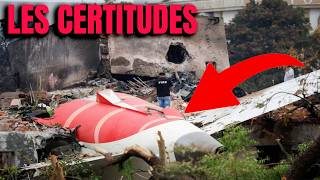
This is a YouTube video titled "Les Certitudes du crash d'Ahmedabad : les images parlent !" created in June 2025. The content is a detailed monologue by Aldo Saron Aviation analyzing the crash of Air India Flight 171, a Boeing 787 Dreamliner, discussing technical details about the aircraft's flaps, engines, and possible causes of the accident. The video includes philosophical reflections on investigative methods and aviation safety, and ends with a sponsorship mention and call to subscribe. The content is a single-speaker presentation focused on aviation accident analysis.
Questions this video answers
230 passengers
12 crew members
242 people
1 minute 40 seconds
2011
Good evening, my friends. Today I have a few certainties regarding air India Flight 171. This Dreamline Boeing 787 crashed on takeoff from Ahmad Abad. It was en route to Gatwick Airport near London. There were 230 passengers on board, 12 crew members, 242 people. Almost all were killed. It seems that there was one survivor, but that will need to be confirmed in the coming days. So today I would like to come up with a number of points that we will confirm. Because when I made the first video we were talking about probably, I said that yesterday it was probably today we have some elements that we can establish, right? That we can practically write on stone with tangible elements. Just a philosophical aside. In the videos on this channel and also in my books, I do not use the Cartesian method as some have suggested in the comments. I am not a Cartesian at all. On the contrary, I think that in a plane crash or a complex situation, like such an event, the Cartesian method can lead straight to a wall, right? Like many newspapers and analysts, for example, have gone straight to a wall. I use a method that is closer to the philosophy of John Locke. David Humm. We are more in an empiricist philosophy, just for a quote. I can't elaborate further because that's not the goal of the channel. But John Locke said that we must raise our level of conviction to the level of available evidence, right? Whereas in a Cartesian approach it would be more like we take an obvious fact, something that we are going to postulate axiomatically. An obvious fact that is so elegant, that strikes the mind so much that it seems true, right? For example, they forgot the flaps, right? And from there, right, Once it's formulated in an elegant way, it becomes true. And we're going to want to demonstrate it by all means. That's the Cartesian method. And unfortunately I don't think it's appropriate for this kind of event, do you? So today I'd like to talk to you about a few very important details. First, we found the wings. So there's a wing. We can clearly see the registration number of the plane on it. It's burnt, isn't it? There are traces of fire on it because the plane is stuck with a lot of fuel and we saw the flames coming up and everything. So there was a very, very big fire. Now if we look at the configuration of the flaps on the 787's leading edge, we realize that they are extended on the wing, isn't that so? These are not things that can extend or retract following an impact. Their mechanism is fairly irreversible. So if you look at the wing, you can see that the flaps are extended. How many? I see five, someone might say I see 15, possibly. But the flaps were clearly extended. So at this stage we are still certain about that. Another thing, there is a photo that was shared by the media. A photo showing rescue workers and people collecting the crumbs from the plane and all that. And in fact there is a detail, There is a very striking detail. And I thank a friend who is a qualified Mechanic on the 787 who drew my attention to this detail. I will show it to you. I'm going to show you the photo and I'd like you to see something. In this photo, there's a flap that's open. This flap is opened by a mechanism that won't open following an impact, nor close following an impact. Once again, it's a mechanism that doesn't accept reversibility. That means either it's driven by a system that rotates or it won't, it won't move. And what is this flap? It's the APU flap. What does that mean? On takeoff, the ah, poo is off. And what happens is that at one point when we look at the remains of the plane, we see that the flap of the poo is open. Why? It's because this proves to us that the APU has started its auto start sequence. The APU started to start? Right. Why? Because the first thing, the poo. The poo. I thank a friend who is a Captain on a 787. The poo takes 1 minute and 40 seconds to come online. Once you press the button to start it or it begins its autostart sequence, it takes 1 minute and 40 seconds. So in reality this APU started to start, but since the flight lasted less than 30 seconds, it, it never fully ignited, it never came online. But the fact that this valve was found in the open position proves that it had started its autostart sequence. One of the reasons why it started the auto start is that it was the first engine that failed. So one engine fails, boom, it goes into autostart. Because this is a very power hungry plane and we assume that if one engine breaks down it means that, well, we're going to start pulling a little too hard on the other one and we're going to have to draw energy from the poo. So we're going to start the poo which actually provides electrical energy. So of course, following the Noise. In yesterday's video, we know that the rat has come out, by the way, a message in the interest of families. When the rack comes out, it comes out. It comes out. It's driven by a spring. It comes out, it faces the relative wind. It comes out with a certain violence. It has a propeller. A propeller is like a blade. It has sharp edges. So indeed, we can potentially, if we are inspecting an aircraft, if we are doing a grand inspection of an aircraft turning around, we could get our spleen. And that can. It can hurt really, really badly. It can injure, it can even kill, because it is something that comes out with a certain amount of violence. Once it comes out, it can no longer be retracted in flight. In any case, there is no way to bring it back in flight. So these elements are now starting to paint a very particular picture for us, which is that we have a failure of two engines, one than the other. Okay, first engine in my failure. The other will follow immediately. So ultimately, there are only two options left, huh? We can look at the problem this way and that, but there are only two options left. Two paths. The first engine failure, and someone in the cockpit rushes and goes to turn off the engine that failed. And he turns off the right engine. So it gives engine failure. A few seconds later, it snaps, and then the right engine shuts down and the plane no longer has any engines running. This is the first blade was close to what I told you in the second video yesterday, where it would seem that one of the engines of this particular plane showed some signs of concern a short time ago. Okay, it showed some signs of concern, but in the end it was accepted back online and it fell apart. So now the other option. So to shut down the engine. Just to show you. I'll show you a picture taken on a 787. A friend who sent it to me, well, he was reading one of my books. It's not a hidden ad or anything, but he was reading one of my books that you'll see in the picture. And you'll see these two buttons, these two big buttons, these two big ones. Uh, that's what controls the fuel supply, in fact. And so someone took one of the switches and shut down the wrong engine. It's happened before. It's happened. For example, remember this Taiwanese company, right, where they shut down a wrong engine? They had an engine that fell out of place. It's an atr. And then the guys shut down the second engine, and then they go, they go towards the ground and unfortunately, they're going to crash. So it's something that's happened before. It's not common. Even if somewhere we say to ourselves, it's a bit too early, it means, okay, we don't have the engine. Okay, we don't have the engine. Well, we're going to reach 400ft, we're going to retract the landing gear, we're going to plan the trajectory, right? And then we're going to start thinking the engine failed. Which one? We're going to stop it now, the two engine failure sequence seems a bit too fast for that. Unless we accept that we have a plane that crashed, something went wrong, whether it was technical or human. So unless we accept that there was an engine failure and literally one of the pilots mentally counted to three, went straight to the engine valve and slammed it. He stopped it. Oops, we stopped the wrong one. It's possible, humanly speaking, isn't it? But we still have a hard time. We have resistance, don't we, when we hear this version. And instinctively, of course, if it's our slightly orthodox side that's going to say this can't be possible. Yes, but. Except that there was a crash anyway. Hey, saying that means we're bound to inevitably end up crashing no matter what we do. The other option is that the pilots didn't do anything wrong. Didn't do anything wrong, didn't make any mistakes. We put the throttle on. Stuck. Positive variop. Gear up. Bang. He shows the thing. We have the wine. I'll show you the image. The landing gear jack will tilt the landing gear. So there, there, there, there. They're tilted 12 degrees backwards. They're going to tilt 12 degrees forwards. So 24 degrees. We make a small movement of 24 degrees. Bang. And at that moment, complete hydraulic cutoff. That means the second engine was going to fail in pe. That means. You could say it like that. Look, you could say that we're taking off, right? We're taking off with potentially an engine failure, maybe after V1, right? No, decision speed, rather decision speed. Engine failure, we accelerate, we take off anyway, gear up, second engine goes. That means we're literally talking about 5 to 10 seconds of failure of both engines. So I was saying, the landing gear pivots. Let's stop there. Second engine stops, the landing gear comes out. The landing gear. I'm going to show you the hydraulic circuit of the landing gear, because yesterday I told you I would bet my hand that it doesn't allow the landing gear to be retracted. Today I am pleased to announce that I am keeping my hand because if you look at the hydraulic circuit in the diagram, it feeds circuit C and this circuit can actually retract the landing gear. Except that there is a one way valve on non return valve that points to the spleen. This means that the pressure coming from the spleen will go to the flight control. But the flight control has priority and this valve prevents it from going to the landing gear because it is not considered a priority in any case, retracting the landing gear cannot be considered a priority in such circumstances. So the landing gear cannot retract via the spleen. You can hear the noise of the spleen, can't you? And so we have an aircraft that starts to come back towards the ground. In this second scenario, both engines stopped at the same time. The pilots did nothing wrong. The pilots suffered, they accelerated, they took off. Bam. First engine fails, okay? Boom. Second engine fails. We're going to the ground. It's possible. Remember I told you about it a short while ago on this channel, the British Harwise 777 is a Rolls Royce engine, the British Royce T7. Both exchangers were frozen. There was no bypass on it because we didn't think it was necessary to do so. Bam. The plane crashed. Luckily there were no fatalities. But if it had been a plane making an approach to a slightly different terrain than hro, wouldn't it, if there had been a chance to have a clearing vacant lot and everything, it could have ended extremely badly. So I can't absolutely rule out that the two engines will be shut down in sequence, one after the other like that. And that we'll say later. Yes, there's a very rare condition, a software bug, something, a choice. Especially since I'd like to tell you something. This 787 plane is one of the first that was manufactured, that is to say old ones. It dates from 2011, it dates from the time when the 787 Dreamliner was released. So generally, just generally, you can see this with the French company for example, that planes that are at the very beginning of production, like cars, are generally not the best. They're generally not the best because sometimes choices have been made which later on in operation we say to ourselves, yeah, maybe that's not the best thing to do and then we improve it. But we're not going to retrofit it to the first production ones, right? And like that, the companies that buy the very first ones that come out, hey, generally it's a bit of a hassle, right? If I had my company, honestly, I assure you that if the plane, if the plane doesn't fly for at least 10 years. I wouldn't sign it. That's it. I think it's something to keep in mind. So there's that either an engine problem or potentially a fuel problem. A fuel problem, you know, when there's a plane accident, whether it's a scheduled plane or even a club plane accident, it's. It takes off late, it falls. Always the first thing the investigators reflex is to seal the truck that delivered the fuel. If it's a tank, well, seal the tank. The documents, the pipes, all that, all the equipment is put on cd and then we have to analyze it because what do the two engines have in common? What do they have in common, right? I mean, they're independent, redundant, all that. Well, despite everything, the 777, the British Royce Flight 38, well, it crashed despite the redundancy that I just mentioned. But if we look at the subject of these fitters, if there's something in common between them, it's fuel. So if they took adulterated fuel contaminated with water, with anything else, I don't know, we have to see if there was maintenance at the airport, if they had installed tubes, if they had, you can't tell. It can end up with fuel that is, let's say, of poor quality, right? To put it mildly. From there, well, you can have the sluggishness that you saw, right? It means the engines are doing nothing. Engine one and two are stopping one after the other. Do you know what I mean? You can tell me about other planes that have taken off before. They haven't had this problem. Well, the sensitivities vary, right? It's not from one plane to another. You can't tell, right? It happened. There was in this canal. There was a case where a bus, I think, went through. But that was a tragedy. I mean, there was water, they pumped water, antifreeze, parabolic stuff into the fuel well. It was the only one that suffered. The others don't have it. I mean, sometimes you just need to do a little bit. There you go. So we'll see, we'll see in the future, personally, if there's any new information, I'll come back. Of course, that's the goal of this channel. It's a channel specializing in aviation. So if there's anything new, I'll come back. If there's no new information, well, we won't talk about this story anymore until the final report comes out or some absolutely crucial information comes out. In any case, my friends, thank you for listening to this video. So far, I forgot to sponsor this channel. You know, I. Aldo Saron Aviation. You don't want to be sponsored by an airline, right? You can't imagine a company sponsoring the content attached. So channel sponsors, they provide professional support. They help careers take off. Bad puns. Uh, they're literally the Rolls Royce of professional coaching. They read my books, they watch my videos. I know them very well, they know me very well and I have sent them a lot of people and everyone was happy. In some cases, for those who live in France, in, in some cases, the training may be entirely supported. The coaching, the training, everything they do may be supported by France Travail. In any case, thank you for listening to this video so far. Thank you for your support, your comments. Feel free to subscribe to this channel and then we'll see you in a future video. See you soon.
More from Aldo



La FIN du Royaume-Uni ? L'Ecosse, l'Irlande du Nord et le Pays de Galles veulent partir !




Analyse Présidentielles 2027 : Marine le Pen remet ENCORE le voile sur la table !


Scandale "60 Millions de Consommateurs" : la France mange des pâtes contaminées au Cadmium !

2 dossiers : Accident d'autogyre en Italie & un pilote sauvé par le parachute du Cirrus