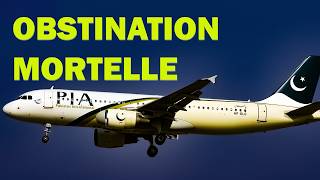
A narrated analysis of Pakistan International Airlines Flight 8303 (May 22, 2020) that reconstructs the final flight: 99 people were on board. The speaker focuses on crew backgrounds (captain aged 58 with ~17,000 flight hours; first officer 33 with ~4,700 hours), a series of procedural and human-factor errors during approach to Karachi (including failure to recognize a published holding at waypoint “Sabin,” selection of Open Descent, extension of spoilers/gear to increase descent, and premature arming of Approach), and multiple system warnings (overspeed masking autopilot-disconnect alert, GPWS priority hiding gear-warning). After a heavy touchdown that scraped engines along the runway for about 1 km the crew initiated a go-around; both engines were fatally damaged (left failed, right later seized), electrical degradation led to alternate law (loss of stall protections), the aircraft stalled and crashed into a residential area. The speaker reports ~97 onboard fatalities, two onboard survivors, and two ground fatalities, and discusses regulatory fallout for PIA and questions about pilot licensing.
Questions this video answers
May 22, 2020.
99 people on board.
Captain: 58 years old, ~17,000 flight hours.
First officer: 33 years old, ~4,700 flight hours.
Waypoint 'Sabin' with a published holding pattern between duplicate occurrences in the flight plan.
Good morning, my friends. It is very difficult to list all the mistakes made by the pilots of Pay Flight 830. We are in May 2020, the COVID era. Remember, air traffic is slowly resuming in Pakistan after a few weeks of interruption. And we have this airbus 320 descending from Lauray in the north of the country to carry. There are 99 people on board. And what interests us most is not the people on board, but those in the cockpit. And in particular we have a captain who is 58 years old with 17,000 flight hours. But he has a very particular personality. He was described in the accident report as being a man of below average intelligence. I quote, a tyrannical, authoritarian person who has very poor spatial references and who does not know how to manage stress. Despite everything, he managed to survive 17,000 hours. And he managed to get into the left seat when he wanted to join the airline. He was disqualified by a panel of psychiatrists, right? So the psychiatrist saw in him a profile that had no place in aviation. He was disqualified. He went to the United Kingdom, he went to other practitioners and he came back with files. He came back with files. He came back with favorable files that came from other practitioners. The company did not want to recognize these references. So he went to court against pia and finally he was accepted, which is perhaps in itself the first fatal mistake in this story. On the right we have a co pilot. He is 33 years old, 4700 hours of flying. And he is someone who has always been described as marginal. He comes from the world of the earth and he has always been. He has always flown in a low key way, a way of speaking. So we have this cockpit with troubled personalities. We are also at the end of Ramadan. It is May 22. Ramadan ends in a day or two in many parts of the world. And so these people are fasting. Does this have an influence or not on what is to come? This has of course been analyzed by the commission of Inquiry. Ah, mystery and bubblegum. There is some of that, isn't there? There is some of that, but there is something else too. Obviously there is something else, because thirst in the end alone cannot explain the tragedy so closely. So I was saying, our plane is flying at its cruising altitude. It is daylight. It left Lauray at 1.05pm There he wants to start his descent. But suddenly there's a small detail that's going to strike the pilots a bit. That is to say, selling the small window in front of him. He puts 10,000ft, he presses the button so that the system, the FMS, the onboard computer that manages the navigation, starts to start the descent, and then the plane, instead of descending sharply, it goes to minus feet per minute, which is quite slow as a descent. And there you have it, it doesn't want to go any faster than that, it doesn't want to descend any faster. So our pilots don't understand why the Erbus does this. In fact, it's a fairly well known feature of the Airbus managed descent logic. If it has its cruising altitude and then the pilots want to descend too early, it means that the system thinks it's way too early to descend. And, well, what's going to happen is that it's going to give them -1,000ft per minute. It can also give 500 depending on the altitude, but from the cruising attitude it goes to 1,000ft per minute. So they start to wonder why it does all that. But in reality, there is an explanation. There is always a logical explanation in these systems. Namely, the flight plan is programmed in the system and as the pilots visualize it, were not the same. There was a particular discrepancy. There is a waypoint called Sabin. This Sabin point appears twice and between the two times there is a holding pattern. What does that mean? It means that the system is programmed, expected to start its descent, later, arrive at the Sabin point, continue to circle the Sabin point, while descending before exiting at 3,000ft at the end of its holding pattern. The pilots had not visualized that at that time. So what the pilots saw, they saw their position, they saw the airport, the destination. They said, we're very close, but he doesn't want to go down. Do you see? That's it, that's the idea. He doesn't want to go down even though we're close, while the plane in his mind had a much longer distance to travel because it had to go on the circuit. So it's just a detail. What they could have done was to cancel the holding pattern, but they'll see that much later in any case, while they're discussing this way, while they're moving forward, and then the plane doesn't go down. There's also a small problem with the frequency, another mistake they're going to make. They're going to enter from the wrong frequency when they're asked to switch from one controller to another. So for several minutes we try to contact them, and then finally they don't answer. Then a controller ends up contacting them on frequency 1215, which is the universal emergency frequency in aviation. So they get Back in touch. And then what the captain is going to do is decide to dive. He's going to decide to make an aggressive descent. So still on the pilot's radar, he's going to change the descent mode. He's going to put open descent. Now, the open descent mode is a very specific mode that allows for fairly aggressive descents. In reality, what the plane is going to do is reduce the throttle completely. It's going to go into idle, into slow flight, and then it's going to pitch down to reach a set speed. So then the pilots give it a fairly high speed so that it pitches down well so that it reaches a high speed. And at that point, well, there you have it. It's going to fall. It's going to fall very quickly. So they start this, and at that point they're going to bypass somewhere. Ah, I used Boeing terminology on purpose, but that's all it says. They're going to bypass the vertical navigation of the plane somewhere. The vinave. There's no vinave on Airbus. There's the concept, but we don't use the VNAV label or terminology like we would on a Boeing. But there you have it. You understand the logic. Planes have lateral and vertical airspace. So what's happening is that the plane is now falling very quickly as it picks up speed. What they're also going to do at some point is to extend the spoilers. So they're going to extend these surfaces that are on the wings there to destroy even more lift, to accelerate the descent. And then at some point, they even decide to extend the landing gear to fall even faster. And all of this was unnecessary because such a fall would cause the plane to fall very quickly. It would be uncomfortable for the passengers, the plane would be noisy, it would vibrate, it would look strange, it would look ugly. I mean, it would even be dangerous. So why, when there was nothing forcing us to do this. But somewhere along the line, there was an obstinacy on the part of the pilots, and in particular the captain, to land at all costs. So during this very, very abrupt descent, the controllers would start talking to each other and they would say to each other, but did you see? It was descending very quickly. And they had this perception that it wanted to land from this profile, which did not seem possible. But one thing you should know, controllers have no authority over pilots. Controllers do not fly the plane. Controllers are there to smooth out dispatch and secure traffic so that two planes don't collide, for example, but they're not there to help pilot or fly an aircraft or make decisions for the pilot. After all, it's the pilot who's supposed to put them on board. So they discreetly try to dissuade them. One of them tells them, are you comfortable with your descent there? And the captain replies, yes, that's fine, there's no problem. Well, later on another controller will tell them, don't you want to do an orbit? Don't you want to do a 360? That just means you get out of the way, you do a 360, so a big loop that allows you to descend, lose attitude, speed, all of that calmly. In reality, he refuses, psychologically speaking, because he's a very stubborn and tyrannical personality. Right? He will perceive this concern on the part of the controllers as a sort of challenge because at some point he will tell the guy on the right or the co pilot, he will tell him, ah, what we are going to do will surprise them. And he didn't know how right he was. That means that every time he was told or suggested to do something else, well, he wouldn't say, yes, I will show them, they want me to do this, okay, I will show them what I am made of. I will show them how I am. I am at the top on that. They end up discovering that there is a holding pattern that has a holding circuit at the Sabel point. So they are going to delete it. They are going to say, yes, it has to be deleted. Except that when he deletes it, it is too late. It changes nothing. Why? Because very, very early on, during this approach, during this descent, we don't yet have in the approach, which is a descent that is made in the axis of the Runway, in the very extended extension of the Runway while the captain presses, and this is an early decision, presses approach mode. The problem is that when the approach mode is armed on an Airbus, what is it going to do? It is armed at the start. It does nothing at the start. It does not touch the aircraft. It will search for the lock. That means the centerline of the Runway. It will ask itself, where is the centerline of the Runway? It will wait for the ILS to catch, ok, circle the system. Then the electronic rail that allows you to go to the Runway. Once it catches it, what does it do once it catches it? It will cancel the navigation mode. And I will use another Boeing term, it will cancel the horizontal navigation mode. So everything that is on the plane and everything that was in the flight plan, he will no longer worry about it. He will get the lock. So he will Jump out of the flight mode and switch to lock mode and then stay on the Runway centerline. So if we modify the flight plan, it will no longer change anything. It's too late. So go and fiddle with it, go and fiddle with it and so on and then remove the roll that's all over the plane is ninja on the Runway centerline and it follows it and it goes on. And ah, this time he's going to tell them, make a 180 degrees turn to the right, or rather to the left. He's going to tell them, make me a 180 degrees turn to the left. His goal is to force them to turn around relative to the approach axis. It's to force them to extend the distance traveled so that they can descend properly, lose speed and everything. But the pilot refuses. The captain says no. He says no, we are, we are, we are already, we are already aligned. It doesn't mean anything if the controller is in his space. It's your plane, but it's his space. If the air traffic controller tells the pilot, make a 180 degrees turn to the left, I mean, you have no choice, you have to do it. You're not going to say anything? No. The captain refuses. So we have a captain who refuses. It has alarms, it has errors, it has instructions from the controller, but in fact it refuses everything. It has entered into a deadly obstinacy. It has entered into a circuit of irreversible obstinacy. It does not want to hear from anyone. It has a plan and wants to execute it at all costs. So what is going to happen is that just to give you an idea, at a given moment, the rate of descent, that is to say the rate of descent at the speed at which it descends will reach 7,800ft per minute. The plane that was initially flirting with 8.9 degrees of descent rate will reach 13.7 degrees near 14 degrees. That should never happen in an airliner. 14 degrees of pitch down does not exist. There is no normal flight that we have done in our life where we have 14 degrees of pitch down that does not exist. So the plane is extremely pitched down. What's going to happen with that? He decides to extend the flaps. You take the flaps, decide to extend them. Except that extending the flaps when the speed is very high, we're talking about 250, 260 knots, the speed is very high. When he decides to extend the flaps, what's going to happen? There's going to be an overspeed warning. So there's an overspeed warning that's going to go off at the same time. What's going to happen? The autopilot is going to disconnect. The autopilot is going to let go of the plane. Why? So the autopilot isn't going to let go of the plane because of the overspeed, but because of something else. The thing is, in the Airbus 320 circuits there are limitations that are programmed into the autopilot. If it reaches them, we consider that there is a bug, an error, something abnormal, and that the autopilot must now stop. This means that it is self deactivating. If the autopilot has to command a pitch angle greater than 13 degrees, the control chain considers that something is abnormal and at that point what it has to do is automatically deactivate. So why did it command such a high pitch angle? Because open, descend, landing gear extended, spoiler extended. So Aerofin fully extended, throttle at idle and as I said, very high speed commanded. So to reach it, it would have had to go for the 14 or 15 degrees pitch angle, which the system that manages the autopilot found completely abnormal and therefore deactivated it. Now I'll tell you something. The following thing is that there was no autopilot deactivation alarm. Why? Because we have an alarm on speed, and as we've seen very regularly on this channel, on, on the Airbus, but also on other planes, there is what is called a priority system. As they say, sometimes we see near level crossings. Be careful, one train can hide another, and well, in an airplane, one alarm can always hide another. Always, always. If a situation arises, and in this situation, because you know there are many dozens, not hundreds of possible alarms in an airplane, each one has its triggering conditions, each one has conditions that mean that it must now be released. Well, sometimes the airplane can find itself, not even sometimes can find itself. In a situation where several alarms would be possible, several alarms have their conditions met, what does the system do? So the system will do what it does in terms of alarms. It will send the highest priority alarm and ground the lower priority alarms. So in an Airbus, the overspeed alarm is more important than the autopilot disconnection alarm. So if you are overspeeding and you disconnect the autopilot or it disconnects on its own, you won't hear an alarm. So the master warning was already flashing, but it won't do anything more. You know, the flash continues to flash and the cavalry charge linked to the pilot can't be heard. So that's already an important point. So we are in a situation where pilots are slowly losing everything. You know, they are really losing the situation completely. So what will happen is that the air traffic controller ends up authorizing them to land. He sees that these are people who are doing anything, who are not even responding to his instructions and so on. So, well, war tired, they cleared them to land. So they were going to arrive on Runway 25 left at Karashi airport. They were approaching the Runway, they were coming in very high, they were coming in very fast. Literally on final, they were at 260 knots, right when they flew over, they were flying over the Runway, they were at 210 knots, something like that. So it was very, very high. Uh, the co pilot at that moment, he had some qualms. At that moment he decided to take charge of the situation. But be careful. We were in a context where there were huge hierarchical distances. So somewhere he, he sensed that we were doing something really stupid. But on the other hand, he didn't really want to upset the guy who was on the left. While we are honestly in a situation where even if he had knocked him out, the jury would have released him, would have cleared him. But what he is going to do is this. He is going to take the mini mange, he is going to pull on it a little. He is going to pull on it just a little bit. So there is like an intention to take off again, to go around again. So he pulls on it a little and he brings the landing gear back in and he tells the captain, we shouldn't do another turn, we shouldn't do a 60 degrees turn to lose speed. So he swings in this way. The captain of Bourne doesn't hear it that way and he doesn't care. He ignores it. He wants to land. So the captain of Bourne is going to dive and then he is going to start extending flaps, 1, 2, 3, quickly like that, in rapid succession. Now, what is going to happen? We have the approach. If we look at the level of the alarms that will arise at that time, we have what is called the gpws. It is an instrument, it is a device, okay, which is relatively independent of the others, which will trigger a certain number of alerts. When, for example, the aircraft is too close to the ground or is approaching the ground too quickly, or when it is approaching a terrain, or when the aircraft loses altitude after takeoff, or when the aircraft is on the ILS and then there the glide path and then loses it and so on. There are circumstances that cause it to trigger an error. However, it is important to know one thing that the errors are also those of the GPWs. The alerts are also classified in order of priority. And we will also have something here. Since the captain is approaching the ground very quickly, what will be heard as a GPWS alert is that he will hear too low terrain. Too low terrain. That's the alert that will sound. Now the GPWS has another alert called to low gear. To low gear. Yes, that's the alert I just told you about. To gear. That's the one that signals that the landing gear is up because he didn't realize that his right hand side had retracted the landing gear. But there are two audio alerts, right? To low terrain. To low gear. Which one is more important in terms of priority? To low terrain has a higher priority than to low gear. That means that the system will only issue the to low terrain alert. You get too close to the ground, the ground is coming towards your face. But it won't say anything about the landing gear being retracted. Okay, there you go. We have two. You see, we have a double here. We have two opportunities. Huh? We have two opportunities. Several alarms that collide, and we have the priority that comes into play. So the captain flies the plane over the Runway. He absolutely wants to land it. He eats up half of it because it is very fast. And then, uh, roughly speaking, it is going to touch down at 200 knots. Touching down at around 130. It touches down at 200 knots. So very, very fast. How does it touch down? Well, it touches down with the engines. Because, look, I'm showing you this. It's a district of Columbia 10 that I bought. This allows us to illustrate certain things. So if you look at the plane, the engines are lower, right? The hull is lower than the airframe. So if this plane had to land directly without landing gear, it is the engines that would touch down first. Okay, Engines that are going to touch down inevitably. So the engines touch the Runway. So they are going to hit the Runway hard. And then the captain takes the thrust reversers and starts to retract them completely. They are not going to open. There is no reason for them to open because the thrust reversers are activated in their circuit. Their energy is energized when the landing gear touches the Runway and it is compressed. So now, since the landing gear is retracted, the thrust reversers do not extend. The spoilers do not extend. They cannot extend because the spoilers, especially those that are completely inboard the ground spoilers, which are the strongest, the most brutal, the, which really destroy the lift, do not extend. They cannot extend. Any further because likewise they are controlled by the landing gear. What does the captain do? He starts braking, it starts braking, braking, braking, braking, like that. But in fact it doesn't break. I said, what's going on? So the plane is going to slide for about a good kilometer. In fact, it's going to make a noise like a pan. It's going to hit it a second time. It's going to make little, little swings. You know, you can't see them on the very poor quality CCTV videos, but the plane is actually going to hit four or five times and it's going to scrape the engines for about 1km and that's going to last for about 20 seconds. So we can always ask ourselves, yeah, but why didn't it break? Because it was reaching about 200 knots in 20 seconds. Later it was at 160 knots. Okay, it lost 40 knots in 20 seconds. Why didn't it break more? Because you have to know that in these circumstances, we're pretty much in the same idea as the JJR last December, uh, if you like. When an airplane hits like that, the wings still have a lot of residual lift. There's a lot of lift. So it's not the entire weight of the airplane. Let's say the airplane weighs anything, let's say 60 tons on landing. It's not the 60 tons that are going to hit. It's a fraction, maybe not even 10 tons that hit. So the friction is not very high because there's a lot of speed. So there's residual lift. That means the plane was destined, right, because it landed in the middle of the Runway. It ate 1,000 meters. It was destined to go off the Runway and then maybe it would have experienced the GGR thing, it would have crashed. There you go. So the pilots at that moment decided to go around. So they said, okay, since we're at it, let's go around again. So the throttles were pushed all the way. He pulled back on the throttle, boom, the plane left the ground. And since it had a lot of inertia, 160 knots, which is generally higher than the takeoff speed of an Airbus. Well, what it was going to do was to rise into the air very quickly. The controller said, wow, did you see what he did? Did you see what he did? He hit all that. He landed on the landing gear. He's covered in oil for 1 km. Right? And metal parts and, and the plane starts to climb. So they made a lot of mistakes this time. This time, well, it's screwed up this time. There are a Lot of mistakes and everything, but the engines were mortally wounded. The engines, well, they suffered because when they scraped over this long distance, their oil network was torn. So they lost oil. They lost almost all of it. We're talking about 60% of the amount of oil that went. So it's running, but there's no lubrication. So the plane accelerates in the Runway axis, retracts the landing gear, well, the landing gear retracts. No need to retract it. I mean, probably he wanted to bring it in, realized that it wasn't there, or rather that it had already come in, so he turned around. In reality, they missed an opportunity to get out of it. Because if we look practically in the axis of Runway 25 left, and we're going to go slightly to the left of it, there's a Runway oriented at 26, almost parallel to that one, uh, of a military base they were at. It was at 3,000 meters. That's three kilometers. So they had their chance. They had targeted this Runway the first time. But, hey, we're not going to expect this team, are we, to make a good decision that day. So they take a right turn and what they're going to do, they're going to want to do a circuit of the Runway. That means climbing in the axis, going into a reverse direction, so turning around and then coming back to present themselves for landing, which is a bit of a strange idea, uh, given the circumstances. The air traffic controller asks them to climb to 3,000ft, as if he could. So they're going to put the throttle on, climb to 3,000ft. Suddenly, there's the engine. There's one of the engines that's starting to seriously show signs of weakness. So it's the left engine, it's engine one. So the captain says, oh, engine one is having problems. Engine one is going to stop. So in the, in the. In the copy responds, uh, I'm going to slow down engine two. I'm going to slow down engine two. With that, he takes the throttle of engine two, he slows down. I mean, they spared no mistakes that day. There's no mistake that won't be made. So what they have is that one of the engines, the left one, is really dying. The right one still has a little bit of juice in it, except that they're going to reduce it so that the plane climbs in at 300 to 2,600ft, roughly. It won't reach 3,000. At 2,600ft, dust starts gently coming back towards the ground. There's not enough energy Left they have both engines that are idling. So you see, it's a very particular situation with that. What's going to happen is that the left engine is going to give up the ghost. You also have to know one thing, that when they hit, the electrical generators were badly damaged. And at one point the right one was damaged, the left one was about to stop and there was no more electricity in the plane. So what happened was that the rat, as we had talked about during the Air India incident, would come out with a small propeller which would start to stir the air and which would allow us to have a little bit of electricity. So in that case, the black boxes would stop for about eight seconds. During those eight seconds there was total darkness. So the story was interrupted. We don't know what happened during those eight seconds, but during those eight seconds the flight control system was running on battery power, wasn't it? And then the rat came in, the electricity came back on and in reality the voice recorder, the data recorder didn't come back on because that it consumes too much to be powered by the spleen. They didn't think of starting the poo. So I was saying something else. The plane is going to go into alternate mode, which means the normal mode, which is the normal piloting mode, we are in fly by wire mode. It cannot be active in these conditions. In these conditions it has no more electricity. A good part of the systems are stopped. It is operating in a degraded configuration. So it is going to go into alternate mode. Alternate mode. There is no protection against stalling. So our pilots are losing altitude by making a turn above the houses now and they want to join the Runway. The problem is that there is no. They are losing speed, losing altitude. They have one engine failed, the other one has been slowed down and it is quite late that he realizes that the captain is saying, yeah, but did you see engine number two? You slowed him down when he was good. He decides to put the throttle on engine number two. So they increase the throttle on engine number two. Ah, we don't know what power he could have given because once again we don't have the flight parameter recorder. So we don't know what his N1, N2 temperature EGT etc are doing. We don't know. But what we do know is that in the CVR we can hear the noise of the engine going up to almost maximum power. So at some point it's going to go up, it's going to go up to maximum power. Except that an engine that's damaged like that, pushing it to maximum power might not have been the best idea. So then after that, it's going to start having explosions, right? So the engine surges, then it's going to start to die. He decides to reduce the power. So he brings the power back down to maximum. They're going to bring it back down to about 60%. And on that note, a few more noises and bam, it stops. So here we have our plane at low altitude, low speed. Uh, the captain says, no engine, of course, there. The captain says to the copy, pull out the landing gear. So not that, but pull out the landing gear. What do you want him to do? Huh? I mean, we're here. We're more like that. You do what you want from there. You just do what comes to mind, and then we'll see what happens. Then he's going to take the microphone, he's going to yell at the flight attendants in your seats. There you go. And the plane starts to sink. He sees the ground coming with the buildings and everything, pulls back on the stick and there they have the voice streaked. In fact, it's a voice that normally, if in normal law, you can't hear it. Because in normal law, the Airbus itself would have taken measures to prevent the stall. Huh? So he would have stopped pitching the plane up, he would have put the throttle all the way down, and so on and so forth. Except that in this specific case, we are in alternate law. There is no stall protection. And besides, it can't even be reinitiated. How are we going to protect against a stall? In this case, there's not really much to do. And so there they are, the Mini Mari. Completely the plane in a stall or semi stall situation. Once again, we don't have exact data. And it's falling there. There it's really falling. Landing gear down. And then there. There's one who takes the microphone, who calls the control tower maid, help me. Ma. Me. But hey, the control tower in reality had already triggered the equipment had already. The controller had already pressed crash well before. Well before. In fact, he had pressed crasher knee at the moment where he saw the plane sliding for 1km with sparks and flames behind it. So there you have it. The plane falls into a residential area. There are two dead on the ground. In fact, there are three. Three young girls who were injured. Burns. One who died later, one on the spot, one later. So two dead on the ground, uh, which is a miracle because the area is very, very populated. It was a Friday, at the time of Friday prayers. So a large part of the population, the men in particular were at the mosque. So that may have reduced the toll a little. Eighteen buildings were impacted, some very badly by the plane, but also by the fuel that was spilled and the fire and all that. Miraculously, none of the 18 houses that were hit by the plane fell. Not a single one fell. And that also helped to reduce the toll. Because if it had fallen like a house of cards, the it would have caused many more deaths on the ground, uh, in the plane, there were two survivors, two people who at the moment of impact saw the light and they were sitting, I give you, in 1000, in the front, not in the back. Huh? Because sometimes we say, yes, those who are sitting in the back and so on. It depends. It depends on the kinematics of the accident, the dynamics of the accident. So here there are two guys who are sitting relatively towards the front at the moment when the plane falls. They see a little light. They say outside, I'm going out this way. They go out, there are people who are going to help them. They move away. On that note, the plane caught fire. Those who weren't able to get out will never get out. That's 97 dead on the plane. Out of 99, right? Almost a total toll, minus two people who were rescued in extremis, two people on the ground, as I told you. So that makes 99 dead that day. And then, of course, the rescuers couldn't do anything. They had to advance with JCBS bulldozers, all that. But there was nothing more they could do for anyone. So this of course caused the blacklist. The PIA company in Europe, the United Kingdom, the United States, all that. The United Kingdom has recently reversed this ban. But there you have it. And there was also, in Pakistan, there was the scandal of pilots licenses because it was suspected that some pilots had fake licenses or had paid to take exams or had promoted for exams and all that. There's a lot of that. But I want to tell you that, and this is perhaps more terrible than we might think, these two pilots did not cheat on their exams. Their licenses were valid. And this is perhaps more serious. We almost wanted an explanation by telling us that their licenses were fake. So there you have it. That explains it. No, it doesn't explain it. Thank you, my friends, for watching this video so far. Thank you to those who support the channel on Patreon. And I'll see you in the next one. See you soon, Sam.
More from Aldo



La FIN du Royaume-Uni ? L'Ecosse, l'Irlande du Nord et le Pays de Galles veulent partir !




Analyse Présidentielles 2027 : Marine le Pen remet ENCORE le voile sur la table !


Scandale "60 Millions de Consommateurs" : la France mange des pâtes contaminées au Cadmium !

2 dossiers : Accident d'autogyre en Italie & un pilote sauvé par le parachute du Cirrus