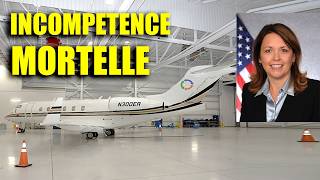
A French-language YouTube monologue analyzes a fatal business-aviation accident involving a Challenger 300 on March 3, 2023. The speaker recounts the chain of events: a pitot/airspeed probe cover was left on during preflight, pilots accepted interruptions during inspection, an airspeed discrepancy between ADCs triggered invalid-airspeed logic and inhibited multiple systems (rudder limiter, takeoff speeds, flight director, auto-trim), and despite warnings the crew continued takeoff. During climb an autopilot/trim failure led to a sudden pitch-up and violent G oscillations (up to ~4g and subsequent negative g), causing an unbelted passenger, Dana Hyde (55), to suffer fatal injuries. The narrator emphasizes that the accident was avoidable and attributes it to poor preparation, system complexity, and lapses in basic airmanship.
Hello, my friends. Lyle, Business aviation in the United States has a very bad reputation. And as tonight's case amply illustrates, it's a reputation that is not entirely unjustified. It's March 3, 2023 in the United States and we have a Challenger 300 aircraft that is going to make a flight between two secondary airports in the country. A short while before the passengers arrive, the co pilot is doing a pre flight inspection because the aircraft has simply spent the night in a hangar. And then we have to go around to check that everything is okay. While he is doing his inspection, a guy arrives with ice because ice needs to be put on the plane so that the passengers can cool their drinks. At that point, the co pilot interrupts his inspection and goes to accompany the guy inside the plane to show him where to put the ice. On that note, he returns to his visit, but he will resume it at a different point from where he had interrupted it somewhere. If all critical operations are stopped, there is no guarantee that they will be resumed at exactly the same point. So by accepting this interruption, he has endangered the integrity of what he was doing. Subsequently, the captain arrives, there are three passengers, the doors close, there are five people. And then the plane is authorized to taxi. He arrives at the entrance to the Runway, starts to roll down it, and then suddenly the co pilot notices that on his side, on the right, the bottom of the airspeed indicator is not moving. It indicates zero, the speed is completely still. He reports this to the captain. And while they are going about 104 knots, or 190 kilometers per hour roughly, so they are literally about to take off, they decide to cancel the takeoff, which is a good thing. So they canceled takeoff, braked and exited onto the taxiway. And at that point the pilot said, okay, I'd still like to go out and take a look around the plane to see if I've forgotten anything. Suddenly he remembered that his inspection might have been a fail. The captain stopped the left engine to allow him to open a door, go down an escalator and take a look. Sure enough, he found that on the right hand side of the plane there was a kind of pointed metal probe that went forward to collect and measure the airspeed, or in reality the speed of the plane. Well, this one had a cover. In the evening, when we put the planes away, we put covers everywhere. We put covers on all these probes to prevent dust, insects, etc. From getting in. But the first thing, let's say the constant concern of every pilot is to make sure that his covers are Removed. He had forgotten one, so he removed it on the taxiway, got back on the plane, the left engine was restarted and the pilots decided to do a big turn on the taxiway to line up with the Runway for takeoff. This was a serious mistake for two reasons. The first reason is a philosophical one. That is to say if we messed up to the point where we left a cover written remove before flight and forgot it, what else did we forget? What else did we do? That means this flight was very poorly prepared and it has to be interrupted. We have to go back and think about what we did and then review everything from scratch. But another technical error is that these planes are modern, very complicated aircraft, equipped with many computers, calculators and all that which share data with each other. On an old aircraft, an SN172, a Boeing 737,200, or for goodness sake, a Look Constellation, since the installed devices are all independent, self contained, as they say, independent of each other, indeed, we can allow ourselves this kind of thing. We forget a cover, we, we remove it and then it will work again. On an ultra modern aircraft, it doesn't work like that. It's much more complicated. When we do this kind of thing, we will trigger side effects that are very difficult to predict. That's what will happen in the rac. So once it moves again and then returns to the Runway, it notices that an error has appeared. It's an error called a run in limiter fault. On these planes there is a rudder. This rudder has a limiter. Why? Because it's very simple on twin engine aircraft as they are supposed to be able to combat a glimmetory link to an engine failure during takeoff while their speed is relatively low. The rudder is generally oversized. It is huge, it has a huge surface area, it is capable of quite a large deflection. So these aircraft, whether Boeing, Airbus Challenger 300 like this one, are equipped with a limiter. It is a system that analyzes the speed and then depending on the speed, it limits the deflection of the rudder to prevent the pilot from inadvertently hitting it too hard and causing it to break. They have this error, they look at it, they say, what do we do then? Well, we'll ignore it and go away. However, if they had looked at their documentation, and in reality there is no need. The TSB says if they had looked at the documentation, but it's in the documentation, it says no go. It says this error there, it's a no, we're not going, we can't take off. But in Reality, especially with all aircraft, all. All errors related to flight surfaces, to flight controls are generally news. There's no need to have made a mistake. If there's a problem with any flight surface or device or system associated with it, like a trim tab, like a yo dumper, like a limiter or something else, it's generally a no. But he decides to take off like. Then he lines up, applies the throttle, accelerates during acceleration. He notices another problem. The flight director remains completely stuck. First, high. Second, he notices that the takeoff speeds, what we call V1, VR, V2, and which are normally displayed, well, they are not displayed. Strange. The speed control is active, so the airspeed indicator is active. Yes, but the takeoff speeds that are normally in the flight management system do not appear. The pilot says it's not a big deal. I know the memories. I'm very used to this plane. And in fact, he was not very used to this plane because he had only flown 88 hours on it. The co pilot on his right had flown 78 hours on this aircraft. So we have two guys who, despite their experience, 5,000 hours of flying, for example, for the captain on other aircraft, are not very experienced on this aircraft. The captain says it's not a big deal. He's accelerating from memory, or maybe with his fingers wet, as they say. He'll say to himself, okay, view, okay, give me a rotation here. And then they lift the plane off the ground and take off. And they've set the altitude to 400ft above ground level. And another alarm goes off. This time they're told that the trim isn't working, if you like. And that's going to be really key for what's to come. The trim, if you like. You have an adjustable horizontal plane at the back of the plane that moves quite slowly. There's a sort of worm screw that moves. Moves either because the pilot wants to move it or because the autopilot usually moves it. And in fact it ensures that the plane is balanced at the speed it's going, given its speed and its gravity, of course. So suddenly they get an alert that the trim isn't working. So he decides to continue their climb and then engages the autopilot. The autopilot agrees to take charge of the plane, which is quite strange in this aircraft because in most airliners when there is a trim problem, the somatic pilot does not activate, but then it activates, and so it will activate. The plane is climbing. It has been about eight or nine minutes since they took off. And then there is an alert that appears on the dashboard saying that autopilot hold nose down. What does that mean? It means that the autopilot is using an increasingly high force to keep the nose of the plane down. That means the plane is out of trim, as they say, because since the autopilot is unable to manage the trim and the speed increases, the plane tends to pitch up. If an aircraft is trimmed at a slow speed, when the speed increases, it will tend to pitch up. So here there is a strong pitch up moment against which the autopilot cannot trim to use the trim. So what does it do? It will use the elevator. So it will push on the stick, if you like, push more and more on the stick to counteract this very strong tendency for the aircraft to pitch up. So the pilots see this, get out their checklist and start thinking, okay, we're going to have to treble shoot this thing, when they either picked the wrong checklist or they didn't look properly. But in any case, it's clearly written and we can even guess without a checklist that since the autopilot is keeping the nose down with more and more force, uh, sooner or later, or depending on what we touch, the autopilot will give up. What will the stick do? The stick will come up suddenly. What will the plane do? It will pitch up suddenly. It will give in to its natural tilt at that moment. So the least you can do is keep your hands on the stick and very, very firmly. They won't do that without touching the stick. They'll say to themselves, okay, what do I do? They decide to do a little reset, right? Of the system that manages the sorting. So they say to themselves, okay, we'll turn it off, then we'll turn it back on. That will give it a little reset and then we'll see. So take control. Bam. And it will turn it off. At the moment it turns it off, the autopilot this time realizes that there's no sorting at all, and it will give up. It will disconnect. At the moment the autopilot disconnects, this plane will make a resource like some fire planes do. It will pitch up suddenly. It will go from 3 degrees to 11 degrees in one second. And we have 4G. We have 4G of acceleration, which means the passengers are completely crushed, completely stuck to the ground. The captain realizes that the plane is pitching up and that it is even threatening to disintegrate because this plane is certified for 2.6 grams. 4G. That's huge, to put it in perspective. So what does he do? Instinctively, he will Push on the control column, and he will push with great brutality. We measured the force. It was recorded. It is about 45kg. So he will push hard. When he pushes, what does the plane do? The plane will return to horizontal, but very quickly, causing negative g. This time 2 to 2.3. What do people the passengers do? Well, a passenger who is not strapped in under such circumstances will hit the ceiling. That's clear. This has happened in other stories, in other airliners in similar situations. We have literally found footprints, traces of passengers, shoes on the roof, on the ceiling of the cabin, right? So the pilot makes the plane pitch down, realizes that he has overdone, it releases the control column a little, and the plane makes another turn. It goes into a 4G. At this point, the number of GS reaches such a high level that the FDR, the flight recorder, thinks it's a crash and starts recording. This means that the FDR's crash detector will come into service and decide that, well, with all that, it's definitely a crash and will stop recording. So we won't record the rest. The pilots more or less managed to regain control of their aircraft and stop this roller coaster ride that must have continued for probably three or so years. Everyone's memories are a little fragile during these situations. There was one passenger who thought he was going to die. He thought the plane was going to disintegrate. And he was right because he had reached accelerations that were compatible with such an outcome. So once they managed to regain control, the co pilot left the cabin and discovered that one of the passengers was not wearing a seatbelt because the pilots had forgotten before doing their photo shoot, they had forgotten to send a message to the passengers telling them to buckle up. She wasn't wearing a seat belt. It seems that just before he started this maneuver, she wanted to go to the bathroom or something like that. Anyway, on planes, in private jets, one of the great luxuries is that many people don't wear their seatbelts even during takeoff and landing. And there you have it. So she hit during the negative G part. She hit the cabin. It's dented in at least two places. We can see impact marks where this person probably hit her head and she was unconscious. So he asks the air traffic controller to give them vectors for a quick landing. They arrive, they land, the firefighters are there, an ambulance is there. The person is taken to the hospital where she will die of her injuries that evening. Her name was Dana ride. She was 55 years old and she was close to the Clintons and The Obamas, we think it really looks like an accident. So, in fact, this is a person who worked for the un, the White House, under several administrations. And the news of his death went around the United States, if not the world, in March 2023. And one of the causes that had been put forward at the time was that it was probably turbulence. Turbulence. Ah, there you have it. A plane experienced turbulence and then began to engage, of course, was with climate witnesses on, well, there you have it, it's global warming or disruption or whatever you want. And in fact, we realized later that it wasn't that at all. There was no turbulence. And turbulence is generally quite rare for it to be fatal. And turbulence generally injures flight crew more than flight attendants. I mean, flight attendants, air crews, etc. Because when there is turbulence, most of the time the passengers are seated or seated and strapped in, which is generally recommended, but the flight attendants are moving around, moving with very heavy trolleys and all that. And if you happen to catch a glimpse of it, bam, there is major turbulence. The trolley lifts up and falls, it falls on your legs, etc. It has often happened that the crew is injured. Now, what really happened? Why? Why were there all these problems? So I'll tell you. In this device, of course, since it's a modern device, there are data circuits for sharing data between various systems. And in fact there's ADC1 and ADC2. So in fact, these are data computers. These are computers that will process the speed, that will calculate it from, among other things, the information from the Python that is outside. So they will take the information, they will process the speed and share it with various systems that need to know the speed. For example, one of the systems is the rudder limiter, because this limiter, of course, since it will allow an angle that will depend on the speed, a sort of downward curve like that, the slower the plane, the higher the angle. The faster the plane, the lower the angle it allows. It needs speed. So if it doesn't have speed information, it can't work. Now, there is one thing in the logic of this aircraft. If there is a difference of more than 20 knots, which is huge, between the speed calculated by ADC1 and ADC2, if there's a difference of more than 20 knots for more than five seconds, at that point information will be injected into various systems that the speed is invalid. And at that point it will inhibit a lot of systems. So it will inhibit the Mac trim, it will even have its speed extremely reduced. It will inhibit the speeds associated with takeoff it will inhibit the flat director. It will inhibit. It will reduce the speed. It will actually inhibit a lot of things. How do you disinhibit all that? In fact, you have to reset everything. You have to reset the aircraft. That's because they say it's Microsoft technical support. You have to reboot Windows. So what you have to do is literally stop everything. You have to stop the plane, restart it. At that point, it starts up again. But the idea of just going to get the tube, get the plastic, the COVID remove it, it's too late. It's too late. The disaster had already happened because the information that we believe the speed is invalid had already been injected into the systems. And removing the COVID won't change anything. The speed is considered invalid. It will be invalid for the entire flight. So taking off with that, well, it was a very bad idea, of course. Well, there you have it. It caused the death of five people. It caused the death of a woman. And it was not at all necessary. It's not at all. It's an accident that is very, very largely avoidable. Not even with pilot training. Just with a little bit of common sense. There you have it. But common sense, you know, is perhaps the thing that is most lacking these days. Anyway, thanks for watching this video so far. Thanks to those who make it possible. I can't thank them enough. To those who make this channel possible through Patreon, and I'll see you in the next video.
More from Aldo



La FIN du Royaume-Uni ? L'Ecosse, l'Irlande du Nord et le Pays de Galles veulent partir !




Analyse Présidentielles 2027 : Marine le Pen remet ENCORE le voile sur la table !


Scandale "60 Millions de Consommateurs" : la France mange des pâtes contaminées au Cadmium !

2 dossiers : Accident d'autogyre en Italie & un pilote sauvé par le parachute du Cirrus