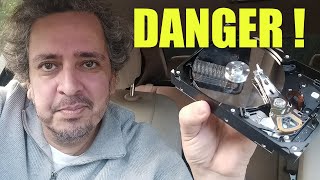
A former IT professional shows how to safely destroy hard drives before throwing them away. Deleted files can be recovered from the platter itself, and companies face GDPR fines if they don't destroy drives properly. Remove the circuit board, scratch the platters, or use an industrial shredder.
Hello, friends. Data problem. I have a lot of disks, disks like this one. And I also have disks like that, hard drives. I have loads of them. I have a garage of these disks. Because, you see, for a very long time, computers were my profession. And every time a computer broke down, well, I would get rid of it, of course, but I would keep the disk because there's data on it. So over time, I have accumulated a bunch of disks. Today I want to get rid of them. The problem is, my friends, never ever throw a hard drive in the trash, because there are a lot of things on there, and not just any things. For example, here, probably, if I put it on a computer, there will probably be a Windows installation. Well, then we'll find my office, my documents. We'll find browsers, we'll find favorites, saved passwords, even if many have changed. We'll find scans of documents, various administrative requests. We'll find backups of phone backups, all that. So, frankly, identity theft these days is the national sport in a lot of countries. There are people who ended up with a bank loan made out to them. There are people who ended up with applications in France, they went to apply for a renovation grant or something, and they were told, yes, but we gave it to you last year and you've already taken it. There are people who applied for a visa for a spouse or a relative or something. Then they were told, yeah, but you already sponsored a family. Six months ago, you brought a family over from Africa. Oh, that's not them. So the more you throw away stuff like that, the more of a disaster it will be. So here I have a cd. I have a machine at home to shred them. You see, it's very, very pretty. It makes little things, so it shreds them, right? It shreds them. But I understand that not everyone has that. So if you have this kind of disc, what you have to do is scratch them, right? And you break them into several pieces. It becomes very, very difficult to read. It's not impossible for an actor who has state resources. But we're not talking about actors of that level. We're talking about actors, criminals, XY or curious people. So CDs, DVDs, it's pretty easy. But don't throw them away either. Now, what do I do with that? What do I do with that? So here I have a Seagate Barracuda 500GB hard drive. It's old 500GB today, which uses a 500GB disk. So I'll show you what I'm going to do with it, I bought a kit on Amazon. You can buy it on ebay On Amazon. Lots of kits. I'm going to open it. I don't know what's inside. I haven't even opened it to show you. Here, I'm going to take a cutter. I'm going to try to open it up. There you go. So I hope I don't get it everywhere. Right? So be careful, be careful, be careful, be careful. There you go. I have it. So what do I have? So I have a piece of paper. I don't care. I have a suction cup. I don't care about the suction cup. I have things like that. And what interests me is this tool. And what interests me are these heads here. Okay? Do you see these heads? So these heads, Torx, they're all sizes. And that's what interests me because that's what will allow me to disassemble the hard drive. Because, as you understand, I'm going to disassemble the hard drive. So we're going to find the heads. Okay? These are heads that look like. I don't know if you can see them. Well, what look more like screwdrivers. So that doesn't interest me. I don't care. In fact, you don't even need to see them. You have a pattern here, right? You have a pattern that allows you to know what it is. So if you look at the disk, you have several things. You have, well, it's a box. You have an electronic circuit here, right? Right. And you have a screwed lid here. So this electronic circuit is essential, but very important. Inside there is what is called a lock. This is the firmware that allows your windows to interact with the hard drive. For example, there are firmwares at all levels. I remember when I worked in data storage, take common disks that you can find on the market. When we put them in our systems, we. We would send a specific firmware inside. So we would replace the firmware there with that. We had an interface that allowed us to talk to the disk. So I could talk to the disk via the command line, tell it to stop, start, move the heads, go to a certain area. And with that, what I could do, for example, I'll just give you an example, is that if the disk failed because it couldn't read a certain area, I could tell it to avoid it, or I could tell it that this area would consider it as full of zeros, which allowed us to recover other data, even if we agreed to sacrifice some. You see, recovering data from disks is a Real science. That's why you have to be very careful with the disk you throw in the trash. So I'm going to try, right? I'm going to take number eight and I'm going to try to see, yeah, number 8B. You see, uh, it fits perfectly in there. I'm going to put it here and I'm going to unscrew this little thing. So this circuit. So what you need to know is what's called the level of complexity. It's like when you have a door, a lock in the end. A lock, well, anyone can break it. But there are locks and locks. Some take 20 minutes, others a quarter of an hour, others five minutes, right? It all depends on who you're protecting yourself against. You see, that's it. So here, if I throw the disk as is, like this, anyone, a kid who goes to high school sees a disc in a trash can, picks it up, takes it home and can read it, right? It's simple. So that's simple. It means it's. How should I say it? It's a little bit for anyone, it's easy. So what I do here is I remove the circuit. So here. Yeah, it's going to get complicated because if someone finds the disk without the circuit, right? If someone finds the disk, there's no circuit, right? I removed it. It's going to be really annoying, right? They're going to have to identify the model, then go on ebay or buy the same one, remove the circuit from the other one and put it here to see if they can read it. The circuits contain the clasp. As I said, as I said, they also contain specific data, sometimes specific data. So what is specific data? For example, they will contain areas that are either factory made or during disk operation, areas that are considered defective. And that changes from one disk to another. And the database for these areas is in the clasp. You see, the thing can also contain memories, but most often they are volatile, which can contain pieces of files because there is a cache in there too. Okay, so what I did here, I broke it, didn't I? So here, I broke this circuit, you see? Huh? I broke this circuit. So first of all, be careful with your hands. You can hurt yourself. It becomes there to read this disk, you have to work to go buy another disk. So first of all, you have to invest. And that reduces this out of the billions of humans on earth, it already reduces the number of people who can access this disk. So now what I'm going to do is I'm going to tackle this side. So here I Have a disc that spins at 7200 rpm. So if you look at the industry, 7200 was the most common disc that spun at that speed. There are 5,600 discs. These are small discs for laptops. I had one lying around. Sorry, I'll show it to you. Like this one. These are small discs that spin at 5600 rpm. They're slower. They're a bit more annoying, aren't they? Even though we find here 5,400. 5,400. Not 5,600. 5,400 RPM. You also have discs at 10,000 RPM. I think this one that's a bit Heavier is at 10,000 rpm. It's a raptor. It's a raptor. I'll show you 180. Go in and do I have the revolution somewhere? It's not written. I can't find it. Look at this. I'll show you. This is a SATA Raptor drive. It was very expensive at the time. It was one of the most expensive SATA drives. It was honestly the best there was before the arrival of SSDs. And the SATA Raptor normally spins at 10,000 RPM. I can't find where the information for 10K is. It says 10K. I think they even made 15K 1s. That means 1500 RPM. So it wasn't very. It wasn't very nice to use it at home because it's quite noisy. Actually. It's quite annoying. I had two or three of them in a case. You could only hear that. That's pretty, uh. That's pretty broken. I have to open this one and throw it away too. Right. So when you look here, right, we usually have screws and there's always a hidden screw. A screw hidden under a label. It's probably there for more, I would say. Probably there. Why? It was just kind of to check that for the warranty and all that. It was always placed under a label. There's always a screw. Normally that's hidden somewhere under a label or that's hidden under something. I'm trying to free it a little bit. Right. So is it there? Yeah, I think it's there. Be careful. Be careful. So. Yes, I got it. I'll show it to you in a second. So there's always a screw that's hidden. Right. So they're all visible. There you go. Look. I just removed the label. And if you notice here, what do you see? You see that there is a Hidden screw. There is always a hidden screw. If you do not remove this screw, you will not be able to disassemble your disc. And I will start with this screw here. You start with whatever you want. Precisely. I start with this one. That's all. So, so I unscrew, right? I unscrew either. And, uh, the goal is really to do this. For each disk, it is to remove first. Remove, remove, remove. Here I am starting to have little screws lying around everywhere. There you have it. There are quite a few of them on this one. Wait, there you go. I'm almost there. I'm almost there. I'm almost there. So you see, I removed three left. Now three left. And we're going to see what's inside. You're going to see the contents, right. Of a hard drive. So when I was working in the disc industry, at one point I was in the disc industry. How do you say? In fact, there are some. I can give you a technique for making money. You know, there are certain companies like banks, doctors, not doctors, hospitals, clinics. They are subject to extremely strict rules on the management of hard drives. It's everything that goes into a hospital. When a hard drive goes into a hospital, the serial number and all that, it goes into a database. And this hard drive is trapped throughout its life. And even when it breaks down, they don't have the right to throw it away when it breaks down or when it reaches the end of its life, saying that the system is there for three years at the end of its life, you know, when the warranty on it is no longer there or its manufacturer has closed or whatever, and we take the data from there, we can't throw it in the trash. You need to have proof that the disk has been destroyed. And there are companies that do that. There are companies that specialize in that, that will destroy the disc using approved methods. They have machines, sometimes machines that fit in trucks that are capable of transforming a hard disk into metal, literally turning it into powder. So there you have it. I was telling you you can make money. I was telling you you can make money. If you launch a disk destruction company or data storage medium destruction company, you can make a lot of money. Really. There is money because there are companies, you know, IPA for everything that is medical. It's ipa, hipaa. It's an American standard. But many companies, even in Europe, observe it. You have the GDPR in Europe, in the European Union, and you have other data preservation systems that make data a real responsibility for the company. So there you have it. What do we have. We have hard drives. The hard drive, you see, it's very pretty there now it's already becoming very, very difficult to read what I just did there. You know what I just did. Now, someone might say, why don't you just erase the data? No, that doesn't work. Because the problem with these things is that when you put the data on there, it's there forever. You can't remove it. Why? It's magnetized. The disk is magnetized. So when you want to erase files, Windows doesn't erase the files. It doesn't actually erase them. There's a file table in Windows. It's going to erase them from there. It will erase the pointer to the file, but the file is still on the disk. That's why we can recover them. There is software that can recover files called FAQ. You have to write to them. So the U.S. department of Defense has approved algorithms for overwriting the disk. Right. So these algorithms, well, they take hours and hours because they involve a lot of writing with somewhat random data to ensure that there is no more data on the disk or to ensure that recovery is very difficult or impossible. But there you have it. So I'm unscrewing this as I speak to you. You see there on the axis of rotation, there are some. I've been using the torque sequence since earlier. There's nothing special. So I was saying, the problem is that even when you write. That's why the Department of Defense requires multiple write passes. I'll tell you why. Because these heads aren't very precise. They go over a track. You can imagine that it divides the disk into sectors to see them as a track like this. And the problem is that they go over a track or a sector. They write zeros and ones, okay? The next time when they go over to erase them or rewrite them, they'll be slightly offset compared to the first time. Not much, but they could be slightly offset so that there will be traces laterally. There will be traces of the old track that was written on. You see, there are traces left. And so we can find them. So there you go. I opened this. So I remove this thing. And now the disks. You see, there's the head here, which is there, which is blocking the discs. I'm going to gradually. I should have brought a big screwdriver. There you go. I'm going to gradually start removing them, as you can see. There you go. I have the disk. There you go. There's another one. There's another one. There's still plastic blocking it. So from one disc to another, of course you'll find it. So now I can't bend it with the ground too heavy. Now, at this point, it's very difficult to recover. That means now the high school student I mentioned earlier who comes by, who finds the disk won't be able to recover it. On the other hand, someone can take the disk as is, like that in bulk and give it to a data recovery company. They might not be able to recover everything because I scratched it a little bit, but they will be able to. I'm losing my laden today. They will still be able to recover some of it because they have benches, they remove the discs, they put them on, they clean them, they put them on special benches in their lab. They have motors that make them spin at the right speed. They have reading heads with different capacities and all that. And they will end up reading it. So on the other hand, he has to pay a lot, right? The more I break the disk, the more I destroy the disk, the more someone who wants to recover my data will have to pay a lot more. It will become more and more expensive. So it's not worth it anymore. Because people who do this are either trying to satisfy a curiosity or trying to steal an identity. Now, if you steal an identity, you have to be sure of your cost. You're not going to take a hard drive from the trash and pay €5,000 to have the data extracted. And then they tell us, no, there's nothing on it, the disc was formatted, or they found vacation photos. So you have this guy, I don't know, they say he was in Turkey or I don't know where he was, where he's making videos from his car and everything. So if you're interested. There you go. So you see what I mean? That's it. So what I'm doing is making it more and more complicated, right? I'm making it more and more complicated to recover data from the disk. That means until it becomes completely unreasonable. So what I did here is I should have brought a screwdriver. I don't want to break this tool. It's very fragile. Because this thing here, you see, I'd like to show you. You see this thing, it's an aim. It's a very powerful magnet. In fact, it's really very powerful. Uh, you can play with it and all that. Be careful. It can pinch your fingers. It can hurt. So this very powerful magnet is held by a screw and is held by the fact that it's a magnet. So if I do this, look look, you see, I can make it move if I let go of it. Since it comes back on its own, it tends to. It tends to come back on its own. You just have to be careful not to get your fingers pinched. There. There I have it. I moved it away there. You have to be careful there, See, the part is lying. That's it, look. Ah, he took it off. He took it off. See, it's very strong, huh? Oh, I'm having trouble removing it. The E in the A's is really strong. Okay? So I'm putting that back here. So gradually, with this method and another one, I'm struggling to try to get my screwdriver back, right? So gradually, I'm dismantling the disc. I'm dismantling the disc. I'm dismantling the disk. So these little discs there, if you want to get rid of them, ideally, these disks there, ideally, two things you can do, rub them against the ground. Take a concrete floor and rub them against the floor so that they are completely scratched, so that they become absolutely unreadable. And then what you can also do is bend them with a hammer, right? You place them on a corner and hit them with a hammer to bend them. Why? Because as long as they are symmetrical like that, you can put them in a reading bench and accelerate them to 7200rpm and read without any problem. If they are bent at that point, you have to accelerate them and straighten them. And straightening them is not always easy, okay? Very complicated to straighten. So that in terms of inertia, it is something that turns. That turns perfectly. So that becomes very, very difficult. So you can see my disc there. If I am realistic, if I am realistic, it becomes very, very annoying. Very, very hard to recover. Okay, What I am going to do, I am not going to do it every day because frankly, it is super boring. I'm going to do this every day. I'm going to make a disc or two, right? Every day I'm going to make a disc or two and that's it until I only have discs like this. If you want, if you're interested, we can take the disk where it is. We can take this one and open it. I'm throwing screws everywhere. We're going to open this one if you want. That way you can quickly see what's inside. See the difference. Of course, if what you're doing is obvious, but you know that I live in the uk, we have to say things like this. Ah, the data is lost, right? Even if you do that, the data is lost. Don't disassemble a disk to repair it. Don't open it. On the contrary, your goal is to recover the data. For example, you work in a company and you need to recover data, or at home, a hard drive has crashed and you want to recover the data. Don't open it. Don't open it. Don't do it. Why? Because there are companies that help you with recovery. However, they all say that the more you touch the drive, the more you mess with it, the worse you'll make your situation. So if a drive crashes, or if you've deleted a large amount of files by mistake or something, shut down the computer right away. Stop. Stop right away. Don't try to recover it. Don't try to use software. Don't disassemble it. Nothing at all. The sooner you stop, the sooner you'll be able to recover the damage later. So here I remove the visible screws. And why won't it open? Because there's definitely another screw. I have to find it. Ah, you see those shiny things there? I think the screws are hidden underneath. We'll try, because sometimes he hides them under the label, and sometimes he hides them. Yes. Well, look, you see, I have one there. And do I have another one here? I'll try and see. Yeah, I have another one here. See, this one has two hidden screws, right? It has two hidden screws. So we're going to open them. And normally, on the Seagate Barracuda, compared to the discs that I just took apart, their discs are smaller. Smaller? Why? Because it's very simple. If you take something this size, it's going to be very, very difficult to spin it at 10 or 15,000 RPM. It could burst, it could break. It's too, too fast. So generally what they use is smaller disks, which means the same thing, but with a smaller diameter. And that's why they contain less data. That's why they contain less data. So look, I removed these two hidden screws, right here. I'm taking this plastic thing and I'm going to try to pry it up somewhere, right? In order to open it. Normally you don't need a lot of force. Wait, normally you don't need a lot of force. Although here it looks pretty stuck. I'm checking with my angles under the label to see if there's another screw somewhere. Wait, is there a way? Right? Is there a way? I don't have a screwdriver. I should have brought a more powerful screwdriver. H It's very, very annoying because it won't come off. It won't come off. It won't come off. Okay. I have a brute force method, don't I? Wait, I'll open the door, knock it on the floor. Let's see. Right. Watch out. Brutal method. So, does it open? No, it won't open. Wait, I still have a label here. Ah, I have a label there. I find a label on the side. Hopefully this label has something on it, right? Oh, no, I'm directly on the trays here. The label on the side. Do I have the label on the other side? Is there a missing screw? Is there a missing screw? Wait, all scratch. Ah, I found it. As if the African method wasn't very recommended. Because, you see. There you go. There you go. Look, scratching here with my fingernails. I found a depression, a depression in the label. On the label. And I think there's another screw. Which just goes to show that using brutal methods is never recommended. So if I were in a job interview and someone had given me this task, I would have already, right? I would have already failed the interview. It was like. Did you see that brute? Did you see what he did? He banged the record against the ground. Brutal methods are never good, you see? Look, there was still more. In fact, the lid is really closed, right? There you go. So. Well, it won't open again. I mean, it's still surprising, right? You see? So we're going back to the African method here. Come on. You see? H. Wait, I'm touching it again. No, wait, I'm going back to the African method. Be careful. No, neither the African method nor the. But you heard the click. I opened it. So it was opened. It was opened by a combination. Wasn't. Was opened by a combination of African methods and Western methods, you see? There you go. I'm an African living in Europe, you see, the two parts of my life work together, right? To open this record. So we. Let's open it together. Careful, careful. We're going to discover the inside, the entrails. Careful. 1, 2, 3, 4, 5. Here's the disk. So the disc. If I compare, I compare. I show you the discs that are there. With this one, do you see the size? There's a difference. I'm going to remove one like this. You can see it like this. Because you can't see it. I'm sure that from where you are, you can't see it very well. So I'm going to unscrew the screws that are here, huh? On this thing that turns there in the middle. Oh, wait, does it turn it turns. Yeah, a magnifying glass, right? A magnifying glass is recommended, right? No, I'm going to have to find a smaller torso. So I took torso E. I told you, didn't I? Here we have a bit of torque. Smaller, my friends. So. Wow, wow, wow. Oh, but this thing is microscopic. It's really microscopic. Wait, since it's microscopic, I'm going to do something. I'm going to show you. We have magnifying glasses on iPhones, right? Well, on every phone on earth, I think. So I'm going to use a magnifying glass and I'm going to show you what it looks like. Wait, what are we seeing there? I don't know if you can see it. Wait, wait, we can't see anything here. Wait, what am I doing? Wait. There, you see? So you see the thing there? This is what I'm trying to attack. This is this thing I'm trying to attack. And we need a smaller torso, right? I hope I didn't throw it out randomly. Mtorcs. Okay, so I'm going to believe that. What is it? So this. Ah, no, those are regular screws. So here I have Torx. Yeah, Yeah. I think I have a chance with that. Wait, with that? I have a chance. So I'm going to try with a really small one. Maybe this one. Yeah, I'm going to try with that. Huh? I'm not too sure. Oh, too big, too big, too big. Come on, a little smaller, a little smaller. I'd like to show you, wouldn't I? I'd like to show you. Ah, one more little twist. One more little twist. Lower. A smaller twist. It barely grips that one. Be careful, be careful, be careful. No, that's too small. So it's in between. It's in between the two. So is there an African method for opening the disc? Is there an African method? Is there a really, really brutal method for opening it? Ah, in fact, what I'm trying to show you is this. What I'm trying to show you is that this disc here, I don't know if you can see it, is smaller than this disc. And I don't know, I think you can see it. It's obvious. It's obvious when you look at it here. But anyway, there you go. Now, once again, this disc, given the way I dismantled it, it's becoming extremely, extremely difficult to recover the data, isn't it? So I'm going to do this game with all the discs. And it's really annoying that during the recording of the video, I've Already lost these tools. You know, the problem is that they get lost all the time. So people wait. Let's see something since we're here. We have a small one, huh? We're going to open it a little bit more, huh? We're going to open it a little bit to show you. Ah, there you go. I found the Torxes. I found the Torxes. Be careful. Ah, we're just between us, huh? I don't know. It works. It works, it works. That's it. Watch. Watch out, watch out, watch out. Don't move, don't move. Stay where you are. Stay where you are. Watch out. We're going to be able to demonstrate this using the experimental method, which is the best method of all. So here I'm unscrewing, right? I'm unscrewing, I'm unscrewing. And I want to get the small disc to show you that on the Raptors, it's not essential information, is it? But it will allow you to see that the disks that spin fast are smaller. There you go. That's the goal of the game. So watch out. I'm almost there. And then we'll take apart the small one, huh? Then we'll take apart the small one, where we are, frankly. Let's go. Watch out. What I'm telling you is the same for SSD disks, because they don't have any. If you open them, you'll see what's called a chip. You have circuits with cards. It's an electronic card. It's an electronic card inside that contains data. It's non volatile. Note that this means that even when you turn off the disk and it has not been exposed to electricity for years, it retains the information. OK, so SSDs are the same, except that you have to dismantle them and then you also crush them with a hammer. Look, this is the 7,000 rpm one. 7,200. And this one, this one, you see? See? See, I'm not cheating. Wait, wait, look. I'm putting one next to the other. And you see that it's smaller. You see that it's smaller? See, there's a difference in surface area because of the 5 millimeters here, right? So it has a difference in surface area and diameter, of course. So we're going to dismantle another one for the road. We're going to dismantle another one for the road. This one, the laptop one. So you've seen the whole collection. Now be careful. It needs a different, smaller Torx. No, that one doesn't Work. That one doesn't work. Wait, let's go even smaller. You see, each one, that's why it's sold in a kit. Yeah, that's it. It's sold in a kit. I'm on six, I'm on torque six for this one, right? So it's still the same equation. We're going to have. We're going to have screws, micro, micro screws. Honestly, they're invisible to the naked eye. So we need screws that we're going to remove. And we're also going to remove the so called hidden screws, right? Because you know now from this video you understood that there are hidden screws. Do you say hidden screws? Yes, they are hidden screws, but. Well, that's not what they are. It can be misunderstood when we say hidden screws. You've seen the weakness of human language. I say a hidden screw and there are people who will think that these disks have screws hidden. But actually, no, they don't have any hidden screws. They just have screws that are hidden. These are screws, not hidden screws. Otherwise it worked fine. At the time, it was where. It was the time where. That was their time. No, with SSD drives and all that. I don't even have an SSD at home. I have NVMe. I use NVMe cards. It's extremely fast, but I have discs, you see. So here I managed to find three labels. Tack, tack, tack, three labels. Now, I won't get fooled. I'll have to check if there's not. If there's not something else under the label here. Something else, something else, something else. No, no, no, no, no, no, no. Listen carefully. Listen carefully. List. No, it's okay. Listen carefully. Sometimes, you know, Listen carefully, you know. So. So we're taking it apart, aren't we? We're taking it apart. Okay? You understand? I left it, you know, because that's how it gets after a while. After a while. You know, I like computers and everything, but the people who gravitate around them, the people who gravitate around them are pretty unsociable, unfortunately. And companies tend to be toxic. There you go. I'm opening it. Watch out, watch out, watch out, my friends. Wait, wait, wait, wait. I think there's another one. Yeah, I missed it. I missed it. There's another one. So this one, it has four. Huh? This one, uh, it looks like the ones who built it, right? Really, really didn't want us to open it, huh? Really didn't want us to open it. Okay, watch Out. Watch out. No, no, that's not true. There's another one. But that's not possible. Wait, that's not possible. I took off all the tickets. Did they put 50 or something? That's not true. That's not true. That's not possible. I'm removing the label because it looks like they put a bunch of stuff underneath the label, right? Wait, wait. Hey, it's like the label on a tin can. So I'm removing it. Hey, there's a tin can underneath. Aha. Do you see where it is? Do you see where the screw is? Do you see it or not? In fact, what they did was they put the label and under the label they put another gold label. There it is. The screw. There, there. So if there's a screw left, it becomes very difficult to open the panel. You can't open it. You can just twist it. Wait, there you go. Wait, I'll show it to you. Do you see it now? It is there. Look at another screw. So we're going to remove this screw there and here. Normally, normally. Watch out. Watch out for the Kadabra. I said. Oh, I forgot one on the side. That's my obvious mistake. Watch out. We're going to do it again with the Kadabra arms. Bam. There you go. It opens. So there we still have. Right? We still have a disk, a hard disk. With, of course, heads. With, of course, a magnet. Huh? There you go. Okay. But from what I've just done. Huh? The fact of opening it, uh, I'm also going to unscrew the electronic part and the broken one and everything from there, honestly, it becomes very, very difficult to recover. What I also do is when I throw them in the trash, I don't throw them all in the trash on the same day. So I can throw them in different trash cans on different days. That way, out of the 8 billion people, someone would still have to be able to recover the trash and gather the discs from different trash cans that may have even gone to different landfills on different days. So that's it. That's it. So there you have it. I removed the thing. It has a kind of little. There you go. And we're going to break it, you see. So there you have it. Good luck reading this. Good luck. There you have it. My friends, it was just to show you that the security of this data is very important, whether in private or in the corporate world, because in a company in particular, if data is lost, it can be a disaster. I mean, if you look at the GDPR in Europe, it's very, very annoying. Right? It's a percentage what companies pay in the event of data theft. And if we take into account the fact that the company wasn't very careful, we can end up with things like a percentage. I think it's 2% or 4% of the turnover of business, not of. Not of income, not of. How should I say, not of the company's profit, of turnover. So we can have a company that is making a loss, that turns over millions, but it is working at a loss, it has not earned anything and it is obliged to pay part of its turnover in fines. So this is super, super serious, my friends, really super serious. So there you have it. I'll leave you. I'm going to continue to dismantle my records and then once I have them in pieces, I'm going to scrape them against the ground. I'm going to break them, Right? Right. I'm going to break them with a hammer and then I'll start throwing them away. There you go. So I think I'll show you something. For the record, the African method is absolutely necessary. Let me show you. See. See how I scrape it there? It's very, very hard to read, really very hard to read. And then I twist it and then I throw them away and that's it. And it would literally take. I don't know, you would have to spend €100,000 per disk to try to recover half a file. It's not worth it. Thank you, my friends, for listening so far. It was just important to remind you a little bit about data security and I'll see you in a very next video. Please subscribe. Subscribe. It's a way for you to show that you appreciate my videos. See you soon.
More from Aldo



La FIN du Royaume-Uni ? L'Ecosse, l'Irlande du Nord et le Pays de Galles veulent partir !




Analyse Présidentielles 2027 : Marine le Pen remet ENCORE le voile sur la table !


Scandale "60 Millions de Consommateurs" : la France mange des pâtes contaminées au Cadmium !

2 dossiers : Accident d'autogyre en Italie & un pilote sauvé par le parachute du Cirrus