On en sait plus : Naufrage du Yacht BAYESIAN Minute par Minute
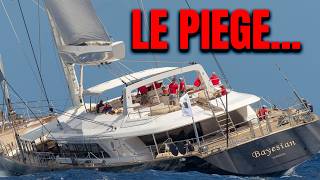
A French-language YouTube monologue giving a minute-by-minute reconstruction of the luxury yacht Bayesian's fatal capsize off Italy during the night of 18–19 August 2024. The video covers the yacht's technical design (72 m mast, a 10 m/60-ton telescopic balancing keel that can retract to 4 m), the passenger and crew manifest (12 guests, 10 crew), the rapid weather deterioration (wind rising from light conditions to sustained 30+ knots and gusts up to ~70 knots), the capsizing sequence (rapid heel from 60° to 90° in seconds), immediate rescue efforts (nearby vessel Bad & Power rescued 15), and preliminary investigation findings from the British MAIB and a Southampton stability study highlighting stability vulnerabilities (low-consumption/light loading state, retracted stabilizer, aerodynamic lift from mast, keel-extension behavior leading to loss of righting ability).
Questions this video answers
Voyage began August 14, 2024; fatal night was August 18–19, 2024.
22 people total: 12 guests and 10 crew.
72 meters.
Keel at the end of a 10-meter arm weighing 60 tons; telescopic arm folds to 4 m and extends to 10 m.
If wind exceeds 20 knots (≈36–37 km/h).
Good evening, my friends. Last year a story made headlines in a particularly tragic way. It was the sinking of the patient in circumstances that we will detail today. Today we know more, which is why I am here making this video. It is the most complete video in any language that exists on the Internet. Today, on this story we will go minute by minute and I will tell you what happened. So we are in Mederranea, off the coast of Italy. We have a certain number of guests who have taken their places on board the Paisian. The Paisian is a super, a luxury ship built in Italy in 2008. It has a special feature. It has an enormous M of 72 meters that can be seen from afar. You would practically have to place it horizontally on your screen for it to hold. Was built this way and a balancer was provided on the other side. That means underwater. You can't see it, but underwater there's normally a quill. This quill is at the end of a 10 meter arm and it weighs 60 tons. It's there to balance this mast which has a huge wind resistance, especially when the sails are out. But even without the sails, given its length and an aerodynamic effect that we'll describe later, it's capable of pushing the ship badly when there's wind. One important detail is that since this quill is 10 meters deep, it's going to create a huge little circle for this sailboat. That means that there will be lots of ports. It won't be able to go because there are lots of ports. There's no depth to put in them. So what happened is that we installed the acquisition at the end of a telescopic arm. This means that this arm is capable of folding up to 4 meters. And when deployed it is capable of going up to 10 meters. Four meters, you guessed it, is what allows it to enter the ps. The second characteristic of this ship is that these Italian manufacturers describe it as unsinkable. It cannot sink. And unfortunately this expression is found in all tragedies. As soon as someone tells you a ship cannot sink, take to your heels. So on August 14, 2024, I said that a certain number of people will be on board this ship. So what we have, we have 12 people, 12 guests. Guests, as they say. There is the owner, Mr. Lich, who is there. There's his daughter Anna, 18 years old. And then there's his lawyer and his wife. There's a jeweler and his wife. There's even a couple with a one year old baby. And there's also a partner his wife, too. What was the idea? The idea is that Mr. Lynch had been acquitted in a story that had gone around the world at the time. He had set up a company with a friend. The company grew to huge proportions. It was sold to HP or Packard for £10 billion. My friends, it's a British company. It was sold for £10 billion. So that HP could then say, we've been ripped off. It's not worth that much, and sue for fraud. Just me. He wanted to send Mr. Lynch to prison. So of course he fought. He was extradited to the United States. No one gave much for his life. In the United States, fraud is punished very severely. He could have ended up with 70 years in prison. A bolt from the blue, a dramatic turn of events. He is free, he is released. He could have died in a mythical prison, but he is free. He is released. Gloriously smiling, flanked by his lawyers, he takes the plane, returns to Europe. And this is something to celebrate and to celebrate it properly, he is going to go on his ship, the Bayesian, registered in London, his home port, London, which is in itself, when you look at it, there is a little bit of a side to it. Here is my ship registered in London, because no one registers their ship in London. It is so expensive that in general, we prefer Hamilton or we prefer to go to the Seychelles or Liberia or Panama than to register a ship of this size in London. But he wanted to assert this difference. He left the United States, I was saying, where he was threatened by the law and set off for Europe in glory without realizing that other dangers were stalking him. I was saying 12 people were on board the ship. Those were the guests, and there were 10 crew members. So 22 people were on board. The voyage began on August 14th. It started on the 14th. They skippered a little bit around the islands, sailed around the Mediterranean, which is a perfect place to walk around. And then the night of the fateful night that we're going to talk about, the night of the 18th to the 19th, and tragically, it was the last night on board, both literally and figuratively. That means that in the morning at 8am, there were taxis scheduled to come and pick them up from the docks and take them away. It was over five days of voyage ended that night. So the next day is disembarkation. The guests will stay late. They will chat, drink, eat until about 300 minutes. So it's already 7:30 minutes. They're all going to sleep. The one who's also going to sleep is the skipper, the captain, if you like so, the captain is going to sleep, but before he does, he'll give instructions. He's going to leave two men. So the two men who are there are Stuart. Stuart stays up all night because if a guest wakes up, opens the door to his cabin, or rings at 3am to ask for an aspirin, ask for a glass of water, ask for something to be cooked for him, the start is there for that. And then he associates a coachman. He has two coachmen, in fact, but they'll swap each other each time. There's one who's sleeping, there's one who's there. And to the coachman, he's going to give the following brief. He's going to tell them, I'm going to sleep. If the wind ever exceeds 20 knots, we're talking about 36 or 37 kilometers per hour. If the wind ever exceeds 20 knots, or if the boat ever starts to drift by pulling on its anchor, you wake me up. In fact, that evening, Meteo France had quite alarming forecasts for the Mediterranean. There was a lot of convective energy in the region, and this created a situation where big storms could form very quickly and then change the situation in an instant, anywhere. In fact, the Pozzian had moved about 40 km that evening. He wasn't supposed to spend the night there, he was supposed to spend the night somewhere else. But it was decided that offshore, a few hundred meters from Porticello, this picturesque little port, it was thought to be safe. So in a way, you could almost say that they threw themselves into the lion's den by leaving from another place and arriving exactly where the story I'm telling you takes place. Speaking of storms, there were a few flashes in the distance. At that time, 1830, there were a few flashes in the sky, but at this point they were very far away and the wind was only 0 knots light, roughly 14 to 15 kilometers per hour. The sea was flat, and next to the Piscean, another boat had also taken shelter. It was now 3am the first coachman had gone to sleep, the second had replaced him. He continued to watch the flashes of the oranges. He realized that they had come much closer, even though at the time the wind was still light and the sea was calm. Half an hour later, some guests in their cabin woke up. They felt some strange movements. It woke them up, but they didn't go out. They stayed in their cabin, but they couldn't sleep anymore. The wind gradually increased, and then at 3:55am it was almost 4am suddenly a heavy rain started to fall, the coachman started running around the boat to close all the doors, close all the hatches and the openings. Remember, this is an important detail because at the time it was suspected it was the shipbuilder who suggested this, that potentially openings had been left and that this had accelerated the fate of the ship. Today we know that this is not the case. Everything was closed. When he finished this maneuver of closing everything, he realized that the wind had increased there. There were 30 knots ahead. It had gone from 8 to 30 knots in a few minutes. That means we were almost at 60 kilometers per hour. And then he also noted that the pazeal was slowly drifting. That means that despite the ink, the ink was starting to be dragged and it was drifting south and slightly out to sea. By the way, the other ship that was parked not far away was also starting to follow the same path. A few moments before 4am the man on the bus realized that it wasn't just his impression, but that this time the storm was very close and that the ship was drifting away, pulling on its anchor and the anchor was no longer holding. It was dragging it. The ship next to it was also dragging its anchor. What did this man do? First he took his phone, filmed the storm, uploaded it to his social media and from there he decided to go and wake up the captain or the skipper. He went into his cabin, knocked, woke him up and said, listen, I'm not too sure, I don't like what's happening. Too much wind. We have 30 knots. There were already 30 knots at this point. That means it had gone up very quickly in a few minutes, from 8 to 30. That means this time the wind was about 55, 56 kilometers per hour. And of course the ship was dragging its anchor. So the two men went up at the same time. There was another one who woke up the chief engineer. The chief engineer felt the ship moving a little. He wasn't very happy with this movement. He understood that bad weather was coming. So he woke up and went straight to start the engines. Because he knew that he wouldn't have time to get those huge sails out and that he would have to do it, especially with such a wind. And at this time he would have to use the engines to maneuver the ship and try to control it. Besides, the ship next to them was running full throttle on this engine and it was still drifting. So they had to act quickly. In the meantime, the entire crew woke up. The crew members wake up and start running through the corridors, up and down the gangways, going up and down, calling out to Each other Note that there is already a certain sense of urgency there because normally we have extremely wealthy guests. We are careful, we walk on tiptoe so as not to disturb them, so as not to disturb their sleep. And then suddenly everyone is shouting at everyone else. So somewhere they there is an emergency situation that is developing. The couple with the baby. I was saying that there is a couple with a baby, a one year old girl. And they decide to go back up somewhere. It is parental instinct that makes them feel uncomfortable. They are at the bottom of the boat in a cabin, the floor already tilted by 20 degrees at this point. And somewhere they suddenly do not want to be there. So what do they do? They go out, they go back up and they arrive on the upper deck. Another person is going to arrive on the upper deck. Mr. Lynch, the owner, is going to arrive. He looks and at that moment there is sailor who comes back completely soaked. He was outside, he got caught in a big gust of rain. And so he sees him. And then he suddenly thinks that the taxis for 8am are perhaps a little too early, given that the night is likely to be rough, that the weather is bad. He is thinking about canceling the taxis, especially since they are only a few hundred meters from the coup. So he has the reception. That's more or less what he is thinking about at that moment. However, there are several people. It is 4:06am Nothing is going well. The wind has suddenly increased from 30 to 70, 130 kilometers per hour. In a few minutes the ship is listing 60 degrees. Terrible gusts hit and the couple who had woken up at 3:30am decided to leave their cabin and go back up. It was the last chance for those who still wanted to go to the higher ground and have a chance of survival. The skipper learned that the engines had started. He was about to start his maneuver to turn the ship into the wind and he didn't even have time to start it when the bond went from a 60 degrees tilt to a 90 degrees tilt in 15 seconds. This meant that it would gradually tilt until the M hit the water. This time it was too late. The engine stopped by an automatic safety device. And then the emergency lighting came on. People were thrown into the water. These people who were the couple with a baby, were thrown into the water and separated. The woman with the child and the husband. She didn't know where he was. While she is struggling in the water, she feels the waves tearing her child away from her. And then suddenly she loses him for three seconds. She loses the baby before she can catch him. The couple who had come back up are also thrown into the water, as are the crew members. One of them finds himself trapped in an air pocket and refuses to go down with the boat. And what does he do with all the energy of desperation? In the few seconds of opportunity left to him? He dives. He feels his way to a door. He finds it and opens a sliding door and gets out. From that moment on, all those who were unable to get out will never get out. The survivors start to drown, start screaming in the water, gather together, cling to floating objects. One of them is injured in the arm. It's a pretty nasty wound. And a sailor gives him a garou in the water, gives him a garou to stop the bleeding. They look ahead and they see the Bayesian lying in a grotesque position. The owner, Mr. Lynch, was last seen by a sailor when the ship was at 60 degrees Celsius and the water had started to come in. He had helped him up the stairs, but he hasn't been seen since. He had probably gone back to get his 18 year old daughter, who must have been sleeping in her cabin. It's 4:24am the castaways float in the water for several minutes, buffeted by a strong wind and rain, clinging to whatever they can. Two sailors managed to swim towards the Bayesian, which hasn't sunk yet, which is lying down, but hasn't sunk. They managed to swim towards the boat and managed to unhook two inflatable tubes. These are circular canals with rain protection. They manage to unhook two of them. The first one refuses to inflate and fortunately the second one opens. Gradually he gets in. The couple who Woke up at 3:30am Are there. The couple with the baby are there. They are in this fragile boat and they try to get as many people as possible and they are going to get in this boat. Ten minutes later, he tries to attract attention. He starts launching flares. He launches a first distress flare. This one is immediately carried away by the wind. No one sees it. With their phones and everything. They try to signal towards the road. He sees the road which seems so close. He sees the hotels, the windows, but it is dark, everyone is asleep. They are just trying to attract attention, to say we are here. They will launch 10 minutes later, at 4:34am, they will launch a second rocket. This second rocket will attract the attention of someone on the ship that was next to them. They are the ones who will try to rescue them. During these moments, the pion will rear up and then it will sink. And disappear under the waves at around 4:53am well, the ship that was parked next to it, the Bad and Powell had sent a small motorboat with members of its own crew. They had already rescued the survivors of the Paion and brought them back to the ship. So they loaded them into the Bad and power and immediately left. This means the captain or skipper of the Payan went back to look for other survivors. In the meantime, the crew of the Biden power contacted the Italian coast guards who were just starting to get moving to come and help as well. We won't find anyone. The 15 people who were rescued were there safe and sound, apart from a few injured people, a few who had twisted something or sprained something during their rapid evacuation or rather their fall from the ship. Well, there were seven that we couldn't find and these seven were people who were going to die in the Bajan, some in very specific conditions. That is to say, statistically, we can see that out of the 10 crew members, nine escaped, one died. He was the chief, the ship's cook, but nine escaped. That means that as a crew member we had a 90% chance of getting out of it. Why? Because the crew members know the ship very well, are more used to walking on it, sailing on it and all that, than the guests, some of whom had been there for five days. And for the first time, while the people who work on the boat know everything, including a little bit about what goes on behind the scenes, so they can very quickly be outside. And what's more, they woke up before the others. Another thing, if we look at the guests, there were 12 of them and outta 12, six died. That means the guests had about a 50% chance of staying on board. So we see that there was literally five times more chance of losing their lives that night. The investigation will begin. And in the meantime, already on the first day, the manufacturer, the shipyard that built and designed the Bayesians and, and the designers began to say, no, it's not possible, something must have happened, but this is not normal, this is a ship that can't sink. We don't understand quote and all that. And yet what happened is that the British mabe, the British Maritime Accident Investigation Bureau, well, it started looking into the construction in detail and then it also involved a naval university which in fact carried out a stability study of the base. And what did we discover? We discovered several things. Firstly, the stability study was always carried out with the acquired knowledge completely out. That means what we did, we carried out studies with three different loads. The heavily loaded ship and that is the maximum stability. Because the heavier it is, the lower it is in the water and the lower its center of gravity, so the more stable it is. Firstly, we created an intermediate value of intermediate loading. And then light, light, light configuration. That is the worst in the case that interests us. Since this ship was at the end of the voyage, it was in the worst configuration. That means 90% of the consumables had gone. The water, the fuel, all that, everything that constitutes weight, ballast had already been consumed. So it was in the worst possible configuration. Furthermore, the stabilizer had not been removed. So why had the stabilizer not been removed? It is not yet mentioned in the report, but it would seem that there was the following problem. The stabilizer is placed at the end of a telescopic arm. A telescopic arm that will take it 10 meters. This arm, given its length, given the weight of 60 tons, that is at the end, and by the very fact that it is telescopic and that it comes out of the hull of the ship, it can move with the current. And by moving with the current, it can hit, can make a clicking sound, it can create a metal on metal noise. It seems this is the reason why it was sometimes preferred to raise it to minimize the torque arm, precisely to minimize or completely eliminate the noise. That way there was no noise. It was probably a question of comfort, because otherwise, if you look at where the ship sank, it sank to a depth of 50 meters. So when it sank to a depth of 50 meters, you can clearly see that there was enough thrust behind it to allow the keel to be extended to 10 meters. Unfortunately, that was not a choice that was made. Otherwise it could have saved the ship. The study by the University of Southampton revealed an absolutely terrible detail. It revealed that the ship was compensating for being able to go beyond 90 degrees, because with the extended keel angle, it could go up to 91 or 92 degrees. That means it could lie down completely and then rise again. They discovered that if the keel angle is not fully extended, this counterpoint is not extended. From 60 degrees onwards, it enters a situation of increasing imbalance. That means from 60 degrees of inclination, the chances of seeing it come back are almost zero. It won't come back. That means from 70 degrees. They also found that it was likely to lie down in this way permanently, in relatively light winds, much lighter than what was predicted. And here an aerodynamic aspect that will come into play. That is to say that we see that from about 63 knots, we are talking about a little more than 120 or 120 km h, roughly. I will do the exact conversion during the assembly at 63 knots without the acquired. Well, it goes quite willingly to 70 degrees or more, especially when it is light, when 90% of the consumables were no longer there, like that day. So this ship, well, it was a trap. It was a ship just waiting to capsize one day. That means that every time it was used with the acquired wind, it would have required a wind that is not exceptional, that is not of biblical strength. We are not talking about a wind that comes once every 100 years. We are talking about a wind that is encountered from time to time in the Mediterranean several times a year. Well, it was waiting for this type of wind to die down. Let me add a detail. The M is profiled. It is an aluminum M that is profiled. The section looks a little like an airplane wing. The University of Southampton found that it has an aerodynamic lift effect. That means that when the air attacks it at an angle, and they say up to 20 degrees below 20 degrees, well, it adds force. In fact, it is simply an airplane wing. It is lift. I mentioned it when I talked about the video when it was in the news last year. In fact, they even found that from 20 degrees this aerodynamic effect. Sorry, from 20 degrees this aerodynamic effect weakens. What does that mean? It means that at 20 degrees the wing actually stalls. Because when you look at the wings of an airplane, you can see that from a certain angle of attack you reach a stall. This time. This means that there is not much lift anymore. There is more drag than lift. Well, the lift of this m up to 20 degrees is probably the angle of attack of CZ Max. It is there and then it drops sharply. But in reality it was attacked under an angle that was unfortunately optimal. That evening it went down. Now, the other thing about people, when we sent divers, because for several days we sent divers to a depth of 50 meters, they didn't have much time. They only had 8 meters, 8 minutes of autonomy before having to come back up. And a diver can't dive several times a day in those conditions. So you need a lot of divers. You have to retrain the men very quickly. In fact, they even had one death. One of the divers was killed during the exploration of the Pagan. And inside it's very difficult to move around. Why? Because there's furniture that's overturned and all that. It's not easy to move around. By the way, the people who fled their cabin and the couple I mentioned who fled when they Woke up at 3:03am well, they said that when they had to leave the cabin, since it was tilted, that's what you have to consider. They had to climb up it. They had to climb up shelves. Because what happens is that if you're in a cabin and it's horizontal, well, you're there, the door is right there. When the cabin tilts 60 degrees, you're at the bottom of a well and the door is on the ceiling. So you have to climb up. It's not always easy. Above all, there are lots of objects that fall. So the furniture and everything else is usually fixed, but they don't fall. But the mattresses on top, the books, the decorations, the knick knacks, the luggage, the suitcases, the shoes, everything falls down. And that can create obstacles. And these people had to climb to get out of their cabin. That gives you an idea of the difficulty for those who were still there when the ship was at 90 degrees. And I'll add a detail. When they found some people, some of the bodies that they brought up. Well, the autopsy showed no water in their lungs. That means they hadn't drowned, they had died of asphyxiation. What does that mean? It means that, you know, sometimes when ships sink, there are air pockets, pockets that form. And in these pockets, a human can find refuge. But there isn't much air. This earth compresses, compresses a bit like a syringe with air in it. And when you squeeze, you compress this earth. So it will compress, heat up a little, but its volume will decrease. And the thing is that several people seem to have been trapped in air pockets for several days, and then they died because there was no more oxygen. Because what happens is that in an air pocket, it depends on its size, of course. There was once a sailor in Africa who survived for several days until he was rescued. He survived for several days in a wreck that was at the bottom of the water. By the way, the divers that were sent there weren't to save anyone. We thought the people were dead. They were to go and get the bodies for the families. And when the divers emerged in this space with their torches and all that, they found a guy who was there. He was alive, but he was already alone. So he was consuming less than if there were several people. Plus the volume he was in was relatively large, so he was able to hold on. But the people who were in the Pagan were in relatively small air pockets. There were several of them, and so the oxygen was inevitably consumed. And that's how they unfortunately met their deaths. So there you have it, my friends. I'll tell you a little bit about this pagan story. The final report hasn't come out yet, but I think we now know the main points. Thanks for watching this video so far and I'll see you in the next one. I have to do an update on the Titan. See you soon. Sat.
More from Aldo



La FIN du Royaume-Uni ? L'Ecosse, l'Irlande du Nord et le Pays de Galles veulent partir !




Analyse Présidentielles 2027 : Marine le Pen remet ENCORE le voile sur la table !


Scandale "60 Millions de Consommateurs" : la France mange des pâtes contaminées au Cadmium !

2 dossiers : Accident d'autogyre en Italie & un pilote sauvé par le parachute du Cirrus