Pression invisible : client pressé, le jet privé arrive comme un MISSILE !
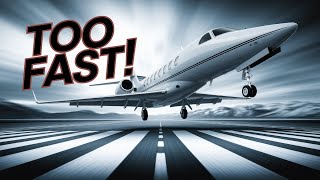
Narrated YouTube monologue recounting a June 12, 2000 accident involving a Cessna Citation 560 (private jet) that attempted a high-speed approach into Zurich after a passenger requested a diversion. The captain (≈2,500 flight hours) centralized control, ignored crew input, and flew an unstable, fast approach (≈245–257 kt) with delayed gear/flap deployment; the aircraft touched down long with ~600 m runway remaining, activated reversers/ABS, and then exited the runway. The co-pilot (just under 1,000 hours) was later seriously injured and never flew again. Investigators criticized both the captain's decisions and the co-pilot for not calling a go-around earlier; the event is used to illustrate poor crew resource management and the risks of yielding to passenger pressure.
Good evening, my friends. This is the story of two pilots who board the same cockpit, but who never fly together. It happens very often. They are pilots who do not respect or recognize each other. And then in the end they do not communicate, they do not work together, they do not form a crew or even a team. Each one is in his own corner, I think. On June 12, 2000, a Sassna Citation 560 approached. It is a private jet with a jet engine in the back. So it is not the private jet that is capable of taking you from Paris and then landing in San Francisco non stop. It is more of a jet, let's say, for regional aviation more than anything else. And that day it leaves from Farbao airport. Farbao, if you like, is the British burger. In a way, it is an airport with a lot of private jets. So they leave Farmbow to go to San. They have a client on board. There are three crew members. There is the captain who has 2500 flight hours. He is the one who leads the operations. It's a one man show that day. He wants to centralize all the decisions. He doesn't have much esteem or respect for his co pilot. The co pilot has a little less than 1,000 flight hours. He is not very experienced on this plane on which he has not been formally trained. But he is there to act as co pilot because someone somewhere needs to tick a box on a form. There is also a person who is the cabin crew and a client. The client wants to go to Soanen in Switzerland. The plane is a Bravo Hotel registration. It is a Swiss plane. You know, business aviation is very flourishing in Switzerland. But generally speaking, whether it is Swiss made on a watch or on chocolate, it is generally a sign of quality. As for the Bravo Hotel on a private jet, I wouldn't say so. There are operators who are very good, but there are many Swiss operators who are almost out of the game. So I was saying that we have this plane that takes off from FARB to go to Sonnen, Switzerland. It takes off and at one point it's a summer day and there's the customer who comes to the cockpit and asks us to change destination. This time he wants to go to Zurich and he insists he's in a hurry. You have to know that when you're a customer on a private jet, it's one of the rare occasions when you have the privilege of doing this. Having the plane change its destination, diverting it if you want, without incurring the wrath of the law. You're within Your rights. It's like taking an Uber or a taxi. You have every right to say, I've changed my mind, I, I'm going somewhere else. So he changed his mind. He wants to go to Zurich. That creates a bit of a disruption. Nevertheless, it's still reasonable. It's a Swiss company. They usually fly to Zurich airport. He's not going to tell them we're going to Cali in Colombia or somewhere else. It's just a simple international, well known airport. Well run by the way. So at this point, maybe, maybe a small revelation of a conflict of interest. The co pilot of this plane is an excellent friend of mine. Even though I haven't seen him for a long time, I still have a lot of friendship and a lot of respect for him. He's a very good pilot and he's also an extraordinary person. You can always find good pilots, but good pilots who are. I feel like the entire pilot community is going to fall on me. Who are people who are as nice as generous. You can't find, you can't find many of them, even though I know a lot of them personally because thanks to this channel I've made friends all over the world in this, in this community. So I'll continue. I was saying that once they arrive in Zurich, since the traffic isn't very heavy that day, we'll allow them to do a little bit of a high speed approach. That means we tell them, okay, the speed is at your discretion. Normally there are speed limits, but on that day the controller had no particular reason to impose limits on this aircraft. So he let them do pretty much whatever he wanted. So what they were going to do was they arrived at level 100. They were at 250 knots, which was a little higher than the 240 knots imposed in the region at that time. But that's reasonable. In most countries below level 110,000ft, you have to stick to 250 knots or less. That's what they were going to do. The problem is that this speed wasn't going to change much. They were going to maintain this speed because the customer was in a hurry. They had to get there quickly. At 2,600ft, 2,2600ft, the aircraft was a few minutes before landing. There are literally three minutes before landing. Right. The Runway is there in front. They have the visual on it. Runway 14 is a long Runway. So it's a Runway that could land in a 380. Right. And so the guys, they're still going fast. 245 knots that means the speed has only dropped by five knots since the 100 level. A little later, once they're at 1,600ft, this time the speed has increased. The speed is two hundred and fifty seven knots. There are even moments when normally they should have received the overspeed warning, the overspeed warning sound. But it seems that one hand pulled the circuit breaker, the fuse if you like. They're fuses with buttons and like that you, you pull. It seems that one hand pulled the fuse of the overspeed so that it was flying at a higher speed. Right. Than what was permitted, what was certified for the aircraft without setting off the alarm. So probably it was someone in the cockpit who was flying brutally. The co pilot signals during the approach on numerous occasions by saying, do you want the spoilers? Do you want like here, I take the lever, I pull back, I'm going to extend the contrails a little bit. There was no response from the captain. Captain De Born did not seem keen to talk to him. The only thing they had more or less agreed on was that since their client was in a hurry, since they were in a private jet that did not need the entire length of the Runway, well, what they wanted to do was land relatively close to the end of the Runway and that way they could exit the end of it. Because what he did not want to do was land normally in the landing zone, brake, exit and then taxi for 20 minutes. Yeah, Zurich airport terminal. So he thought to himself that if I could just exit completely to the end of the Runway, that would save me five or 10 minutes. That was more or less the plan. So the co pilot thought to himself, okay, we have to trust the plan. As the fans of Trump, we have to trust the plan. There is a plan. Yes. It's true that we're going fast, it's true that we're barely above the ground and we're hurtling like a missile. We're at VRF 130 knots, right? Uh, we don't have the landing gear down, we don't have the flaps down while we're barely above the ground. I mean, the passenger, he's sitting there, he's looking out the window, he can read the license plate of a parked vehicle, but the landing gear is not down. In reality, they're only going to start lowering the landing gear and flaps when they're a few hundred meters from the Runway at 12,000 nautical miles. Right, we're 900 meters, we're less than a km from the Runway and at the speed he's going, the Runway Will be there in a few seconds. So he starts flying over this one. And while he's flying over it, right, he continues to prepare the plane for landing and the Runway, they're eating it up. Finally they manage to touch down. He, he touches down at an excessive speed and by the time he touches down, there's 600 meters of Runway left. So there, his idea of landing, the captain, his idea of landing at the end of the Runway. He pushed it a little bit to its limits. He pushed it to its quintessence. Somewhere he lands, bam. The front end pauses. Since he's going really fast, well, he's not going to lose energy easily. You have to know one thing. These planes don't have a lot of wheels, right? We have one wheel on each side. I don't remember if the Cessna, I'll have to look. It has two landing gears that are braked, so there are normally one or two wheels in there. And then there is the nose wheel, which is not braked. So in terms of contact with the ground, it is not huge, it does not brake well. Furthermore, since there is always residual lift on aircraft, especially when they are at high speed, it will not create very strong pressure on the aircraft to allow effective braking. So he lands, starts braking. The ABS system is triggered. They put the thrust reversers to full on both engines. And the speed is not dropping quickly there. The co pilot is going to say something that will probably be the only mistake perhaps of the entire flight. When he said, go around, go around, the captain ignored him. They did not go around. And then finally they went off the Runway. They went off the Runway abruptly, a big shake up, like they say in Switzerland. And then finally the plane came to a stop with 30 broken landings. They got out. The customer who was in a huge hurry found himself on all fours, crawling in the grass with his weapons and luggage around him. So the gentleman was served. He wanted to get there quickly, he got there quickly. And the captain was never able to explain what went through his mind. He was probably someone who regularly overstepped the mark. And as Alphonse said, once you overstep the mark, there are no more limits. So once you step outside the bounds of the rules and the usual standards of the profession, you're in uncharted territory. I mean, sometimes it works, sometimes it works, and then one day it doesn't. It was one of those days. It didn't work. Later, the investigators went over all these details with the black boxes and the cvr. They also criticized the co pilot for not having requested A go around earlier because given the approach, which was not stable and was very fast, it would have been correct to request a go around much earlier. That said the type of person he was flying with, I'm talking about the captain, we probably would have done as he pleased. He wouldn't have said, oh, okay, go around, okay, no problem, I'll do it. He probably would have. He would have completely ignored it. He was someone who was determined he had ignored it. He even had a GPWS warning. That means at some point, since he was flying very low and the landing gear was up and the flaps were down, the ground proximity warning system had started to get ideas. It had started to imagine that it was an aircraft that was going to hit the ground because of a warning. It even started to send a warning signal and the captain persisted. That wasn't enough of an incentive for him to go around. So I don't think he would have gone around for that. On the other hand, on the other hand, what they pointed out as an error is that their calculation showed that if the captain had put the go around once they were braking and the spoilers, the spoilers were out and the reverse and thrust reversers were activated, if they had decided to go around at that point, what would have happened is that they would have very probably hit the terminal opposite. That means they would have picked up speed, they would have left the Runway at the very end and they wouldn't have been able to take off. They wouldn't have had enough time to take off before hitting the terminal a few hundred meters away. So in a way, they shouldn't have gone around. They just had to accept the decree of Providence and agree to go off the rails as they did. It was a situation that could have ended extremely badly. They were lucky that the wing didn't break, the plane didn't catch fire, all that. So it's still very lucky that it could have ended much worse than that. Another thing, even if the accident report doesn't say so. No, the accident report says that there were no injuries. The co pilot was injured, quite seriously injured, and he never flew again. That was the day that accident, that was what sealed the fate of aviation. And then his career ended that day. I don't know about the captain. I hope he didn't take on the responsibilities of an aircraft later on. But well, knowing the field, I highly doubt it. Thank you my friends for watching this video so far and I'll see you in the next one.
More from Aldo



La FIN du Royaume-Uni ? L'Ecosse, l'Irlande du Nord et le Pays de Galles veulent partir !




Analyse Présidentielles 2027 : Marine le Pen remet ENCORE le voile sur la table !


Scandale "60 Millions de Consommateurs" : la France mange des pâtes contaminées au Cadmium !

2 dossiers : Accident d'autogyre en Italie & un pilote sauvé par le parachute du Cirrus