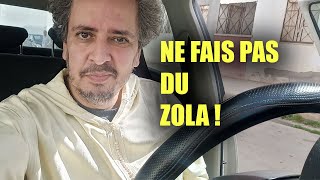
A French-language YouTube monologue where the speaker recounts a chaotic immigration-driven career path and explains how a fragmented CV hurt job prospects. After emailing a career coach, they learned the central insight: 'your CV is not your autobiography — it's a sales brochure.' The speaker advises tailoring CVs and cover letters to each employer (seen as clients), modularizing a long master CV into targeted shorter versions, temporalizing cover letters, and focusing on relevant skills/keywords. They report improved response and hiring after applying this method in the UK.
Hello, my friends. You know, I've had a very, very chaotic, very difficult journey in my life. Here you see me in my native country. Hey. Hi. There are people who come to say hello to me. That won't happen in a while. Wait, it's thin. Are you okay? I'm telling you, I don't know. I'm. So I was saying that I've had a chaotic journey since I left my country. Chaotic in what sense? Chaotic in the sense that I've been to many countries and each time, well, it wasn't going well. You know, immigration is not a bed of roses. I left here and then, well, I was in Switzerland, I was in France, I was in Germany, I was in the United Kingdom. I. I've been to many countries. I studied studies that sometimes fell through because I didn't have enough money to continue. Because sometimes they wouldn't renew my residence permit. Because, because, because it's not necessarily my fault, but the fact is that I ended up, after a while, with a CV that was all over the place. So what does a CV that goes all over the place mean? When you look at it, you. You think, what is he? What is this thing? What is this career path? He goes there, he goes there, he goes there. I don't understand what this guy does. And so my cv, I had the impression that it was working against me. After a while, I was looking for stability, but I was really bothered by it. So what did I do? One day I was watching a show on CNN and they had brought in a woman who was a job counselor, a job coach, whatever her name was displayed below like that. And I decided to send her an email. I just googled the girl. There was her website, there was her email. I created an email for her. It was really. How do you say it in English? A long shot. It's a long shot. It's really. When you shoot really far, you have a gun that can reach 1000 meters, and you shoot at a CIP that has 1500. I mean, it's really far. I wrote to her, I said, listen, here. Here's my problem. I sent her my resume. I said, here, I have a resume. When you look at it, you get the impression that you're dealing with a fantasist. That's it. So what do I do? And surprisingly enough, this woman, who is a celebrity in her world, who is probably a very busy person, and who is probably someone you have to pay a lot of money to access without knowing it, she replied to me. She replied to me, she replied to Me in a very kind way. She replied to me in an elaborate and personalized way. And in fact, I'll tell you what, she told me something important that came out of her email. She told me your CV is not your autobiography. She told me your CV is a sales brochure. It's a sales brochure. I have knowledge, I have expertise, I have experience. I want to sell it to a client. The client is looking for something. For example, I have expertise in cyber security. So if I'm going to write to a company that wants cyber security, I'm going to highlight my experience in cyber security. I have experience in networking. So if I have to contact the company that does networking, that's what I'm going to bring out. But I won't necessarily. I have expertise in aviation. I even have a housing channel that works very well. But I'm not going to put it on a cv. I'm not going to put it. If I'm shouting at a company that does cyber. I'm not going to go on about my aeronautical training and then make half the cv, half the keywords about aeronautics. People will say, but wait, this guy wanted to send his CV to an airline. Did he make a mistake? Did he send it to us or something? You see what I mean? So you have to see the CV as a sales tool. It's not an autobiography. When you read the cv, you're not interested in your life. It's not because you want to understand your life. You want to understand the skills that we need in our company. So the idea is that you have to adapt your CV and the worst mistake you can make, and I've seen this, unfortunately, a lot of people do it, is that they write a generic CV or even a generic cover letter. So sometimes they'll pay someone and tell them, I'll write you a cover letter and a cv. It doesn't make sense because the CV and cover letter for a sincere, serious search are always personalized. I'm not saying that you have to rewrite it from A to Z every time, but personalize it. Let me give you an example. Sometimes I have headhunters who write to me. And you know how they open their email? Some of them open it like this. And hi, it's Thursday. Today is Thursday. For example, Hi, it's Thursday this week with the railway strikes, it's been very difficult. But fortunately, the weather has been very nice. I hope you're doing well. Listen, I have an interesting client. I'd like to talk to you about him. Why does he mention the strike? Why does he mention the weather in his email? Why do they do that? It's to tie it to a time, it's to tie it to a calendar. What does that mean? That means that the email I'm reading was written today. It's not an email that's part of a database that has thousands of emails that are randomly generated and that we've been sending the same template to everyone for five years. So the email that's sitting in time, in temporality, means that it was written today. So the same goes for a cover letter. I'm not saying, I hope you're not going to talk about a strike or about the weather in a cover letter. That's not it. But when you send a cover email, for example, if you want, if you can temporalize it, that means adding an element that temporalizes it. That would be absolutely perfect because it means that you haven't been sending the same thing for months and months and months and months, okay? Especially since these people who sell CVs or templates or whatever, and often they sell the same ones to everyone. And then you start getting the same cover letter over and over again. Do you see what I mean? You adapt your CV and you adapt your cover letter by thinking of it as a brochure presenting a service. You are selling a service. And these, and these and these elements must allow someone who is reading them to buy your service. Because what you are looking for, you are not looking for a job. That is what is important to understand. You are not a job seeker. You are a seller of services. You are selling your services. Who are, who are you selling them to? You see them as a client. So the person you are going to write to is not your potential employer. Don't see them like that. See them as your potential client. You send a brochure to a client, I want to sell this car. If I write a brochure about this car, I will include the elements that interest the client. Client and allow them to make a decision, decision to contact you or not. Arouse curiosity, arouse interest. Am I going to contact this person or not? Okay? And honestly, that's what she told me. Your CV is not your autobiography. That flashed in my head. I took the CV back and said to myself, yeah, she's right. This isn't a cv. This is an autobiography. So I started removing, I removed a lot of things. And I started approaching companies, saying to myself, okay, first I wrote a very long CV that was, I think, four or five pages long that I never sent to anyone, but it was modular. Then I said to myself, okay, then that's okay. Remove this, that, or keep this, that, take this block, this block, this block. And from this CV, I created CVs that I sent out that were smaller, one and a half or two pages long, but that consisted only of very specific and specific elements for the employer I was targeting. When I started looking this way in a dynamic market, I sent out three CVs to the United Kingdom. Of the three that I sent out, I received two responses. Of the two responses, I had two interviews and one of them hired me. Do you see the thing? Do you see the efficiency? Do you see the strength? Whereas before, I would send out a fancy CV to everyone and then in the end no one would respond because no one recognized themselves in it. It's important that you don't necessarily recognize yourself in the cv, even though that's important. It's the client, your client, who has to recognize themselves in this CV and say, ah, that matches what we want. Okay, that's it, my friends, thank you for listening to this video so far and I'll see you in the next one.