Turbulences Mortelles : Singapore Airlines SQ321
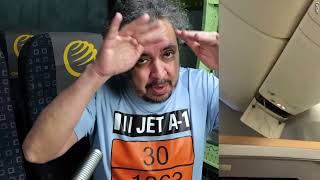
Aldo Sterone narrates a YouTube video about a severe turbulence event involving a Singapore Airlines Boeing 777 that caused one passenger fatality, about 30 injuries and significant cabin damage. The speaker emphasizes always wearing a seatbelt, explains how powerful convective cells (cumulonimbus) can produce sudden, extreme vertical accelerations that briefly put an airliner into a ballistic/non-aerodynamic state, and recounts related historical incidents (including an Air France A330 flight in February 2012) and personal anecdotes to illustrate pilot responses and limits of avoidance.
Questions this video answers
One killed; about 30 injured.
About 40 seconds.
About 8,500 ft per minute.
Approximately 5.1 G.
February 2012.
Good morning, my friends. In today's news, a rather tragic event occurred on a Singapore Airlines Boeing T7. This Boeing went through turbulence, an area of extremely severe turbulence. Although in aviation, turbulence is classified into three mild, moderate, and severe. There is no such thing as extremely severe in the aeronautical sense of the term. But between us, we understand each other. Severe enough to shake the passengers. Those who were not wearing seatbelts flew out of their seats, and unfortunately, one was killed, 30 others were injured, and there was considerable damage inside the cabin among passengers and flight crew. The photos are quite impressive, and it is something that happens from time to time. I want to say, even if pilots know how to avoid this kind of thing, well, throughout their career, they avoid it. And then one day, instead of turning left, they turn right. And there you have it, disaster strikes. In this case, unfortunately, it caused death. To tell you, given the media sensitivity these days to Boeing bashing, I would like to tell you that if it had been an Airbus 350 that had gone through the same turbulence, the laws of physics are the same for all manufacturers, it would have ended up with roughly similar damage. I would like to tell you something. When I travel by plane, there is one safety element that I consider absolutely essential, and that is to keep your seatbelt on at all times. You will see that there is this fasten your seatbelt sign that is displayed during takeoff and landing, but at a certain point it stops. It means that you can remove your seatbelt to fly. Sure, if I have to fly, I take it off. But when you're in your seat, honestly, it's not worth the risk of taking it off. As soon as the pilots release the passengers, you hear that distinctive click of people taking their seatbelts off. You hear it all over the plane. Well, that can make the difference between life and death. When there's turbulence, it can make the difference between arriving home and saying, you know what? I'm going to tell you something. Today I was on a plane. It was really bumpy. It could be the difference between telling people that and the difference between learning to walk again, for example, because there were people. One guy was killed and 30 others were injured. I remember a pilot telling me about a pilot from Algeria in the 90s. He told me something and I thought he was exaggerating. He said, we went through some turbulence by surprise and then we landed. It's pretty much like what happened with Singapore Airlines. He told me that there were footprints from a passenger's soles on the ceiling. It's really hard to believe, but in Fact, a passenger took off his seat and hit the ceiling and came back luckily. He was just. He. He had a few bruises and then he got through it. If you look at the photos on the Singapore Airline, you have marks. You have very characteristic marks. You see that the plastic there, the decorations and everything. Well, they are. They are concave, right? Well, it's concave and it means that someone hit it, right? It could be by people on the head or something. And that causes considerable damage to humans. I can tell you something. These planes are designed to withstand such a high number of GS that passengers can be seriously injured or even die while the plane lands normally and two hours later it resumes its flight without the slightest problem. 547. I talked about it on this company channel. I think it was China Airlines W China. I sometimes tend to confuse the two companies. Oni sohim actually thinks the 747 stalled because they were in cruise flight and lost an engine. The guys started talking a little too much. They were talking when they were supposed to start descending because the plane couldn't maintain that altitude on three engines. So they started discussing what to do. And it reminds us a little bit of that Elvis Presley song. Little less conversation, more action. Please quote. In fact, there was no action. The net result was a loss of speed, a stall, and then they went into a barrel roll and everything. The plane received 5.1 grams. 5.1 G. That's a huge number of GS. That's a number of GS that can knock a lot of people out. This happened in a story about a 727 that I am currently preparing for you where they caught. Geez. Following a loss of control, the flight engineer sitting in the middle between the two pilots who were sitting in a slightly back seat fainted. He fell onto the console, but he was strapped in. He didn't die. He woke up later on at 5G or 4G. You can find yourself unconscious, you can find yourself seriously shaken. But if you are strapped in and everything is fine, if you are not strapped in, that's what really kills. It's not the crashes themselves that kill. It's the fact that people are thrown around inside the cabin and well, it can be extremely violent and cause deaths. I would like to tell you about a story. This story happened in February 2012. We were on an Air France flight. It was an Airbus A330. And in fact, when we say 2012, we say Airbus 330. We say air France. We immediately think of a Very strong sensitivity at the time. Remember Air France447? I didn't necessarily want to mention it, but just to give you a bit of context, the air France Airbus447 crashed in June 2009. In 2012, the memory was still vivid. The reason is that it took a long time, it took months to find it. It took two years to assemble the black boxes and all that. So in 2012, the story of the 447 was still relevant to a lot of pilots and to the public in general. We have an Airbus 330 that is going back up from Madagascar to the unpronounceable capital. I have it in mind, but I'm not going to try to pronounce it. It was supposed to be going to Charles de Gaulle. He took off in the evening from Madagascar for a landing that was scheduled for early morning at Charles de Gaulle. So it was a night flight. In their weather report, the pilots just have a little indication that towards the equator, when approaching the equator, there are areas with quite a few convergent phenomena. This means there are cumulus nimbus clouds, that is to say, clouds that develop vertically. And some are extremely powerful. They will push the air upwards. Real chimneys, you can easily reach speeds of 100 to 150 kilometers per hour inside. So it can be extremely powerful. Generally when it reaches the tropopause, the. What happens when it reaches the atropause, it is supposed to stop and it is not supposed to go any higher. So it starts to flatten out into an anvil. So that's why they have this very characteristic anvil shape. Now there's also a question of inertia. When the air is pushed violently, when it is pushed violently through the, the, the. At the level of the athropopos. While sometimes it exceeds and goes into the stratosphere before, before, before flattening out, giving, giving, giving very characteristic temperatures where we have, somewhat paradoxically, air that is at altitude so that it is colder than the air that surrounds it. A bit of a very, very special phenomenon, but radars are very capable of detecting it. This Air France flight, I was saying, had received information in the weather report that we are in the south between latitude 12°S and 2°5 south. And well, it could shake. 10 degrees latitude is what. If you watch the video on why we use 1,000 nautical miles in aviation. Well, 10 degrees GR latitude, we are on a great circle. We have 10 degrees GR, so we have 600,000 nautical miles, so we have about 1,100 kilometers roughly, that's because 1,000 nautical miles is 1852 meters. If we look at the speed of the plane, it it will take about one hour to cross it, because they are not flying on a north, south, north heading, but they are a little off center. So roughly it takes 1 hour and 30 minutes to cross all the hazards that they will have to go through. Our pilots are at level 360 and the air traffic controller asks them twice, do you want to go up to level 380? He asks them if they do not want to go up to level 380 and they say, no, we prefer to stay where we are. Not that the plane wasn't able to go there. It was able to go there. But at that time it had developed, precisely following the alleged crash, that the Airbus pilots began to avoid going to the maximum possible altitude which is displayed on their screen only by setting the rec max. They preferred to leave a margin compared to the rec max, even if in reality the manufacturer leaves fairly comfortable margins to the rec max. At the RC max, we we are not in what is aerodynamically called the coffin corner. There is still some margin. There is enough to do at the wrecks. But the pilots began to be a little more conservative that day. It may have saved their lives. So they are flying in this area gently heading towards the equator. They have about half an hour left to cross. Is dark. I was saying they can see the stars, so they are not in a cloud mass. He sees the stars on the radar. There are a few cells that they avoid on the right and left, but they seem to be okay. There is no turbulence where they are. And yet from time to time he sees lightning. Now, lightning can occur between two cloud masses, can occur within the same cloud, can occur between a cloud and the ground, but there is always a cloud in the equation. So he sees lightning, but at one point he sees lightning, and the next moment it is literally the gates of hell that open. On this flight. There is extremely brutal turbulence that is going to occur. The pilots are rescued in all directions. There's already a noise, There is a tremendous noise of ice hitting the windows of the plane that makes it impossible for the two pilots to talk to each other. There are two of them side by side in the cockpit of an A330, but they are having trouble talking to each other. The autopilot is going to disconnect right away. It is going to disconnect right away, leaving the pilots with the little ugly ones. The problem is that the captain is having trouble using his left hand to reach the mini stick. Why? Because his arms are sometimes thrown to the ceiling with the G's his arms are going. Later, he manages to reach the mini stick to control the plane, which at times goes into a 30 degrees bank. So it is extremely difficult. But he is unable to pilot once he gets his hands on it. Why? Let me show you. We have this, we have this, we have this, we have this mini stick. It looks a bit like the mini stick on an airbus. So he puts his hand on it like this, except that the plane moves. The plane itself moves. The. The plane is not stable. So what happens is that he finds himself hanging on the ministick with a plane that moves in all directions. So involuntarily he will introduce movements, movements on the ministik and therefore these will translate into movement on the flight surfaces. In this configuration. The movement of the ministik gives, if you pull like this, a response and incidents. Not a response in number of G, but it is something or in load factor. I don't want to explain would easily make the video a good hour longer. So I was saying that it is extremely difficult to fly. So after a while he develops a technique that is very interesting. It is this one. The guy has to be inventive. The captain has to be inventive. So what does he do? Start doing this, start doing that. That means the minibus, it comes out that it returns to the center. So it gives a little push to. Correct. Then it lets go. So it starts to pilot like this. That's abrupt in piloting, but it's a precarious form of piloting. Let's say the buttons in front of them, for example, they have the autopilot button. They want to reconnect the autopilot, but they can't. Why? Because the button for the automatic batteries, I have one there. It's this size, it's very small. You. You see, I can cover it with my fingernail. The problem is that it moves in all directions. So when they want to hit it, well, it's not easy. It hits the wrong way. It becomes very difficult to reach this button in the middle of the console. The instruments are the same. The instruments move in all directions. It becomes very difficult to read them. And in fact, there was a phenomenon that occurred, which was that the plane began to climb at a speed of 8,500ft per minute. 8,500ft per minute is something unimaginable. It's something that the Airbus 330 even empty, even with five liters of fuel, zero passengers can't do at 8,500. It's an airplane that is being carried. It's an airplane that suddenly finds itself in a kind of rising air that is literally trying to throw it into orbit. These pilots, thanks to their training, escaped an illusion that could have been fatal to them. Quite simply, you know, the plane is lifted, lifted suddenly at 8,500ft per minute. But for a pilot in his seat, it feels like he's been kicked in the butt. And it feels like the plane is nosediving because it's being lifted suddenly and potentially the wings are higher than the cockpit because this force is being exerted on the wings. So the plane tends to pitch down and then it's being lifted. A non inverted pilot, the risk he would have had was to say to himself, I'm nose diving, I'm doing this, I'm pitching up. And so that could have gone very badly into a stall. So these pilots will find themselves at some point in a N landland because very quickly they reach level 380380. So they're thrown 2000ft like this, they're literally blown away. And then something will happen which is that they end up in a ballistic trajectory. That means when you look at the speed bar on what is called the pfd, the primary flight display, the primary screen, where there is the artificial horizon and to its left, like in a Sasana 172 on the left there is always the speed. So the speed horizon, whether in an A380, a 777 or a Cessna, always the artificial horizon is on the left speed. So the speed bar is dynamic. It displays the possible speed up and down. And in fact, at the bottom we have the vls, the minimum selectable speed, and at the top we have the mmo, the, the maximum Mach number below the versus it is red. Above the MMO it is red. In reality, what happens is that these two red zones overlap by overlapping, they either animate or reduce to nothing. The entire possible flight zone, the entire flight envelope no longer exists at that point. So the plane is literally taking off. This time it is no longer aerodynamically viable and is simply taking off in ballistic flight. So it will take off for a few seconds in this manner, it will slowly return to level 360 and then the turbulence will stop. The turbulence will stop as it came. The entire scene that I told you about, from the beginning to the end of the turbulence was 40 seconds. However, the those 40 seconds will change lives. One of the lives that will be changed is that of the captain who will never fly again. For him, his career ends there. That day, on that flight, in fact, the plane will continue without a flight all the way to Paris. There will be people who are a bit shaken up, injured. There were no deaths. There was the potential for deaths. And in fact, what happened is that news traveled so quickly that when the crew contacted the European controller in Switzerland, they were arriving from the south. They contacted the Swiss controller. They were under his Swiss control authority. Well, he told them on first contact. Are you the plane that was shaken up with passengers injured in turbulence? There you have it. News and bad news in particular. Travel very quickly. The plane landed in Paris at Charles de Gaulle. It actually arrived on time. And three, three hours later, it was taking off again for Chicago. Three hours later, the plane was taking off again. So to tell you, when I told you at the beginning of the video that you can get killed on a plane and the plane takes off again, it wasn't just an image. If there had been deaths, we think that the prosecutor or the judicial police would probably have kept the plane on the ground for a few more hours. That day. There was just a little bit of traffic. You know, a lot of people were scared. And then I, uh. Other people were a little bit injured. But there you have it. Captain de Boer wrote a book. Unfortunately, I couldn't get my hands on it. I would have liked to know his version, but this story caused quite a stir within Air France, within the B, within the pilots association or the pilots union and all that. So this is a story that I wanted to tell you today. I tried to reproduce this situation a little bit in an Airbus A330 simulator a few months ago. That's why I'm telling you this story. I hadn't prepared it today when I heard about Singapore Airlines. It's a story that I'd had in mind for a long time that I really wanted to tell. Well, if you. I tried to reproduce this in an Airbus 330 and it's quite impressive when you get to this situation where the two red zones of the PFD collide and they are one inside the other, at that point, the plane, well, it can't fly anymore. There's no more flight envelope, and that's it. You just have to not make the situation worse. There you have it. My friends, thank you for watching this video so far. Thank you for answering my call yesterday when I asked you to subscribe. It was a mark of appreciation for me. When you answered that call, the channel jumped without a hitch. And made people laugh. Over 100,000 subscribers. And that really justifies the years of work on this channel. And also, I would like to pay tribute to the pilot who helps me make these videos. You know, just before I made this video, before I recorded it, and we were talking specifically about the Singapore Airlines 777, I contacted a friend of mine who was a pilot in command of Triple seven. I said to him, did you see the news? What do you think? I thought I had prepared my story well. He left me a ton of messages, sent me screenshots, and lots of other things that helped enrich this video. So when I started, I was alone. I was in a car and I was alone. Today I have contact with pilots all over the world who are kind enough to share their experiences and help me with projects. And I pay tribute to all of them. Even though they are all professionals who work. I can't name them, I can't name their employer, but there are some on Airbus, some on Boeing, some on airplanes, and there are military personnel, ex military personnel, people who fly private jets. I pay tribute to them all. They will recognize themselves. There are some who are sitting on the left, some who are sitting on the right, some who are on the A320, A330, 80, some on the triple seven. 787, 737. All types of aircraft are represented, and they all bring their experience and knowledge to this channel. There are also mechanics, there are also air traffic controllers, all the professionals who really. And I would like to end today by telling you a little story, a little personal anecdote. I was on a company plane. Normally I don't mention the names of the companies, but today I'm going to make an exception. I'll tell you later. I'm on the plane, I'm a passenger. I'm traveling like everyone else. I'm paying for my ticket. Uh, the. There's a stewardess who recognizes me. Hi, Aldo, how are you? Yes, we watch your channel. It's really nice and everything. Okay. I'm touched by the welcome, by the congratulations I receive for the channel. Then I watch the flight a little bit. I watch the flight on my phone. I have the app, I have Internet. And I see that the Triple seven stabilized at an altitude and shortly after, it changed altitude. Shortly after, it changed altitude, really? Every few minutes it changed by 1,000ft. Well, I thought maybe it was the TC, maybe it was something else, I don't know. And then the captain came and I chatted with him for a few minutes. I chatted with him. He showed a tablet, he showed the flight. He showed how he tried to avoid turbulence, how he extended his flight by several minutes to avoid a convergence zone and all that. So you can tell that there was really a search for creating maximum comfort. And I'll tell you again, when I asked him, but why did you change altitude several times in a very short time? He said to me, well, during boarding, there was a passerby who came up to me and she said, I'm scared, Captain. I'm scared. I'm scared of flying. I even took a course. I even went to the shrink. I'm really scared of turbulence. And will there be any today? She told him, I don't know, not normally, but you never know. She went to his seat and changed altitude several times in search of a place with the least amount of turbulence. So the message she gave him affected the way he worked that day. Turbulence of all levels was considered routine on a normal day, but because there was a separation on a huge plane, a long haul, a 350, well, that justified the pilot changing altitude. The company quotes Air France just to tell you that there are companies that really do extra work that go the extra mile to ensure comfort. I saw something similar on a British Airways 777. I was in contact with my own brother and he said to me, why is the plane you're on zigzagging? I said, oh, really? I looked and showed him a photo of Pador and there were actually lots of storm cells. He said, the other planes in the area are on a track and it doesn't zigzag. It goes through the 777 that I was on, the British Airways one zigzagged to avoid that, just to improve comfort. So from one airline to another, we will find an extremely high sensitivity for passenger comfort and turbulence avoidance. I saw it at Air France and I saw it at Brit Airways. But to come back to what happened at the beginning of the video with Singapore Airlines, sometimes it's just not possible. There were other planes in the area. It was the only one to have followed its turbulence. Why not it, not the others? Well, it may have happened like with France, where they probably flew over a Kamulon bus in formation. And since it's a cumulus that rises very quickly, if we take a cumulus that rises, I don't know, at 3 to 30 meters per second, although this one was more than 30 meters per second, well, in 10 seconds it traveled 300 meters. In 100 seconds, you know, 1 minute, 1 minute 40. In 100 seconds, it flew 3,000 meters. That means that literally, if it had passed a minute before, a minute after, or two minutes before, two minutes after, it wouldn't be there. Do you see what I mean? That's why sometimes there's a plane on which this happens. And then the others, well, they didn't see anything, or the others were able to avoid it. But there's one that got hurt in the middle. Thank you, my friends, for watching this video. Up to this point, it was a bit long. I want to be quick and informative, but that's not always possible. Thanks again and I'll see you in the next one.
More from Aldo



La FIN du Royaume-Uni ? L'Ecosse, l'Irlande du Nord et le Pays de Galles veulent partir !




Analyse Présidentielles 2027 : Marine le Pen remet ENCORE le voile sur la table !


Scandale "60 Millions de Consommateurs" : la France mange des pâtes contaminées au Cadmium !

2 dossiers : Accident d'autogyre en Italie & un pilote sauvé par le parachute du Cirrus