Cybernetics is not the banana, part 2 — Benjamin P Taylor with Laksh Raghavan (2025)
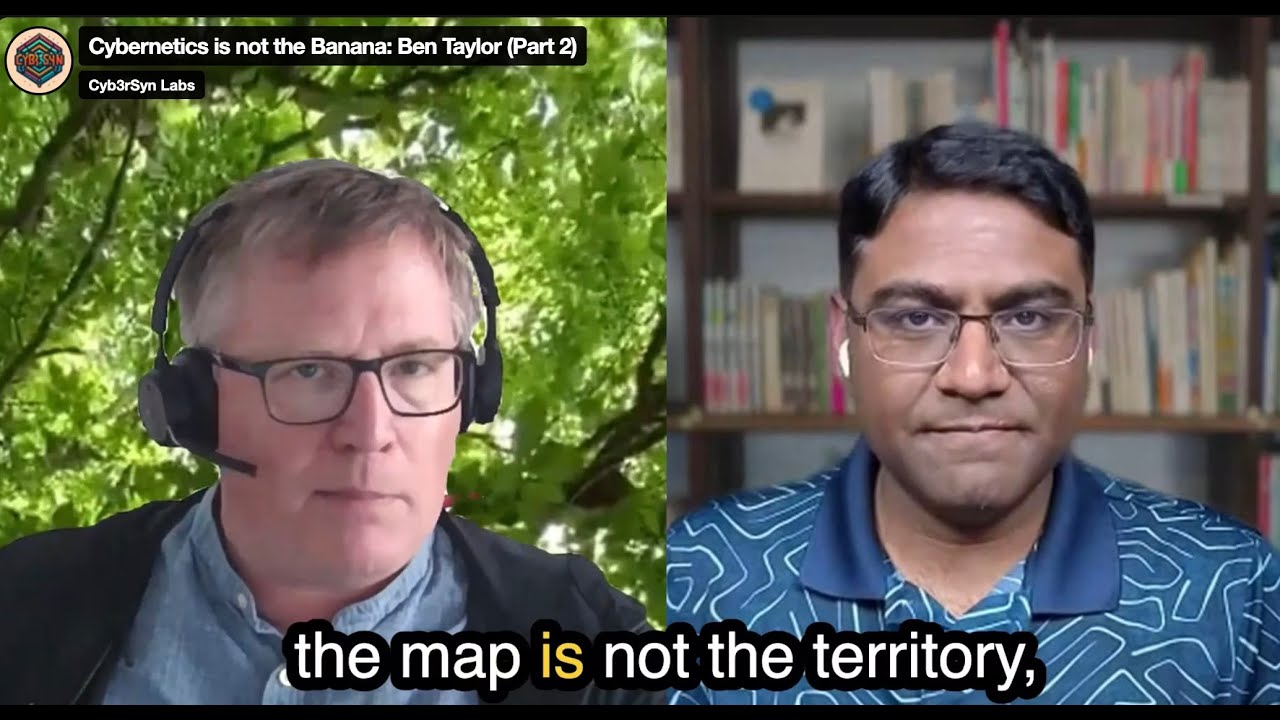
In this conversational interview, Benjamin P. Taylor and host Laksh explore deep concepts of cybernetics, epistemics, and systems thinking and connect them to practical organizational challenges. Taylor argues that "the map is not the territory" and stresses epistemic humility, urging people to name and objectify dynamics to increase authenticity and impact. He defines work as purposeful effort bounded by judgment and discretion, highlighting the need for negotiable, consensual boundaries and illustrating this with the self‑organising Buurtzorg (Birksorg) district‑nurse model. He discusses the paradox of hard versus soft systems, the ontological debate about whether systems "exist", and references Heinz von Foerster’s banana‑and‑stick metaphor to illustrate second‑order cybernetics. Taylor recommends Patrick Hovestad’s The Grammar of Systems as a practical entry point, describing its 33 system laws. He critiques contemporary management for lacking a coherent philosophy, noting the over‑reliance on “nice” management and the backlash toward “nasty” management, and calls for an integrated, purpose‑driven approach drawing on adaptive leadership, Elliott Jaques, Barry Oshry, and the Viable System Model. He shares anecdotes about public‑sector complexity, the limits of technology versus human‑centred solutions, and offers advice to tech practitioners to engage in radical self‑inquiry and challenge their worldview. The interview concludes with personal reflections on his Antlerboy handle, the moral weight of systems work, and the importance of grounding cybernetic practice in ethics.
Chapters
The Czech word robot, I think, comes from slave. You know, if you're just being directed, you're just a pair of hands. You're not really doing work. You know, you're slaving or something. We should only really talk about epistemics, in my view. The map is not the territory, but that implies, if you're not very careful, through metaphor. So actually having boundaries, negotiable, consensual boundaries, hopefully, about what your work is, is actually really, really important. And to understand that there are infinitely many ways of seeing the situation and that you can potentially move fluidly between them without necessarily getting locked into one or the other. A hugely powerful thing that you can do that massively increases your own authenticity and your own impact is to name the thing. You can just pick up one of the systems laws and any given situation in your life or in society or in the world and say, What is the application of this law to this situation? We just assume that tech is better, and often it really, really isn't. And often it's masking the problem. Often it's doing really well what ought not to be done at all. Right? And there is a distinction between when you've properly framed the problem based on your context and reaction to it as complicated and complex. That's a real distinction. But the distinction is based on your understanding and your framing and your purpose, not on something out there in the world.
Yeah. So, so a lot more epistemic humility and a lot less ontological arrogance. Yes.
Yeah, exactly. And I'll go back to Philip Boxer's good quote. You know, we, we can, we should only really talk about epistemics in, in, in my view. The map is not the territory, but that implies if you're not very careful through metaphor, mm-hmm. That we can better map the territory, that we can maybe understand the territory, that we're in some sense living in the territory. And in a sense we are, but you're only ever comparing your map to another map. That's the fundamental point, right? And maps can be more or less useful, but what they're more or less useful for depends on what you're trying to do.
Yeah.
So what is work? You know, effort to a purpose using judgment and discretion within boundaries over time. All of those points are important. Right? Purpose is important, right? Which depends on context, framings, understanding, and so on. And so if we don't have some shared purpose, which has to come within some kind of shared worldview, some kind of shared sensemaking world that I just talked about, then it's going to be quite hard to achieve anything. There isn't work unless you are using your judgment, discretion, expertise, your own choices. The Czech word robot, I think, comes from slave. You know, if you're just being directed, you're just a pair of hands. You, you're not really doing work. You, you know, you're slaving or something. But it's also the case that if you're given too much freedom to act, that's not really productive in terms of either an individual's creativity. I mean, if you're doing art completely unboundaried and, and, you know, doing something creative, that's probably not work, which is great for you if you're doing that, you know. Yeah. But, you know, work usually is problematic and will create problems in other parts of the organization if you don't have boundaries. So actually having boundaries, negotiable, consensual boundaries, hopefully, about what your work is, is actually, is actually really, really important. And don't forget that a lot of the boundaries are implicit. There's that great powerful story of Bertshoort in the Netherlands, how they created a self-organizing organization. Yeah. from the district nurses. And there's been many attempts to replicate it, and a few of them have been quite successful, but, but not many. But one of the things that I think is important, so in Birksorg, they took these district nurses, budgets were going down, they were getting pressured to kind of, you know, they weren't getting paid for travel to the appointments, they were only getting 12 minutes to get somebody out of bed or whatever, you know, all of those usual constraints and problems with the kind of personal care that community nurses do. Mm-hmm. They took away basically all the managers, huge financial saving, and enabled, empowered, and supported the district nurses to self-organize. But I always think that what doesn't get told enough in that story is that there were all of these commonalities between the nurses, a sense of purpose, a sense of mission, a profession that they consistently trained in and continued to develop in. They were mostly female, but they were mostly, almost all Dutch. Mm-hmm. And they were probably all religious. They probably all had some sense of civic duty. And they had these norms, these, these familiarities and common ways of sensemaking that was really supportive and really practical to enable them to self-organize. Right. I always tell along with this story, the fact that the very first Big Brother house was, was made in the Netherlands. Endemol is a Dutch production company that produced it. And it was really boring because all the Dutch people got together, played guitar, read stories to each other, you know, created little bits of drama. They, they, they had a productive, friendly culture, no drama, no conflict, no good TV. Yeah, they had a great time. So you can't necessarily read from one culture into another. So self-organization requires a lot of buttressing and a lot of organization to get to self-organization. That's one of those, you know, enantiodromic paradoxes or something like that. So we need the boundaries that give us the space for discretion and that allow coordination between different kind of sensemaking worlds. So, you know, there's this, there's this combination of the, of the hard and soft, the, the boundaries and the enabling, the freedom and discretion, which I think is, is really kind of, really kind of fundamental, really, really central. Yeah. So I think that for me is something that I'm always bringing. And again, sounds very conceptual, as will, as will the next couple of pieces, but I think it's very relevant to everything in organizational life and very practical when you're actually trying to, trying to get things done. Maybe I won't go into this one as deeply, Laksh, but I do think that one of the things that I do is, and another good cybernetic definition You know, what is a situation? And, and if you can define a situation and say, who are the actors? What are the purposes? What are the framings? How are these things being mutually enforced and reinforced and relearned? There's, there's a great Nora Bateson line about all of the energy and effort that goes into keeping a system the same. And that's fascinating and in a way depressing, but also empowering if you're trying to change, because there's that energy in flow. If we make a change here at the beach, you know, take out one part of the beach defenses or something like that, that huge energy will be unlocked to create a new consistent pattern in a, in a, in a very different kind of way, if, if, if that makes sense. So, you know, knowing some of these things which lean a bit into critical systems heuristics and questioning the framing that we are bringing to a situation allows us to see a lot of implications, a lot of possibilities within situations, if, if, if that makes sense.
Absolutely.
Famous quote, Heinz von Foerster, one of the leading lights of second-order cybernetics. You can watch this video on YouTube. Somebody asked him on a, one of those very '90s, '60s TV programs, what is cybernetics? He said, imagine a chimp in a cage. In this cage, there's a banana on top of a large shelf out of reach. However, there is also a stick. Of course, the chimp will manage to get the banana using the stick. Cybernetics is not about the banana. And I think this is really useful. You can ignore my words here or not. But the point is that that situation, chimp cage banana stick, can be conceptualized in a lot of different ways. And there's a, there's a first order, which is getting the banana. There's a second order, which is learning to use the stick. There's a third order, which is the concept of reconceptualizing situations, which you've, you've learned if you've actually gone from banana to stick to, oh right, there's a thing, there's an affordance going on there. There's a— Yeah. capability or possibility within the situation. And that might allow you to reconceptualize in other ways. Isn't, isn't opening the cage the real goal? Isn't actually, you know, getting to the point of, well, as Donella Meadows said, that number 2 is changing the paradigm and number 1 is the ability to transcend paradigms and to actually understand that paradigms are paradigms. And this is very analogous to what David Chapman calls fluid mode. It's often linked to adult development and it's linked in Buddhism to a sort of enlightenment. Um, uh, but the point is that you can be capable, certainly in business situations, because they're very weak paradigms compared to society and the sense of self and things like that, to understand that there are infinitely many ways of seeing the situation. Yeah. And that you can potentially move fluidly between them without necessarily getting locked into one or the other. That's okay.
I think this, this is fantastic. I
know it's a lot.
This was fantastic and a lot of insights in there. And as you put it, even though this may all appear very philosophical and abstract, it's super, super practical when it comes to day-to-day. Ben, with that said—
Well, as Kurt Lewin said, there's nothing so practical as a good theory.
Yes, Kurt Lewin, yes. Why don't we pivot into some of the heuristics you use? I think a lot more leaders are comfortable with having simple heuristics and thumb rules and stuff like that. But from a systems complexity and cybernetics lens, I'm sure you've developed your own heuristics over the years. Maybe we can talk about a couple of those.
So, I mean, there, there are models and approaches that I use regularly, and I think, but I think, I think I, I wanna talk more, more, more generally, if that's okay. And I've got 2 really. So first one, first one that springs to mind is naming the thing, the power of calling something out. Stating a dynamic that's happening, objectifying something which was previously latent or contextual or part of the context rather than the text of the situation, if that makes sense. By naming something, sometimes that can be a, you know, direct challenge to power. Sometimes it can be an expression of authenticity and discussing the undiscussable, bringing into discussability, things which organizationally are holding things in place, are part of our framing, part of our context. But fundamentally, it makes them objectified. If you say, I see that there's a pattern that's got— Peter Block is fantastic at this. If you read Flawless Consulting, one of the things that Peter Block says, one of the most powerful things you can do if a meeting is getting stuck is say, we seem to be stuck.
Yeah.
Because most of the time we are in denial of that. We're actually, nobody wants to say that we are stuck. So that contributes massively to the, to the stuckness. As soon as you say we're stuck, we might get to a deeper reason why we might take a break. We might,
you know,
give it up. Yeah. But, and on the other end, one of the most powerful sales techniques you can do when we are absolutely primed to Avoid and ignore objections is to be really eagle-eyed and really eager to see objections in your sales process and pause and ask and draw out and really understand what the objection is. And then see if you can, see if you can address it. Whereas the human instinct is to skate on. The human instinct is to ignore the embarrassing, the uncomfortable, the use of power. in, in, in the situation or the objection to your, to your own argument, a hugely powerful thing that you can do that massively increases your own authenticity and your own impact is, is, is, is to name the thing. That I think should go hand in hand with, remember, there are no things. Um, uh, you know, that don't get carried away with objectifying things and therefore think that they are, you know, concrete objects. Understand that that, that's your framing. That's a different framing that you're, it's a different map that you're calling into existence. It's not that you're naming reality. In a certain sense, you're breaking through to some new layer, but in another sense, all you're doing is providing an alternative way of seeing and thinking, if, if you see what I mean.
Hmm.
Shifting a perspective, maybe suggesting a gap in the worldview or the framing that you're using. That's, that's, that's, and actively suggesting something that the possibility that there could be a framing that, that could be more useful. Yeah. Yeah. Given some of the people that you speak to, that leads me to think about the, do systems exist conversation. I've got quite clear on this over time, and that's because I go backwards and forwards. Clearly systems do exist. Many of the systems methods that are really effective rely on there being an ontological reality of systems and things going on. And, you know, if you're looking at an engine, that's a system that is functioning at the Clearly systems also don't exist because all you ever have to operate on, even if you are interacting with, you know, a diesel engine in the real world, is your own map of the territory, your system that you are looking at, which works dynamically with, with your interactions in the real world, but is your framing of what's going on in the real world in, in the situation. So in that kind of conflict between soft systems, the way we think, perspectives, worldviews, differences of opinion, all of that, and hard systems, engineering, my view is that hard systems are just one special privileged application of soft systems. They're just one way of applying our, our understanding and our worldviews to the world. Now, they're They, they're special for good reasons because you get more instant feedback from the world when you're, you know, tinkering with an engine. You can apply the scientific method in a more concrete way, and they, they are more concrete, but they're still only about applying a framing. And, you know, the original writing about paradigm shifts was about scientific paradigm shifts and the way that our deep understanding of the way that, you know, actual atoms and systems and things operate in the real world. Yes. can still turn out to be wrong and just a map and just an approach. But what, where that leads me is that I think to sort of do a callback to Wittgenstein, mm-hmm, to talk about the existence or otherwise of systems is just a category error. It's actually a bewitchment of philosophy, as, as Wittgenstein might say. It's actually leading us into a belief that, that, that word, a system, Can properly be applied to things in, in, in, in the so-called real world. And that it's just a different type of word that's used in a completely different language game, that it doesn't really make sense in the purest sense of being a sentence that can make sense to say systems exist. I
think the way I look at this is it's, it's a great cone that is really make you think if you belong to one camp or the other. Yeah. You know, you can really just. Sit down and think about the paradox.
Well, that's true. That's true. I mean, it's a bit like Possewood, isn't it? The, the, the beautiful thing about the, the phrase, the purpose of a system is what it does, is that it's an incredibly effective mechanism to make people think about purpose and our understanding and interaction of our purposes with so-called systems. It's the same, it's the same question, but you've just mentioned Possewood on social media. You get lots of reactions. It's fascinating. People really, really interested and engaged. But what they're engaged with is the question that Possewood points to, and that I've just pointed to, which is what is purpose and what is a system and what do we have a right to say about them?
Yes. Awesome. One of the questions that I ask all of my guests is what books, talks, or papers that profoundly influenced you along the way. And you have proactively created a PDF And shared it widely with everyone on LinkedIn. So I'm gonna take that and share it with my community.
I've got to read this.
I'm sure they will find it useful, but maybe we can just talk about one book from it and you can talk about why it profoundly influenced your thinking.
Well, I mean, one of the things I'm at pains to say is that I'm not a very thorough or very detailed reader, especially not these days when, you know, my, my brain has been broken by social media and the rest. And that personally, I learn best that legitimate peripheral participation by kind of listening to other people who understand stuff, talking about it, by picking it up, by entering into the conversation and checking within context that I'm playing the right language game and so on. So my encouragement, and I wrote this in that reading list, is don't feel you have to slog through any of this. There's so much richness. and diversity in the systems cybernetics complexity field that it's much better to shop around, sample, explore, find people you can have conversations with about this stuff, and then see what, what floats your boat, you know, what, what excites you and interests you in, in the space. Sure. Because that's really what I would recommend focusing on. There's this, it's not fruitful to, to, to, to do anything else, if you see what I mean. I guess if I have to talk about one book, I've said his name twice already, I think, in this interview, Patrick Hovestad. I would say that The Grammar of Systems is the one that I would encourage people to look at because it's got 33 systems laws arranged according to structural, dynamic, and perceptual complexity. And they are essays at those underlying laws. rules, functionalities, things that hold true, which is a, which is, which is a bold thing to do. They're all, they're all taken from other sources, if you see what I mean.
Mm-hmm.
But, but they are, it's quite accessible. It's quite a short book. It's, it's, you know, got 33 laws. And this isn't like one of those, you know, 7 approaches to this or 7 approaches to that, which I, which I've produced many of in, in, in, in my life. It's not an artificially kind of engineered thing where it's a list to You know, make things exciting if you, if you see what I mean. It's, you know, a genuine buildup of all the things that are deeply informing systems complexity and cybernetics theory and practice and tools and, and all the rest. So yeah, readable. You can read it in chunks. You can read it on the toilet. You can just pick up one of the systems laws. Yeah. and any given situation in your life or in society or in the world and say, what is the application of this law to this situation? And it's an activity we regularly do in our development days, and you will find something productive and insightful. So I recommend that. It's a, it's a really good one to dig into. And lots of little stories and vignettes in there that, that, that kind of bring some of them to, to life. Some of them are gnarly, really mind-twisting. pronouncements. You won't get any of the philosophy from him. He's, he's just all about, you know, these things get results. They work. They're brilliant.
Yeah. Awesome.
He's secretly into the philosophy, but he won't give it to
you. Yeah. Awesome. Um, let's kind of shift gears. Um, I know you work with a lot of public service, public, public sector folks, and I'm kind of curious for your thoughts on what do you think is sorely missing or underrated or broken In mainstream management in general.
Uh-huh. Yeah. Yeah. And I think, you know, public sector has to deal with a lot, a lot, a lot of complexity. Back in the day when I was e-government manager at Hammersmith and Fulham, we had a national service list which identified 1,111 different customer-facing services. Now there aren't, there aren't many businesses That would allow themselves to continue with those. But these are all like statutory required services that, that, that a unitary local government in the UK had to do. And it's got complex, it's got more complex since. So they're good testbeds and they're really important for understanding that you're working in an ecosystem, that you're working in a place, that there are knock-on effects and feedback effects and delayed effects of all your actions and all the rest of it. What I think is interesting is that we've mostly got quite soggy management. I'm not talking about public sector here. I'm talking about across the piece. I do, you know, international work. I do leadership development. I work with companies from Australia to Europe, occasionally the US. And most people don't— they're scared of being accused of micromanagement. Mm-hmm. There are lots of things in the way of rigor, and accountability is often quite weak. There's a general broad consensus that we should be kind of doing nice management, which is, which is not, but then the problem is it's not effective. And we often get this backlash and then movements and people standing out and saying this nice management isn't working. But rather than actually looking at effective management, what they end up doing is nasty management by default because they think that that's the way to counteract the problem with, you know, ineffective niceness. So I think, you know, Brené Brown is on the nice side of things, no doubt. But I think her quote, you know, clarity is kindness, is a really, is a really good one. But I actually think that what's needed, and very, very, very few people ever offer this. Is an actual philosophy of management, an actual guiding methodology, an actual kind of overall approach. And I think some of the things I've talked about today, you know, do genuinely offer that and don't offer that as a reaction to anything else. I think there's great things to be said about adaptive leadership, for example. I think adaptive leadership has got a lot of tools for dealing with complexity. It's a powerful approach, but it's primarily a reaction to top-down command and control restrictive management. Mm-hmm. Rather than actually blossoming into a philosophy and an overall approach in its own right. So I think the stuff in group dynamics, I haven't been able to talk today about integration and differentiation as kind of core dynamics of organization. But I think the stuff in Elliott Jaques and particularly systems leadership theory. But I think if you put this, you know, what I'm trying to do overall is put together the things that I think are powerful, those things and Barry Oshry and viable system model and All the rest. I haven't come up with a philosophy of management myself, but I think that working towards that is something that actually managers should be doing, bearing in mind, of course, that it is a practice. It's not, it's not a science, but, but I think that's just lacking. I think people don't have the audacity to do it anymore, except in very oversimplistic, problematic ways, which then causes a backlash to the wishy-washy niceness and general, you know, rule of HR, which nobody thinks is any good.
So, if I can kind of summarize that, it's like a lack of a guiding philosophy methodology overall, that managers just lack that and then they just wing it.
Yeah. Which, you know, goes back to those quotes. Organization is there to manage complexity. Progress relies on both hardness of intent, accountability, but in with the intention of creating consensual coordination of meaning that gives freedom, that gives coordinated action towards a purpose. And, you know, understands the dilemmas inherent in that, the paradoxes inherent and works with them.
Yeah. Yeah. Awesome. Um, one of the stories that I remember from I think it was one of your posts from several years ago is a story about how, I forget the details. I think this was probably in the UK where there were like, you know, the local government wanted more trees in the village or town and nobody would get it. And so they would just buy it and put it in a place with a fence. And within a couple of weeks, like everybody, you know, in the village took them and they just planted in their backyard, which is exactly what they wanted. Yeah. Uh, to, to plant them and take care of them. Yeah. Do you remember the story?
Yeah. And, and it's definitely not, not my original story. It's also analogous with the story, maybe apocryphal, of how they introduced potatoes to the peasant population of France because, you know, potatoes were considered poisonous. So they said, these are only for the king and they put guards around them, but the guards were not very good and had very long breaks and so on. And so, so, So people took, took them away. Yeah. I mean, you know, Rory Sutherland is, is quite a hero in terms of the way he persistently, and, you know, with that British twinkliness, encourages people to think counterfactually, to understand the realities, not what we aspire to be the realities of behavior and motivation. I don't think that's his story, but it's exactly the sort of story that he would, he, he would love. And, and I think he's right. You know, he doesn't tell this story, but I remember this, this, this is one of, one of mine. At one stage, the London Underground, the Tube, introduced those, I've forgotten what they're called. They have a specific name. But anyway, the timers on the platforms that tell you— Well, yeah, the dot matrix displays that specifically tell, tell you when, when the next train is coming. And, and the, the, the head of quality was absolutely furious. He said, it's costing us millions of pounds to do these. Bloody displays. They don't improve service quality one bit. All they do is improve customer satisfaction. And that's just such a fantastic story about a framing and a slip of a framing and a more powerful and effective framing. Because just like that classic story of we could spend £1 million to upgrade the elevators, or we could install mirrors so people can be happy looking at themselves while they're waiting. Exactly. You know, if we frame things that work for human beings, then They work for human beings. Yes.
I think you can solve a lot of problems with psychology rather than technology. And the Silicon Valley syndrome is just the opposite.
Oh yes, yes, absolutely. And, and actually, you know, we are just having that debate. There was a good tweet the other day where somebody made the point that in practical terms, as a physician in a hospital, it was a lot quicker for them to read through paper files that were usually on hand and, you know, available than it is now to try and look through 10 disconnected different apps on outdated systems that might require separate logins and 2-factor authentication. And the computer runs slow and you can't get Wi-Fi in the hospital and yada, yada, yada, you know? So, you know, we just assume that tech is better and often it really, really isn't. And often it's masking the problem. Often it's doing really well what ought not to be done at all, where we could actually cut out an awful lot of the steps in most business processes by just focusing on, you know, what's actual value.
Yeah. Yeah. Awesome. I think speaking of that topic, the Cybersyn community is a community full of technology practitioners, a lot of people here from Silicon Valley and around the world. And so what advice do you have for them, given, given, of course, advice doesn't make any sense without the context, but in general, like what are the things they can do to improve their worldviews towards these ideas?
Well, I mean, the big thing that I would say is if you are not already, and if people are in your community, they probably are, but be willing to engage in what reboot.io call radical self-inquiry and, and actually try to objectify and understand the limits of your worldview. And I specifically would say, and of course you get quite a biased view. I have some exposure to US businesses, as I say, but often I see things through social media and the rest. But money isn't the be-all and end-all. It's perhaps more important than I acknowledged early in my career. And, you know, Nothing wrong with actually wanting to earn good money, but I do see now if you just look at the billionaire class in tech, I don't see that they have a focus on enriching themselves in their world in a true sense, or that that's necessarily bringing them really deep satisfaction. I don't think they have bad lives. I don't think they're crying in their Chablis or whatever, but you know, I would say. Think about what framing you are bringing to your own life choices and think about, you know, what about, you know, environment, friends, society, family, and try to achieve some kind of happy balance there that allows you to pursue what you're interested in and to earn a good living and to make the most of the, you know, commercial talents that you've got. It's a time of great opportunity for people in that community, which is absolutely brilliant. But don't let that swell to fill your entire worldview as it seems to do for some people with all kinds of negative second-order implications elsewhere. That might be a bit of an obvious moralizing. I'm sorry, you know, it's a bit of a kind of clichéd answer, but I do think it's really important. But it speaks to that, you know, objectify and challenge your assumptions and you'll learn a lot that way. I can't say that you'll be happier. I can't say that you'll achieve all of that balance, but it will certainly be more interesting and you'll learn more along the way, which I think is important.
Awesome. I think we'll end with one fun question. Why do you call yourself Antlerboy? Why are all of your handles Antlerboy?
Yeah, it's maybe not the most professional name that you could choose, but I am kind of stuck with it. The problem is really simple, Laksh. My name is very common. Across, across the, across the Western world. So it's very rare that when I get on social media that I can get anything approaching Ben Taylor. In 1995, I got ben_taylor@hotmail.com, but it still had the underscore in it. You know, somebody still beat me. I, I, I, and I still get emails from other Ben Taylors on, on, on Hotmail.
Interesting.
So Ben Taylor is not an option. Benjamin Taylor, which I go by these days, is still quite common. Even Benjamin P. Taylor, there's quite a few of them. Out there. I'm, I'm, my married name is Benjamin Taylor Kraynovich, but that's a little bit of a pain to, to put on things and to spell out for people and so on. I was at a Christmas party in about 2003 and they did an anagram round of people's names and I wasn't the first one to spot Ant the Boy, but it was kind of a gift. So Ant the Boy is almost always available. There, there is a kind of YouTube celebrity called Ant the Boy who occasionally tries to buy my name off me, but not for any good price. So I've, I've been, I've been Antler Boy and everything ever since.
Awesome. Ben, um, any other question that I should have asked but didn't, or, or any other parting remarks?
You know, it's a, it's a really challenging time in the world. I think maybe it always is, but it really is. And personally, I find it hard sometimes not to get overwhelmed with seeing genocide happening every day in front of us. We're seeing the breakdown of decency in politics and the victory of some of that lack of decency. Yeah. And the destruction of things which will not easily or quickly be rebuilt. So, you know, I think it's worth acknowledging that since we, since we are talking kind of philosophically and about, you know, business in the context of life. But people really do surprise me with generosity, resilience, creativity, the ability to connect people and so on. So, you know, I stick, I stick with that. I stick with, you know, that, that there are phases in these things and good guys, bad guys, not, not, not, not always simple, but even when it is, the good guys don't always win. The best approaches don't always win in business or, or in life. And in that context, I think it's really important to say This stuff, systems, cybernetics, complexity, if you get it right, it's really, really, really powerful. It's really effective. But in themselves, they're mostly value neutral. So, you know, you need to have your own grounding in ethics, your own thinking about what's important to you, what's meaningful to you alongside this, because the practices can be used for good or for ill, unfortunately.
Yes. Awesome. That's, that's a great note. We'll end on that. Ben, thank you so much for being so generous with your time. Thank you.
It's felt very indulgent. I hope people get a lot out of this. I would love to hear from people and engage. If people are interested in following up on anything we've talked about, please feel free to send them my details.
Absolutely. I'll include a link to your website and handles. Once again, thank you for sharing your insights and thank you for everything you do to spread the message of systems complexity and cybernetics. I hope I did my little part by inviting you and helping you spread the message. Once again, thank you.
No, I love what you're doing and good luck to you as well. Thanks a lot.
More from Benjamin

How to Transform Public Sector Organisations Through Systems Thinking With Benjamin P. Taylor


Cybernetics is not the banana, part 1 — Benjamin P Taylor with Laksh Raghavan (2025)
04 | Culture, Clarity & Conversations: Leading in Uncertain Times with Benjamin P. Taylor

The Key To High-Performing Teams Based On Trust – Benjamin Taylor | Compass Tech Summit 2023

Benjamin Taylor - Jan 2021 - SCiO Open Event - The 'Four Quadrants' of Thinking Threats
Five core practices for effective organisation - Benjamin Taylor | Stretch Conference 2022

Ep36: A wholeheartdly work Is Crucial To Your Business. Learn Why! Benjamin Taylor - CX RedQuadrant