29. Episode 15: Camille Burns, CEO of Women Presidents’ Organization (WPO)
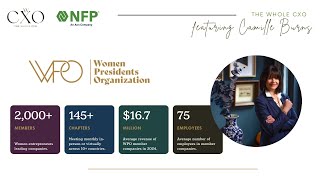
In this interview, Camille Burns, Chief Operating Officer of the Women Presidents’ Organization (WPO), discusses the evolution of the global peer‑learning network that supports women CEOs of multimillion‑dollar companies. She recounts her 20‑year journey from the organization’s early U.S. days to its current scale of 140 chapters and roughly 2,000 members. The conversation centers on how the pandemic forced a rapid shift from high‑touch, in‑person chapter meetings to virtual platforms, prompting the creation of 21 webinars in five months to address urgent topics such as remote work, PPP loans, and strategic planning. Burns highlights the network’s role as a lifeline, describing how members helped each other pivot, share expertise, and maintain resilience. She shares her leadership philosophy—acceptance, passion‑driven work ethic, and the importance of setting boundaries—along with personal habits like listening to podcasts (Revisionist History, HBR IdeaCast, Secular Buddhism) and reading Brené Brown. Advice for emerging entrepreneurs includes adopting a startup mindset, making decisions without over‑thinking, and learning to say no. Burns concludes with pride in her team’s adaptability, a call for continued community support, and her personal mantra of acceptance.
Chapters
We are welcomed today by Camille Burns. She is the Chief Operating Officer of the Women's Presidents Organization, which is a fabulous network for women business owners that are at a certain revenue threshold. And they are a global, global, global, like, I mean, that's like insane network. And I've had the privilege of being a part of the WPO, I think since, oh my goodness, I should have looked at this date, maybe 2013.
I would say 2013. Yeah, it's been a while. It's been a while.
Yes, we are starting to date ourselves, right? So I'm just, I always just enjoy my time with you and love seeing you and your smile and learning from you and your knowledge and your wisdom and your strength. Which is always so admirable. So tell us, just catch us up to speed. Tell us a little bit about yourself and the WPO.
Sure. Well, the WPO, for those who don't know, it's a peer learning organization for women CEOs and presidents of multimillion-dollar companies. So as you said, Annette, we have over 140 chapters around the world and about 2,000 members. So it's really just an incredible network of women CEOs running successful businesses. I've been personally doing this a very long time. I came into the organization 20 years ago now when it was a small US-based organization with not very many chapters. And so I've had the real opportunity to work with the founder, Marcia Firestone, on taking the organization and growing it and bringing it to where it is today.
And it's amazing, the network of women and how they support each other. It's almost insanely hard to explain until you really witness it and you're in it and you, you live and breathe it. And, um, and that's what's really cool. So, so we've had, uh, 20 years of you in this position, you— well, you growing with the company, you actually growing the company, and, um, and now into the role of Chief Operating Officer. So how does that feel?
You know, it feels great. I did come into the role just shortly before the pandemic hit. So it's been an interesting ride. This was not the year that I was planning. But in a lot of ways, it's been really powerful to be part of this organization right now because women business owners and business owners in general need support. They need the connections of other business owners. They need to feel not alone through what they're going through right now. And so It's felt really wonderful to, you know, I felt almost more passionate about what we do in the last 8 months than I felt my entire, you know, 19 years prior to that. So, you know, it's, it's been a, it's been an interesting time. And I think the other thing that's happened with the last, you know, what's happened in this country over the last 8 months is that I came into this role knowing that we were going to have to make a lot of changes. We're an organization that's been around a while and you know, we need to modernize and we need to make sure that we're supporting the next generation of entrepreneurs, right? And what the pandemic has forced all of us to do, I think, is change a lot quicker than any of us thought was possible. You know, there's things that we're doing now that would have been very hard to talk people into a year ago. And I think we're all seeing, you know, whether it's working remotely or meeting on Zoom or, you know, all of the other things that we've moved to the virtual space, I think we're all seeing that it works better and in some ways is easier and more efficient than I think that we all sort of knew that it would be.
Absolutely. And I love how you are seeing the gift in this year and what this year has done. The change and the pace of change has been more agile. And it's, it's so important as a leader, right, and stepping into leadership role even more so than you were. I mean, you built this, your blood, sweat, and tears, you built this. And it's been just amazing to see that journey of yours. Now, talk to me about some of those major changes that you saw this year.
Well, we're, you know, we're a peer advisory group, right? That's the core of our business. So chapters got together monthly, and like, you know, you have a board of advisors of other women CEOs and presidents. And we have always prided ourselves in being this high-touch organization, right, where you feel you're in this confidential environment, you feel really comfortable talking about whatever's going on in your company and looking to each other for support. And one of the biggest shifts was, you know, taking away that whole high-touch component, right? So all of a sudden, none of our chapters really could meet in person. And, you know, some of that has changed over time, but that inability to meet in person and then move to what people feel like is a much less personal space, which is the virtual space. I think that, you know, that was a big transition for us and really transitioning all of our chapters around the world because there wasn't— there hasn't really been any place where, you know, people were continuing to meet in person and everyone felt comfortable with that. Other shifts that we've made are really, you know, going through all of this, all of a sudden business owners were impacted like never before, at least in my time. You know, I've been working with business owners through 9/11, in 2008, and the impact of all of this has been just beyond, you know, it's just been, it's been tremendous. And we started putting out a lot more content because we really looked within our network. We've got women in industries, you know, every industry you can think of, and a lot of expertise, and taking advantage of that so that members could, you know, help each other with whether it's transitioning to a remote workplace or PPP loans, you know, that was obviously in the US a big topic for a while, or scenario planning versus strategic planning, and all of these other, all of these other topics that became so relevant. And so, you know, people needed to address these things so immediately. So that was just a big shift. And we did, I think, 21 webinars within a matter of like 5 months, just because we felt like there was so much that the business owners needed right now, because everything was changing so fast.
And that really speaks to the power of the network. And these women are insanely incredible. And they, they have have been in their businesses, I guess, do we know the average, like, years that they've been owning their businesses?
It's about 20 years, give or take. Yeah. Okay.
So that is so significant. There is so much wisdom and so many resources there just within the network of women business owners to, to gain more knowledge from, to learn from. Obviously no one, and you and I have not seen this exact situation, but when you put together the power of the hustle and the power of tenacity and the power of just the energy alone, it makes really great things happen. And you felt that. I know, you know, you felt that. And the amount of time and resources that you as a leader invested in your chapter chairs who are actually orchestrating these groups globally, was just to be commended. I mean, you all really just spent the time, invested in the chapter chairs. And what were some of the things that you heard as feedback?
From the chapter members?
Yes. Yeah, from the chapter chairs or the chapter members. I'm sure it was moving.
You know, one of the words I heard over and over again is WPO has been a lifeline. That having this place to go and, you know, some of our chapters in the beginning of the pandemic were getting together weekly. And sometimes it was just an hour check-in every week, but it was really to check in with each other and just help. You know, the other thing I heard a lot of is members really helping members think about what they do and how they can change what they do to meet the new market demands. Right. So I saw in a lot of chapters, members weren't going to let other members fail. So if members were in industries, let's say they were in the event industry or travel industry, and you know, they were in industries that were just hammered, really, you know, watching the other members of the group kind of rally around them and think, okay, well, what if you try this? Why don't you try that? I can connect you with so-and-so. And just really working with each other and not letting each other get into that place, because I think that it is easy to get into that place when the world changes and all of a sudden what you do, you could have been very successful overnight, is no longer successful. All of a sudden, you know, everything you do has been turned upside down and just not letting each other get to that place of like, you know, resigning to that, right? And I've seen with our members just incredible resilience and this incredibly— and maybe this is business owners everywhere, but I really see it with, with our women— is just this ability to change very quickly, to make big decisions and move and not spend a lot of time thinking about things. And we have just seen incredible transitions in businesses, whether they're going to be permanent or whether they were just, okay, well, this is what we need to do right now. And, you know, maybe when things go back to normal, if there's ever going to be anything like that, you know, maybe they'll, they'll shift back a little bit, but it's been, it's been really incredible. And I think that lifeline and really just having that community of other women business owners who are so smart And so just a powerful group and hardworking, but also really want to help each other, really want to help each other. There's no feeling of competition right now. It's really just, you know, women wanting to help other women and making sure that all of our members are staying in business, as many as possible, and, you know, getting through this, weathering this.
It's so true. And the word surrounded always comes up in our meetings, in our WPO meetings here in Baltimore. And it's one of those things, it's like almost sometimes the month rolls by and it's like going to the gym. Your schedule's so busy, your week is so busy, you have so many things going on in your business, it's like, okay, I can't handle that right now, I can't get there right now, I don't know how I'm gonna make it happen. And it's like going to the gym, once you get there, you're fine and you're so glad that you did it and you feel less alone and you have that chance to look up in your business and you learn something. You contributed and you helped someone else. And that's really where the power is. And I know a lot of our audience out there, they are looking for different outlets like this that are trusted places, that are really wonderful networks of that roundtable experience. And there's a lot of options out there, but this is just so unique. So, um, Let's talk a little bit about you. What kept you going as a CEO? Where were you finding your answers or your fuel or whatever you were looking for on whatever day you were looking for it?
For me, I'm one of those people, so my life, like most people, but it shifted dramatically in that I was someone who was on a plane probably once a week almost. I was traveling around the world. I'm very much a people person. And so the shift to all of a sudden working from home, you know, by myself, uh, was challenging for me because I do think that I get a lot of energy from other people. Having said that, you know, I, I get a lot of energy from the team. I get a lot of energy from our members. And where I really just pulled a tremendous amount of energy was just the desire and the passion around are women business owners. And okay, we're not gonna let people fail. We're gonna do whatever we can as an organization and whatever we can to support our chapter chairs. Because our chairs that are running these chapters, it's, it's been hard. I mean, it's not been easy to run a chapter of 20 women business owners who are going through everything that we're going through. And, you know, it's not just the economy and, you know, the supply chain and all of these other things that have impacted businesses, but it's also all of a sudden a lot of our members had kids at home and had all of these other challenges on top of trying to run their businesses. So I think just the energy I was getting is, you know, running on really on the fuel of our members and what can we do to support them, what can we do to support our chapter chairs to help support them.
Absolutely. And I was— I just— you sparked a thought for me and When we had our WPO meeting, there were a lot of tears and there still are a lot of tears. Last month, our tears were over us really truly missing being in person together and really being together and just needing, like you said, that human-to-human interaction, right? And facilitating tears over a Zoom call is probably, I'd say, the hardest thing because you just can't hand the tissues over and you can't give the hug that you wanna give. And to see how members really connect with one another and build each other up so that that member who is venting or just finally, it finally just comes out. You don't even, you're like not expecting it and it just comes out. To have that safe outlet has, it was just so, I'm like, I'm just thinking about it because these were so many and they are so many real feelings. Like this outlet and the organization that you have built is, Beyond anything describable. It really is. It really is. So let me ask you this.
What—
we have a lot of young listeners out there too who are growing in their careers, growing their business, thinking about major transitions, maybe have different paths to take or different avenues to take in their, in their careers and their businesses.
Okay.
So what advice do you give to those who are struggling with those types of, those types of decisions or are really processing those types of things in front of them?
I think first of all, I remember a WPO member when I was a lot younger, a woman with a very successful retail business. I think she had 17 or so stores in the Northeast. And she once said to me, you know, stop overthinking your future. Life is going to take you in directions that you had no idea. And I think about that a lot because I think if someone had told me then, you know, in however many years, 17 years or whatever, you're going to be CEO of the organization, I would have laughed in their face. You know, it's just— so I think some of it is letting go of the expectations and just really making the decision that you think is the right decision at that time and then not regretting it. You know, you can't, you can't turn backwards. So just moving forward. And I think the other thing that I've really realized more recently is how quickly we can change, how quickly people can change and how quickly we can change our own lives or change our own businesses. Um, it's a lot quicker than I think that we all think it is. I think we think these big changes need time and I think One of the things I've realized in 2020 is big changes can happen very quickly. Big changes do not necessarily need a lot of time. So I really think just, just move, you know, don't get stuck, don't get stuck and overthink everything and, you know, just make a decision and go with it and you can change that decision. Nothing is set in stone.
Absolutely. Absolutely. And sometimes what sounds like an insane idea, like the impossible idea, can quickly become a reality. And we learned that this year. I remember you and I having a moment in DC saying, well, maybe we could just make it like this. And thinking, ah, it would never work. It would never be like this. And then, woof, here we are, right?
Exactly, exactly.
There we go.
There it—
and it happened. So, so you have an insanely admirable work ethic. I feel like I just have always— I mean, I don't know if it's because we've known each other so long. I always just am inspired by your work ethic, your focus, your tenacity. So do you think that that is something that is within you? And where did you get that from? Or is it something that you've kind of worked on and conditioned through the years? Or maybe a matter of both?
Yeah, I think it's a bit of a combination. I'll tell you this, I don't have a great work ethic if I'm not passionate about what I'm doing. So I, you know, I, I'm not Type A when I'm doing something that I'm not excited about or I'm doing something that I don't feel like has a purpose. But when, you know, when I feel really excited about something or passionate about it or empowered, I will throw my whole self into it. And sometimes I have to work on the opposite. And over the last 9 months, I've really had to do to be like, okay, you've gotta, you know, your work isn't who you are. But I think I also have two successful parents who worked very hard and sort of, I just always had instilled in me, you know, that you work hard and that you find what you love to do and that you work hard at it. And that that's an important, important part of life. My mother's father was Church of the Brethren. So it, you know, Mennonites, and they believed you were put on this earth to work, and, you know, then you died, I guess, and could relax, or, you know, go to heaven. And so my mom had this incredible work ethic instilled into her. And so, you know, I believe in working hard, particularly if you are excited or passionate about what you want to do. Having said that, I think that balance is extremely important. And I think if work overtakes your life, it overtakes you as a person. And I think you can sort of lose who you are in that process. So true.
So true. And I think we both have really been there and seen that happen. Right. So let me ask you this. As you are leading 2,000 women business owners, twofold, what's the best advice you would give women business owners right now? And then what's and the best advice you've received from one of them currently in this world?
Okay. The, the best advice that I would give right now, I think, is I don't care what size your business is. I don't care what you do. I think we're in a period of going back to basics. And I think we're in a period of almost everyone needs to think a little bit like a startup. Everybody needs to look at what they're doing and, um, think, you know, with that entrepreneurial spirit as opposed to, particularly for some of the businesses that are more mature businesses and, you know, they may have started out very entrepreneurial and then have a business that's been working for many, many years. But I think we're all right now at a place where we really have to step back and think with that kind of startup mentality. I, one of my colleagues the other day said, you know, we're welcome to our 20-year startup. You know, about the WPO. And it sort of feels that way. And I think we're seeing that. I mean, I know a number of our chapter chairs who are bringing almost startup kind of content to their meetings of these, you know, women who are very successful. But it's because no matter what you're doing, you have to think about it from a new lens and a new angle right now.
Yes. Great advice. New level, new devil, I always say.
Yeah.
It's so true. How about the flip side of that? Has anybody kind of just thrown something at you this year that was, that just kind of was good solid advice?
I think for me, the advice that keeps coming back to me is really just to say no. Say no to things. I think that as women, and I'll speak for myself, it's so easy, particularly in a time right now where everyone needs support and help, but really just to say no to things. Say no to things that aren't a good idea, or say no to things that you love the idea but you know you just can't handle and you can't handle it effectively. Because I think, you know, we could all work 24 hours a day right now. And I think we're all seeing— I know with my team, I'm seeing them work harder than they ever have, working longer hours than they ever had. And so I think, you know, just— I've always had a bit of a problem. I'm a pleaser by nature, and I've always had a bit of a problem with saying no and turning things down because I never wanted to upset people. But I think right now it's harder to do because emotions are more raw. But at the same time, it's even more necessary because it's just too impossible to do everything we need to do right now.
It's so true. And I also want to give a huge shout out to your team and to your— the chemistry between your team and just, you know, you all make so much happen. In such a quick turn time and you do such amazing things. And I know that it's just in startup mode, quote unquote. So I'm really excited to see all of the really great stuff that you have kind of cooking behind the scenes, right? So are you a podcast or a book kind of girl?
I am. I do both. And I also have gotten really into Audible over the last couple of years because You know, in terms of podcasts, I think my favorite podcast is Revisionist History, Malcolm Gladwell's podcast. I love that. I love just the random topics and taking that deep dive. I'm also a big fan of his books. I just find him to be just someone I feel like I can always listen to and sort of always gets my mind rolling. In terms of other podcasts, there's a HBR, Harvard Business Review podcast. What is it? I think it's IdeaCast or something that I really like, and it's just random business topics, and I think that's helpful. Another podcast I like is called Secular Buddhism.
Okay.
And it's a guy, he's Buddhist, but what he does is he talks about Buddhist philosophies and how you can think about them for the non-Buddhist. Or how you can sort of think, take the Buddhist learnings and apply it in your life or apply it to how you think about things or situations. And I just like that a lot because I'm not a Buddhist, but I like the— there's a lot of philosophies and just ideas in Buddhism that I think are helpful for me just in, you know, managing my own emotions and managing how I go through things and, you know, whether I carry things with me or not, or, you know, whether I hold on to grudges or anything like that. So I really like that podcast and there's a million of them. He's been doing it for a while.
I need to check that one out. That sounds so fun.
Yeah.
And how about any good books on your nightstand? Are you, are you reading one book or you're reading like 20? A couple going, some people— Yeah.
I mean, it depends. I've got sort of— there's the business books that I, you know, that I get into and love. I'm a big Brené Brown fan, and I think she's been, particularly this year, I've kind of gone back to some of her work because I find it very helpful at a time, you know, she has a lot of focus on vulnerability, and I think we're at a time where we're all A, feeling vulnerable, and B, need to be vulnerable with our teams and with our organizations. So I've been kind of going back to some of her work. You know, sometimes I like just, you know, mysteries or like detective books, just things like that that kind of pass the time. And I would say the same thing for shows, you know, sometimes just watching kind of a Swedish detective show or something like that.
Absolutely, that just like we can turn it off, right? Yeah, yeah. Check out and not have to worry about anything. So true.
Exactly.
So Camille, what are you the most proud of right now?
I'm the most proud of my team right now. I'm the most proud of how, how well a number of members on the team have just adapted and changed and really rolled their sleeves up. And I'm a very, very different leader than the, the founder, Marcia Firestone, of this organization. And, and I think it's not a comment on— it's just different leadership styles.
Absolutely.
And I think that there's a number of people on the team that have really just adapted and adjusted, which I think is hard. I think when you've been working with a certain type of leader for a long time and then you've got someone who's polar opposites in many ways, it's been— it's, it's hard to do that. And I think there's just a lot of few members on the team. It's not a big team, as you know, that have really just taken things and run with them and really been creative in what we've been doing and creative and putting together programming and, and things like that to support the organization. I'm also just proud to be, quite frankly, supporting small and medium-sized business owners right now.
Absolutely.
I think they're so vital to the economy, and I think that we're in a time where You know, there's, there's recent statistics coming out of the number of women-owned businesses that are closing because of the pandemic. And, you know, businesses are closing in general, but women are getting hit very, very hard, women business owners. And I'm just very proud of being able to support women and help them hopefully lead their companies and, you know, keep their employees employed and change the direction of their companies if they need to and really move into 2021 and be profitable and all of that.
So good. And the way that you have supported all of these women business owners and the outlet that the Women's Presidents Organization has provided is just— it's unreal. It's unreal and so needed and so needed. So how can we help you? How can we help Camille Burns? How can we help the WPO? What do you want to put out to the universe? Ask for it here.
I mean, that's, you know, this is, this is probably one of my problems, but I'm sort of sitting here like, how can we help the business owners who are listening to this? What can we do? But again, you know, anything that can help support our members, you know, I'm all about putting, giving them content if possible and helping support our chapter chairs. So for me, it's really I've seen so many women not only join this organization and grow their companies tremendously, like Annette. I mean, you've grown your company tremendously in, in the number of years that I've known you. And, um, I've watched you become such an incredible powerhouse of a, of a woman business owner. And not that you weren't before, but you know, I, I've seen that evolution and I see that evolution in so many women. So for me, it's just if this organization can be a resource for you, let us know because I want to help. And, you know, I want to help business owners in any, any way that we can. And, and in general, I'm a big believer in networks, and I think right now we need communities more than ever. And whether it's WPO or another type of community, I think, um, you know, I think we all need to find a place where we have like-minded people. And I think WPO, if you're a woman entrepreneur, it's a place with like-minded people. Absolutely.
Absolutely. And thank you for your kind words. You're so sweet. All right. Last question for you. What's your personal motto, your personal mantra? Like, what do you— what's your, like, phrase that you say to yourself when you need to keep going or snap out of things or anything like that?
Yeah. The word that I live by is acceptance.
Yeah.
And I just, for me, I'm constantly going back to that place of acceptance, of accepting where I am in this moment, accepting what's happening, accepting a decision I made, if it was a bad decision, or if I, you know, not going back and saying, I wish we would have done things this way, but just accepting this is where we are today. And, um, and taking that and, and moving forward. And I think that, you know, I've been I've sort of lived by constantly trying to be like, okay, you know, this is where we are. I'm accepting this. This is the situation. I'm accepting I'm in my 40s now and not in my 20s or whatever it is. But I think this is God. This has been a year where I think we all just have to accept what's going on because, you know, you're not— things aren't going to just flip back to how they were. And I think we've all just had to go through a process of acceptance.
Right, absolutely. It almost seems like we're in this interesting kind of test experiment and someone is trying to say, you know, how are they really going to do with this?
Yeah, yeah.
I'm like, I'd say we would be passing the experiment with flying colors because everyone, for the most part, has learned something new about themselves, has made somebody else's world better somehow, has helped, has contributed, and certainly WPO is a huge, huge piece of that. So Camille, I am grateful for your time. I'm always grateful for your energy and your friendship. And you are just getting started. You are just getting started. I am so excited. I'm one of your biggest cheerleaders from the sidelines. And I can't wait to see what's, what's to come for you and the WPO and your team.
Well, thank you so much, Annette. It's so fun to talk to you. I love seeing your face and hearing your voice. Just connecting. And, you know, I think it's really incredible with this podcast and everything you're doing on top of your business in, uh, just providing content and access and all of that for entrepreneurs. I think that it's so important right now. I think entrepreneurs are, you know, they've always been in my mind the, uh, you know, the heartbeat of, of the economy. But I think right now, my gosh, it's like more than ever. So I just applaud you for everything you're doing to, to help entrepreneurs as well.
Oh, thanks, Camille. Thank you so much. And they definitely picked up some really good nuggets of information from you today. So that's what it's about. So thank you so much for sharing. And I can't wait to give you a hug in person one day.
That day will come. I know. I know. Thanks, Camille. Take care. Thanks so much, Annette. All right. Bye-bye. Bye.
More from Camille
Camille Burns Unlocked: Scaling Secrets from 25 Years Leading Women Entrepreneurs
Camille Burns Unlocked: Scaling Secrets from 25 Years Leading Women Entrepreneurs
Camille Burns on Peer Networks and Scaling Women-Led Businesses | JPMorganChase
S5 E4: The Power of Womanhood with Camille Burns, CEO of Women Presidents Organization
Entrepreneurs as Equalizers (Feat. Camille Burns) | Dauntless LeadHERship Podcast #05
Empowering Women Entrepreneurs: Insights from Camille Burns and Linda Hamilton