Camille Burns Unlocked: Scaling Secrets from 25 Years Leading Women Entrepreneurs
In this episode of the No One Alone podcast, host Kara Trott interviews Camille Burns, CEO of the Women Presidents Organization (WPO). Burns recounts her 25‑year journey from a small nonprofit with 15 chapters to a global network operating in nine countries. She explains how WPO’s growth shifted from organic, opportunistic expansion to a strategic, data‑driven approach targeting regions where women need peer‑driven support. The conversation explores recurring traits of high‑growth women‑led firms—people‑first culture, hiring leaders who share core values, and the willingness to let go of day‑to‑day tasks. Burns and Trott discuss financing decisions, emphasizing control over capital, selective private‑equity partnerships, and the cultural challenges of mergers and acquisitions. They compare the resilience required to scale businesses in diverse markets, from Africa’s power outages to U.S. aggressive business norms, and highlight the importance of intentional networking and community mentorship. Burns shares personal challenges, notably stepping into the CEO role just before the COVID‑19 pandemic, and how community, self‑care, and a belief in herself helped her navigate burnout. The episode closes with Burns’ bold vision for the next decade: dramatically increase the share of women‑owned companies surpassing the $1 million revenue mark, and her advice to younger selves—believe in oneself and hire complementary talent. Listeners are directed to women‑presidents.com for more information.
Chapters
Welcome to No One Alone with Kara Traut, the podcast exploring the crucial intersection of healthcare innovation and entrepreneurship.
My guest today is Camille Burns, a visionary leader and global advocate for women entrepreneurs, serving as the CEO of the Women Presidents Organization, which we finally called WPO, where she empowers women-led businesses to scale through peer-driven learning and a strategic community. With two decades of experience, she's transferred the WPO WPO from a small US-based nonprofit into a worldwide network of successful women business owners recognized for driving innovation, inclusive leadership, and sustainable growth. And I have personal experience with WPO. I do credit my work in my peer groups. I was in a local peer group early on in my career and then eventually in one of the Platinum groups, which is for larger companies, and I, I got so much out of the experience. So I'm really excited to have Camille here, and I always highly recommend to people to join peer learning organizations. They're incredibly powerful. So Camille, welcome to the show.
So happy to be here. Thanks for having me.
Yes. Well, let's just start sort of talking about your background and your experience and how you've taken WPO from— I think when I started, it was our chapter in Columbus was one of the very first ones. Yeah. And, you know, it was obviously very good and they were growing around the country, but now you're international. So tell me about that journey and how you shifted kind of and made the shift to be more of an international organization as well. Sure.
So I've been with WPO coming up on 25 years. So I started at the organization when it was very small, as you said. I think there were 15 chapters and I think Columbus was one of them. So um, very, very early on in the organization. And, uh, when I came in, you know, I, I had a lot of interest in women's issues. I had majored in sociology in undergrad, and I was very focused on the women's aspect of it. And I just liked the idea of women in leadership positions, but the business side at that time was something that just wasn't exciting or of interest to me. But I liked the idea of women CEOs. And through time and with the organization, I, I ended up getting an MBA and, and just really falling in love with small and medium-sized businesses, what they do for the economy. Um, and it just became a real passion of mine. So both the aspect of supporting women in business, but also just supporting business and, and small and medium-sized businesses to grow and scale and, and, you know, bring your companies to the next level and WPO has grown globally. We're now in about 9 countries and growing. And that's actually an area that I'm quite focused on right now is our having a bit more strategy around our global growth. A lot of it to date has been very organic. You know, a woman finds out about the organization, she meets someone like you. It's, it's been sort of opportunistic and now we're really looking at it with more more strategy in mind in terms of where are we going, where are the right places, and where do women really need this kind of community. Um, obviously women still need it in the— in North America, but there's so many places where even just finding other women business owners, finding other successful business owners is, is challenging for women. So trying to create a space to, to make that happen.
Yeah, I, I think it was, um, really great to have women. And first of all, entrepreneurship is a common experience, whether you're male or female, but the ability to have that trust and relationship is, I think, very, very strong with women and to support each other. So you have seen a lot of different businesses. What common traits or mindsets have you seen among women who scale, who are able to really scale and really break through? I remember there was a time where it was, the theme was Make Mine a Million. And I've been very fortunate because mine is a lot more than $1 million. $10 million. And actually, when I should say, when I started at WPO in my local chapter, my company was only $2 million.
Wow. That's amazing.
Yeah. When I joined the Platinum chapter, it was, it had just hit the threshold of $10 million. So that, if that gives you any scale, I mean, you know, now it's obviously worth well over a billion dollars and you know, it's a very big business, um, started from nothing. But that experience is incredible. And I'm curious to see what you've seen. You know, I know my own experience, but what you have seen around the women who actually are able to scale and really kind of break through, because there are a lot of those in your organization.
Yeah. Uh, you know, I think there's a couple factors. Um, one is I, I do think that women can be, and, and Kara, I think you're a really good example of this. Focused on the culture and focused on your people. And I, I do find that women often put their people first. And when you put your culture or your people first, I think you create an environment that is really poised for success, um, particularly if you have, like you do, or you did and, and still do, just an incredible idea and, and really seeing that there was a need and, and jumping on that. Um, the other thing I'll say is when I look at companies that scale, and, and we ask— you've been on the 50 Fastest a number of times, and, and that's our list of the fastest growing women-owned and led companies. Um, when we ask them, you know, sort of, there's key questions. What do they think, um, what do they think really helped their journey or helped them scale or helps them grow? One theme I see year after year after year for decades is getting the right leadership people, bringing in the right expertise, and letting go. And I think so many entrepreneurs can struggle with letting go, um, and, and bringing on the right people and trusting them. And I often see when women do that, when they bring in the right people, the right leadership team, make that investment in someone who brings that expertise or experience you don't have, you really can see that, that, that often will help take the business to the next level.
Yeah. So on culture, I totally agree. And there are studies out there. In fact, so there was— it totally coincidentally. So my book came out on April 22nd officially. Congratulations. Thank you. On the same day, a movie was released and it was a documentary on the concept of resonance and how companies that have great culture actually perform better. And there are studies out there, and there is more being done. Harvard's in the midst of just starting to do a case study. I'm being interviewed for it in a couple weeks about how focusing on culture will actually drive higher financial results. And if you look at stock market performance of companies that are in the great, you know, the best places to work category, they have a tremendous delta compared to other organizations because the culture really does drive it. And I always think of it as like people can do the job with 60% of the effort. And the art to getting your work done with more is to get that 40% discretionary effort. And that is where culture makes the difference because people attach to purpose. They attach to something bigger than themselves. They're part of something. And you really do see that. And I agree with you. It tends to be a more natural skill for a lot of women, as opposed to just the pure finance of a business. So it's great that you've seen that. I really appreciate that too. How is your own personal definition of success? You know, so you've been there 25 years. I've been in my company 26 years, actually, don't count the couple years of researching it before I started it, but that's a long time with a lot of personal development. And that was one thing I was going to say is one thing I learned through WPO is that you have to get out of your own way. If you want your business to grow, it can't be limited by you. And that is, that's a hard skill for a lot of people to learn, to ascend from the doing of the job and, you know, figuring it out to leading and leading an executive-level team, not just managers or doers, but people who are thinkers and who can drive things. So how have you made that transition?
You know, I think it's a, it's a tough transition for everyone. Um, it's hard when, when something has grown and you've been with something and you've— I didn't start WPO, but I've worn so many hats along the way, and there is that element of just letting go. And, um, and I— it's hard at first. I think it's hard for everyone to let go at first because you also want to feel needed, you want to feel part of things. And, um, but in order to have a leadership team that can really run with things. It doesn't serve to sort of have your hands in everything, although it can be, it can be a bit tempting. But I, I think entrepreneurs struggle with this a lot, particularly when they start something and it's their baby. And, and you went through this journey, is, is have— is making that transition to leading from really doing. Um, and I, I feel that's where, when we look at peer groups, where it can be really helpful is sort of learning from other entrepreneurs and Having it mirrored back and seeing what other entrepreneurs are doing and kind of seeing when they're getting in the way in their businesses and thinking, okay, where am I doing that in my business and how can I, how can I get out of the way so I can really let other people thrive? And, and often people who, at least in my case, are smarter than me, better at things than I am, and just, you know, let them run with it because they're going to do a lot better job than I would.
And I do always say that as the, you know, there's differences. Like I'm still the chairman of my company and I'm not the CEO. I stepped out from that in September of '21. But, you know, you always have some ability to step back in to help with things, but you have to be really, really careful about that. And you have to really reserve that. And I always try to be very clear to people that, You have this. This is your responsibility. I am here as an advisor. I'm here to help and help you think things through. I am going to hold you accountable to your results, but I'm not going to do the work. I'm not going to second-guess you. And there are a few things that I want a heads up on, or I want to have the chance to weigh in on, but I'm not the dispositive party to make those decisions. I'm only going to reserve this a small set of things, which primarily around leadership and recapitalization of the company and things like that, that I'm going to hold on to as my own decision-making. And it takes a lot of discipline to do that. But I think you're right. When you have peers, you can definitely learn from the experience of others and you can also see how they thrive on the other side of things and how their businesses thrive. And that's pretty exciting. So I'm going to pivot a little bit and just ask you about healthcare and women entrepreneurs. I know there's a lot of companies in WPO that have some kind of connection and involvement in healthcare, but, you know, that industry is so hard to disrupt. It's just, it's so, it's dominated by a few small players and the benefits side, and the insurance companies tend to have an outsized impact on even innovation and things like that based on what they will or won't pay for. What parallels do you see between healthcare innovation and challenges faced by WPO members who are maybe entering other industries or similar industries or even the healthcare industry where it's kind of hard to disrupt, hard to get your foothold? But if you can, you have the potential, just like Quantum Health had, to have a huge and outsized impact. Have you seen a lot of that?
Definitely. And it's very interesting. That's really fascinating what you're saying about healthcare. Because I imagine— I'm not in healthcare, obviously, but I can't imagine even going into healthcare because it seems so daunting.
And I didn't want to either.
Yeah.
I, like, got a little fearful.
I, I think there's a lot of industries that are, that are extremely challenging to break into, um, or extremely challenging, I guess, to change. And as you said, to come in and disrupt. But I think that disruption is really where the success is, um, when there's a way to break in and do things better, do things differently. Because, um, in so many cases, I think women entrepreneurs, or entrepreneurs in general, I imagine you you see something and you see, you know, that's sort of— that's not right. Like, what do we need to do to fix that? What can we do differently? And, and so many women come from working within corporations or working within an industry and seeing something that just frustrates them, upsets them, you know, bothers them, they think can be done better, and make that entrepreneurial leap because they, they want to try to, to try to disrupt a system. But it's tough, and I It's tough for women. It, it— there's, there are challenges when you're a woman-owned business in terms of, you know, access to capital. There's just so many challenges and credibility issues and, and just being able to, um, to, to come in and make those kind of changes. I think can— there can be an added element or an added challenge for women entrepreneurs when they're doing that.
Have you seen anything among that set of entrepreneurs that would say, you know, there's some power skills in that. What kinds of, you know, power skills have you seen that, that seemed at least have some traction or get, you know, help people get through that?
That's an interesting question. I, first of all, I think just determination is a power skill of so many successful entrepreneurs, and I, I'm sure that's one of yours too, is, is really— and also just having a strong belief in sticking with it and knowing that what you believe is right and being willing to— entrepreneurs are risk-takers by nature, so I think, um, being willing to take risks and push through even when you're getting a lot of pushback, that's what I see often with the successful women. And, you know, there's also an element sometimes of, of not underestimating the power of being underestimated. You know, if you're coming into a room and you feel like, okay, people are underestimating you, okay, fine. You know, I still know what I'm doing. I'm still— I think there's a real element for women with when you have the confidence and you know that what you're doing is right, or you know that you're on the right path, just sticking with that and moving forward and kind of pushing the naysayers aside or just not letting them get to you.
Actually, it's interesting that you say that about not, you know, not being underest— or not worrying about being underestimated. I feel like I was chronically underestimated in my early years because I didn't come from the healthcare industry. Industry. It was, you know, I didn't know what I didn't know. And to be honest, that was a blessing because I was able to create something and create a space in this massive industry that didn't previously exist and to lead this space. And I was, it is a very male-dominated industry and I was chronically underestimated because who was I? You know, this was just a cute thing. And I am small in stature. I'm 5'11 3/4, and I feel like I use that to my advantage because if people underestimate you, they don't see you coming. You figured out how to navigate things. And I was very strategic about not poking the big bears too soon until we had kind of our sea legs under us. And our model was proven and it could produce a consistent result. And we had actuarial proof of it, which is gold in my industry. And I think that it really served me well. And combined with what my investors have called me, Midwest modest, kind of like a quietness, like the results will prove themselves. I'm not going to go out and shout it before I know that it works. But I think that's an important thing is I think sometimes people get frustrated with it and they shouldn't. They should just use it as an asset and figure out how to maneuver in people's blind spots. Because if they don't see you coming, but then all of a sudden you're there everywhere, it's a shock, right?
Yeah.
And you have the advantage. We talked about culture a little while ago and growth. You know, can really test companies' values because, you know, you can, you can kind of get on that flywheel of growth for growth's sake, but you do have to do it strategically. But, and I know that WPO is one of the things that you're driving on is, is helping companies grow. But how do you find that, that WPO members maintain their culture and mission during very intense periods of scaling, like, you know, double and tripling in short periods of time?
I, I think it's really tough. And particularly, I think when companies, if there's any kind of merger or acquisition involved in the growth too, I think you've got added challenges. But, or outside capital that has culture differences. I, there's a lot of elements when people grow and scale. I find very much it's sticking really to who you are and your core values in that, and what the core values are of your company and just making sure that no matter what, you're staying true to who you are. And I think that's really key when you're trying to grow and scale, because as I always— I think about people like you and I think, how do you even do it? You know, it's hard enough to add 1 or 2 or 3 new people to a team. And then you hear these stories where you're adding hundreds of people in a year or over a couple of year period and how challenging that is to, to maintain. But I think if the leader stays really true to who they are and what the mission is of the company. And just, it, it all comes down to communication, right? And make sure that continuing to communicate with new team members, continuing to just communicate those core values and hire around them. Um, I think that's when companies are, are the most successful. But it's, it's a challenge. I think it's really tough to— I, I'm always so impressed with companies that like yours that get bigger and bigger and are able to maintain that culture and are able to stay a place where people wanna work, where you've got those people who've been around forever from when you were a small company and then have stayed as the company's grown because they're the right fit and, you know, they're in, they're able to stay with the company, but that it, you haven't lost that element. It's, it's really hard to do.
It is very hard to do. And, um, I remember when I first joined WPO, we had a national conference and Jim Collins spoke at it.
Yeah.
And I made some notes and, you know, this is, you know, we've always grown at about 30 to 40% a year, but I always tell people it took us 20 years to serve 1 million members. It took us 2 years to serve, then 2 years from that to serve 2 million and 1 year to serve 3 million. And that's really rapid growth. At a large, already a large size. We have, you know, over 2,400 employees. And one of the things he said, and it's particularly true about bringing outsiders into your company, is that they must come for leadership positions particularly. They must come with your values already intact. You cannot teach people. They have to come with the same value system that you have. Now, We have brand pillars, which are about what are we delivering to the members that can be learned. But the fundamental value of being an empathetic person, collaborative and authentic and team, kind of what's in the best interest of the business first rather than my ambition and things like that, they have to walk in the door with that. And I will tell you that the hiring mistakes that I've made or the the not firing people soon enough were related to the fact that those people didn't have some value. They were performing, but you were struggling. And I finally did learn that if they don't have the values walking in the door, they're not, they're bad. Even if they perform, they're bad for your organization. Must, must have that. And the other thing he said is, They must think what you do is super cool. Like, they act like a lot. And I thought that, and that is, I mean, that is true because otherwise it's just a job and you're looking to these people to lead and to inspire. And there is an art to that and bringing those folks in, but that helps keep your culture intact from, you said, any M&A or any kind of recapping or bringing outside funding in. That's where it gets trickier. And I found that in my business, I made a decision, and I've actually had this experience with other WPO members. I don't find that the groups in WPO tend to do what a lot of the Silicon Valley companies do and run with no income, basically just keep funding, go Series A, B, C, D, E, F, G, double and not make money. And I made the decision that money, profitability is control. It's control over your destiny. Even though growth will sometimes drive valuation metrics, in our case, that has historically been true. When you, when you don't need money and you choose to bring new money in, which I, I've done 4 recaps. I have never brought outside money in. Um, but when you choose to do things like that, you are in control because you don't need it. It's good to have. It's helpful to have. You have to be very strategic, but it gives you the opportunity to choose your partner and to choose well. And I had one partner that was terrible. And, but because we were in control, I had not given them majority ownership. So they had, they had minority ownership and I was able to limit their involvement in the company when they misbehaved. And then I've had, you know, one, another really good one that was perfect for the stage that we were at, recapped with a third one that, who came in and bought them out. And the third one is still with me and has been amazing. And then, and then a few years later, because we grew so much, we brought in a fourth one that's now partner, but we still have shared governance. And when you have financial control over your business, you have the ability to have optionality and make decisions. And, you know, you may be, and the trickiest one is, you know, bringing outside investors in. They can be very charming and everything. And yet sometimes they have, and you always have divergent agendas, but if your main agenda is still to position the company for ultimate success, you know, you may disagree a little bit on how to get there, but at least you've got the commonality. And there's a lot of work in doing those deals. And the same thing with mergers and acquisitions. We just did one, and we've never done an acquisition before, and it was a smaller acquisition, but it's, again, it's getting that commonality of vision and mission and, you know, making sure that the people, particularly at the leadership level, that might be sustain from that organization, have, just like when you're hiring an executive. And I did, I think that, you know, WPO is really, really good about helping owners know how to kind of financially engineer their companies because a lot of people don't come in with that skill set. And also to, you know, help you understand the importance of culture and how to secure it because it's a continuous effort. You have to be intentional every single day about it because My experience is if you aren't intentional about your culture, you will have a culture. It will be default to the lowest common denominator and not a good one. So you had better really be intentional about it.
Well, and I think what you just said is so— going back to the leadership team with the values too, I think when you're talking about bringing in money, it's just the exact same thing. I think your point is so spot on. I know a member who She met with, I want to say, 85 private equity companies or so. I mean, it was like an obscene amount of effort where you think— and she's got— she has a company that she's had this fantastic relationship, but the amount of work she put into identifying the right partner and not just taking money from the first people that knocked on her door, um, it's— and you just— there's so many horror stories, you know this, um, I mean, any, any entrepreneur does, but just realizing how well her relationship has worked because of the effort she put in to make sure that there was that values match at the end of the day.
Yeah, that's, that's so critical because I do see a lot of times people get so attracted by the money, but what you really need to think about is not the money, it's, it's what is it like day 2 after the transaction? What is day 365? And are these people really showing their true selves? I mean, the first one that I did, I thought something wasn't quite right and it just didn't make sense. But, you know, I went ahead and I learned a powerful lesson. Now, fortunately, I had controls in place to take care of the situation. Part of that's because I'm a lawyer and I had done M&A, but You know, it could have been a devastating situation for the company. It really could have been. As it was, our nearest competitor was created by that party who was unhappy with having the minority position in our company. And we also made the decision that in a space we were an N of 1, it was better to have competition that came from your ideas but not fully baked than than have, you know, something come out of left field. But it is a really tricky proposition. And I, again, I think give credit to you, to WPO for helping to create the forums for people to learn from each other's experience around that.
Definitely.
And I, you know, I just, I'm always like, don't think about the money. It's not about the money. Because if your company is good, it's going to go from here to here to here. And you're always going to have opportunities. Think about the partner and, you know, what the working relationship is going to be like and what your, what your world is going to be like and how your company is going to do.
I love that.
You know, networking is another issue, I think. And I always hate the concept of networking. I mean, I get asked by a lot of people to help them with things. If I did that, I'd have no time to do the project you're involved in. But, you know, how do you— I know WPO is very good at this. I'm just curious, how do you think about helping people understand how to do what I would call productive networking and building kind of an intentional kind of support structure around themselves or access to things? And how is that working through WPO now?
Well, when you're an entrepreneur, I, I believe the most valuable asset you have is your time, right? So it's really—
it's also your non-replenishable commodity.
Yes, exactly.
You can't create more of it.
And, and so how you spend your time and where you spend your time is so crucial. And one mistake I see small business owners make sometimes is, is just putting head— like their head down and just work, work, work because they're so invested in their business but they're not building those relationships. So you have to find the time to build the relationships because, as you know, those strategic relationships, you never know who's going to be there, who's going to have the contact you need, who's going to, who's going to be able to support you when something comes up. So you really need to have that network. And that's one thing that, that there is a lot of information on, is that men tend to have larger networks than women, and, and that can really get in the way sometimes of women's growth. So building a network is, is crucial. I, I think it's about finding where's the right place for you to spend your time. So just making sure that you're in the right rooms, doing a little bit of research. I believe in— I, I believe in sort of finding people who have what you want and finding out where do they hang out, what do they do, what organizations are they part of, um, and getting involved in, in the right organizations for where you are and in your business and, and who are the right kind of contacts that you're going to make. Because just going to every event in the world isn't the solution, but being strategic about it, I think, can be really beneficial. And that's why I'm a big believer in entrepreneurs spending time with other entrepreneurs, because be— you know, there's industry groups, of course, but then also just building your network of, of entrepreneurs, you know, whether it's in WPO or— there's a lot of other organizations out there to build the connections because entrepreneurs have the kind of resources and relationships that might be helpful for you depending on, on where you are in your own journey. So getting involved in entrepreneurial organizations when you are an entrepreneur, I think, is, is a huge— is just a very good use of your time in terms of, of building your network.
And networking is hard. I mean, you know, walking into a room of people and I I have always found like it's important to have a reason to be there, you know, to that you're adding some value to the organization or, you know, it's, there's some commonality in order to really, you know, kind of get past your own like, oh, I don't feel like, you know, I just be up in my room watching TV or something.
Yeah. I'm extroverted, but I haven't, I need people. I get energy off people, but I, I'm also. A bit introverted. And I think it's hard for even if you're an outgoing— I'm outgoing, I'm talkative, but it's hard to walk into a room where you don't know anyone. It is very hard when people all seem to be having conversations. You know, how do you— I find that very awkward and uncomfortable myself. So I understand what you're saying. Somewhere where you— where there's some other— where it's a little bit easier in a way.
You're sitting down. There's a reason for being there. It's almost like there's somewhat of a structured conversation. I'm not talking a super defined structure, but a structure enough that, you know, it's curated a little bit, right? You're not left to just say, oh, hey, you know, here's who I am. Who are you? Kind of. Yeah.
Yeah. Yeah.
I know. And I'm surprised. I'm actually surprised at how many business executives, um, and entrepreneurs are introverted. Um, you know, we live in our heads a lot. That's kind of how you would think of an introvert a little bit, like you kind of go away and you recharge and then you come back. And I do think that the networking, but I also think that it's helpful to clarify networking for what purpose. So my challenge is always like, I'm a super busy person. I'm now involved, I now chair, in addition to my own company, I chair 3 other organizations and they're big and, and one is incredibly big. It's $11 billion organization and it's very, very complex. And then mine and then 2 others that are a little smaller than that, but still complex. And I get asked a lot from people, you know, well, will you just meet me for coffee and, you know, help me? And, and I'm sort of like, okay, half an hour. Of my time is never half an hour. It's like really an hour and a half, and then I have to disrupt other things that I'm doing. And I feel like, and I don't know what the solution is, but I feel like there's a way to kind of help people understand how to do networking in a productive way that is, because there has to be some kind of symbiotic relationship between the two people in order for them to be able to benefit And, and, you know, a lot of people in more— I would define me as a little bit more legacy stage— are happy to help out, but there's a limited set of people that I can do that with without, you know, impairing the other things that I'm involved in. I, but I do, you know, I do feel like, you know, if you're targeted— and the thing that other entrepreneurs can help with is who was helpful for you if you're trying to figure out finances or figure out sales organization or something like that, you know, having resources. And I, again, I feel like WPO has always been great at that, having those resources that have already been kind of vetted, used by others, you know, you're like, they're not charlatans calling you out of the blue, then you have a better chance at, you know, kind of being able to navigate that. How do you see, you know, globally kind of women's businesses and the impact of women's businesses and, you know, the women leadership approach, are you seeing that vary a lot in different countries? Or, you know, is, are people just people and we all kind of take similar approaches and the impact of women's businesses?
Yeah, I do see, I do see some differences. I would say some of it is just cultural differences. In some cultures, it's easier to be a woman entrepreneur than other cultures. There's— it's interesting because in some countries entrepreneurship is, is such a necessity. It's a way of life. It's a— it's, um, you know, there aren't enough options. Whereas in somewhere like the United States, there's a lot of ways people can have, you know, lucrative careers or be successful without, um, starting their own, their own business. Whereas in some countries, it's really— it's, it's one of the few paths for some individuals to to break out. Uh, so you do see that in, in some cultures, like I see it in some of our members in Africa and, and places like that where it's, it's almost more of a necessity to start a business as a way to really have the kind of success or, or career or have that kind of ownership over your own life. Um, but I do think that there are, I think there are differences. One thing I find with interesting is that, um, you know, US We're a much more pushy, aggressive kind of culture in business. And I find even, even Canada, for example, I find our members are just, are not— they're, they just do business differently than the members in the United States. And I, I think there's so much to learn cross-culturally from how people do business because we all do do business a little bit different. You know, we've got, um that our members, for example, that are outside of the U.S. can feel like, like the U.S. members brag a lot or talk a lot about themselves, and they don't feel as comfortable talking about their success. They don't, they don't. And that's just something as Americans that we've been taught to do, or it's, you know, it, it's something that's more comfortable for us. So I think there's a lot of learning there because I think there is an element of that that can be good, particularly for women, to kind of you know, be able to talk about yourself and talk about your success. And women aren't always as, as comfortable doing that. Um, we, we've— I've seen some really interesting things happen, um, where we've had, for example, we have an issue processing method in our meetings that you know very well, right? Where you come to a meeting and you have an issue and you work with it on the group. And we had a US member actually do an issue processing session with a whole South African chapter. It was a Platinum member who did it with a Platinum chapter in South Africa, and both the South African members and the US member learned so much just because the ideas around the room were so different than what she would have gotten in a— at a roundtable with, with just US members. And the South Africans were just so fascinated about how she thought about business and how she went about things. And so, um, I— we need to be doing more, I think, learning from from the ways that other people do business because there, there are those differences. And I think it's, it's really quite beautiful.
That's really fascinating. I mean, I, you know, my business is 100% domestic. I mean, healthcare in America is just so different, you know. So I don't actually have a lens on that. And it's really interesting to hear. Are those businesses thriving the same? I mean, do they get the same kinds of results just through a different means? And You know, what are you seeing on that front?
Yeah, I mean, we've got women doing incredibly well all over the world, but it's sometimes it's the challenges are that much greater. You know, I'm always blown away. I'll go back because we're our biggest region outside of North America, South Africa. So I spend a lot of time in Africa with our members there. And, you know, things like power outages, like things we just don't— we take for granted, you know, are just parts of life. Our members in Istanbul, there's just a a lot of challenges, you know, earthquakes and things that happen that seem to be, that seem to have more of an impact. And, and the women are so resilient. Like, I'm just blown away by what they go through sometimes on a daily basis in terms of just the challenges of life in, in other places and, and how they just get up, sort of brush it off, and you move forward. Okay, we don't have electricity, we're just gonna, you know, figure it out. And Whereas these things, I think, from our perspective, where we just take these things for granted, um, it, it's, it's different. It's different. But women are— we've got women doing incredible things all over the world. And I— and the industries are a bit different in different countries, which I always find interesting. Um, is, you know, there's a lot of just women in mining, or a lot more agriculture, I would say, outside of the— outside of the U.S., I find, in other countries. And it's, it's interesting. It's interesting to see the different industries and who's thriving and who's proceeding and the different challenges and obstacles.
How exciting. I mean, that is really cool to have that lens and be able to see that. You mentioned resilience, and, you know, that is such an important skill for entrepreneurs to have. And I'm curious, though, you've been at this for 25 years in various positions within WFPO and now leading it. What kinds of personal biggest personal or professional challenges you faced and how did you get through it and how did you learn from kind of your, you know, you're working on your business, but your business is helping other businesses. How, what kinds of learnings or what kinds of things did you lean back on when you had those challenges?
I, I'm a big believer in community. So for me, um, one thing, you know, one challenge just right off the bat is I became CEO of WPO in January of 2020. So, you know, we all know what happened a few months later. So I came in with all these, you know, I'd been with the organization so long, I had all these ideas. I was really excited to dive in. I'd worked so close with the founder for so many years and the transition finally happens. And then there's a, you know, global pandemic, which impacted entrepreneurs and small business owners in a very, very serious and significant way. I mean, you're in healthcare, I'm sure you have stories for days. I can't even imagine. But, um, I— what I found for— what I found is so helpful is having a community. And for me, it's, it's women that I could call and, and having women of— that are older than me. I've, I've been so lucky through my career because I've had so many women, I've had so many mentors and, and just people who've been through things before, you know, who'd gone through recessions, you've gone through tough times before. And, and having that just that ability for me to talk things out with other people and just throw ideas at people and have somebody listen or someone say, you know, I've been here before, we've been through this, we're going to get through this, it's not that big of a deal. Um, but I, I'm so driven by supporting other women business owners, and that's really, you know, I get up every morning with just the goal of wanting to see you succeed. So for me, it's just, if I just think about I want our members to succeed. That's most important to me. And I think WPO will, will succeed as long as we keep that front, you know, front and center, that our whole goal and our whole intention is to see all of you succeed. It's not, it's not really about our success. It's about your success. Yeah.
Yeah, that, that's, that's terrific. Yeah, there would be no greater challenge than stepping in in January 2020. I mean, you have to. Especially because your business at the time is so personal, right? The personal forums, the events kind of based in person. Yeah, it's certainly not the same. But yeah, that was an incredible challenge in healthcare. Yeah, we kept operating. We had to keep operating because we're an essential service, so we had to figure out how to space people, we were just fortunate that at the time we had started work on a campus. So we're in a campus environment with several buildings now, and we were all crammed into one building, which we were bursting at the seams. So we quickly moved people over to another building that we had leased because we knew we were going to have to have overflow until our campus building was done. But it let us kind of get the construction of our campus building done without having to worry about, oh, when do we move people in and everything. But it was really tricky, really, really tricky. And it didn't stop there. I mean, for the next year and a half, it was pretty much of a roller coaster and pretty crazy. Yeah. How do you prioritize the values inside your organization around things like well-being, avoiding burnout, not just helping your members, but you guys yourselves? I mean, You must be traveling around the world. You've got a lot of demands on you. You've got the strategic things, you've got the programming things, all of those kinds of things. Yeah, how do you help you and your team kind of balance all of those and stay focused, have energy, stay resilient, etc.?
I, for myself, I've put a lot of energy into this over the last few years. I found when I stepped into the role, and it was that just very intense time period. I was working constantly, and I, I just got extremely thin. I wasn't eating. I was like just putting work so front and center, and it just wasn't— it wasn't healthy for me. Um, so I've done a lot in my own life just in terms of trying to make sure that I'm prioritizing exercise, health. Um, you know, I, I try to meditate when I can. I try personally to take care of myself. I actually also— I've lived in New York City for 28 years and moved just a few months ago to the country. So, um, I have to tell you, psychologically, that's been hugely beneficial for me, um, just because I travel so much. It's kind of coming home to this. I'm now on 5.5 acres. It's like just a— just night and day from, you know, Midtown Manhattan where I was living. Um, and that's been really helpful for me. But I With the team, you know, I, I'm— I have to remind my team because they work so hard, and we're a nonprofit, you know, we're not, we're not a, uh, they're not working in finance where they need to be working around the clock. And I have, you know, a few individuals on my team that I, I'm constantly just reminding, like, you've got to take time. And, and it's so important. I— when they go on vacation, I I love when people turn your phone off, like, let's separate, let go.
I—
that is so key to me, just being able to let go. The world's not going to fall apart. Everybody, you know, other people on the team will figure it out. They'll step in, in your place. But you have to put yourself and take care of yourself because otherwise the work, quite frankly, the work suffers.
It does. And it— but it's so hard to do. I mean, I know people have asked me like, You know, oh, tell me your fondest memories of like the earliest years of Quantum Health. I'm like, I don't, I don't really have them because it's really hard. I was exhausted. I started my company, my son was 6.
Oh, wow.
It was crazy. And I had to travel all over the country at the same time that you're figuring out and architecting an organization and it is exhausting. And I feel like I continued that for probably at least 15 years. And I actually had to work hard at kind of trying to prioritize me, prioritize having interests outside of my business because my business was just, it was all consuming. And I, I had a mentor who worked with me and he, he made the comment because at one point I had an executive over an area that person didn't didn't work out and I had to exit them. And I was really freaked out because I had just gotten some balance and I was, um, really freaked out because that whole area was going to bounce back to me. And I was just like, oh my God, I don't know how I'm gonna do it. And he said, you may— people will always take as much of you as you will give them when you later— they will always take as much. They will want you in every meeting, every decision. They love it. They'll, they're happy to do that. You have to set the boundaries and you have to tell them how you want to be involved and be very clear about how you want to be involved and that what your expectations of them are. And that was super helpful to me to, you know, be okay with, I didn't, I didn't have to respond just because people are asking me to, I could, I could kind of create my own rhythm and do my own thing. And it's, it again, you know, I think that's what, because you need think time, you need space. I'm so excited to hear that you moved to the country. That is very different because all the years I've known you, you were downtown in New York.
Yeah, I was a city girl.
New York City girl. Yeah. So that's, that's, yeah, that's a great thing that you've done for yourself. I think you'll really enjoy that. So what is your boldest hope for women entrepreneurs over the next 10 years?
I, I would, you know, I've been doing this a really long time and we just haven't moved the needle very far. And that's been really challenging. You know, the, the statistics on women-owned businesses still only, you know, just over 2% generate over a million dollars. Um, and the number of women-owned businesses has grown. More and more women are starting businesses, but it's still so hard for women to break that million-dollar barrier, which, you know, in today's day and age, that's not a very big business either. So it's, um, my biggest hope and dream is that we can get to a place where we're, we're seeing more women who are able to— you know, not everybody wants to grow and scale their business, so I, I don't want to say that that's the be-all end-all because I think You can be making a lot of money, you can be doing really well, and you can, and have a business that you're not— you don't want to grow and scale. But I think there's a lot of women who do. And so my, my biggest hope and dream is, is with WPO, but with all the resources out there, what can we do to help women break down those barriers? What can we do to help women access what they need, um, to get to that next level and grow their companies if if that's their goal and that's their dream, uh, because women like you are, are incredible. You contribute so much. You contribute so much not only to the economy but to all of your employees, to the community. It's, it's, it's so impactful what companies like, like yours are able to do. And so I just want to see more women being able to, to quite frankly achieve the kind of success you have, Vera.
Uh, well, yeah, I mean, that would be great because, I mean, that saddens me to hear that we still only have 2% that are exceeding $1 million. That's a really, that's a very small business, kind of living on the edge almost. I have to confess that sometimes I get frustrated because they'll have shows like on the Today Show or something like that with, you know, featuring a woman entrepreneur and it's always a tiny business. I know that there are big businesses out there. I mean, my business is one, but there's a lot of big businesses out there. Here, and I feel that there's an opportunity to really inspire female entrepreneurship that has aspirations to grow. What do you think are some of the major barriers that prevent them? Maybe some of it is just seeing yourself as the ability to do that, but are there structural barriers or is it a mindset barrier? Experiential barrier or just kind of, you know, more of a lifestyle goal or what?
I think it's a combination of factors.
I—
your point about The Today Show and it, it's so true. That's the reason we started the 50 Fastest.
Yeah. But that does not get traction nationally because it should.
Yeah, it does. But, you know, I'd love it to get more traction.
I hope so.
But it is exactly for that reason where you're like, we wanted to show the world that there are women not just running bigger businesses, fast growth businesses, non-traditional businesses, whatever that, whatever, you know, people put women-owned businesses into a box, I think, still today. Um, and that's when I talk about the needle moving very little. That's the kind of thing that I've, I've seen in all this time that I've been doing this. It's like there's still this perception around women-owned businesses, um, that they're very small niche businesses. And, and there are a lot, and there's nothing wrong with that. It's just I, I'm with you that I think we have to show women, young women, that you can be that. You can be Kara Trott. You know, this is, this is, this is something that you can do. So I think there's obviously capital issues. Women still have a lot of trouble accessing capital. Um, I do think women struggle sometimes with imposter syndrome. I think there are some mental barriers, and some of that may be not having the role models that show you that that's something that you can be. But, but those are issues that, again, why communities of, of other women entrepreneurs can be really helpful, because it can help you overcome some of those internal barriers that might be getting in the way of you being able to take your company to the next level.
Yeah, I agree. I agree. Um, well, I'm glad you guys are out there and, and helping businesses have aspirations, women-owned businesses and women entrepreneurs have aspirations beyond, uh, being a million dollars. So my last question, which is one of my favorite questions, is if you could give yourself, your younger self, one piece of advice before taking on the role of CEO of WPO, what would it be? What would be your advice to your younger self?
I would have told myself to believe in myself. I think there's a lot of people who believed in me before I believed in myself. And if I could go back in time, it would be really Camille Burns, these are things you're good at, you know, you're smart enough. You're— I just, I had a lot of that stuff myself in terms of feeling like I was kind of— I, I just didn't know, I didn't believe in myself the same way I think other people believed in me. And I'm lucky that I had other people kind of pushing, pushing me forward because I don't know that I would have pushed myself forward in the same way if I didn't have so many amazing women. So if I could go back in time, I would I would just, I wish I could feel about myself 20 years ago the way I feel about myself today. And I could really, you know, I could tell myself that, that you're okay, you're smart enough, you're, you're gonna be fine. And what you're not good at, there's a lot of other people who are really good at that. So just find them and hire them and, and you don't have to worry about it.
Right. No, I, I actually, that's probably some of what I would tell myself as well. Because I do think we do have imposter syndrome. So Camille, this was great. I love hearing your story and I love all the work that WPO is doing. How can people reach you and learn more about WPO?
Sure. Our, our website is women-presidents.com, so you can visit us online or, you know, we, we're all over social media as well, but we'd love for any women business owners out there to, to find us and get in touch. We'd love to help you.
And thank you so much for your time, Camille. I really appreciate having this conversation.
You too. This was wonderful. You've been listening to No One Alone. To connect with Kara, go to karatron.com. No One Alone with Kara Tron is a production of Forbes Books.
More from Camille
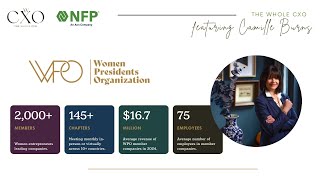
Camille Burns Unlocked: Scaling Secrets from 25 Years Leading Women Entrepreneurs
Camille Burns on Peer Networks and Scaling Women-Led Businesses | JPMorganChase

S5 E4: The Power of Womanhood with Camille Burns, CEO of Women Presidents Organization
Entrepreneurs as Equalizers (Feat. Camille Burns) | Dauntless LeadHERship Podcast #05

Empowering Women Entrepreneurs: Insights from Camille Burns and Linda Hamilton