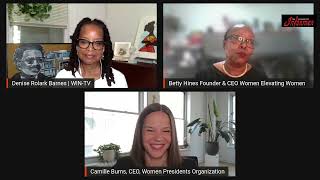
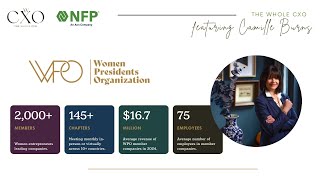
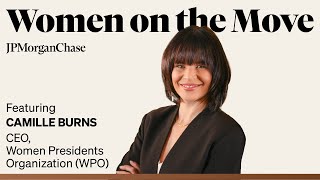
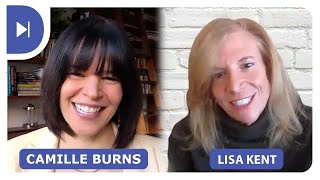
In this WIN TV interview, Betty J. Hines (CEO & founder of Women Elevating Women – WEW) and Camille Burns (CEO of Women Presidents Organization – WPO) discuss how their partner organizations support women entrepreneurs and CEOs. WEW is a global, multicultural network that feeds women‑owned businesses into WPO once they reach $1‑2 million in revenue. They describe peer‑advisory groups, workshops, and the “5 Pillars of Success” that address common barriers such as access to capital, branding, and collaboration. The conversation highlights the value of women‑only spaces for sharing stories, overcoming bias, and balancing work‑life challenges. Both leaders promote the upcoming Woo Conference (a two‑day, in‑person event on September 13‑14, 2022, held at a Bluemont estate and a JPMorgan Chase venue in Washington, D.C.), detailing registration, speakers, and the focus on collaboration. Camille expands on WPO’s global chapters (Canada, South Africa, Europe, South America, Turkey) and how international networking creates strategic partnerships. They also note the diversity of industries women lead—manufacturing, distribution, construction, tech—countering stereotypes. The interview ends with a call to action for women to join the virtual community, attend the conference, and leverage global networks to scale their businesses.
Chapters
Where do you come to get all your news? Washington Informer.
I want to welcome you two ladies, uh, Betty J. Hines, CEO and founder of Women Elevating Women, uh, and, um, uh, also Camille Burns, right, uh, the CEO of Women Presidents Organization. So thank you all for joining us.
Glad to be here.
So happy to be here.
So, so tell me, um, I don't know who I should start with. First, um, but, uh, either one of you can jump in and tell me a little bit more about the organization and what you do for, uh, women who are, uh, in business.
I'll, I'll kick it off. Uh, Women Elevating Women, or as we affectionately call it, W.E.W., uh, we are a multicultural, multiethnic, multinational, global organization that we attract, uh, women who are both executives and entrepreneurs, and we meet with them to help scale their businesses. So I'll start with that because we are a feeder program into the WPO, Women Presidents Organization. It was because of WPO that, uh, we launched Woo, because the women in WPO must have revenues of $2 million, $1 million if they're, uh, service-based. So, uh, that's what WOO is all about. We try to get them to that level of scaling and then we hand them off to our big sister, uh, WPO.
Wow. And, and, uh, so Camille, that means, uh, I mean, what, what are the ranks of the women in WPO? I mean, do you have a large membership?
We do. We have about 2,000 members and all members of WPO are CEOs, presidents, or executive directors of privately held companies. And as Betty said, we have the minimum revenue requirements. So this is just a match made in heaven because we can really help support women from the beginning of their businesses as they're growing their companies. And then when they get to those next levels of growth, women need different things. And so this is just a great partnership.
Betty, I'm going to go or talk to both of you all about this. As a woman business owner myself and striving to one day maybe meet that mark, Camille Burns. But as we do that, I mean, do women— what are the challenges that women face in making sure that their businesses are as profitable as they could be?
Well, one of the things that I tell women, and I will tell women like yourself, you don't have to do it alone. There are studies that show that women learn more effectively and efficiently if they're in peer advisory groups. So we have peer advisory groups and we're global. So we have them across the country and we meet monthly virtually. They bring their challenges within their businesses and we discuss them. But ultimately what we are bringing to them are workshops, seminars on how to leverage their social capital and how to have access to capital, resources, information to help them scale. That's something women don't do well. They can perfect it. Those are some of the monthly sessions that we have.
I guess one of the when I think about it, because, you know, a lot of us may be members of a Chamber of Commerce, we may be members of a Black Chamber, but a women-based organization is something that maybe some women don't think about except early on in their careers. So, you know, I guess— and I guess what I'm trying to get at is sometimes there are barriers that we don't see. And so what is it that's so specific to women? Is it internal? Our ideas about what we can do, or do we put limitations on ourselves, or are there external barriers? What are the things that— maybe one or two things that you think you've seen that women being a part of either one of the organizations helps women to overcome?
Well, I'll start with, for women, One of the things for women is that we do have some barriers there, and that's like getting the capital that is needed. So women also, and this is something that I teach them every day, that, or every month, is the 5 pillars of success. We need to learn how to do more of how to collaborate because there is enough out there for all of us. We need to learn how to connect with the right businesses and organizations that's going to help us scale. And we also need to do some things in terms of branding. So there are 5 things that I won't go into in depth. They're on my website. But these are some of the things that hold us back. What we do— what we've also learned is that women learn exponentially in sharing their stories, hearing about the successes of other women. And that's how we scale. And we have been fortunate enough to partner with WPO, where WPO is giving us a broader platform because they invite all of our women in Women Elevating Women, or WEW, to their annual conference. And Camille, maybe you want to add to that.
Sure. And, you know, Denise, what I would say also is that when a woman is running her own company, when she's a CEO, president of a company, you know, that's it. You don't separate your work from your life when you're running a company. You know, it's all one. And I think that one of the most important things about women getting together with women is, A, there's a comfort there, uh, B, other women in the room understand what you're going through and they can really relate and they can understand those challenges of being a woman, maybe having children and trying to run a company and just walking into a room room and some of the biases that exist and things like that. So there is this added safety, I think, when you're in a room full of women and being able to really talk about some things that you might not feel comfortable when you walk into a room full of men. And as Betty said, we have a conference every year and it's an amazing event, the WPO conference. We have about 850 women from around the world come to that.
Wow.
And it's just, you know, there's an energy when you bring a lot of women entrepreneurs together that's that's really powerful. And then Betty's conference next week is really an extension of that. And it's just— I'm really excited to be part of Betty's conference, the Woo Conference, and the women who are coming into that program or to that event are really exceptional as well.
So I was trying to say that that's the dessert here. I was trying to save that to the end.
Jumped the gun.
Yeah, I'm glad you did because I wanted to segue to that, to the conference. There is a conference coming up, Betty, next week. And so tell us about that.
The conference is our— what we call our local domestic conference. The women come from all over, from California, across the country, north, south, west, east. And we also have membership in Dubai. And this, because we meet virtually, they don't have an opportunity to see each other but on two occasions. Number one, at the WPO conference this past year— well, this year it was in Montreal in May— and then here in D.C. So this gives them an opportunity to come together and see each other face to face. And more importantly, the emphasis on this conference is how do they— can they collaborate with each other? It's amazing. If women would do more collaboration, they can scale. And so this is what this conference is totally about, is how we can work together. If not working together, how can other sponsors that are present help us, help give us the sources that we need to scale and to just become a million-dollar business.
So, um, I, I was talking with some folks, uh, just the other day about collaboration, and it seems as though that's, uh, in my years of business, it seems as though that's been a fairly new term that works because, uh, business owners historically seem to always think that everybody was a competitor as opposed to someone that you could really collaborate with. We just saw that a few minutes ago on the call about Hannah and the bookstores, but she still gave shoutouts to the other Black-owned bookstores in the area. So working together does make a difference. But what do you think is— well, let's stick with the conference right now because I want to make sure that those women that are listening, because we don't have a lot of time, that want to participate in this conference can do so. So tell me how that can happen, Betty.
They can. There's a 2-day conference, and they can go on the website, which is woocrew.com. You'll see it right there, and they can log and register. They can also see the 2-day agenda, and if they can't make both days, we've provided them with a 1-day admission. They can come to either day 13th or on the 14th, and they just put in there when they register the redemption code, which is 1-day collaborate, and so they can pick which day they want to, uh, attend. So they can have access to all these amazing people. Camille Burns will be there, and the other— we have, uh, Phyllis Newhouse. Phyllis Newhouse is an Entrepreneur of the Year. Uh, she's the first Black woman to take two companies public on the New York Stock Exchange, and then we have other speakers such as, uh, uh, Nicole Parker, who is named this year— she's right here in Maryland— she was named the 2022 8A Business of the Year, and Dr. Angela Marshall, who's had the fortune of being on the same platform with Dr. Fauci. So we have some amazing speakers and the members themselves are amazing.
And did I miss— is this— this is in person?
Yeah. Okay.
And tell us where.
The first look on the 13th will be going to Bluemont, and that's in Bluemont, Virginia. It's a 50-acre estate, and we will hold workshops there and we'll have our keynote speakers. Then the second day, we're being hosted by JPMorgan Chase, and that's downtown D.C. on 15th Street. The addresses are located on our website.
Wonderful. Camille Burns, let me ask you, because I like the global concept, because there are women entrepreneurs or women presidents around the world. We never hear about them. We don't know what impacts that they're making on their communities. I mean, how does that networking really grow? Uh, uh, still women who've, who've reached that mark but can still excel. What is that? What are those collaborations like, um, with, uh, women from, you know, various parts of the, of the world coming together?
You know, it's fantastic. I think that the world's gotten a lot smaller, right? So I think having connections with business owners around the world is huge. So many companies are looking at ways that they can expand their businesses, they can develop strategic partners, and having that global network, I makes a tremendous difference. I'll also say that one of my passions is our chapters that are outside of the United States, because in so many places, women are where women were in this country maybe 20, 30 years ago. And it's really hard for women to even find other women entrepreneurs, let alone have a network of them. So it's really impactful and exciting to be connected in these other countries. We're big in Canada, we're big in South Africa, and then we've got some chapters in Europe and South America and a couple other places. So Betty's group, actually, she's a chapter chair. And so Betty and I go way back, what, 20— 2006, I think. And Betty's group, her WPO chapter, has a sister chapter with one of our WPO chapters in Turkey. So every quarter they get together. And so there's those kind of relationships that are really invaluable. And the businesses in other countries are different. They have different challenges. And so understanding that global community in that global entrepreneurial space, I think is really impactful for all business owners.
And have we— have you found— have you found that women, particularly those who are presidents of companies, are expanding into areas that are really quote-unquote non-traditional?
Yes.
Such as?
Such as construction, tractor companies. What else do we have? Tech, there's a lot of women in tech, and I think that people don't think about women being in tech. Um, and really anything you can think of, we probably have a member who's in that industry. So it's, you know, I think that's one of the misconceptions about women-owned businesses is that women are in these traditional spaces, or what we think of as traditional spaces. Our, our third largest industry in the WPO is manufacturing and distribution. Um, and so I think that people don't really understand the kind of businesses that women are running. But it's exciting to see women, I think, advancing in all fields.
Well, you all, I mean, I'm glad to see you leading the crowd here in this area because I think, again, and I'm guilty, I always say I think of myself as a Black-owned business, but I don't always think of myself as a woman-owned business. And maybe I need to sit down on your couch, Betty, and you can analyze why that happens. Please.
I would encourage you. I would encourage you.
You know, and I don't know how many other women do that. Maybe because I'm second generation or something. I don't know. But anyway, we won't, we won't analyze me on the show today. But I think it's really essential and that you all are doing what you're doing. It's great. And so, I mean, I don't know if I've missed something. Is there something else you want to add that we haven't quite talked about? Yes, I just want to mention to women, you know, to reach out again.
I want to stress, you don't have to do it by yourself. And so that is why we have a virtual organization and we take women who are at, you know, who for any type of a background in fields, we have people in trucking, but you need to get outside your zip code. And I would say that to you as well. In order to scale, you got to get outside your zip code, your county, your state. And that's why we're global. And we're glad we have a global partner.
Well, I want to thank both of you all for being with me today and for sharing this great information. I hope that we've been putting up the website places where people can go to learn more about the organization and to participate in the conference with that one-day collaborate. I like that. So that's, that's, that's the word we have to keep remembering. So thank you so much for joining us, and maybe you'll see me next week.
I hope so. Thank you for giving us the opportunity to tell our story.
We appreciate it. All right, have a great one.
Thank you.
Thank you.
Where do you come to get all your news? Washington Informer.