In this conversation, Speaker A and Carl discuss how to prepare a company’s chart of accounts for growth. They first describe the common but unsustainable practice of duplicating account lines for each department (e.g., separate wage accounts for sales, marketing, R&D). While this works for a handful of departments, it quickly becomes unmanageable as the organization expands, leading to hundreds of accounts. Carl notes that this approach is simple for small teams but will break down with multidimensional growth. The speakers then introduce a better practice: using a secondary dimension—such as classes, departments, or custom fields—available in major accounting platforms (QuickBooks, Xero, NetSuite). By assigning a single set of core accounts and tagging transactions with a secondary dimension, the chart of accounts stays compact, easier to maintain, and still supports detailed departmental reporting and budgeting.
Chapters
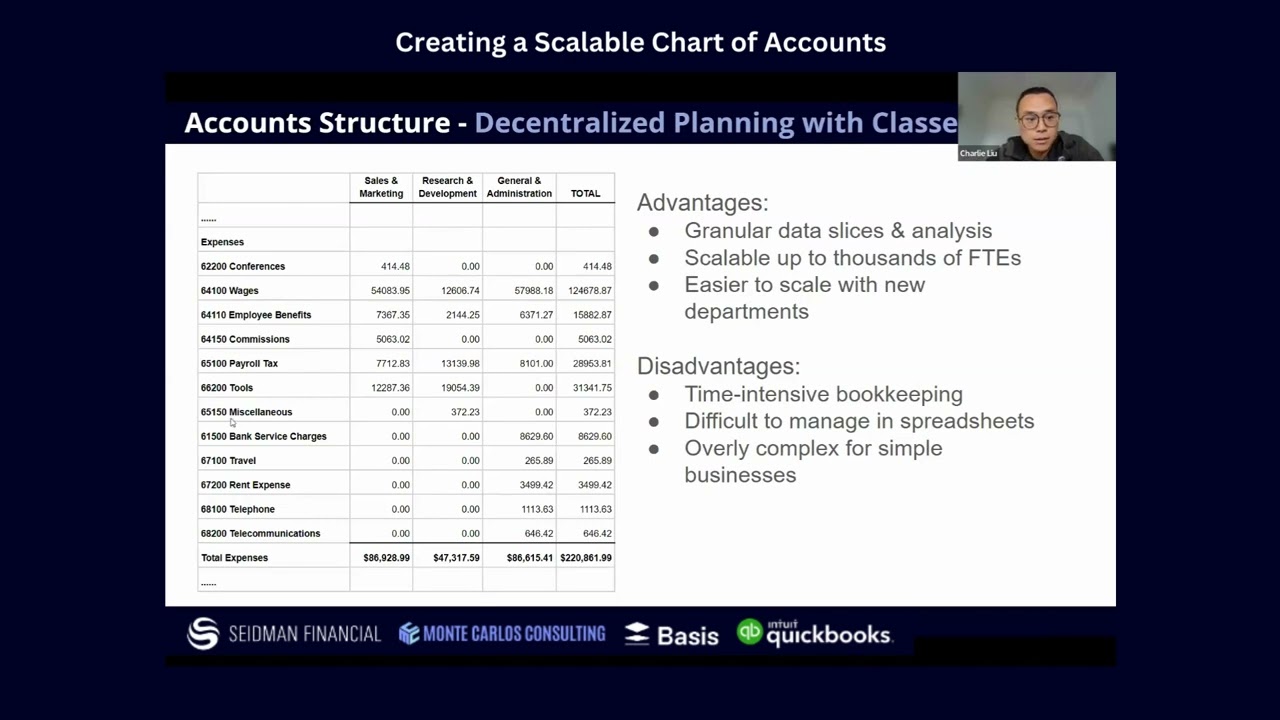
We are talking about scaling and managing business and getting them ready for that growth, right? That usually means your business is a little bit bigger, right? So we, we're now starting to see different functional departmental heads, sales, R&D, engineer, right? So how do we set up your data, your chart of accounts for success? A primary way that I often see is basically start leveraging your chart of accounts, copying and duplicating different accounts for different departments, different sections of your business. For example, right here, where I'm looking at wages, no longer do we have just wages for the whole company. We now have wages for sales and marketing, wages for R&D. And the whole idea is you take those accounts that are useful across multiple departments and start copying and replicating, leveraging that across different functional departments of your business.
Yeah, so in my fractional CFO and FP&A advisory work, this is often a good place to start. It's simple, it's basic. It's not difficult to take a look at what this is providing to you. Very few departments for a small headcount organization. This is probably just fine. However, if you are going to be growing or adding in multiple, multiple departments or wanting elements of multidimensionality, this is probably going to be difficult to grow with.
Absolutely right, Carl. So the whole idea is this works if we have 3, 4, 5 departments, because what you're doing is you're just copying those accounts, right? And if you have 3 or 4 departments, your account list might go from something from 20 to maybe 60, 70. But let's say we fast forward and you have 10 departments. That's just not scalable because now you're gonna have 300, 400 accounts, right? And to improve that, there is a better practice, right? The whole idea is we can actually start leveraging additional dimensionality. So no longer are we just relying on just accounts, right? I can start leveraging a second dimensionality. In this case, I'm looking at departments, and this is something that's available across all accounting systems, whether it's Xero, NetSuite. For today, we are looking at QuickBooks because they are one of the most widely used systems, especially in North America, right? They call them class. They also have additional things like custom fields, right? But the whole idea is just introduce a secondary dimensionality so that you don't have to copy those accounts and duplicate them over and over again. You're going to have a much tighter chart of accounts, much smaller, easier to manage. And then you also have that dimensionality as well.
If you were to think back to the visual you just shared where within the chart of accounts you're adding in a hyphen and the name of the department, well, think as you're growing, you're going to have to go back into the chart of accounts, change around some of this coding, change around some of the nomenclature, and that becomes a mess. Going forward to the classes, what this lets you do is to not have to backtrack into your chart of accounts and change a lot of these descriptions. So instead, we have sales and marketing, R&D, SG&A, and as you start to get additional functions or different additional departments, you can class these out separately. So for companies that are growing in size, this is probably the best advantage through this kind of segmentation. It also gives you great visibility in terms of not just your overall expenses, but your expenses and overall burden for these individual departments. So as you start to grow and scale and start to empower these functional leaders, they're gonna ultimately own their own budgets, their own forecasts, their own accountability. And so this approach typically lends itself more credibly to that.