Chris Power (Hadrian) on Building Autonomous Factories

Chris Power's Hadrian builds fully autonomous factories that run 24/7 with workers who have no factory experience, achieving 10x productivity gains. The company generates its own labeled datasets for manufacturing code because ITAR restrictions block public data, and sources CNC machines from allied countries since the U.S. stopped making them.
Chapters
Chris Power, welcome to the show. Jordy's slacking off. He's taking a break. He'll be back in a couple minutes, but good to have you. Welcome to the show.
Thanks for having me. It's a pleasure to be in the capital of the capital.
Thank you. Yeah, it's good to have you here. How has life been? You've been traveling. You were spotted on a flight to Washington, D.C. a couple weeks ago. The paparazzi caught you.
Yeah, that was crazy.
Yeah, that was crazy. I didn't realize that there were so many spies out there in Silicon Valley, but how was your trip to D.C.?
It was incredible. Obviously can't talk about most of it. Some of it's classified. Very impactful, especially with the new administration coming in and wants to fix American manufacturing. And, you know, the vice president gave an incredibly rousing speech about reindustrialization at the Induracing conference. So it was incredible. And yeah, look, I don't know who leaked that photo to you. I was a bit concerned whether it was a fan or like a communist spy tracking down all the defense tech founders. But, you know, you got to be careful these days.
Yeah, yeah, yeah. You got to be careful. Maybe wear like a full beard and glasses next time. Full disguise.
I just got to go out and say, I think you have the coolest office of anybody that's been on the show so far.
It's a fantastic office.
What would have you— unless it's a green screen.
It's not. I've been there. It's real.
It's not a green screen. Real factory.
And a lot of machines working constantly. How are the lights today? I know that on the top of each one of those machines, there's a light. It can turn red. It can turn green. How are we looking today?
Very, very green, fellas.
Very green. That's great.
Just like the Ramp logo. Everything's going up.
Fantastic. That's great to hear. Well, anyway, you didn't even get a chance to introduce yourself. Can you just give us like the high-level pitch for Hadrian, what you're building, and where it's going?
Yeah, so I'm Chris Power. Hadrian builds autonomous factories. So, you know, we deindustrialized the country from the '70s through the '90s and gave all our industrial power to China. And now the incredibly skilled workforce that does incredible technical things in high-precision machining or castings are all aging out. So we really don't have an industrial base anymore. So our mission is to reindustrialize the US by building highly automated factories that are, you know, as efficient as China with a lot more software robotics and a new manufacturing workforce.
I see that the lights are on in that factory. We're trying to get to lights-out factories. Is that the goal? Is that just Chinese propaganda when I hear them talk?
No, we're lights out today. We run 24/7.
Oh, you do?
We have a handful of really smart people running the fleet. The lights are on now because we're all here. We're a 24/7, 7-day-a-week operation.
Wow, that's awesome.
Can the robots save us, right? It's a very scary time right now where China's producing a lot of robots that have— can be used for a lot of things, you know, flying, you know, maybe over your kid's birthday party to get fun footage, or they can, you know, be used in kamikaze ways. But it feels like automation and advanced robotics-led manufacturing is the only way that Like you said it yourself, maybe the only way that we really reindustrialize, we just don't have this sort of skilled labor force. But you're betting the company on that. But maybe kind of talk a little bit more about that specifically.
Yeah, I mean, our goal with our software and robotics is to make it so easy to be highly skilled that anyone can do it. And 100% of our workforce are people who've never set foot inside a factory before. They're just 10 times more productive. because we're getting them superpowers with software and robotics, right? And I would, you know, you guys are big fans of Formula 1, so like a lot of what our software does is, you know, imagine if your son or daughter who was learning to drive had Tesla Autopilot on an F1 car. They can just, you know, drive a McLaren very quickly without much training. That's kind of what our software does. And we really believe in using the best of software and robotics to give the new workforce 10 times more efficiency with superpowers, you know, versus like replacing them entirely, you know.
Yeah. And so is this the same way, like, to compare it to yesterday, anybody can, can do Ghibli, Studio Ghibli animation. So like anybody should be able to make like, you know, the most, you know, advanced aerospace, you know, parts, etc.?
That's exactly right. That's exactly right.
Yeah. Is Do you think we can get to the— like, what was impactful yesterday is that over the past maybe a couple years, if you were really, really good at prompt engineering, you could kind of create some outputs like we were seeing yesterday, but the average person would go into these models and they wouldn't have any success, right? They tried a couple times and be like, this is slop.
Yeah.
Are we still at the point today on the sort of manufacturing side and what you're doing where it's like you need to be like actually like very, very good, but you're sort of aiming to get to that point where Somebody can come in and just sort of like make, make a part and one-shot it?
I think 80% of our processes were at that point where we're in Ghibli mode, one-shot. There's some really deep digital manufacturing stuff that you still need an expert to do. So we're in the like software engineer is 10 times more productive land versus anyone can code. But I would say 80% of our factory is like anyone can code today.
Are there— the specific programming language is like CAM? programming, right? Isn't that it?
Yeah.
Is there, is there like a, are there LLMs that are good at that type of coding language? Like there's no cursor for CAM that you're like on top of and just plugging in to speed things up?
No.
So we had to build that full stack ourselves. Okay. And the main reason is all of those digital manufacturing tools, which are super hard to use, and you need to be an expert, generate basically terrible assembly code that the machines run on.
Yep.
But because American manufacturing is largely regulated in ITAR, there is no training data on the internet. So one of the reasons why our internal models actually work for manufacturing, machine learning models, is because we're the only ones with a labeled dataset because we're creating it daily in the factory. There is no Stack Overflow for manufacturing data. So none of the off-the-shelf models actually have ever been trained on any of this.
Interesting.
I imagine that every hard tech, defense tech, frontier tech founder eventually has to come through and kiss the ring at your factory just because it's like, hey, they're basically like, hey, we're going to make prototypes and then we're going to go sell contracts and then we're going to eventually need to deliver on those and somebody's got to make the parts. How many companies right now do you have that are like, they're going out there promising these big things and then at the end of the day, they're going to come back to you and be like, okay, now we need to make this? The key thing is so funny because I imagine you You work with some of these sort of more established companies, but then I'm sure there's like 100+ pretty exciting companies that are basically almost in your pipeline where they're like, we're going to work with you, we just need to prove that we can make this.
Someone's got to make the parts for the F-47.
Yeah, and someone's going to make the whole products as well. So I would say that for our large established customers, we're making a lot of stuff for them. For a lot of the newer entrants or for new programs, we are becoming a co-prime where the DoD— hey, John, you can definitely make 50 drones or 50 of this product, but we'd really love you to partner with Hadrian because we think they should build your Tesla Gigafactory for this product line. There's really this partnerships model of helping them prototype and then scale rapidly.
Got it.
But yeah, we're like, you know, we can only build so many factories a year. So the waiting list of everyone wants a Hadrian factory to deploy their products at scale in the US is growing quite a lot, which we're very lucky for.
What do you think about the classic Harvard MBA who's like, I'm going to go buy this SMB manufacturing shop that's putting up $5 million of EBITDA and they've done so for 30 years? So they're just going to— are they buying an aging asset or is it worth— is there value in understanding what they're doing and upskilling it?
The machine shop roll-up idea.
Yeah, the machine shop roll-ups of the world.
I think in general it's a terrible idea. And the main reason is, is like you want to run a factory, you got to, you got to be leading the people and you got to have that credibility. And no master machinist or welder is going to respect a kid who's got a suit and a Harvard MBA on coming in and telling them what to do. I think it's a really tough gig.
Is it also one of those things where you want to—
Chris actually tried to do this like years and years ago.
Yeah, but is it also—
before it was a trend?
No, I imagine there's been so many advancements in everything from robotics to AI that you would want to just think about the factory? Like, how would you build a factory today versus sort of buying this asset that's been operational for decades? Because we're having Dhruva on from Deterrence later, and he's got all these crazy stories. We're walking around these factory floors and there's an active machine being used that's from the '40s, like the 1940s. Like it was working in World War II and we're still using it today.
Keep using it.
And so I imagine if you have the opportunity to partner with a new defense tech company and say, Well, like, here's what's available now. Like, you don't have to go and try to take over some old factory.
Yeah. And a lot of the capital equipment in all of the naval facilities or, you know, everywhere in machine shops is, you know, somewhere between from the 1950s to the 1980s. And it's just impossible to automate it because often none of them have computers on them in the first place. So you really got to— you really got to build these factories from scratch with new technology and new workforce.
How do you think about when you're setting up one of these new factories? And for companies that are in defense at all, are there the actual machines themselves that then sit on the factory floor? I imagine a lot of the best ones are built and designed and manufactured, everything in China. So how do you think about the supply chain for the autonomous factories that you guys are building and figuring out?
It's a very hard question that the country's got to answer. So the machinery market— so we invented— Air Force invented CNC machine. And we no longer make CNC machines in the US. And I think you saw this article about, you know, Haas white labeling some China ones and selling to the Russians. But the main, the main manufacturing markets where we buy from is China's number one. We don't buy for them because they got spyware all over this stuff. And then it's, you know, Germany, South Korea, Japan are the best machine makers. And it's kind of like the car market. You know, you can buy an Italian one and it behaves like an Alfa Romeo and it's really fast, but it's going to— it's— you're going to be in maintenance hell forever. The German ones are really stable and, you know, The Korean ones are quite good. So, you know, if the balloon goes up with the conflict, you know, can we even buy the amount of capital equipment to put in the factories because we don't produce that capital equipment in the US anymore? So, you know, part of my job is grow super fast and buy all the CapEx from our allied partners and make sure it's in the US. But yeah, we no longer make the underlying machines in the country anymore.
Can you talk a little bit about the continuing resolution? You're not a company that's going directly for program of record, but obviously your fate is kind of tied to that. I mean, yeah, I know that you probably can, but can you talk about like, how did you interpret the news? There's been a lot of chatter about this is a bear case for the entire industry. Maybe there's green shoots of opportunity. How are you processing it? What's your strategy?
So we're in a really lucky position where we're everyone's factory. So as long as we have enough customers who are winning and losing, like we're growing at a rapid clip rate because we're kind of the index of the market, right? Which is a really lucky position to be in. We also partner with a select few companies again to co-bid on these major programs that manufacturing is a real challenge. But for our core business, you know, if you're a small defense startup that they've got one big program of record and that gets delayed 9 months, your burn rate's through the roof. You're canceling your ramp credit card. You know, you can't put ads on AdQuick anymore.
You're in a really tough position. No Eight Sleep?
Brutal.
No, I mean, if you've paid for it, yeah, Eight Sleep's not leaving you.
Yeah, but for larger companies like Anduril, you know, they're working on 10 programs at once. So if a couple of them get delayed, it's not a huge issue. I think Delian's absolutely right about like, if you're a startup and you're bidding on one and that revenue cycle blows out 9 months, you're in real trouble. For platform companies like ours where we're growing with many customers and sure, some of them get delayed, like it doesn't really affect us that much. And we're in a really good position where we can eat those long continuing resolution cycles because our core business is growing like 10 times, you know, 10x year on year. So it doesn't affect us as much. It's kind of like, you know, do you guys really care whether people watch movies on Netflix or Hulu because everyone's using AWS? We certainly don't. And we try not to have favorites, you know. We'd love to manufacture everything for everybody.
What does success look like just purely from a, you know, The thing that comes to mind is like there was this meme that like 30% of venture dollars go to Meta, right? I didn't think it was quite true, but is the future of Hadrian, it's like 30% of hard tech dollars just go straight to Hadrian? It's like obviously like if you're just, if your job is to produce products, like, and you need a factory to do that, like a huge part of the cog should be the factory. And then—
Yeah, I think the most successful companies that are continuing to raise huge growth rounds are building faster and better with Hadrian. You know, and yeah, I think 70% of all the deep tech dollars goes to, you know, there's some headcount for engineering, but a lot of it is producing prototypes and then scaling factories and components. So yeah, we believe that we will quickly become the index of the market. And, you know, everyone needs a Gigafactory, right?
That's right. What's going on? What's your thoughts on Europe broadly? We've covered the automotive market Quite a lot on the show. Just you know Germany's kind of throwing in the towel. Some manufacture, you know sending their manufacturers. You know it was even Porsche setting up U.S. manufacturing. I think it's a bit of a shame. Do they? Is there a world in which Hadrian you know helps kind of revitalize some of these? You know the German industrial economy just because maybe they they they they have this great industrial base, but then. Haven't maybe focused as much on on sort of core innovation around the factory.
Yeah, so we have so much work to do here in the U.S. that we'd love we'd love to support our allied partners in Europe and the you know the Middle East and countries like Japan reindustrialize as well, and they often have the same kind of core skilled labor problem. We've got so much to work to do here fixing the Navy, fixing munitions production, helping our customers scale. But I think we'll get there in a year or two. I think really what you're seeing in Europe is. 2 warring tribes. One is the people that, you know, set their energy policy based off the poor advice of a 14-year-old Swedish girl and gave all the leverage to Russian oil and gas. And then you've got your kind of Richard the Lionhearts. You know, it's like we need to reindustrialize Europe. Let's go make our own fighter jets and drones and naval fleets. So, you know, it's good that the English are waking up, in my opinion. We need it. We need everyone in the fight.
Fantastic. Well, that's a great place to wrap up. Thanks so much for coming on the show. We'll have to have you back.
It took way too long to get you on.
I know, I know. We messed up. But this is a perfect day.
You're busy.
Great day for This, and you've been—
it's a perfect day.
I'm happy to, uh, happy to be at the capital of capital anytime. And, uh, you know, God bless the United States of America and, uh, you know, the financial system of the US economy. Thank you, gentlemen.
Just fantastic. Thanks for coming on. Great to see you.
Bye.
More from Chris
Hadrian CEO Chris Power Series D Allows Us to Build ‘Factories of the Future’


Hadrian's Chris Power: How a 40-Year Manufacturing Gap Became a National Security Crisis
Hadrian CEO Chris Power Reveals Next Move After Firm Hits $1 6 Billion Valuation
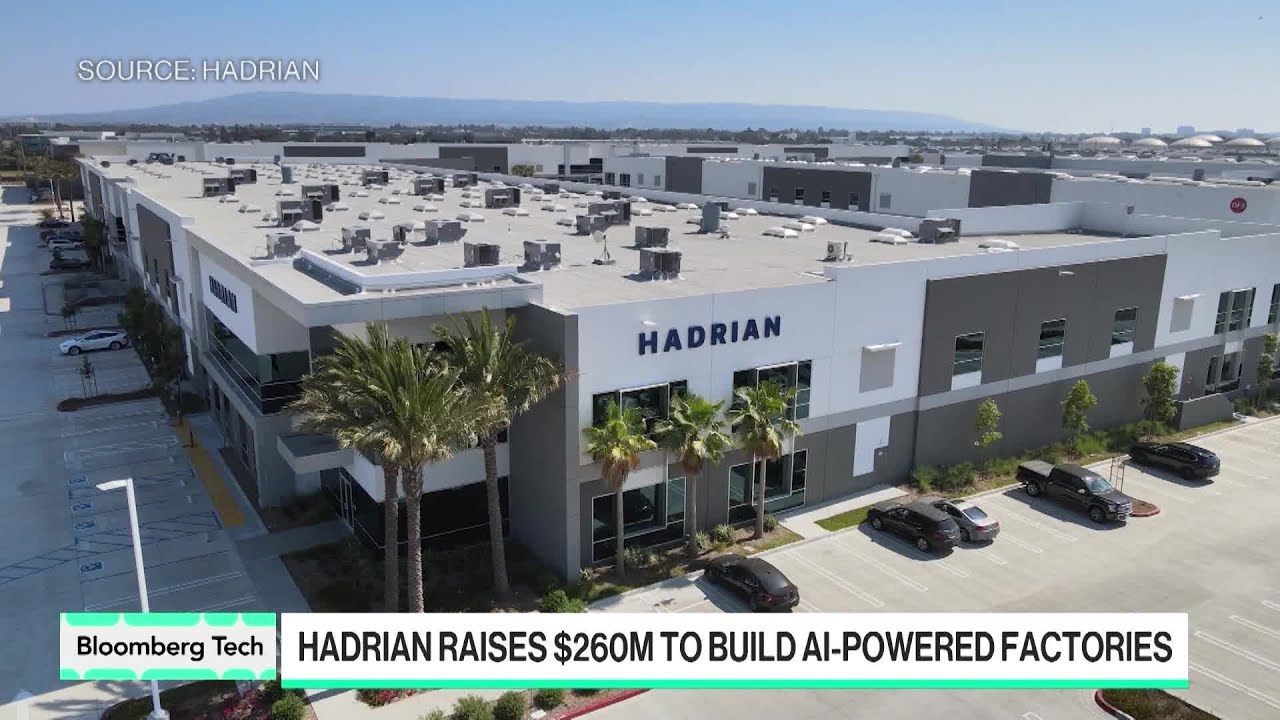

Startup Hadrian raises $260 million to expand its AI-powered factories to meet soaring demand



This Next Billion-Dollar Startup Founder Is On A Mission To Revive American Manufacturing
