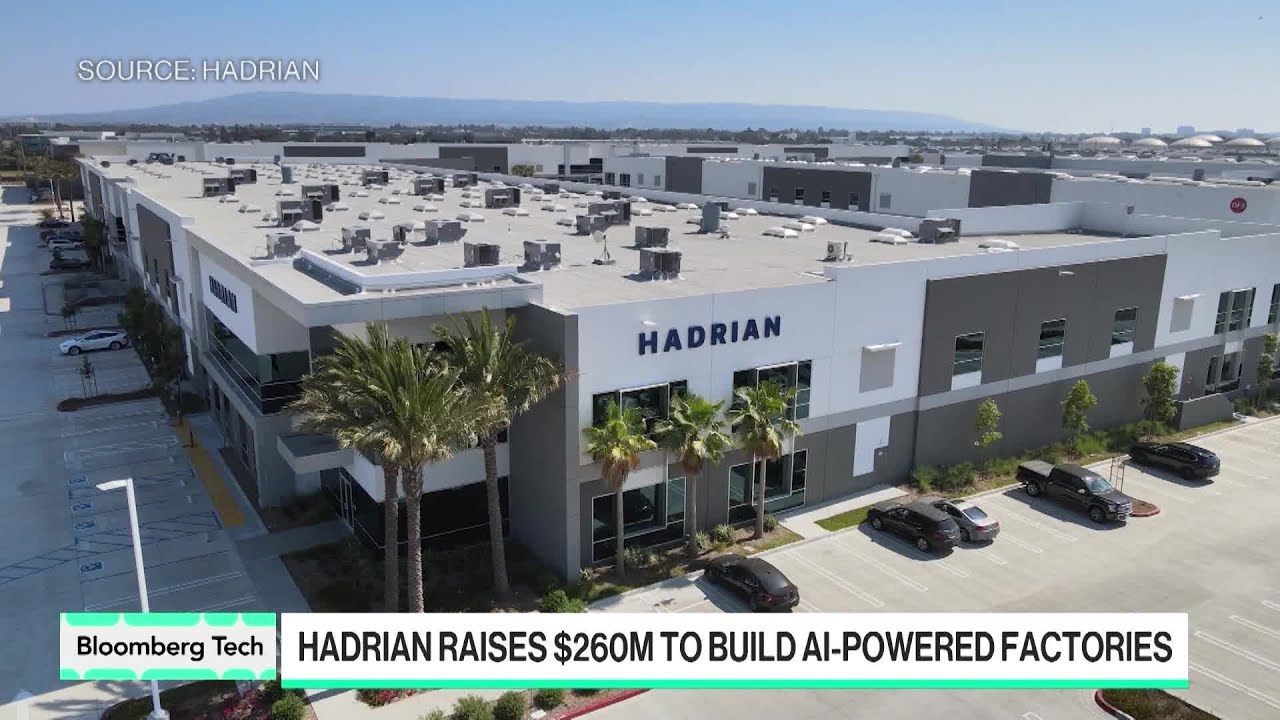
In a conversational interview, Chris Power explains Hadrian’s $260 million funding round led by Founders Fund, Andreessen Horowitz, and Lux Capital, highlighting the speed of the raise and the strategic use of capital to expand manufacturing capacity. Power defines the company’s core offering as a “factory‑as‑a‑service” system that combines proprietary software (Opus) with a newly trained American workforce, positioning the factory itself as the product. He outlines plans to build a new, four‑times‑larger facility in Arizona, while maintaining R&D in California, and emphasizes a broader goal of establishing factories in every state to create millions of manufacturing jobs. The discussion delves into the focus on welding, casting, and additive manufacturing to meet defense department demand, addressing a national skills shortage by making workers ten times more efficient through technology. Power also frames Hadrian’s mission against China’s offshore manufacturing dominance, arguing that re‑industrializing the U.S. is essential for national security and economic resilience. Finally, he hints at expanding beyond the Department of Defense to serve commercial primes and hardware startups.
Chapters
One of your investors says that the the product is the factory. Just explain that.
So we view our job as to reindustrialize the country, and from the 70s to the 2020s, we really like offshored everything we possibly could. And it's this whole system of both our software powered by Opus as well as this new American workforce that creates this factory system, and that that is the real output to our customers. It's like what are we producing? How accurate is how on time it is? And this full stack factory autonomy. And the new American workforce that we're enabling with that alongside is the most important thing we're building. And that's why we think that the factory system that we're building with people and technology combined is the product.
Sizable round, interesting group of investors— Founders Fund, Andreessen Horowitz, Lux Capital. Why the size of the round, the difficulty or not in raising it, and what you plan to do with it, Chris?
We're very lucky. That we were open and shut within a small handful of weeks, less than a month. Really, that's just a credit to my fundraising ability or the market. It's just the team's hard work over the last year. What we will do with this capital is expand into Arizona with a new factory for our customers that's 4 times the size, as well as use that capital to hire more people so we can ship more manufacturing capabilities to our customers, both in aerospace, the defense sectors, commercial manufacturing, and obviously, you know, the DOD as well.
In January of this year, I was with the Anduril team in Ohio when they announced and confirmed that would be the site of Arsenal 1. And part of the discussion I had with Palmer Luckey was why not California? You know, Hadrian also has this, this big footprint in California, but you've looked to Arizona for your expansion. I think that's really worth discussing.
Yeah, we will have, you know, R&D in California and we're not moving out of California. But one of the most important things is that we're creating thousands and thousands of new manufacturing jobs in every state. Arizona has been great to work with on the practical stuff like permitting, workforce, getting energy connected to the building, all these basic things that are harder to do in some states. So we're really happy to expand into Arizona, but it also won't be the last. You know, our goal is to have factories in every state and creating millions of new manufacturing jobs along the way.
Chris, something that I think was kind of missed from, from your post and the announcement was what you're expanding into— welding, casting, additive. Is that just because that's where the demand is, particularly from the DOD and the defense apparatus of this country?
That's right. I think if you look at, you know, pretty public information from the Secretary of the Navy or the Army in areas like shipbuilding, the nuclear force, munitions, There's these huge lack of skills in the country. You know, we need millions of welders, we need millions of machinists, we need millions of quality inspectors in all these manufacturing capability areas. And we just don't have the skilled workforce at that volume anymore. And this is what we're really doing with factories as a service, which is combining technology to make people 10 times more efficient and enabling them. It's not about replacing workforce manufacturing because we just don't have a manufacturing workforce anymore in this country. So we really need to combine the 2 things that America is best at, American software and the American spirit to get this 10 times advantage over our global competitors. And yeah, we're working on those categories primarily because they're so important for areas like shipbuilding.
Chris, when your peers come on this program, you know, Castellion, Sironic, Vannevar Labs, or the Anduril team, they frame it in the context of China, China's manufacturing prowess, its competence in areas like software and hardware. How do you think about China and what is the sort of Hadrian mission statement with regards to China, if indeed you take it into consideration?
Yeah, we think that the, the arsenal of inventory is not deterrence. It's the ability to produce fast and onshore, not just in areas of defense but in pharmaceuticals. And that's why you have to reindustrialize the country. And, and I agree, you know, we've, we've given the farm away to the CCP by letting them have all our manufacturing capability over the last 3 decades. And now we're in a position where That really degraded the skill set of the trades in the US. And this is why, you know, building ships, building munitions, building machine components in this country is very difficult because we kind of offshored that talent to the Chinese. I certainly think that, you know, the US needs to be the strongest industrial power like we were post-World War II again in order to prevent or meet that threat.
Chris, is your ceiling limited just by the idea that your core customer is the DOD? Or in the future, do you do business with these other primes and other startups as well? Very quick.
All of our customers are, you know, a defense startup or a space startup from day one up to all the mega primes through that whole chain. The DOD has only been recently a part of our business, but we are working with the vast majority of, you know, hardware startups all the way through to the, you know, mega-cap public primes and everything in the middle.