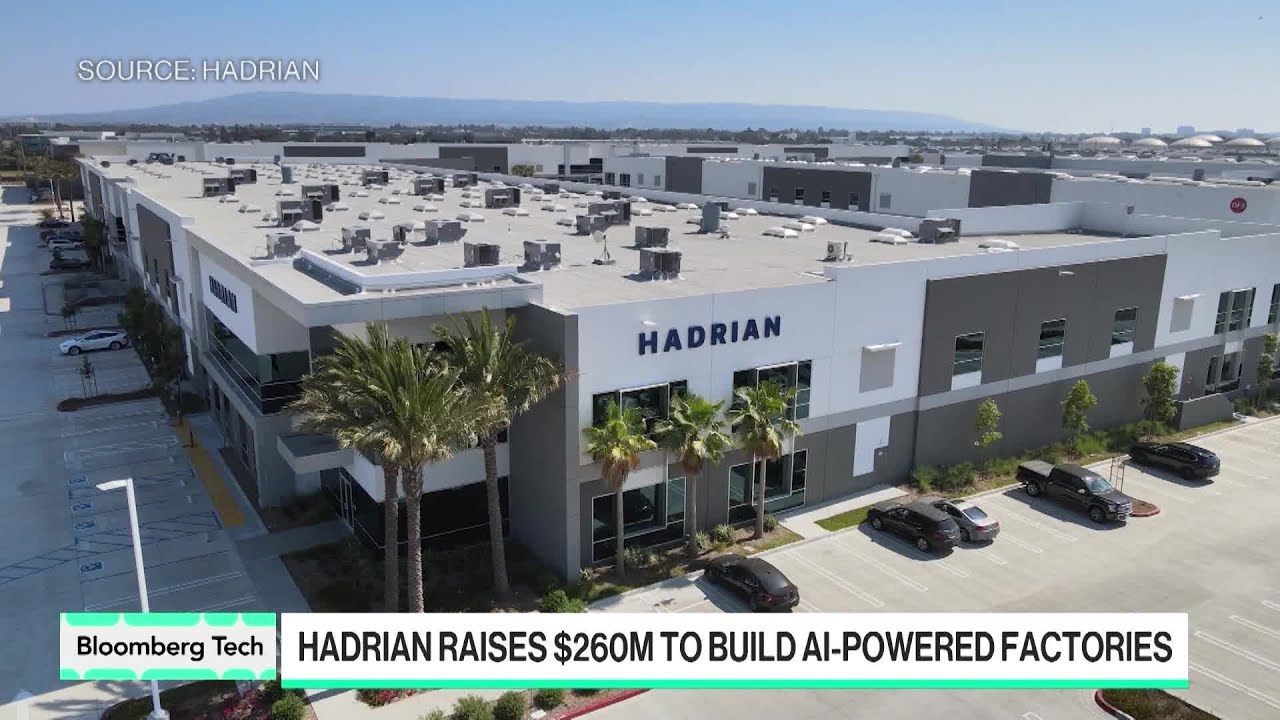
Hadrian CEO Chris Power raised $1.37 billion in Series D to build automated defense factories. The company calls it "physical AI"—applying AI to manufacturing to make workers ten times more productive. Power plans to hire 1,000 to 2,000 blue-collar technicians in Alabama with equity grants, a first for manufacturing.
Chapters
Well, Hadrian is on a mission to build factories of the future, and investors are all in. The company just closed a massive $1.37 billion Series D fundraising round. And joining me now is Chris Power. He is the founder and CEO of Hadrian. Chris, welcome to the New York Stock Exchange.
Thanks so much for having me.
Congratulations on the news about this funding round. How are you going to put those funds to work?
3 very simple things. A lot more factories, a lot more investment in our workforce and software, and really getting ahead of our customers' and departments' needs as we go on this half-a-trillion-dollar mission to reindustrialize America.
So we've met before, we've spoken, but just for the viewers who are new to Hadrian, what is your mission? What are you doing?
So America offshored the vast majority of all our manufacturing for the last 40 years, and now we're reshoring it and rescaling the defense industrial base. And what that means is that we're operating with a Cold War-era workforce and Cold War-era factories, and there aren't that many skilled people. So you need high levels of automation that enable the new American workforce to be 10 times more productive so we can compete globally, create millions of well-paying jobs in America, and reindustrialize the country. And we do that through building and operating design-agnostic, highly automated factories powered by our software platform and our new workforce of the future together.
How is your approach different?
So most advanced manufacturing is, is new manufacturing methods are at a small scale and still very, very reliant on incredibly skilled people. Like skilled welders can take 20 years to train and there just aren't millions of Americans who have those skills anymore. So it's really the power of physical AI and the people together to get that productivity gain and then deploying it as factories as a service where we can solve massive problems for customers.
When you say physical AI, can you break down what that is for the viewer?
So, you know, everyone's heard about AI for business and obviously AI for making software engineers more productive. But the next big wave is how AI is going to impact the world of atoms instead of bits, which means mining, manufacturing, logistics, construction. And one of the biggest places that you can use physical AI to empower the workforce, make them more productive and compete globally is in manufacturing, which has really been because of the offshoring, been left alone by technology in America for the last 30 years. So as I say, we can't forget that the world of atoms, the economy of atoms, is 100 times bigger than the world of bits and represents a huge investment and jobs growth opportunity in America.
And why do you think investors are seeing advanced manufacturing as a long-term growth opportunity?
Well, secondly, the world's a very different place. You know, we offshored everything and went global and now we're becoming a sovereign country again. So if you offshore $1 trillion worth of manufacturing, you've got to re-onshore it. So that's obviously a huge opportunity. And secondly, there is a huge technology change happening in the world of atoms instead of the world of bits where physical AI is now real and possible instead of maybe impossible 5 years ago. And the third thing is big policy changes. Up until a couple of months ago, we were still buying Chinese drone components in all our police drones. $50 billion worth of drone component reshoring. So you have to build new factories. You have to make them more efficient to be globally competitive. And same thing across the board. So it's the money's there, the policy is there, and the opportunity is there now. And investors see it as both the largest new AI wave, the best thing they can do with their capital to create instead of destroy millions of American jobs and do really important work to help the Department of War and the commercial industrial base reshore and rescale.
Are robotics and AI in factories, is that something new?
Industrial robots have always existed in factories. And then you've got humanoid robots which will come online in 5 to 10 years. But a lot of advanced manufacturing is actually in the digital world automating these equipment. So they do run flexibly. It's massively more simplified and lights out. But America is very far behind China and the rest of the world on deploying humanoid and industrial robots in factories that work. And that's one of the things that we are extremely far ahead of our competitors on.
And what is on your radar in terms of the conflict in the Middle East?
Everything. Look, I think as the president said, we've got plenty of munitions ramp. I think the key here over the next couple of years as we refill the battery, there are thousands of suppliers that have to scale. We finally banned having adversarial components in our munitions. There's a lot of reshoring needed to be done. And simply production scale and the workforce challenge across the entire country, not just in munitions, but in submarines, shipbuilding for the Golden Fleet, and certainly the drone industrial base. It's a whole-of-nation effort to get the industrial base where it needs to be. And it's always true that, you know, factories being, being able to output missiles in months, not years, is the most important thing in a time of conflict. So that's what we're laser-focused on, and that's what we'll be deploying billions of dollars into over the next 12 months.
And looking ahead, where is the greatest growth opportunity for Hadrian?
Very simple. Maritime dominance, submarines and surface vessels, the drone industrial base. The Pentagon's publicly said they're going to spend $50 to $60 billion on drones. Most of that was made in China and now is being reshored. Huge opportunity. And obviously the munitions ramp. That's— those are the 3 critical areas for us.
And what opportunity does reshoring provide? Well, for—
I think, I think the most important opportunity is for the American workforce. So we lost millions and millions and millions of jobs to overseas over the last 40 years and really destroyed a lot of the wealth creation engine in the middle of the country. So our largest factory is in Alabama. Over the next 3 years, we're going to hire at least 1,000 people, probably more like 2,000. Really good paying jobs, high healthcare, and most importantly, Every technician at Hadrian gets, you know, a very significant equity grant in a Silicon Valley growth company, which has almost never been done for, you know, a blue-collar workforce before. So the economic opportunity to create an economy and a manufacturing base that works for every American instead of just the coast is really important as we go through this trillion-dollar wave of reshoring and reindustrialization, not just in defense, but, you know, biotech as well needs to be reshored from China. It's an across-the-board problem and It's going to create millions and millions of American jobs, you know, when we need them the most.
And after this $1.37 billion fundraising round, what is next?
A lot of new factories, a lot of new hiring, making sure we deliver on critical programs for our partners at the Navy, Army, customers like Lockheed Martin and the other services. So just laser-focused on delivering and scaling, hiring a ton of smart software engineers, robotics engineers and manufacturing workforce and leadership to just help us keep driving the mission. And hopefully we'll be back next year with another fundraise.
All right. Chris Power, founder and CEO of Hadrian, thanks for joining us and congratulations again.