In a July 17, 2025 interview recorded at the Reindustrialize conference in Detroit, Chris Power, founder and CEO of Hadrian, outlines the company’s mission to "reindustrialize America" by deploying AI‑powered smart factories that make the American industrial workforce ten times more productive. Power describes Hadrian’s existing 100,000‑sq‑ft Los Angeles facility, its 10× revenue growth last year, and the recent $260 million Series C round led by Founders Fund, Lux, Altimeter, 1789 Capital, Andreessen Horowitz, Construct and a large factory‑financing line from Morgan Stanley. The capital will fund rapid expansion, including a new Arizona factory (four times larger than the LA plant) slated for operation by Christmas. Power emphasizes the acute shortage of skilled machinists, welders, and technicians, arguing that Hadrian’s AI‑driven software platform (Opus) and upgraded “dumb” machines can train workers in 30 days, delivering a ten‑fold productivity boost. He positions the company as a dual‑use supplier to defense primes, maritime and munitions sectors, noting the U.S. shipbuilding gap with China (5 vs. 1,700 ships) and framing manufacturing as a national‑security issue. The interview touches on demand signals from the defense establishment, the cultural shift needed to attract non‑traditional talent, the company’s full‑stack software‑hardware approach, the lack of direct competitors (Hadrian competes with itself), and Power’s personal motivation rooted in a historic great‑power competition narrative. The conversation ends with a call to treat reindustrialization as a national mission to preserve American global leadership.
Chapters
Joining me now, Chris Power, the CEO and founder of Hadrian. And Chris, it's great to speak with you today. Welcome.
Likewise. Thanks for having me.
Okay. Before we get into the news, just first a little background on Hadrian. What is Hadrian and what are you focused on doing?
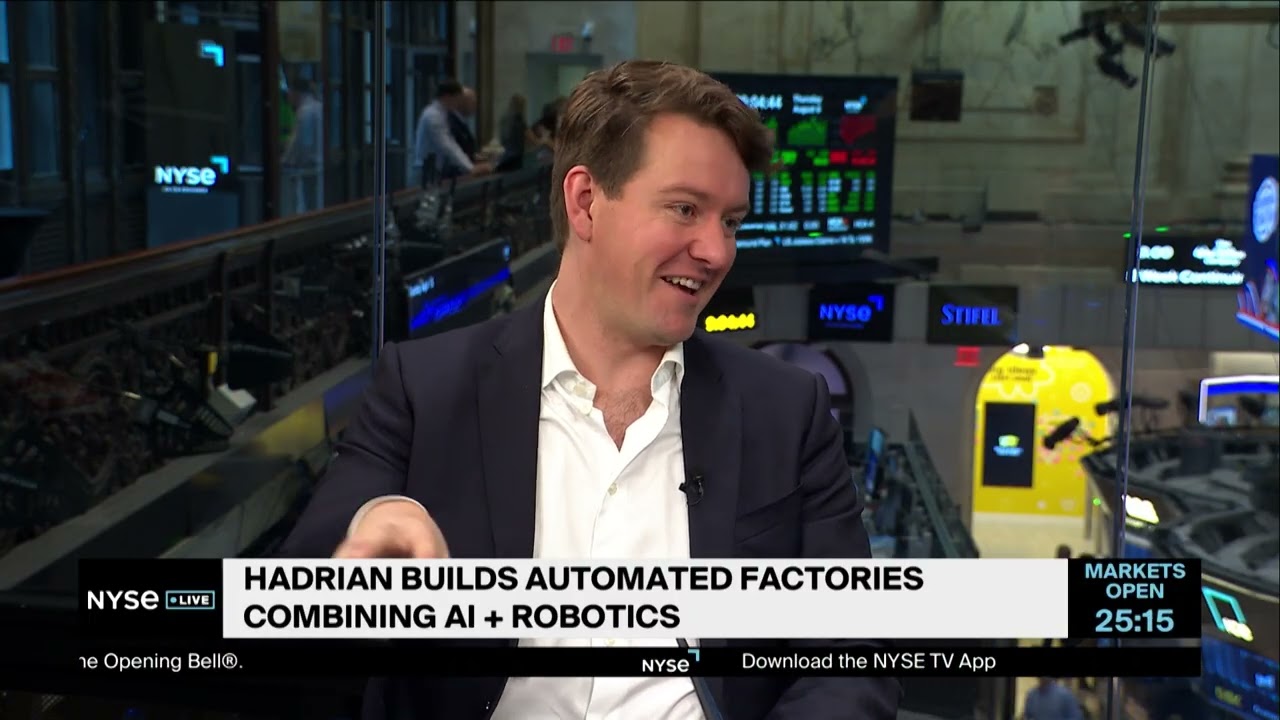
Our mission is to reindustrialize America. And I'm joining you filming at the Reindustrialize conference in Detroit. So the timing couldn't be better. Our mission is to reindustrialize the country, and we do that by building AI-powered smart factories that scale and make the new American industrial workforce 10 times more productive.
Do you already have factories that you've built and that are operating?
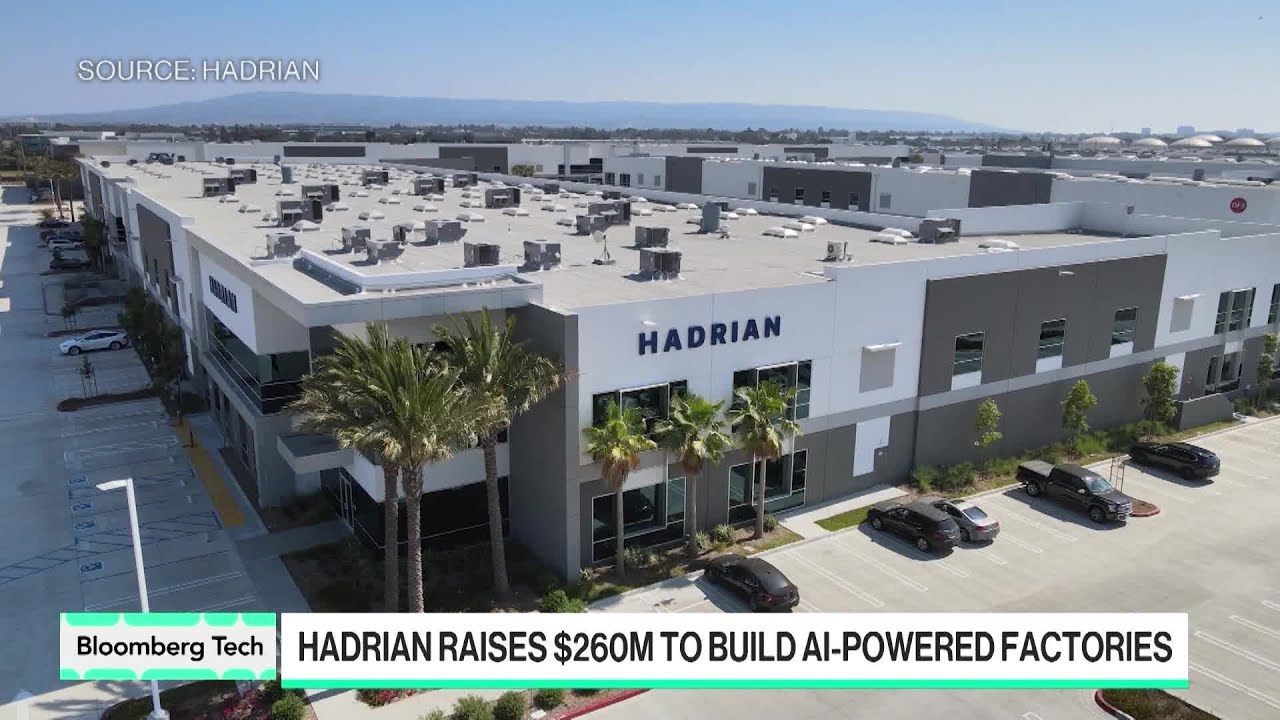
Yeah, we operate a 100,000-square-foot in LA, and we're easily the fastest-growing manufacturer in America.
What does fastest-growing mean? How quickly are you growing?
We 10x'd revenue last year alone.
Wow.
Yeah, very lucky.
Okay. And so now you've also just closed a new funding round. So talk to me about that and what that enables.
We're very lucky to be announcing a $260 million Series C led by Founders Fund, Lux, new investors like Altimeter and, you know, 1789 Capital, as well as our existing investors like Andreessen Horowitz and Construct, as well as a huge factory financing line led by Morgan Stanley. What that will enable is supercharging our explosive growth. both entering new manufacturing verticals as well as scaling and launching Factory 3, which will be up and running in Arizona by Christmas from start to finish in 6 months. It'll be about 4 times the size of our current facility in Los Angeles.
Okay, so you're building these new high-tech AI-enabled factories. Are you— are companies coming to you and outsourcing their manufacturing? Like, how does this work?
The biggest challenge that manufacturers and defense primes or industries like maritime and munitions have in this country is the lack skilled workforce. You know, we're here at Reindustrialize, and Secretary Phelan of the Navy commented yesterday that the number one thing you could do as an American to help the nation is go pick up a trade. The reality is we just don't have that many machinists, welders, or advanced skill sets in this country anymore. So what we do is build and run these advanced factories that make the workforce 10 times more productive and enable a much lower entry point. So we can train someone in 30 days and they're 10 times more productive. instead of taking 10 to 20 years. And that's what we really need in this country is this quantum leap above China's manufacturing model where it's about supercharging the worker versus replacing them. So yes, we are lucky enough to work with most of the large defense primes, neo primes, and startups, as well as part of this financing is launching these dedicated divisions to support the maritime and munitions industrial base where we are frankly 1,000 to 1 behind China. Which is a really important moment in time to go fix really fast.
This is super fascinating to me, especially when you talk— start talking about this idea of bringing shipbuilding back to America. I think a lot of folks don't realize, appreciate, or understand from a military shipbuilding standpoint how slow and difficult that process is to make, for example, a nuclear submarine, slower and more difficult than it should be, even in part because of the labor dynamics. So when I hear you talk about using AI to basically help skilled workers. How much does that change the game, both on the defense side and also potentially on the commercial side, since I'd imagine you're going to be dual use with all of this?
That's right. We are a dual use company. And, you know, China built almost more than 1,700 ships last year and the US built a grand total of 5, which is not great. And the primary issue is the lack of a workforce. And we really deindustrialized the country for the last 4 decades. And what that meant is we destroyed the middle of America and all these people that had really high-paying jobs. In this era, it's not about automating jobs away, it's about using automation to enable 10 times more productivity. The way we think about it is to leapfrog China here, it's all about the people. And we want our software-powered factories to give people like an Iron Man suit so that you can get up and running in 30 days instead of 20 years from any background. 100% of our workforce now have never set foot inside a factory. You know, they're from Home Depot, they were a bus driver, they're a Marine. We feel like this is what the country needs, is these advanced factories that are powering industries like shipbuilding, the submarine industrial base that are, as Secretary Philan said, years behind schedule. And the number one problem is the American talent. We have to use what is best in this country, the combination of American software and the American spirit in this fusion to really go fast and meet the growing threat of the Chinese Communist Party.
It's interesting because I find myself having these conversations on TV and off TV, the debate about what AI is going to do to jobs and the idea that particularly white-collar workers, entry-level positions, AI may disrupt and actually take away some of those jobs where you need fewer people moving forward. But when we talk about it on the manufacturing side of things, it's a different— it's a different dynamic, right? Like, that's where the argument around AI increasing productivity really comes in and turbocharges.
That's right. And, you know, for white-collar jobs, I'm sure, you know, the AI economy will transform that. In manufacturing, you know, we need millions and millions and millions of skilled welders, skilled quality experts, skilled machinists, skilled technicians. And, you know, we could train, you know, a million of these folks, but we can't train 10. And we need this productivity gain through AI, robotics, and software-powered factories to really help us get there at the start. You know, I think you could give me $1 billion and say, go hire, you know, a million machinists or a million welders. And it's just not possible because we destroyed the talent in this country for the last 4 decades. And upgrading the next generation of the workforce with AI and robotics, one, we just need to do it because there aren't that level of skilled workforce left in the country. And secondly, it's the— manufacturing is the last job AI will ever replace. It's really about enabling and empowering versus, you know, destroying jobs. I think the second point is when we deindustrialized, we lost 80% of the manufacturing revenue offshore. And if we can get more productive in the country, what that will create is 10 times more new jobs as that volume comes back onshore and the productivity of the country ramps back up. So I think it's a— the best thing we could possibly do for the American worker is give them this Iron Man suit of AI software and robotics to be able to compete globally. How long would it take?
You mentioned the fact that you're growing very quickly. You also mentioned the fact that you're working with folks on the defense side and commercially as well. We keep hearing about all of this new investment that's being pledged here in the US. You're at this reindustrialized conference. What are you seeing in terms of demand signals and how quickly can you keep pace with it?
That's a great question. So I think the demand signal is enormous. Keeping pace with this is about 2 things. Financing, fab factories, and it's really about the workforce, which is why we so focus so hard on enablement and shortening this training and enablement cycle. I think the biggest challenge our country is going to have is making these big bets on national champions, because, you know, to capitalize shipbuilding, to capitalize the munitions base, even in drones where we are so far behind DJI in this country, I think the momentum is there. And I think Compared to last year at Reindustrialize, we've got Ambassador Greer, Secretary of the Navy Phelan, and many other folks in the government that have realized that manufacturing is no longer an economic issue, it's a national security issue. I don't think we're there yet, and we have to do a lot more a lot faster, but certainly we're able to keep up with the scale right now and grateful to our team and customers for letting us go and do that. But as a country, we have to treat this like a national security crisis, not just the economics of manufacturing.
Are prospective workers on board? Like, do they understand that the jobs they're going in to do in factories such as yours are going to be very different and maybe even more high-tech? Or I guess, you know, require this software troubleshooting skill set?
They do. I mean, we have a very unique model, and I'll say our workforce is very passionate, you know, whether they're coming out of the military or, you know, they had a job at Home Depot or they were a desk worker. One of my favorite people at Hadrian was a paralegal filling out forms during COVID and now he's in our company running 10 machines at once with all these advanced things and working with software engineers. I don't think the country has realized what advanced manufacturing can look like as a cool job. You know, one of the biggest problems that we've got culturally is your dad lost their job in manufacturing in the '90s, so you told your son or daughter to go get a 4-year college degree. At Hadrian, people understand this. It's an awesome place to work. We think people have really advanced skill sets and get to work on the national mission. As a country, I think we need to wake up and recognize that, like, these new factories and new jobs are a far sight better than the jobs of old and certainly what we see in China. But I really think we have to reinvigorate the culture about the skilled trades and that you don't need a 4-year college degree to earn a lot of money or be really successful in this country.
So are you developing the software and the hardware that's on these factory floors? How to think about that and how you're partnering with other companies?
So we upgrade very dumb machines. We buy all our CapEx off the shelf and then make everything smart. And we've built this full-stack software platform called Opus, which coordinates our factories, reduces the amount of skilled time needed, and makes it simple enough that we can enable this new generation of American industrial workforce. The reality is software in manufacturing is 30 years behind the rest of Silicon Valley. So there's a lot of headroom in productivity and a lot of things we can do with software, robotics, and AI. And it's really this full-stack approach to factory autonomy that is enabling us to scale and enable this new workforce and keep up with this explosive customer demand.
So when Jensen Huang comes out and says the next era is industrial AI, is this it? Are you on the front lines of it, or is it going to look even, I guess, even more different than it does right now?
I think we will continue to upgrade factories and we get better and better every month, every quarter, and every year. I think with physical AI, unlike software engineering or, you know, data labeling a piece of paper, because manufacturing has been offline, there isn't really any good training data to enable these AI models. At Hadrian, we have the largest set of trained labeled data in manufacturing anywhere in the world, is my belief. And that will enable us to get better and better with our AI models over time as we scale faster and faster. We've got more data, but Because manufacturing has been offline for 30 years, you really need software-powered factories to capture that in the first place so that as we scale, the system keeps improving. But I do think that if you think about job creation and the workforce in this country, manufacturing is, and the physical world is so far behind the AI revolution that we're seeing in, you know, filling out a sheet of paper or writing code, which I think is a really good answer for how do we enable the rest of the country's, you know, job creation. Let's go AI first in manufacturing and reshore all this volume and not worry about whether we're going to lose jobs because we don't have the skilled workforce. Let's reshore all this manufacturing volume and 100x the amount of jobs and make them really cool and advanced and put factories all in the middle of the country.
Who do you see as your competitors?
We're really competing against ourselves. We're very lucky that this is such a hard task to do with getting to the sort of software scale, the workforce, and the CapEx. We're really competing out ourselves, and I think it's a race against the clock. You know, we truly believe that we are in this 15-year window of seeing the CCP rise and making sure national policy is focused on reindustrializing the country. Really, it's about how fast can we go, how many people can we train, how many factories can we stand up, how many of the primes or the neo-primes can we help transform to this advanced style of manufacturing. We're lucky enough that this is just such a difficult job that I wish there were 20 more Hadrians. There just aren't, which means we are going to rapidly expand into every type of manufacturing that has a critical need for the DOD and national security. But I wish we had more competitors because I think this has got to be a national mission that is not manufacturing economy. It's national security priority number one.
How did you decide to start this company? What was the, what was the moment for you where you said, This is what we need. I'm going to make a bet on this. I mean, I feel like it's what everybody's talking about now, but that wasn't the case a couple of years ago.
That's right. And, you know, I'm Australian, probably the most patriotic American Australian you'll ever see. And from the Asian perspective, it was very clear that things were going to change in the world. And the CCP is such a strong rising power. And if you look back through history, every 120 years there's a great power competition. The last time this happened, it was the Dutch to the British Empire, then the British Empire to the American Empire, which was like a very good thing for the world to have Americans leading Pax Americana and the security of the globe. Now we're in this 20-year window where it's very obvious that, you know, we can't ship enough munitions to Ukraine, we can't build ships anymore, and this is going to create a scenario where China knows that we are weaker than we think we are. And our job is to reindustrialize the country so that America continues to lead the world for the next 500 years. And this has to be fixed in this 20-year window where the threat of China taking Taiwan— and by the way, they're not going to stop at Taiwan, they're going to keep going— is the most critical thing we could be working on. Because the reality is there isn't another America to try this again with. This time it's literally the American Pax Americana system that's been incredibly good for the world with all its flaws. versus the Chinese Communist Party. And we have to fix this in this 20-year window. Otherwise, I don't really want to think about, you know, any other option than winning this fight.
It's Power of Hadrian. Thank you so much for joining me today.