CES 2026 Preview: Gary Shapiro on AI, Manufacturing Innovation & the Future of Technology
Gary Shapiro, CEO of the Consumer Technology Association, discusses CES 2026's expansion into manufacturing and AI. The show has grown from a 1960s event into a global platform now partnering with the Society of Manufacturing Engineers to address reshoring, tariffs, and workforce shortages. First-time attendees should register early, use the AI app, and keep pitches to two minutes.
Chapters
Hello and welcome to Advanced Manufacturing Now, the podcast for manufacturing professionals. Please remember to like and subscribe to get new episodes delivered to your feed each week. I'm your host, Steve Plumb, editor-in-chief of SME Media. I'm joined today by Gary Shapiro, CEO and vice chair of the Consumer Technology Association, which of course puts on the annual CES Consumer Electronics Show in Las Vegas, which this next year will be held January 6th through the 9th. Gary, thanks for joining us today.
Thanks, Steve. Happy to be on this program.
So I know it's a hectic time of year as you're— we're getting into the final weeks of pre-show preparation. I really appreciate you taking time out of your schedule. So did a little bit of research beforehand, and I hadn't realized that CES actually dates back to the 1960s, but in its current form, it's been going on and venue, it's been more like 1998. How did you become involved with CES and CTA? And I know your background's not technology per se, but obviously for the last 30 years or so, you've been heavily involved in it.
Well, thanks for asking and thanks for focusing on CES. You're right, it was started in 1967 by the guy who hired me, Jack Wayman. It was a New York City show, expanded, moved to Chicago, and one January was so cold out that no one left their hotel rooms. So Jack had the foresight in the '70s to be the first big business event, moved to Las Vegas. It's never— Las Vegas was divorces and gambling, and Jack turned, you know, took a chance that people would want to go to Las Vegas for the business environment. And that was precipitous. I joined the organization literally as a student working for a law firm where, and they were the client. And that's how I started out. And then I, my first CES was in the early 1980s. And we had, we were in Chicago and Las Vegas and the Chicago show was shrinking in January. In June rather, and the Las Vegas one was expanding, and eventually we just shut the show down in Chicago, and everything is focused on Las Vegas once a year, and it's been really healthy. Las Vegas is a wonderful environment. It has 3 of the 10 largest convention centers in the country, and it has a workforce dedicated to doing great things for entertainment and information, and you know, it's just an incredible city.
So I mean, the show's really taken off in the last, 20, 25 years where it's become a, you know, a must-attend venue if you want to see what's coming next in the industry. You know, really in some cases very futuristic technologies. How have you seen it really evolve in, you know, more recently, the past 5 or 10 years, you know, especially post-COVID?
Well, certainly it's, It continues to evolve every year. In fact, we have a rule that has to change a lot every year, and we do follow that. This year we have so many things that are different coming up in January that it's incredible. One of the biggest ones is obviously artificial intelligence, which seems to define everything these last few years, and that was a big focus of CES. But also we had, you know, dipped our toe into mobility and healthcare, and certainly, you know, there's a big mobility story there now and a big healthcare story, especially after COVID, the healthcare, I think companies stopped copying each other and started creating things and inventing things because of COVID And the healthcare has obviously become something we think of and talk about more than we ever have because maybe because I'm getting older. No, but it's, I think it's society's talking about it because there's so much happening that could change people's lives and improve them and using technology to do that with AI and sensing devices as they become very cheap. And smart algorithms, and AI allows so many other things to happen. I mean, I could spend 15, 20 minutes just talking about that. But in terms of evolution, you know, it's no secret that we have President Trump's focused on US manufacturing. It's a great thing for the manufacturing industry, obviously, for the Society of Manufacturing Engineers, and we're so thrilled to be working with them because this is an opportunity for, I think, both of us. We have a, a huge group of executives that come around the world. You know, over 40% of the people that come to see us, about 140,000 people or so, are from outside the United States. That was 55,000 people in January of 2025. And those are decision makers. They're politicians. They're media. We get 6,000 media from around the world. And the CEOs that come from around the world are looking for partnerships, they're looking for inspiration, they're looking to do things differently. And obviously we got a huge US presence as well. It's the number one country that's represented in terms of attendance and in terms of exhibits. Korea at this point is number two. We'll see what happens at the end of the show, what numbers are where. But the bottom line of it is this is a global event. It's one of the very, very few US global events, which we're the number one in our category, because we don't really focus on that as a country about getting people here and doing— other people spend a lot of money to get people to visit themselves. So on the one hand, we've had this tremendous focus on manufacturing, and it's a great idea. I think people will be very open to seeing what the Society of Manufacturing Engineers there, but we, and we also complement that with a whole bunch of companies that are exhibiting as well as conference sessions.
You mentioned SME, Society of Manufacturing Engineers, which of course I'm part of. And, you know, I don't often get the chance to speak for our executive team. Janine Kuntz is going to be out there, but I know she would like to say that she is very excited about coming out to the show. Obviously, manufacturers are a part of everything that's made, you know, in the past with CES, but this is really the first time that the manufacturing industry and SME, of course, being part of that, has participated in CES. What do you think that, you know, what's the importance of having this presence out there? You mentioned reshoring and some of the initiatives going out there. I mean, the manufacturing industry itself is transforming with with technology, the new ways the workforce is part of the manufacturing process. What do you envision this partnership with SESAME and CES to be?
Well, I think it's great for both of us because the factors you're talking about are factors for us as well. Companies are trying to figure out how to deal with tariffs, they're trying to be pretty good citizens in the United States, and they, you know, ideally they'd love to do more manufacturing in the United States, but there's a lot of obvious issues. There's workforce issues, there's issues involving the cost of construction and cost of business. There's a skills issue in terms of just people who could build the manufacturing facilities that are necessary. You know, Tim Cook of Apple, one of our members, said, you know, in China it would take several buildings to hold all the skills people that they have in China that, that build factories. In the United States, uh, it wouldn't take a full convention center or necessarily even a full hotel ballroom. I mean, it's, um, there's a lot of skills we need here. At the same time, you know, the US is exporting a lot of people that are in the construction process of buildings and, and others. Uh, some obviously are not here legally or there, there's restrictions on their visas or they're not getting the visas now. There's obviously tariffs on the inputs we need to build factories. It's a very, very complicated time. And my experience has been it's a good time in complicated times to get the people who know something sitting physically at the same table, meeting in the same place and talking to each other. Because I don't think our industry claims to be, you know, great manufacturers, but there is clearly a desire by the president of the United States focused on the US technology industry where we are. Doing amazingly well compared to almost everyone in the world, but a lot of what we're doing well is more in chips and in algorithms and service providing rather than designing websites, rather than building physical things. And when I hear manufacturing, that means building physical things, and that's really important to the country, and I understand why. I had the honor recently of interviewing the Deputy United States Trade Representative, and I just said, where are you going with all this? What do you want to do? Do you want us to build pencils here or everything here? And he answered, yeah, everything that we consume should be built in the United States. And, you know, my response, I was trying to be neutral as an interviewer, but it's not going to happen in the next 5 or 10 years if that's what you want. And then the question is, what will it cost if we do build things here for Americans? And we're dealing with so many complex things from interest rates to the economy to inflation. And we're trying to do a lot. And I respect enormously the fact that the President of the United States wants manufacturing here, that he wants to get things done, that he's breaking things and making things happen. And it's a balance though, in terms of meeting the reality of physics and the skills that we have in the US. And let's be very honest, the willingness of people to work in factories, that's just a real issue. I love immigrants because they seem to appreciate the US and what we offer here more than anyone else as citizens. And they have this incredible attitude towards working here, many of them, not all, obviously. And the question I've been asking members of Congress is how do we separate those that really want to come here and make us better and work versus those who want to tear us down? And that's the fundamental problem with immigration. But immigration is part of our growth, is part of our solution. And in my view, honestly, it's part of our success The US story, if you look at the people that head tech companies, most of them are either first-generation or second-generation immigrants. So there's a lot of issues there. These are issues we'll be discussing, many of them publicly at CES. And of course, everyone's always having discussions. But if we know where we're going, then we can figure out how to get there. I need some credence into believing where we're going, and I don't believe we are ending up building pencil factories.
Well, you mentioned, you know, want to build everything and every— anything in the US, but CES a lot of times focuses on the high-tech, the sexy things. And there's been a lot of introductions at CES over the past 10, 15 years, smart appliances, GoPro cameras, Impossible Foods, driverless and flying flying cars. I mean, I imagine you get to see, get a little sneak preview on some of the unveilings before they happen. Can you tell when something's going to be a hit when you hear about it or see it?
In my own mind, I can, but I am the sample of one, and I've written 4 books, and in one of the recent books, I definitely talk about some of the big mistakes I've made, And one of them, I remember when Bill Gates, I was at his rehearsal with the only non-Microsoft person in the room and he was introducing the dancing paperclip. If anyone's a certain age, they might remember that. What turned out to be quite an annoying feature that you couldn't get off your Microsoft program. And it was actually his wife's product. And I had some input on his rehearsal that I wanted to give him and compliment him, but I spoke to him before he went on and said how excited I was about the product. But I learned subsequently that it was his wife's product. And when they're, I'm not sure they're married, but bottom line is everyone's afraid to say anything to him about it. But I guess I just encouraged you. Anyway, no, there are a lot of products. I mean, I'm a huge believer and I have been since a kid in science fiction and how that sometimes basically becomes reality. And we've seen that. At this CES coming up, there's gonna be a lot on robotics. In robotics with quasi-human forms, wearable robotics, robotics that enhance the human feature, and of course even factory robotics, we'll have some demonstration there. Collaborative robotics, the Universal Robots will actually be in the Advanced Manufacturing Showcase produced by CTA and the Society of Manufacturing Engineers. And there are other companies that will be there showing various products, but I think those will be there. I look forward to it. I'm pretty— I expect they'll have a field day talking to people and asking them about manufacturing and what they could do when they work together because we do have a lot of companies that have traditionally exhibited from Asia and say, we could do your manufacturing for you. But to have it focused in the US, it's a totally different flavor. There'll be different types of people. And, you know, when we get 130,000, 140,000 people there, That's a lot of people to deal with, and I just hope that the people who are, who will be working at the booths understand this is a 4-day full-time thing. Wear comfortable shoes, drink plenty of water, and, you know, be recognized that your pitch has to be short and get out what you want because there are 3,000 or 4,000 exhibitors at the show. And people want to see them all, and there's like 1,200 people speaking, including the whole manufacturing focus as part of what we're doing.
Do you see a lot of potential for crossover between, you know, traditional manufacturers and the more consumer electronics-oriented companies and in consumer industries that, you know, you mentioned wearable technologies, cobots, and things like that?
Do I think there's an opportunity there for discussion? Absolutely. I think it'll be really great for both sides. I can't predict how it'll end up. I hope it'll be worthwhile for both. This is an experiment. I'm not lying. We don't traditionally focus on US manufacturing. Last year we started focusing on just simply the use of energy in terms of, is there enough energy being created to, you know, keep electric cars going, to keep quantum computing coming forward. And also, of course, the big one, daddy of all, is generative AI and the massive amount of electricity that requires. Things we just assumed would get done, we can't assume anymore. And electricity is one of the— this is where I was a year ago with— I am now in manufacturing, where I was with energy saying, here's an issue. We have an obligation as a platform of CES to provide our attendee base with information on, you a real issue. And this is a real issue, and manufacturing in the US is extremely important for a lot of reasons, especially from a national security perspective, to the extent we don't want to rely on adversaries for important things we do. I mean, I'm an American first, and I want our country to succeed. We focus on education and science and math and technology education, and we focus on other things, but the role of government in our view is not to do everything. We in industry have a responsibility, and one of the things is to talk to each other and see what we need to succeed.
Last question before I let you go, and you touched on this already with advising to wear comfortable shoes, but for attendees and first-time exhibitors, any advice that you can give them? Obviously you can't see everything everywhere, but how can they make the best game plan to cover CES?
Well, first, obviously, to register for the show, get an airfare and hotel, or make sure you can register. The show is not open to the public, so you have to show that you have some relationship with the technology world, which the manufacturing engineers clearly do. Second, once you get everything, you download the app and start planning out where you want to be. The show is spread out for several facilities around and several convention centers around the city, and you don't want to spend all your time trying to get from one place to another. I mean, we do spend a few million dollars on free buses, but, and there's obviously taxis and Ubers and there's a metro and even we use the Tesla tunnels to get places quicker. But things in Las Vegas are further away than they actually appear. So walking is challenging. I mean, it's far away. And second of all, there's a lot of traffic during CES. We try to manage this growth of the show and use all these transportation experts, but we're moving around a lot of people. And to the extent that people stay in one area, that's good. As an exhibitor, obviously, that, you know, we ask for Eureka Park exhibitors and others to just show up with their idea. You don't have to have a final product, but you have to have a message that someone could absorb as they're walking quickly by your booth and to see if you can solve a problem they have or they didn't even know they had or just curious. But having a lot of small type doesn't do it. Having, you know, this is a marketing event. To market, you're competing with thousands of other exhibits and conference sessions. And I might add, the conference sessions in manufacturing are worth going to and plan where they'll be and to go to them. I'll have the privilege of interviewing this manufacturing track. We have the head of the National Association of Manufacturers, and obviously the SME will be there visible as well, but there'll be a lot of others to talk about it. We have Barbara Humpton of USA Rare Earth to talk about that, who is from Siemens. Our keynoter is from Siemens, and it's worth getting to see a keynote like that. I see at least one keynote. We have a another really interesting one as well from Lenovo in the Sphere, which is really quite an experience. We have a lot of other people speaking as well. The chip manufacturer AMD, Lisa Su, will be speaking. So I'd look at the program, plan it out, use the app. The app is AI-enabled, so you could ask the app questions and hopefully the app will answer. But definitely break in those shoes before you get to the show and drink plenty of water and Try to stay away from the alcohol.
Yeah, I had the chance to go to the Sphere last time I was at CES, and it definitely is an experience.
Absolutely. So anyway, it's a great opportunity, I think, for two different industries to work together. And in the world we live in now of business, you have to cooperate across industries to succeed, across companies. And that's what this is about. The magic happens when we have, you know, different companies get together and cut deals, not necessarily buying and selling things directly, which is, of course, big part of it. But just strategically, financially, could be an investment, could be a partnership, could be a lot of different things. And, but to do that, you need that live face-to-face 5-sense experience of talking to and seeing each other. As much as great publications like yours exist, the reality is we still do business because we trust someone. And to trust someone, usually you have to meet them face-to-face.
Well, Gary, thanks again for joining us. I look forward to meeting you face-to-face next month. In the meantime, you mentioned the app and registering, but where can people go to learn more about CES and hopefully register to attend?
CES.tech, T-E-C-H, CES.tech, 7 letters.
All right. And to learn more about the latest manufacturing trends and hear more of our podcast, visit advancedmanufacturing.org and be sure to like and subscribe to our feed.
More from Gary
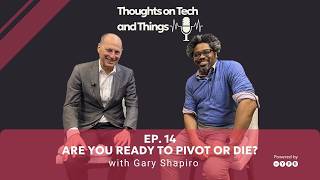

CES 2026: AI and Innovation Take Center Stage with Gary J. Shapiro of Consumer Technology Assoc.
Innovation Conference: Gary Shapiro, CEO & Vice Chair, Consumer Technology Association (CES owner)
Gary Shapiro, CEO + Vice Chair at Consumer Technology Association Joins NYSE TV Live
Gary Shapiro, CEO + Vice Chair, Consumer Technology Association Joins NYSE TV Live
The Future of Technology and Innovation: A Conversation with Gary Shapiro, CEO of CTA
🎙️ Tech Leadership Insights: CTA CEO Gary Shapiro on Innovation & Adaptability