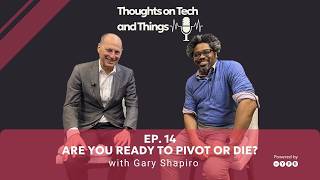
Gary Shapiro, CEO of the Consumer Technology Association, discusses CTA Tech Week, where tech companies showed lawmakers cutting-edge products on Capitol Hill. He warns that a 145% tariff on Chinese goods and 10% on most other imports will raise consumer costs and strain supply chains, citing Delta Airlines as an example. He argues for strategic decoupling focused on national security rather than blanket tariffs.
Chapters
Joining me now from our nation's capital to talk more about it is Gary Shapiro. He's the CEO and vice chair of the Consumer Technology Association. Gary, after a busy few days for you in D.C. and certainly some busy days here at the exchange, we're happy to have you. What are the takeaways from CTA Tech Week?
Well, CTA Tech Week we do every year to basically make sure that people in industry can mingle and be with and explain issues to policymakers. And it's Right. You know, we're in our nation's capital and we're right there and they're going back and forth from all their votes and their committee hearings. And we had some of the leaders of the Congress talk to our group and meet with them. And we also had a, you know, CES is our huge big event we have every January in Las Vegas focused on innovation with over 4,000 companies. Well, we had about 24 of the companies just exhibit in Innovation House, which is a house we have right next on Capitol Hill next to the House of Representatives. And we had a whole bunch of members of Congress seeing some really, really cool things from big and small companies.
Interesting. Now, how are lawmakers approaching and embracing some of these emerging technologies?
Well, you know, they're very excited and passionate about innovation and they believe in innovation. They want to do the right thing, both Democrats and Republicans. To be honest, this entire week compared to prior years was overshadowed by one word, you know, tariffs. It was the top of the mind. And of course, while we were there, right after our board met before CSUN Hill, the big news came out from the White House, which is we've been more outspoken on that issue than any other trade group in Washington by every definition. And there was some appreciation for the fact we'd taken a major step forward after having a hell week for the last 7 days. Mm-hmm.
So what more can you share about that? Certainly we saw it was a historic rally on Wall Street yesterday as President Trump did walk back tariffs on most countries, with the exception, of course, of China actually ramping up those reciprocal tariffs on the world's second-biggest economy. It too responded. For our viewers just tuning in here, but how do these impact and this change impact the industry now?
Well, anything that affects our industry affects innovation and affects consumers and what they pay and what's available. You know, it was, it was, it was like the walk away from the precipice last because there was so much going on in the world in those 7 days. You know, world stock markets falling for a week and disaster. And we were hearing from our small business and our large, largest companies in the country about how significant it was that these tariffs were so pervasive and going in such a wrong direction. What it really means is that was a sugar high yesterday. It was significant. But we're also left with, with, you know, a pail half full of garbage and costs that are unnecessary. On the positive side, maybe the president will get tariffs down to zero, which would be great for the world and for consumers and for workers. But right now, the effective rate for China is, by our calculations, 145%. And we import every day billions of dollars worth. So that means that's going to have a negative impact. And still across the board, there's a 10% tariff for just about everybody when a lot of those tariffs were 3% or lower. So more than tripling in tariffs. So this is— and it's only for 90 days. So we're still facing a lot of uncertainty. You know, when a company as big as Delta Airlines, you know, can't do anything forward-looking, say anything because it's such devastating for a company like Delta. But that's— Delta is just symptomatic of many, many companies that are affected by this, you know, and it gives— so, so it's serious, I guess, is what I'm saying. Still, it's not over. We don't need like 90 days of just up and down and waiting. Hopefully there'll be some major breakthroughs and announcements of great deals with allies and everyone else to follow. But it's— we just can't hope. We need to get to a little bit more business certainty. So people investing in the stock market could feel confident companies could go forward. They can make plans and investments. This, you know, a lot of companies left China because of Trump asking them to, and they're in Vietnam and elsewhere. And still, you know, 90 days of 10% is not an answer. And it's still too much uncertainty for any rational economy.
Interesting. Gary Shapiro, so in terms of how we move forward from here, what were the conversations that you were having with lawmakers? It's my understanding that more than two dozen actually were in attendance over the course of this week at your particular event.
Well, actually, if you had all the different events, it's probably even a lot more. The— Kristen, to be honest with you, the Democrats and Republicans were both pretty strong that these tariffs are not a good thing, that the Republicans were clearly sticking by their president publicly because they felt they had to. I mean, the reality of Congress and Republicans is they're afraid if they disagree with the president, they'll be primaried. And, and but, but it was popping over. You could just tell by some of the comments some members were making even publicly. And, you know, lawsuits were ready to be brought and things like that. So I think President Trump did the right thing by stepping back. But I think we have to just move forward. He has to give some clarity on where he'd like to see countries go because he's definitely in the catbird seat to a certain extent now. And we got to get back to working with our allies. And if we want to get away from China long term, We should do it strategically. We should focus on defense and things that are important to our national security first. Basically, you know, chips and ships, things like that. And we should not be going wholesale across the board tariffs, just trying to punish countries. I believe when countries do trade together, they're less likely to fight wars. So we just got to get some stability. You know, this can't be subject to the whims of one person affecting the world economy.
Gary Shapiro, CEO and vice chair of the Consumer Technology Association, joining me from our nation's capital. Gary, we really appreciate it.