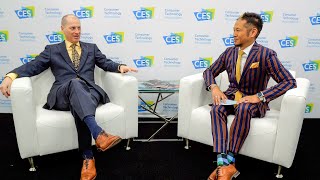
Gary Shapiro's 'Ninja Future' Sneaks Up On You
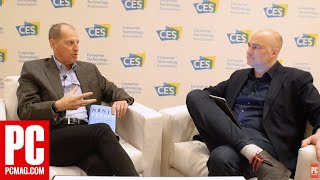
Gary Shapiro, CEO of the Consumer Technology Association, discusses his book Ninja Future and trends at CES: self-driving cars could save millions of lives, AI is becoming a pervasive ingredient in products, and voice interfaces are emerging as a fourth medium. He calls blockchain overhyped and warns that protectionist tariffs threaten innovation.
Chapters
Hi, I'm Dan Costa, editor-in-chief of PCMag.com, and welcome to Fast Forward. We have an ongoing conversation about living in the future. My guest today— this is a special CES version of Fast Forward— my guest is Gary Shapiro. He's the CEO of the Consumer Technology Association, the organization that actually throws CES every day. This is my 14th consecutive CES. Gary, we've been, uh, talked about technology for a very long time. Thank you so much for doing the show.
Well, thanks for coming for 14 years in a row.
You've also got a new book that's just coming out now called Ninja Innovation. A lot of the themes that you talk about in the book we have covered, and we'll show it to the camera here. These are the same themes you've been talking about for years, and this is actually not your first ninja book. So how did you decide this would be the follow-up for it?
Well, a few years ago was Ninja Innovation, which was about what I've learned from the best and most successful companies in the world, the biggest companies like Amazon and IBM and others. This is very different. This is about the future. This is about where technology is going and how we can plan for it as individuals, as businesses, as companies, and as even governments. 'Cause everyone wants to benefit from innovation. They recognize the landscape is changing under them, but they're not sure about what they should do about it. So this is based on real life personal advice. Real-life experiences I've had, but also a sense of where technology is going in certain directions like artificial intelligence, robotics, self-driving cars, 5G, quantum computing. All these things that we know are going to happen, except maybe quantum computing is still in the, we think it's gonna happen, we just don't know when. Blockchain.
Is there, so what type of innovation do you see succeeding that would really be ninja innovation?
Well, what I'm excited about is self-driving cars because we lose 1 million people in a year and several million people are injured and we all know it impacts people. That will fundamentally change economic models in terms of the need for drivers and collision repair shops and having to pay for auto insurance, emergency room physicians, but it'll also change how people are disabled, people who are older, how we get around, how we have to deal with people. How our cities are built. I mean, look, just the introduction of Uber and Lyft has changed how people buy cars and where they live and where they work. So we're seeing rapid changes all along the way in so many different areas. I mean, the underlying technology for a lot is artificial intelligence because, I mean, it's already being used. If we fly in commercial planes, that's being flown mostly by artificial intelligence. The pilots are just there for the takeoff and the landing. That's when they're really active. And it's made flying much safer.
It's amazing how many pitches I've gotten about the CES that include AI in a variety of different products and applications and services.
Absolutely. So we have a separate area for AI, but we also know it's throughout the show. It's an ingredient technology. And the other part is how that information gets around. Another big thing is 5G. Every 10 years, there's a G. 1980, we began. 1990 was 2G. And 2010, rather, was 4G. We're about to do this much faster, bigger, lower latency. Lots of little dishes spread around will change how we get the information. It'll also help with self-driving cars. We're going towards robotics. That's exciting. The robots area of the show is always growing. And we have other areas, like e-gaming, which is big. And obviously, in a mobile environment, it's even bigger. We're going to other things. The blockchain is creating all sorts of new use cases. AR and VR, you know, they got a lot of hype, but didn't explode the way everyone thought. But it's a strong, steady push towards the future of being used. And we're seeing all of that at CES.
AR and VR are actually a good example of technologies that generated a lot of buzz, a lot of interest. They didn't become consumer. Not everybody bought an AR system. But the technologies are still developing and the platforms are being built out. Are there particular AR or VR applications that you are excited about?
Sure. So many. Education, modeling, trying on clothes. Training is huge. Workplace education. Going into an area, there's— I saw a startup I was judging where they had something where firemen could go into a place and they could immediately see the plans and logistics of the whole layout of where they are. There's so many different applications. and then of course there's the gaming side of it, which is its own separate category, if you will. And that's VR probably more than AR, but AR, there's a gaming side as well. It's just smart, clever, creative people coming up with really cool uses for things. You know, but you could take AR, VR, which may be a little overhyped in the beginning, people thought it would explode more, but it's definitely growing more every year. And you can compare it to something like 3D television, one of the great disasters. That was introduced here, frankly. And I kept saying it's overhyped. This is just a feature. And I had some people really upset with me in the industry. But we have credibility. I have credibility. And I don't like to waste it on a product which is such a— then there's something like 3D printing, which was the story of the show one year. I really thought that would be more of a consumer product. But there's steady growth there. It's happening. It's just things happen at their own rate. If you're predicting— You not only have to be right, you have to be right at the right time, which is why if you're investing in the stock market, that's a whole dangerous game.
What do you think is overhyped right now?
Well, I think blockchain's a little overhyped, personally. There's great applications of blockchain, which are coming, and there's probably some out there because of all the different things it could do. But the cyber currency thing I am not comfortable with personally. I just think there's a lot lost through slippage, through fraud. And since I first heard of it, I've been a skeptic. Of course, that's when I could have bought those bitcoins for like $0.15 apiece. And now, at one point, they were selling for $20,000. So I'm sticking my guns in that one. It's just— there's nothing behind the currency that I— and plus, the uses of it, I'm a little— I'm not into governments rushing in to regulate something new. But I do understand some of the purposes of some of the shakedowns that are going. Have to be paid in Bitcoin, I don't particularly appreciate. Yeah.
And it's built to be so anonymous and to be deregulated. There are naturally going to be those applications. It's going to be hard to separate those out. Is there a technology that you think is undervalued here that people haven't been paying enough attention to that's really going to change the world?
Well, we've talked about it, but I don't know if people— I don't know if it will change the world, but it's definitely changed— there's a fourth medium now, and that's your voice. And smart speakers in terms of being a medium to get things done, to control as an interface, is really cool. You're talking about a very short-term phenomenon. I mean, a zillion years ago I used to try to dictate things I write in books and it was always too slow, the system couldn't handle it. Now we're getting in the high 90s of accuracy in terms of voice. It's getting better with accents, different languages. And it's a medium where in a sense, will the next generation of kids never even learn how to write? I don't know. Or even type it. Obviously there's advantage to the people with certain disabilities, it's huge. I love self-driving. To me, that's totally underestimated in terms of what that's gonna do. And robotics, being an old sci-fi nut, that is the future. Robotics are just huge.
One of the things you talk about in the book is aging populations and how technology is going to enable people to lead longer and better lives. Through some relatively simple innovations. Can you talk a little bit about what you see there, what you see today, and where you see the technology going?
Absolutely. Some of this is gener— I mean, it depends what country you live in. In the United States, we have a much older population. We are getting a lower birth rate. We're moving, many people move away from their parents. There's a lot of anxiety when you have older parents. And they're living longer. And our systems are based on 50 years ago, our Social Security system. But now there's technologies which allow them to stay in touch and communicate. There's all sorts of things. We have our own foundation which focuses on technology, getting technology to people with disabilities and older people. But the aging population has— there's a whole set of products that they'll benefit from, and technology is just beginning to help out in that area. Also, the truth is Obamacare has changed medicine. We have a fixed number of doctors we've had for 20 years. People are leaving. You need more healthcare as you get older, and there's a disconnect that's absolutely huge today. We need telemedicine. Telemedicine helps older people. Older people require caregivers. My wife is a surgeon that deals with older people. I see the problems there and it's just, there's just not enough doctors. So technology isn't gonna be the answer. Technology is also an answer, I hate to say, to part of the drug problem. People who get hooked on pain relief meds. There are technologies now which allow you to deal with pain, localized pain, all sorts around your body. There's also something called focused ultrasound, which is 3 FDA approvals, including zapping some certain types of tumors and tremors. Rapidly expanding. Technology is a solution to a lot of big problems we have, whether it's the expense of healthcare or the aging population.
Let's talk about this CES. There are a couple of headwinds coming into the show. The government is currently shut down, should be opened up again perhaps by the time people are watching this, but that's forced some people to not show up. And then also the trade tensions with China. You've got 1,200, 1,400 Chinese exhibitors here at the show. A little bit less than last year. How are those international tensions sort of making the show different this year?
The government shutdown is more of an embarrassment and an irritant than it is a real problem for us as a trade show. It is something, if it continues for a long time, there's a lot of basic functions of government which I think are underappreciated by the person that lives at 1600 Pennsylvania Avenue. There's so many things that are very important, whether it's the SEC to get public offerings out, or various regulatory things, or just even for average Americans, just visiting museums or going to our national parks. It's just harmful. Producing an international event where we get over 60,000 international visitors, it's an embarrassment as an American. I don't know how else to say it. We're hosting ministers and top government officials from around the world, and we can't even have their counterparts here that plan to come here, a whole bunch of cabinet secretaries and government leaders. Can't come. It doesn't really affect us, it's just embarrassing and it's humiliating, frankly, as an American. The other issue you mentioned, so the Chinese thing really hasn't affected the show almost at all that I could see yet before the show opens. We have about the same percentage of exhibit space for Chinese exhibitors, about 13 to 14% of exhibitors' space is Chinese or Chinese-related. Same as last year. So the tariffs actually, we got a little bit of a reprieve in the sense that we were heading in January 1, the tariffs were supposed to go from 10% to 25%. That would have been devastating. We have 60 days till March 1st now. Hopefully there'll be a deal then. We have opposed the tariffs. They're taxes. They don't make any economic sense. The last time we did anything this, unhelpful was in the 1930s with Smoot-Hawley and 2,000 economists opposed it, just about every economist. Same thing happening today. Every economist we could identify but one person who works in the White House thinks this is a bad idea. There are other, so many other things we could do. There's no question that Chinese practices are different culture, but we view it as unfair and they are unfair to American companies. We have a show in China. We know how difficult it is. You have to have a partner. There's all sorts of restrictions and rules that are ambiguous. There's restrictions on the press. It's just not helpful for the type of free enterprise entrepreneurial culture that we have in the US. But it's a different culture. They have the right to their own laws. But we have a right, as President Trump has noted, to set the rules of the business. I just think when you have two elephants fighting, the ground gets stampeded. It's really not affecting CES in any way that I can see. The Chinese overstate the number of Chinese exhibitors in the media, and people keep reporting it. I have no idea why. But the reality is it's 13 to 14% of our footprint. We've measured it.
In terms of the international landscape, I think that most Americans don't really know whether we are, how we're stacking up against China. There are people worried that their companies are stealing our intellectual property. They're obviously a giant manufacturing power. But what advice do you have for governments in terms of building, you know, innovative states?
So we rank all the countries, the developed countries in the world and developing ones like China, as to how innovation-friendly they are. And we look at various criteria. It's all publicized on our website. It's our measurement. We're doing it as Americans. We value liberty and freedom of access to the internet, freedom of expression, freedom of religion, freedom of choice in who we associate with. Freedom of all sorts of things. The Chinese don't. That's not a core value of theirs. We value clean air and clean water. We have among the cleanest air and water in the world. We're trying to be penalized for stuff we've done 50, 60 years ago, and we're told we have to pay the Chinese billions of dollars. They're the biggest polluting country in the world. They pay for more coal companies than anything. And in my view, President Trump was absolutely right to pull us out of the Paris Accord, because China could do whatever they want till 2029, pollute the whole world. And then they have a voluntary agreement they will do whatever bad stuff they're doing in 2029, they won't get much worse than that, voluntarily. So it was a really, really bad deal that somehow the Chinese were made to look like they were great and we were bad guys. We are not the bad guys in terms of pollution. We are the great guys. And our industry, by the way, is voluntary. So we're gonna exceed the Paris Agreement. As an American technology industry, we're gonna do better than that. So to me, that's an emotional issue. So what else makes you innovative? Well, in the world of artificial intelligence, actually, the ability to use data is very important. The Chinese are going to kill us in that because they have no privacy. We respect privacy. We're going to have reasonable protections of our citizens' privacy. Hopefully we won't go as far as Europe, where we basically clamp down on innovation so much that there's almost no unicorns there. There's almost no real innovation coming out of Europe. The US has been the leader. It still is the leader. In terms of where we're going, Chinese have a good strategy. It's based on educating millions of engineers every year. It's based on using data. It's based on focusing on some core technologies. And frankly, it's based on copying. But not only copying, but you take the next step and you not only copy, but you do it 1,000 different ways and the marketplace determines which copy is the better, better, better, best because it's been changed by some brilliant Chinese entrepreneur. They're hungry. We're not hungry anymore. And we have to stay hungry. We are in a competitive battle with China, not only for innovation and competition, but for the hearts and minds of the world upon which political system will survive. We're fighting for the hearts of Africa and the Mideast and South America as to whether freedom, democracy, liberty, clean air and clean water are the way to go, or whether a system of central control where all the media is controlled by the government, there's no real freedom of expression, or that way. And I wanna fight for the American way 'cause I think we have a way that I want my kids and my grandkids to benefit from. I don't want to see the US shrink in terms of our influence in the world and our carrying the torch of liberty, if you will, with frankly Western Europe and Australia, New Zealand, and Canada.
I want to ask you a couple of questions I ask everybody on the show. Is there a technological trend that keeps you up at night, something that really concerns you?
Well, the freedom of nuclear, Technology is one that concerns me, but it has for a while. I mean, it keeps growing. And that's why we have some of the concerns we've had under various presidential administrations, whether it's concerns with North Korea or Iran. That's just a reality.
It's an old problem. That's not a new— that's one that we've been living with for over 50 years.
But it doesn't mean that it's solved. It's just, it's still there, but you become complacent. I'm more like the Israelis, and I think you should be paranoid. And live with the fear and move on with your lives. And you have necessary security and you deal with it.
Is there a technology or service that you use every day that inspires wonder?
Well, I don't have that male gene that allows me to get around. I'm totally lost. So the nav device has always been my favorite. But definitely smartphones have become the Swiss Army knife of our century. And they do everything. And that's— there should be a new word for the anxiety you get when you think you've lost your phone. Because it is a form of panic that you get that is biological.
Yeah, it's a scary feeling. The book is out now, Ninja Future. People can buy it on Amazon and normal bookstores.
Or they can hear me read it on Audible, actually, which is rather rare for the author to read the book.
How was that?
It's a great experience. Everyone told me I shouldn't, including the publisher and my staff, but I had to actually prove that I could do a chapter, and then they said, "This isn't so bad," and we got it done. I would recommend it for any— By the way, doing a lot of book signings, I hear that from almost everybody, that they prefer the author read the book.
Yeah, I think that's a universal truth. Gary, thanks so much for talking.
Thank you very much. I appreciate it. I appreciate you taking the time. Enjoy CES. Ciao.
That's Fast Forward for today. You can watch more episodes of Fast Forward on PCMag.com, or you can download them wherever podcasts are given away for free. Thanks so much for joining us. I'll see you in the future.
More from Gary
CES 2026 Preview: Gary Shapiro on AI, Manufacturing Innovation & the Future of Technology

CES 2026: AI and Innovation Take Center Stage with Gary J. Shapiro of Consumer Technology Assoc.
Innovation Conference: Gary Shapiro, CEO & Vice Chair, Consumer Technology Association (CES owner)
Gary Shapiro, CEO + Vice Chair at Consumer Technology Association Joins NYSE TV Live

Gary Shapiro, CEO + Vice Chair, Consumer Technology Association Joins NYSE TV Live

The Future of Technology and Innovation: A Conversation with Gary Shapiro, CEO of CTA
🎙️ Tech Leadership Insights: CTA CEO Gary Shapiro on Innovation & Adaptability