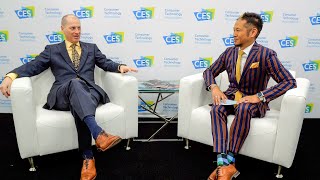
Gary Shapiro - 10 Killer Strategies of Successful Co's.

In this keynote, Gary Shapiro, president and CEO of the Consumer Electronics Association, outlines the "Ninja Innovation" framework – ten strategies that distinguish the world’s most successful companies. He begins by describing the scale and influence of CES, especially its startup hub Eureka Park, and argues that innovation is now driven by mobile, broadband‑enabled ideas that can launch globally overnight. Drawing on observations of leaders like Jeff Bezos and cultural comparisons across the US, Canada, Israel, China, and Japan, Shapiro identifies core ninja attributes: diverse, complementary teams; high emotional intelligence; focus on strengths; embracing failure as learning; setting SMART, measurable goals; rigorous scenario planning; and the ability to adapt quickly. He links these traits to broader technological trends – driverless cars, 3D printing, drones, wearable devices, and the evolving radio broadcasting landscape – emphasizing that companies must stay flexible and culturally aware to survive. The talk concludes with a brief audience Q&A about hiring for the digital age.
Chapters
—our first speaker. He's the president and CEO of the Consumer Electronics Association, which represents more than 2,000 of the most important electronics companies worldwide. He runs the most important innovations trade show in the world annually in Vegas, the International CES. It says here, drawing thousands every year from every nation. I asked him and I said, it's like tens of thousands. He said it's 160,000. 60,000 people. If you need a room, book now. While the show is running, the world press converges to see what's around that virtual corner, and daily reports run on every TV network available to us on the planet. He's joining us today to speak on the 10 killer strategies of the world's most successful businesses under the title Ninja Innovation. Please join us in welcoming the highly honored and respected Gary Shapiro.
Thank you. The Consumer Electronics Association, which I head is a trade association in the Washington, D.C. area of over 2,000 technology companies. So that event is held in Las Vegas every January, and it attracts over 160,000 people, 40,000 of whom are from outside the United States. It's not open to the public. It's only open to people with a business interest in technology and innovation, and it attracts people from multiple industries that are touched, whether it's Hollywood, Madison Avenue, the broadcasting world, people who want to see what the future is. It's gotten a phenomenal interest from the car manufacturers because the car has quickly shifted to be a technology product. But it's also produced a lot of the world's leaders in innovation and government and elsewhere. And so it's really the most— honestly, the most exciting thing I've ever seen. I first attended it in the early 1980s and I said, "I want to be part of that," and I maneuvered my way into a job with the organization. Which is really good. Actually, I started out as an attorney involved in litigation involving technology. And that was— there was a case which went all the way up to the United States Supreme Court, and it said that the VCR, the videocassette recorder, which is, for those people here under 30, it's an ancient product that actually allowed you to record. You can never do that before. You always have to live in the present. The moment there was a broadcast, or you're sitting in a movie theater, and you had to be right there. You couldn't preserve something and watch something when you wanted to. Now, with audio you could, obviously. You could do that with what we called were LP records, and then CDs, and there was even a flirtation before CDs with this horrible product called 8-track. Anyone ever buy an 8-track? Oh, there's one right there. I'm sorry. And we went to digital audio tape, digital compact cassette, and of course now we've gotten all sorts of other media. Very exciting, fast-changing world. And through my job, which ironically I am the cheerleader, I am the paid cheerleader, I am salaried, and I am paid to be a cheerleader for the technology industry. But along the way we've produced this phenomenal growing expanding event. An event not unlike this one where people get together in a room. Even though you deal with technology all the time, this is being streamed, it's being— you don't have to actually come here. But yet we do, we get together, and why is that? Because as good as technology is in audio and video and watching it somewhere else, unless you can get to know people, you're not going to have the relationship, you're not going to get the full impact of the body language, you're not going to be able to assess whether or not you trust someone in a 5-sense experience. And indeed, that is what a trade show is. A trade show is a 5-sense experience where we have, in our case, 3,500 different companies who are trying to show the world including 5,000 journalists, what they are, what they're about, what their innovation is, and they're trying to establish relationships. It's also very efficient, and you can see a lot in 4 days, 4 killer days. Walk around and get a sense of what a company is trying to show, where innovation is heading. And the important message, if there is one today about where innovation is heading for you, is innovation is going mobile, totally. And that's— I want to talk a little bit about where the— what the trends are in technology, but first I want to talk about innovation generally. Because I've been saying for many, many years now, in my world, to my industry, the message I've been giving is innovate or die. The fact is that there's no trade shows, there's no conferences like this one, there's no anything happening unless something changes. Something has to happen. Something new will be out there. And what we see in my world is innovation is really changing quickly. Just met a young man this morning who has a phenomenal innovation involving a an application which allows— well, I don't want to give it away, maybe you'll come up and do a pitch sometime, but it's a great idea and it's one that will most likely be very successful because it allows people to get together with common interests in a genre of music or a specific artist very quickly through social media. But there are people out there, and we're living in an era which is historic because never before in the history of mankind could someone with an idea and access to broadband and computer and some application skills basically create an international company almost overnight. We have a portion of the CES called Eureka Park. It is designed for startups only. It just started a few years ago. It is now the hottest area of the show. It's where everyone wants to go. Mark Cuban walks around there and writes million-dollar checks. Walmart goes around there and they place orders. These are people which must qualify. They must not have existed a year or two ago. And they never sold anything, but they go there and they start. We had a company that exhibited there last year and this year, 2 years in a row, and they just sold the company for $2 billion. So you go from startup to a $2 billion sale in less than 2 years. This is truly a phenomenal time to live in, and you can see with the array of companies that are out there that have literally didn't exist when we were kids, from Facebook to Google to Yahoo. To Twitter, to others, multi-billion-dollar valuation companies. And the truth is, anyone in the world could have started those companies with just a computer, broadband, and some apps development. That's all it took for these companies to start. So why did— why do some companies start and why don't— what's the difference? What has changed so dramatically and what are the skills? I've gotten to know a lot of the CEOs of the world-leading companies because of my job, especially in the innovation and automobile and technology arenas. And my observation is that they do have certain things in common. And I wrote a book about it called Ninja Innovation. Now ninjas, as many of you may know, were ancient Japanese warriors. They were always outmanned and outgunned, but they almost always won. And they did it in certain ways, they had certain things in common. So I took the concept of the ninja and I married it with the fact that I personally, I'm not that good at it, so this is a real hyperbole at this point. I'm a black belt in taekwondo, and I studied that for a number of years working all the way up to black belt. It's been a while, so don't try to beat me up because you'll probably win. So I took that concept of the martial arts and of ninja and I combined them. Now honestly, taekwondo is a Korean art form and ninjas are Japanese, so I combined the Asian, the language. A little bit infusion there. And I combine it with the fact that I've been close to these companies, I've observed them, I've seen their leaders at work, I've seen how they've changed, and I talk to them in my view what the attributes are of ninja innovators. And this is an especially important message I've been giving since about 2008 when the recession was just starting. And basically in the technology world, if you don't innovate, you will die. Because there's a common mistake that a lot of people make, a lot of companies, even at the most senior levels. And I've seen it around the world. I've been in Tokyo and Osaka meetings. I've been in Korea. I've seen what companies do and how they think. And oftentimes what they'll do is some bright person in the company will take a snapshot of the world and they'll look at it as of today and they'll say, "This is what we must do and here is our opportunity." What they always ignore is that their competitors are looking at the exact same picture. And seeing the same opportunity. So the history of the technology world is everyone introducing the same product almost at the same time and doing the same thing. And really, the, the ones that actually succeed are the ones who do something different. So if you remember the dot-com boom of the late 1990s, there was like 5 or 6 Pets.com and various— or grocery delivery Peabody.com— all these similar business models which created all at the same time, and frankly, I don't think any of them are left. And if you go back a deep way, the only one that's really succeeded and survived in terms of delivery of products since then is Amazon. And Amazon succeeded because they've dramatically continued to innovate and change and test and challenge their own business model. What I love about Jeff Bezos of Amazon is he had this great concept of having a really neat website and delivering products to your door, And it started out, you might recall, with just books, and it expanded to music, expanded to other products, expanded to almost everything at this point. And then everyone thought he was crazy because he introduced an electronic book which would compete with what he had, his successful book franchise. And I remember he came to speak to our group of people and he wanted to give this speech and talk about this electronic book. And I remember, Acton, that I, along with everyone else in the audience, thought he was crazy. 'You got this great website, Amazon delivering books. Why the heck would you try to come up with this new technology and have books you think people really want to read as screen? I mean, that's really difficult. It doesn't feel like paper. You know, you're probably— a lot of people are just not going to want it.' But, but it succeeded. And now what he's done is he's continued to do things over and over again differently. He never ever lets the status quo— he just never rests. He always is challenging his own business model, which just really makes him, in my view, a ninja innovator. So what is it about companies that do things and survive and succeed versus those that stagnate and go away? And in my world, there's plenty of companies that go away all the time. Companies go out of business. In the United States, RCA used to be an incredible company, an incredible name. Zenith used to be an incredible name. Motorola was a TV set company. These companies essentially don't exist, or at least they become more brands that have been bought by others than companies with an original product line that they still they'll have in the area they're in. And the companies that succeeded have changed. In my view, the ninja attributes they have are— some of them are counterintuitive. For example, one of the things is that there's a myth that there's a sole entrepreneur that creates a company and it's a great company. Thomas Edison actually had a team of hundreds of engineers working behind him. Steve Jobs of Apple Not only had Steve Wozniak— if anyone's read the book about Steve Jobs, it's— the truth is there's a lot of people. I mean, they were sworn to secrecy and silence and all that, but Steve Jobs definitely motivated them in various ways and produced some incredible things and was clearly an innovator in so many different ways. But there was a team of people, and they were very unlike him. And that's the most important thing in getting a team of people together, is that you get people that are not like you. To succeed in business, I think you have to have something called emotional intelligence. Emotional intelligence is the ability to understand your own weaknesses and strengths and look at yourself really honestly and stand outside yourself, especially when you are emotional, observe yourself being emotional and critique yourself and recognize if you're good at things and you're bad at things. We have 150 employees in my organization, and one of the things we do every year is we do annual employee reviews. I have to admit, it's not my favorite time of the year I'm pretty good at giving feedback, positive and constructive feedback, throughout the year. So I do the process as a little redundant, but kind of necessary. What I used to do is I used to have reviews of my direct reports and we'd say, "Here's some great things you've done," and that would be 5 minutes. And the other 55 minutes would be, "Here's some areas where you can be more effective and you can improve upon." And the truth is I realized after a while that the improvement areas are the same every year. Some people are good at things and some people are not. So what I've shifted to is basically saying, here are things where you really have to strengthen your staff, and when you're hiring, this is what you should be looking for. Because this is what you're really good at, and this is where you should be focusing. You should be focusing on what you're really good at. What you're not really good at, you're just not going to be really good at. I mean, you can improve marginally. You can recognize that you're doing bad things, like having temper tantrums, you know, that some of that stuff has to stop. But in terms of actual weaknesses, you're not going to change people. So when building a team of any entrepreneurs, you have to complement your weaknesses and strengths. And, you know, I don't want to be too US-centric about it, but my example of not doing this the right way was Mitt Romney ran for president. When you're in the US, you run for president, you win the party nomination. You have the right to choose your vice president. It's the first big visible choice you make. Mitt Romney chose Paul Ryan. Paul Ryan could have been Mitt Romney's son. They look alike, they talk alike, they're 2 white, good-looking males with a lot of hair. Yeah, I'm jealous. And it was— and Paul Ryan's a bright guy, nothing against either one of them, but the pic to me symbolized a very bad choice because you need someone who's going to push back, you need someone who's different, you need someone who has diversity. And even if you look at on a bigger level what separates companies, what separates countries even, since I've talked about innovation around the world to a lot of countries and everyone wants to be like Silicon Valley, which is crazy because there's only one Silicon Valley. But every country has its own strengths and weaknesses, and they have to play off them. One of the strengths I see in 3 countries actually, in Canada, the United States, and Israel, is phenomenal heterogeneity. If you go to Asian cultures, for example, it is homogeneous. And when you're homogeneous, uh, when everyone looks the same and acts the same and has the same religion, the same culture, the same background. There is an advantage. There's not a lot of dissent. Some of the very thorny social issues that we in the United States are struggling with, like abortion and gun control and capital punishment, things like that, have long been resolved in most of the other countries around the world. So there's an advantage of homogeneity. You, uh, have a lot less social friction. But the advantage of being heterogeneous is that you have tremendously different ideas coming And you have the ability to push back. The Asian culture, for example, is one where disagreeing is not— in some languages, there's not even a word for "no." You try saying the word "no" in Japan, it's a problem. You try disagreeing with a boss, I mean, they just don't disagree with each other in the corporate setting in Japan. But in North America and Israel, it's more of a food fight. I mean, although Canadians are much more polite. Maybe I shouldn't group you in that way. You have a reputation for politeness, which I've seen. And I am half Canadian, so I'm half polite. So what we see in different countries is different levels of innovation, different levels of ability to disagree. And disagreement is very important. Cultures that tolerate risk, cultures that tolerate disagreement, cultures that encourage risk when you fail, it's not the end of your business life or reputation. In the United States, if you fail, it's actually considered education. One of the standard interview questions that's asked by a lot of interviewers in the United States is, "Tell me about when you failed and what you've learned from it." Because the truth is, if you think back in your own life, and you can even think personally when someone dumped you or something like that, think about what you've learned. You've learned from failure, you haven't learned from success. When you're successful, your ego grows, you think you're brilliant, you think— you know, there's a lot of false ego there. But when you're unsuccessful, it causes great introspection and it causes lessons to be learned. And that's, to me, one of the valuable things about our culture, is a culture where failure is something that we can live with and learn from and is considered rewarding. It's also a culture where kids start out young and they have lemonade stands and become entrepreneurial. It's a culture where kids, although, at least in the United States, everyone says How horrible our school system is. To me, yeah, you know what, we don't do really well on standardized tests and we should do better. But, on the other hand, our kids are always taught to ask questions. They're always asking why or why not. They're pushing back, they're pushing back against the teachers. So what we see in the United States is, um, the Chinese, which are working very, very hard to be more innovative, in fact, they had a new 10-year plan They have a goal that for every 10,000 people they expect something like 2.4 patents. That is a specific, measurable, attainable, realistic goal with a timetable. A SMART goal, as we call it in my company. And everyone has SMART goals, including me, including the whole organization, including every employee for incentive compensation. Goals are really, really good. In the Chinese case here, they have recognized that they're the world's manufacturer, but they're not that innovative. Despite producing millions of engineers. So it's a part of the way to reach that goal is what they're doing is they have 200,000, 200,000 students today in the United States that are from China. And they're getting younger and younger ages, especially if they're Communist Party bosses' kids. They're going to elementary school and other school in the US so they can learn to be innovative. They recognize they have a problem. I was in Israel a couple months ago and I hosted a panel on innovation and why Israel is so Why are they so innovative? And I think by my definition of innovation, it's very difficult to come up with a good definition, but one of the ones that's typically used is the number of patents filed per person. It's just like Chinese use. Israel has more patents per person than any country in the world. And I was asking the head of Google, Intel, Yahoo, and a couple of guys who built up huge companies and sold them in Israel on a panel why Israel's innovative. And I got a bunch of very good answers. One of them was that Israelis are very serious because they feel they're surrounded, and so they study harder at the university level. They're always— they're really intense in terms of what they're learning. Another answer was the mandatory military service, which is unifying and binding and gives you that same sense of purpose and seriousness. A third answer was, look, when you're surrounded by people who want to kill you, taking a business risk is not that big a deal. Deal. So we're really willing to take risks. The answer that actually really stuck with me out of the audience was Yossi Vardi, who started a company called ICQ, which was instant messaging, and he sold it to AOL for over $100 million. He said, "Ah, it's very obvious. None of these answers are right. It's because of Jewish mothers." So, I mean, and then all those answers are correct. It is cultural, it is familial, it is why people take risks in countries and cultures and businesses and even in your own life versus others. I was on Facebook late last night and a friend of mine was on the— indicated that he was on the Howard Stern Show yesterday and said he really didn't do well. And my response to him was, you stood out there, you took a risk. You know, 99% of the people aren't willing to take that risk and do one and expose themselves and in such a very highly visible public way. And taking a risk is what it's all about. Ninjas take risks. They're willing to fail and they learn from failure. They put a team together that's a good team. They put a diverse team together that complements their strengths and weaknesses. And they set goals. They set very specific, measurable, attainable, realistic goals with a timetable. And also, they plan. Boy, do they plan. When we produce our CES, we go through a lot of scenario planning based on the weather. The weather, the economy, the union situation, what could go wrong, what could go right, what if the crowds show up, what if no one shows up. We do that all the time. We have to plan. We spend a lot of time, I spend a lot of time talking about our 2015, 2016, and 2017 events at this point. Because our 2014 event is behind us, our 2015 event is virtually sold out, and we're just planning for the future in terms of how we can succeed. At the same time though, No matter what, it's like when you go to battle, as military commanders say, your plan for the battlefield doesn't survive the first brush with the enemy. Things change. Things change all the time, and that's really important. You have to be able to look out at the landscape and change what you're doing. I don't know what it's like in Canada, but I know in the United States the worst sin, sadly, a politician can make is to change his mind, because they're hit with a barrage of ads calling them flip-floppers. Flip-floppers, or they don't have principles, or things like that. To me, that's absolutely crazy. You should be able to change your position on something. In fact, I'm gonna give you an example of something that I changed my position on in the last 24 hours. I'm a little embarrassed because I think the person I changed it with might be in the audience. So one of the things that I've been very critical of radio broadcasters about in the United States is the fact that they're stuck in the past. That there's a— and I've been visible about this, and I've been especially visible because radio broadcasters proposed something which I didn't want. They wanted the US government to mandate that every telephone, every portable smartphone, had in it an FM chip that got FM radio. I represent all the people who make those little devices, like Apple, Samsung, BlackBerry, and others. We don't want to be told what to do by our government. We like the marketplace. We think consumers should be the one to choose devices. So I've been pretty visible out there beating up on this proposal, which honestly didn't last that long as a proposal, and it was relatively easy to beat up on. It got zero traction with our Congress or our regulators. So I kind of forgot about the whole thing. But last night I ran into Jeff Smullyan of MS Broadcasting, who is the primary proponent of the proposal. Jeff, are you here? All right, there he is. Okay, it's a little embarrassing because Jeff and I have not exactly been friends the last few years. And Jeff showed me what that had evolved into. It evolved into this incredibly elegant, beautiful way for broadcasters to get into portable devices seamlessly without cost to the consumer and be exposed to all sorts of different radio stations by genre, by channel, by music, to other things online. And I think it's terrific. I actually tweeted about it either this morning morning or late last night. So I think that's— I changed my view about it. Out of fairness to Jeff, Jeff changed his business approach or his approach to a problem, and he also adopted to the fact that the whole landscape of radio broadcasting has fundamentally changed. And which I think is the way to go for radio broadcasting personally, because the fact is, if you're relying, as you know, 20 or 30 years ago, people sitting in their car where a lot of, as you know, listening occurs, who was driving and listening to radio. That is fundamentally changing. First, of course, as I used to preach to the National Association of Broadcasters, I remember 25 years ago saying, you got to be ready for the fact that every car is going to come equipped with a CD player. And they were like, who cares? Who cares about CD players? We're radio, we're more important than that. And I kept talking about all these changes in technology and how you have to step up. You should go to RDS, Radio Data Systems, which is something we had developed with broadcasters but no one was adopting. That you should go to, uh, look at HD Radio. I don't know if my friend Bob Struble is in the audience here. Okay, well HD Radio is something. There's another example. HD Radio used to be called Ubiquiti. It wasn't succeeding in terms of selling broadcasters. Broadcasters didn't care. So what did Bob Struble do? He went out to the car manufacturers and now he's like, he has like almost 100% success rate. It's tough to buy a car now without an HD Radio part of the car. So he produced, he looked at the other end of the demand curve and said, said it's out there, radio broadcasters are going to have to come along if they want to survive. But what's changing still even today, and this is inevitable, this is one of the trends, it's totally going to happen. And honestly, some things I don't know what's going to happen in the future. Some things I have 100% certainty of. Here's one I have 100% certainty of. Is that in the next 10 to 20 to 25 years, the concept of radio listening in the car is going to change because you know what? There's not going to be a lot of people driving cars. We are heading in a— well, we are definitely heading to a driverless car. No question about it. Because— and think of it— that obviously would change because people won't have to listen. They could view, they could sit in the back, they could do anything they want with any of their devices, or they could sit in the front. It doesn't matter. But the reason we're going to driverless cars is because— simply because of lives and safety. Driverless cars will get down close to speed zero car accidents, collisions. It'll affect the insurance business. It'll affect the body repair business. It'll affect the jobs for drivers. It's going to affect a lot of things in a very different way. And it will affect radio broadcasting as well. That may be a good thing or a bad thing, but whether you view it, it will happen. Because now one of the biggest problems is distracted driving. It's drunken driving. It's fall asleep while you're driving. It's all these other things. I have a few minutes left and I want to get to a couple of other things. In addition to the driverless car phenomenon, there's a few other trends, maybe they don't have the biggest impact on you, but you should be aware of. One is there's a move to 3D printing. That is production in your home or your business of almost anything you want. It's going to not only production of things, it'll be going to food, it'll be going to organs, medical devices, it's already being used for artificial hands around the world and things things like that which are expensive. It will have an impact on you. Over radio, perhaps, you could send 3D printing instructions or plans or how-to-buy type of things to your customers. We're also going to obviously wearable devices, robotics, drones are coming in very big, that has impact for newsgathering. So think about it, today if you want to buy something, you have two choices: you go to a retail store and buy it, Or you order it and it's delivered to you by mail or a shipping company, FedEx or UPS or whatever. In the future, you'll have 5 choices. You'll have those 2 choices, but you could have it delivered to your home by a drone, it could be made by a 3D printer, or— what else? There's a 5th way, which I am forgetting for some reason I can't figure out. But there is another. So you'll have different ways to deliver. You'll make it, you'll buy it, you'll make it yourself, and it will be delivered to you, which is a really good thing. So things are changing very quickly, very radically. Innovation is inevitable. Change is inevitable. And once you accept the fact that the status quo just exists for a second, then you'll be much better about embracing change. You'll be flexible like a ninja. You'll do well. And I see I have time for one question. Is that okay? Okay, I think there's a microphone right there. If anyone wants to respond or push back or say anything. Any questions for Gary? Wow.
I've got one. Okay. I've got one. You probably run the most culturally diverse commercial gathering on the planet. Is that fair enough to say? I mean—
Well, I don't run the United Nations, but— No, but damn close.
You probably get along better than the United Nations. So you've got 115 people who run that thing for you. What do you— you talk a lot about HR. What do you look for at the top when you're hiring? What kind of people are able to lead in this new digital space? What kind of thinkers are you looking for?
I'm going to be honest, when we hire, which is a very timely topic for me because we have a new HR head that just started last week and we've already had these discussions. First of all, I look for people that don't have— I don't want to be prejudiced about it— but don't have a silver spoon in their mouth when they're born. I like people that work their way up. I especially like people who work in the serving industry, waiters and waitresses or something where you have to establish a relationship with someone in 30 seconds. Look them in the eye, be efficient, be fast, be smart, and be hardworking. That's my personal bias. Second of all, I look for people that can think on their feet and are smart and quick and articulate orally and in writing. I look for good writers and good speakers. I also look for people who, as I say, complement weaknesses, whatever area we're hiring in. And, you know, to me the name brand schools and things like that are kind of irrelevant. And the other thing we do is we have 25 interns every year. So, and that is our primary candidate school for hiring because we've tested each other out. So they hit the ground running and it's a lot easier that way. Thank you very much. Thanks, Gary Shapiro.
More from Gary

CES 2026 Preview: Gary Shapiro on AI, Manufacturing Innovation & the Future of Technology

CES 2026: AI and Innovation Take Center Stage with Gary J. Shapiro of Consumer Technology Assoc.
Innovation Conference: Gary Shapiro, CEO & Vice Chair, Consumer Technology Association (CES owner)

Gary Shapiro, CEO + Vice Chair at Consumer Technology Association Joins NYSE TV Live


Gary Shapiro, CEO + Vice Chair, Consumer Technology Association Joins NYSE TV Live


The Future of Technology and Innovation: A Conversation with Gary Shapiro, CEO of CTA

🎙️ Tech Leadership Insights: CTA CEO Gary Shapiro on Innovation & Adaptability