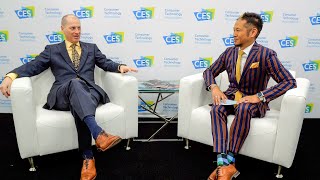
Gary Shapiro, Consumer Technology Association - Keynote 2016

Gary Shapiro, CEO of the Consumer Technology Association, opens CES 2016 by announcing the organization's rebranding and laying out a vision of a hyper-connected world where data becomes the new currency. He walks through drones, 3D printing, autonomous vehicles, and wearables, citing $287 billion in U.S. consumer tech sales and warning that outdated regulations could stall innovation.
Chapters
Ladies and gentlemen, please welcome the President and CEO of the Consumer Technology Association, Gary Shapiro. Welcome to CES, the world's gathering place for all who thrive on the business of consumer technologies. This is our biggest ever event. What a footprint! 2.4 million net square feet of exhibit space. And as we saw already twice last night, keynotes that are gonna blow your socks off. And you'll see innovation after innovation. You'll see self-driving cars, robotics, 3D printing, digital health and fitness devices, biometrics and drones. You'll see advances in 4K Ultra HD, High-resolution audio, virtual and augmented reality, and of course, the connected home. It's all part of the consumer technology ecosystem. If it's part of it, you'll find it here. Indeed, CES is the center stage for the amazing innovations that will help drive our industry to a record $287 billion in United States sales this year. Of course, innovation and growth are who we are. Walk the show floor, attend the keynotes, visit the conference sessions, talk with each other, and you'll see how our industry continues to expand, creating new markets. We engage almost every major industry segment here, and of course, we've embraced America's beginning burgeoning startup economy. We're touching almost every part of consumers' lives. And just as our industry and our show have totally evolved, so too has our association. Recently, we announced a new name, the Consumer Technology Association. The new name more accurately represents the growth, the excitement, and the innovative spirit of the innova— industry that we represent. CTA also better captures our association's vision, our scope of advocacy around the world, and our current membership base, and our brand promise. Of course, like CES, CTA represents innovation. Innovative technology holds a promise to empower each of us. Our industry is literally changing the world. Solving some of our planet's most complex challenges and improving the lives of people across the globe. Today, I want to share with you my, my vision of a connected world that is really changing rapidly. Billions of intelligent products and services are now woven into the fabric of our daily lives. They connect each other, and these products and services also, more importantly, connect us to each other. Connected devices that are constantly learning and discovering new ways of doing everything, and they're improving how we live. They're creating a new era where intelligence and data are the new currency. What does this new world look like? Well, for one, it's a world of choice. New delivery models, actually what they do is they save resources. In many different ways. Think about drones. In 2016, more than 25 companies will be in our drone marketplace here at CES. Indeed, that's up 208% over last year, and we estimate that 400,000 drones were sold in the US this holiday season. But what else can it do? Think about lives in remote villages that are difficult to reach with medicine, They're now getting it through drones. Or, of course, we're talking about getting products to our homes, maybe first in rural areas, but eventually to urban. Even in cities, rooftop-to-rooftop deliveries will become a reality, relieving traffic congestion below. And think about if your child is lost in the middle of a forest. Don't you want a search-and-rescue drone looking for your child? It's so much more efficient and effective than thousands of volunteers combing the forest. Or in disaster relief, needed supplies can be brought very quickly to remote areas with drones. But there's also economic uses, changing jobs and how we do things. Think about wedding photographers. Think about farmers analyzing their crops. Think about bridges that are being inspected. Or even real estate agents trying to show a different vision of where a home is. They could capture an aerial shot. Now, another way that we are going to get things differently is through 3D printing. 3D printing will totally change how we get things. When the space station astronauts broke a tool recently, it would have taken them 3 months to have that tool shipped up to them. Instead, they used a 3D printer and got it replaced within hours. 3D printers can also make prosthetic limbs. Think about what that means. Let me tell you a story. 3D printing created a new start for a young boy who lost his lower arms to a bomb in the Sudan. He was literally given robotic hands produced on a 3D printer. And doctors are now increasingly printing surgical practice models, like kidneys, which allow them to practice before they do actual surgery. And in disaster areas, we're also starting to see engineers putting together 3D emergency shelters. Of course, in business, 3D printing allows us to go to market so much quicker with rapid prototyping. It makes a big difference. Now, another new delivery model which will be huge are self-driving or autonomous cars. The potential applications include door-to-door food delivery, carpooling support. And think about it, about 30,000 Americans lose their lives every year because of car accidents. Most of that will go away. It'll not only save lives, but driverless cars will improve lives for seniors, people with disabilities, and even children. It will reduce accidents and congestion, it will increase safety, it'll make us more efficient, and give us time we didn't have before. Indeed, autonomous, electric, and connected cars are a driving force of innovation at CES. We have the 9 top automakers here, and several companies are introducing new electric vehicles. Last night, during his keynote, Volkswagen's Dr. Diess announced VW's BUDDHA concept and e-Golf Touch. These are cars of the future that will change our whole concept of mobility. There's a great future coming, and you're gonna see it at CES. But all of this is part of a transition and a bigger transition affecting our economy. It's a rapid growth in part of the sharing economy. The sharing economy creates jobs and it boosts the overall economy. We champion the sharing economy at the Consumer Technology Association. In fact, we're really pleased with the fact that thanks to working closely with our members Uber and Lyft, We now have these companies providing service in Las Vegas for the first time at this show. Now, the Wall Street Journal calls the sharing economy a green shoot in a post-industrial age. Sharing is green, but it also enhances consumer choice. It lowers barriers to entrepreneurship, and it increases the use of capital. Airbnb guests spend over 2 times more than typical visitors when they stay in lodging through Airbnb. And Lyft reports that in 2014, access to affordable transportation brought in $156 million to local establishments in just 2 cities, San Francisco and LA. Now anyone can be an entrepreneur by offering an underused resource, from parked cars and spare bedrooms to specific skills and everyday chores. People can supplement their full-time jobs with extra work. Think about Airbnb. It's given over 350,000 people worldwide a platform to become entrepreneurs, and 52% of the hosts are actually low to moderate income, and 53% of the hosts say that, hell, by being an Airbnb host and getting revenue, it's allowed them to stay in their home, pay that mortgage. Uber, they're adding about 20,000 new drivers every month. And 3 or 4 of those drivers are, say, given the choice between a traditional 9-to-5 job and more independent work like Uber, they go for the independence. Uber and Lyft also perform a service. They're bringing services that are critical to underserved areas, not served by public transportation or, or people, for people who can't afford automobiles. With these services, people can visit, live, and commute to areas outside those served by existing hotels, taxis, and public transportation. And they also save lives. Ridesharing services reduce the risk of drunk driving. It's been proven in study over study. Indeed, recently MAD reported that alcohol-related crashes fell by 60 incidents per month for drivers under 30 in California since its ridesharing service began. But what we're up against and what we deal with is old rules that impede innovation, that not only hurts innovators, but they block a safer world, a world of competition and choice. Our job at CTA is to defend disruptive industries against burdensome rules and entrenched incumbents. Recently, we launched something called the Disruptive Innovation Council. Our challenge here is to ensure that new competitive industries can rise up and be created, because new entrants are important to our economy. They create jobs, they improve lives, and innovation, of course, changes everything. What you see as you walk through the entire CES floor is you see products that are solving real-world problems. They make us healthier. They improve our well-being. And they actually affect our behavior. If you see me walking up and down this stage, the reason I'm doing it is not to pretend I'm thinking about something profound. It's actually I'm in a Fitbit challenge and I'm trying to get some points. So wearable devices and smartphone apps actually change our behavior. And they enable healthier lifestyles. In fact, already, for a product that is relatively young, 1 out of 10 Americans are already wearing fitness activity trackers. And by harnessing and sorting individual data, healthcare can be more personalized, democratized, and much more effective. Plus, technology can identify early onset diseases, offer preventive health benefits, assist and manage chronic conditions and provide more effective remote care of loved ones. Think of our aging society. We need technology to help take care of them. Tech makes the world a healthier place for everyone, even those who can't access or afford basic medical care. Think about Rwanda. A study there that found a smartphone attachment can accurately diagnose HIV and syphilis in less than 15 minutes and for just pennies. That brings technology to everyone, anywhere. Sensors, smart apps combined together to help combat cancer, diabetes, and Alzheimer's. My mom got Alzheimer's. She suffered for 15 years before she passed. And in that time, let me tell you, she could not— she started not recognizing people. And I would have given anything for facial recognition technology which would have helped her. For technology which would have helped track her when she wandered away. These are important things, and we have to balance some of the policies that are coming out and the people who are saying, "Facial recognition technology violates my privacy." We have to balance facial recognition, voice analysis, and other facial— voice recognition technology, stress detectors, facial micro-Q technology. All these technologies are available and coming and getting better, and they're making the world safer. And of course, we have to balance them against privacy concerns. In so many other cases though, these products and technologies are coming, they're changing our world. The Internet of Things is a great example. Think of all these connected devices, literally billions of them already. What are they doing? We're saving energy. Real-time data from thermostats is already helping avoid brownouts and blackouts. In healthcare, there's an analysis and correlation of massive data which is potential. That's gonna totally affect how we treat people generally and individually. It will help us know we're getting sick, it'll help us avoid sickness, it'll make us healthier. And accessibility in so many ways. Just last year on this stage, Intel's Bryan Krasanich demonstrated a suit that a blind person can essentially wear and see who is around them in movement. And I was so thrilled and pleased as was my wife, to share that technology with 4,000 of the top eye researchers in the world. Weather. Cars are going to be able to collect information on their temperature, whether their windshield wipers are moving, whether they just hit a pothole, even whether they hit a car accident. And they're going to be able to immediately share that information to the cars behind them, thereby avoiding accidents, skidding, all sorts of things. And first responders could come upon a car accident and immediately know the occupants in it, whether they're alive and what their health condition is. Does this violate privacy? No, this helps create information and save lives. It's very important. Even with aircraft safety, engine turbine blades send data to a server that analyzes their integrity. And of course, in natural disasters, we learn so much immediately. Jawbone maps how far in each direction the 2014 Napa earthquake was felt. This is the power of technology. This is the power of innovation. This is the promise of our industry to better lives and solve problems. Of course, there's gonna be roadblocks and naysayers. There are those who only see how the bad guys will use technology to threaten our security and privacy. And of course, we know there's gonna be bad guys, and we can never fully guarantee that the products and services our industry produces won't be used for evil. But I believe that technology can help us fight back and help protect us. Technology can connect us across borders, leading to a better understanding of what we have in common, not what divides us. So we need to continue to pursue public policies and protect our safety and fundamental rights while allowing all these green shoots of innovation to thrive. We need governments to let the marketplace work instead of trying to force fit old rules that hamper entrepreneurs and innovation. Whether it's in healthcare, digital health, agriculture, communications, or even the ability to educate more broadly, the age of intelligence and data is totally going to allow us to improve lives on a scale that we have not seen before. The technologies you see on the CES show floor this week not only hold the promise of making our lives better, they hold the promise of making our world better. For us, our children, and our children's children, we have a bright future in front of us.
The only ones I've ever known. And I've never been where I'm supposed to go, 'cause I've never found a place that feels like home. But when I'm with you, my whole world's on fire. You break down my walls to build me up higher. 'Cause when I'm with you, my whole world's on fire. We're untouchables. Like we're running on water when I'm with you. When I'm with you. When I'm with you. When I'm with you, I feel invincible.
More from Gary
CES 2026 Preview: Gary Shapiro on AI, Manufacturing Innovation & the Future of Technology

CES 2026: AI and Innovation Take Center Stage with Gary J. Shapiro of Consumer Technology Assoc.

Innovation Conference: Gary Shapiro, CEO & Vice Chair, Consumer Technology Association (CES owner)

Gary Shapiro, CEO + Vice Chair at Consumer Technology Association Joins NYSE TV Live


Gary Shapiro, CEO + Vice Chair, Consumer Technology Association Joins NYSE TV Live

The Future of Technology and Innovation: A Conversation with Gary Shapiro, CEO of CTA
🎙️ Tech Leadership Insights: CTA CEO Gary Shapiro on Innovation & Adaptability