If you don't understand insulin, you don't understand fat loss
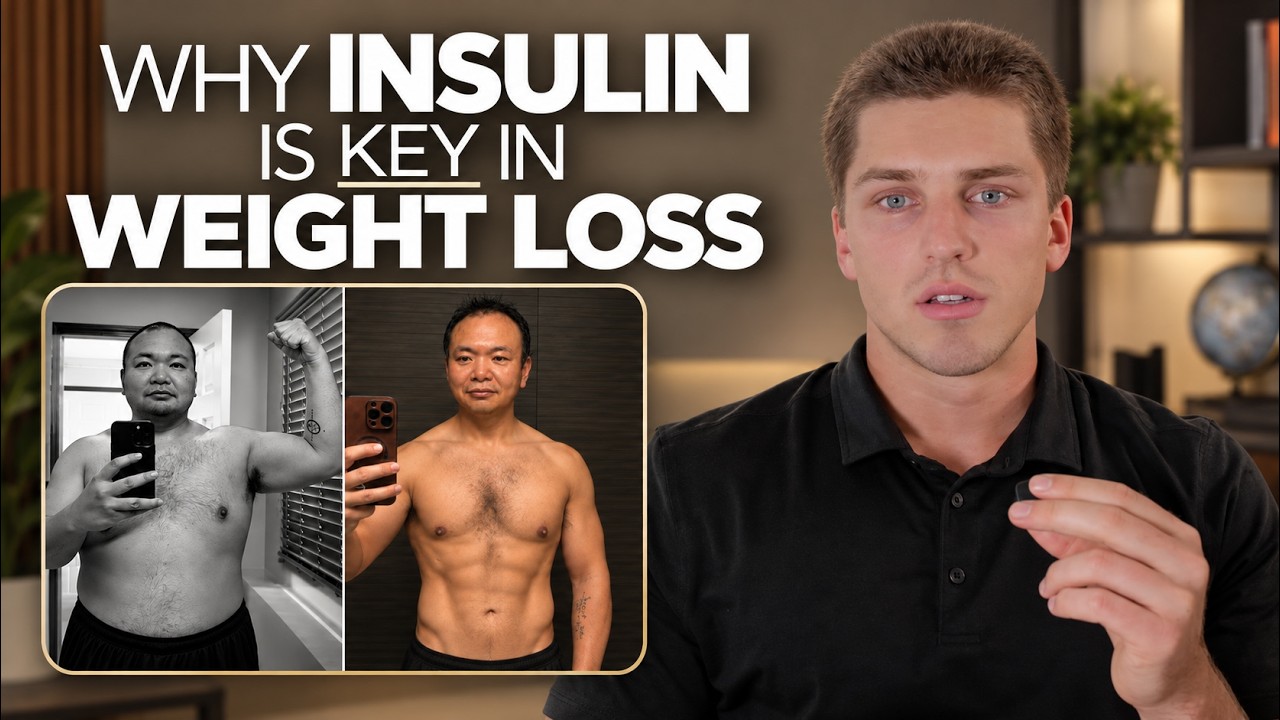
Josh Heverly argues insulin is the key to fat loss. Chronic eating spikes insulin, triggering resistance that blocks fat burning and drives inflammation and belly fat. His framework: 16:8 fasting, carbs around workouts, protein first, post-meal muscle movements like squats to pull glucose into muscle.
Chapters
So let me guess, you walk 10,000 steps a day, you eat in a deficit, you train consistently, yet no matter what you do, you can't lose the belly fat. There's a reason for that. There is a single mechanism in your body, a hormone more specifically, that allows you or doesn't allow you to burn fat. Now, if you're in this position, I'm guessing you've been overweight for a good portion of your life and you've never heard of the term insulin. Insulin is a hormone that controls the amount of glucose that goes into your cells. And if you've heard of insulin, I'm sure you've heard of insulin resistance, type 2 diabetes. And if you've been chronically overweight, even if it's only 10, 20 pounds for a good portion of your life, there is a very high chance that you have prediabetes and you've never even realized. And the reason all comes back down to insulin. And once you learn how to control it, you can control your whole life. Your weight comes off effortlessly, you have way more energy, and you look and feel way better than you ever have. But first of all, why should you even listen to me on this topic? Well, I studied at the University of San Diego. I played football there for 5 years where I learned from the best of the best— trainers, coaches, nutritionists, the list goes on. And even better than that, I have clients like Vinci, Christian, Dan, Dom, Issei, and way more that have gotten results because they learned how to manage their insulin. So in this video, I'm going to explain what insulin actually is, How to utilize it for your benefit and how to ultimately lose that stubborn belly fat by manipulating insulin. So first of all, I need you to understand what insulin actually is. So it's a hormone made by your pancreas. Its one job, move sugar out of the blood and into the cells. So here is the hormone called insulin that's released from your pancreas. It then goes into the bloodstream, travels into the cells. So essentially what it does It pulls that glucose, the sugar, from the blood vessel into the cell. And all insulin does, it unlocks the door. Insulin is the key that allows sugar to go in to be used by the cell. So where does insulin unlock the door? The muscle, brain, liver, fat cells. And you really want to prioritize using it for the muscle and the brain. But where the problems occur is when your liver and fat cells are constantly using the insulin. So a little bit deeper into that, how it actually works for you. You eat food, your blood sugar raises, your pancreas releases the insulin, the insulin unlocks the cell. So this is just a magnified version of that previous image. The insulin is the key. It is a ferry basically that transports glucose into the cell. So here's the insulin and it allows the glucose to be used within the cell for energy. So that is all insulin is. It is a transporter that allows glucose to be used in the cells. You want to be insulin sensitive so your cells can easily absorb the glucose and use it for energy. But the issue is, when you're chronically spiking your insulin and blood glucose levels, you will become insulin resistant, which makes it nearly impossible to burn the fat. So for example, when you're constantly snacking, this is what your blood sugar and insulin will look like throughout the day. If this is your normal baseline, every time you eat, it is spiking and then dropping that blood sugar and insulin levels, but it never gets back down to baseline. So every time you raise it and you're constantly eating throughout the day, it never gets down to that baseline. And the baseline is where you can actually burn fat. So essentially, when you are always eating, you cannot burn fat for fuel because your insulin and blood glucose is high. Your body's main job when your insulin is raised like this is to solely bring back down the insulin to the baseline levels. So this is an example of somebody who's constantly eating throughout the day, but what does it look like when insulin is optimized? Here's a blood sugar and insulin optimized diet. Just for a very specific example, a 16:8 eating window, training fasted, and carbs timed around it, not away from it. So the carbs are energy, that's sugar in the cells. So take just for example, for this person, you train fasted, but this can differ person to person. You could train in the middle of the day, at the end of the day, it would all depend on your specific situation. But the overlying concept Remains the same. Keep your insulin around the training. So you see how this person trains fasted at 7:00 AM, but then they have their biggest carb meal, the breakfast, right after they train. This is so their body can use the sugar, use the carbs to replenish the glycogen and actually build muscle. This way, the blood glucose gets lowered quicker because the insulin is sensitive. So in this example, potatoes and eggs, but a large portion of your carbs would come right after this training. And like I said, it can vary. If you work out in the middle of the day, you would have some carbs before and the biggest meal right after. But all I want you to focus on is this 16:8 eating window, and whenever you are furthest away from your training, that's when you keep your insulin low. So as you see here, dinner, proteins and fats, very minimal spike. And then the rest of that 16 hours of fasting, the insulin is low. We're trying to keep our insulin low, and I'll get into this in a moment, but insulin low equals growth hormone up. That's what we want to focus on. And insulin isn't all bad. It is a key hormone in our body. We need it for energy recovery, brain function. We need it to transport that energy into the cells. Without it, we would simply die. But with too much of it, Which— what is chronically elevated insulin? It leads to inflammation, it leads to type 2 diabetes, type 3 diabetes, which is ultimately Alzheimer's, and I'll get into that in a second. But what I want you to know is that insulin is important. It's more so how you use it is what causes the damage. So when you never let insulin reset, like I mentioned before, you're constantly spiking it and it never gets back down to baseline. Well, sugar gets stuck in the blood, and what that leads to is insulin resistance because the cells stop responding, they downregulate insulin receptors, and the pancreas pumps out more insulin. It compensates with more of it trying to unlock that cell, but then the resistance deepens, the cycle repeats, and it worsens. So this cycle repeats and deepens consistently. The more that this happens, the cells stop responding, pancreas pumps out more, resistance deepens, And it's just a cyclical thing that never stops. That's why it's so hard to get out of. But here's what I want you to know: when you properly time your insulin, it will never be a problem. This will allow your body to use it as fuel and use it to recover. But when you keep your insulin low the rest of the day, you're able to recover properly and actually burn fat for fuel. But why is it such a problem if you become insulin resistant? Well, when the cells resist, the pancreas pumps harder, which means The fuel can't get in. That leaves you tired and hungry, but the cells tired, hungry, and inflamed. Blood sugar stays high, leads to glycation, which essentially means the sugar bonds to proteins, making them stiff and weak. The blood vessels take damage, the pancreas wears out, and like I said, it's a loop. It is hard to get out of, but when you address it from the jump, man, everything in your life becomes easier. Fat loss, lower your inflammation, better energy, Lower disease risk, it all comes down to the insulin. So, there's 3 things that I want you to focus on every time you have a meal. How much insulin are you going to release from it? What time of the day is it? And the protein that's associated. If you can always time your insulin around when you're most active, working out, right before and right after, that allows your body to use it as fuel and use it to recover. Because protein takes longer to digest, you want to have the protein before you have the carbs so the carbs don't go directly into the bloodstream. And even if you aren't working out, there's very simple ways to manage your blood sugar. So for example, doing air squats after you eat, push-ups after you eat, some dips, even a walk. The goal is simple. You want to activate your muscles so they pull glucose out of the blood instead of leaving it in. That's insulin sensitivity. It's trainable. And like I mentioned before, you want to be insulin sensitive. Meaning you want your cells to pull the sugar out of the blood. Doing something that gets your heart rate up a little, that activates the muscles, especially the bigger quads, glutes, hamstrings, like air squats, would be the most optimal. A walk is good, and I'm sure you've heard it before— walk for 10-15 minutes after a meal. It's great for aiding digestion, but it doesn't really get your heart rate up. It doesn't really work any muscles. I would prefer 25 to 50 air squats over a 15-minute walk. Every single time because it pulls the sugar out of the bloodstream. And the thing is, when you can manage your insulin, you can lower the sugar in the bloodstream, you're actually able to burn fat for fuel easier. So I'm sure you've heard it online, walk 10,000 steps a day and you'll lose weight, you'll feel better. That is great, it helps you burn more calories, but it doesn't necessarily help you manage your blood sugar. Like I said before, we want to activate our muscles to pull the glucose Out of the bloodstream. Squats, push-ups, dips, anything that activates the muscles after we eat is going to aid that process. So instead of thinking more steps, less calories, I want you to think insulin and how can I manage it. I want you to think for a second what's actually at stake for chronically high insulin. Fat storage, inflammation, hormone disruption, disease risk, everything leads back to high insulin And inflammation. And the funny thing is that insulin leads to more inflammation, more inflammation leads to more insulin. So like before I mentioned, this is a cyclical problem and you have to address it at the root cause. And it's as simple as a few things: doing this practice to pull the glucose out of the blood and actually eating the right foods. So what spikes it the most and the least? Well, proteins, veggies, healthy fats. This would be the least of the few. Whole fruit and whole grains, moderate depending on how much fiber is in there specifically for the fruit. And then refined carbs and wheat, these are the absolute worst. So every single thing that you eat— bread, pasta, cookies, cereal, bagels— refined carbs and wheat break down to glucose the fastest, meaning it causes the biggest spike in insulin and glucose in the blood. So the more that you can remove these, like specifically refined carbs and wheat, Remove these from your diet completely. Bread, pasta, cookies, bagels— these have no nutritional benefit, especially here in the United States where all of the wheat is enriched. It's toxic, GMO. You don't want to be eating those types of food because they cause a lot of inflammation and also raise your insulin. It's twofold and is the 2 worst things that you can do for your health. So specifically spike your insulin with healthy carbs like potatoes, fruits, rice, oatmeal around your workouts And that's going to give you the best chance to actually use insulin properly. Now, what do you actually do about it to lower your insulin and have better insulin sensitivity? Well, cut the refined carbs and wheat, prioritize whole foods and protein, try 16:8 intermittent fasting, move daily, walk, lift, sprint. And genuinely, it is that simple. Time your carbs around your training, eat less carbs overall, cut out the refined processed carbs, wheat, Bread, pasta, cookies, bagels— cut all of that out, no exceptions. I know it's hard. And intermittent fast. If that is all you do, you don't have to track calories, you don't have to worry about your steps, you will greatly improve your health and the fat will absolutely shred off your body. That's all that I have for you right now. And if you want to learn how to go from 20% to 12% body fat specifically in 90 days or less, click this video right here. It breaks down that whole process and everything really, really in depth. If you have any questions for me, leave them in the comments. I would love to help you out. God bless. Stay holistic.