Augmented Intelligence vs Predictive Analytics with Lara Shackelford 1
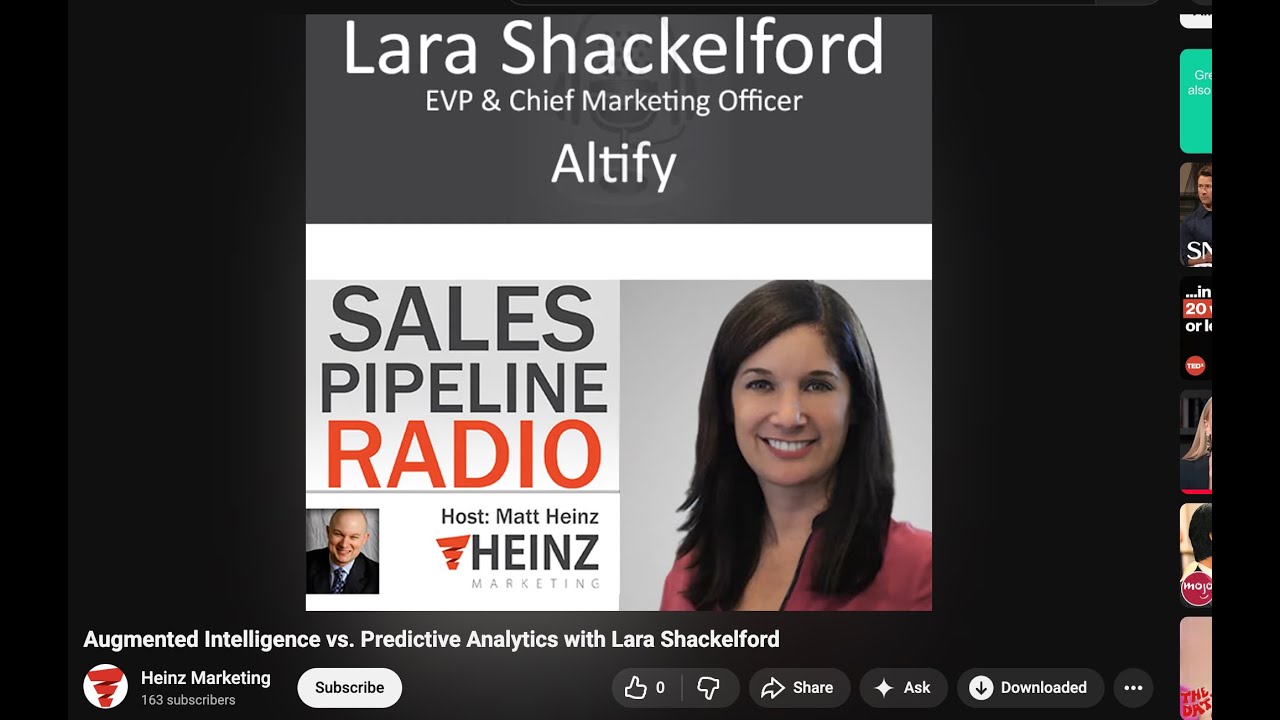
Lara Shackelford, CMO of Altify, explains how augmented intelligence differs from predictive analytics. Augmented intelligence surfaces context-rich insights to humans, while predictive analytics forecasts outcomes from data. Altify embeds 30 years of sales methodology into software that helps reps sell like their top performers.
Chapters
Welcome everybody, it's time once again for another episode of Sales Pipeline Radio. So grab your board, catch a wave, and ride along with the surfmeister himself, Matt Hines. Hey Matt.
How we doing, Paul?
I'm doing good. Where you surfing to today here?
Well, thankfully today we are still at the world headquarters here in Redmond, Washington. Next week the road show begins again. We'll be live from Dreamforce next week, the annual Salesforce .com extravaganza. Yeah, I think it's gonna be a little smaller this year from what I've heard. Like, I think in the past couple years they've had, you know, upwards of— I'm not kidding— like over 100,000 people at this show. I think this year they've had to restrict it since they're still— they're still reconstructing Moscone Center and doing some work down there, which quite frankly terrifies me even more because it's still going to be a huge number of people, uh, and it just sounds like that many more traffic cones and sidewalks that don't exist. A little corner of the world somewhere, and we do every week at 2:30 Eastern, 11:30 Pacific. Make sure we bring you Sales Pipeline Radio. Thanks everyone for joining us today. So excited to have everyone with us live that's listening on Sales Pipeline Radio. Enjoy, uh, Garvin, everyone who is joining us from the podcast that is available on demand at any time from Google Play in the iTunes Store. Of course, you can find replays of all of our past episodes on salespipeline.com. Always real excited about the guests we have. We've been doing it this summer. We've had just a great group of sales and marketing leaders covering a variety of areas. We've been lucky to feature a lot of great authors, thought leaders, people that have new books that have been coming out on the sales and marketing side. That's great, but one of the disadvantages of focusing in that direction is we lose sight sometimes of the people that are really driving innovation results in an operational capacity. People that don't just talk about generating results, people that do it on a daily basis and are grinding it out and being successful at doing it. So that's one of the reasons I'm excited to have Lara Shackelford, who's the EVP and Chief Marketing Officer for Altify, on the call today. Lara, thanks so much for joining us.
It's great to be here. Thank you.
Awesome. So, you know, before we begin, I've got a bunch of questions I want to ask you just about some of the work you're doing, but maybe just start with, you know, tell me a little more about Altify, what you guys do, and sort of, you know, what market you're serving.
Sure, so we sell to sales professionals, people in sales operations, sales leaders who use our software. We've built in 30 years of sales methodology into software that helps sellers to sell better. So the goal is that every sales rep can sell more like your best sales rep. We are a SaaS platform, and we've just introduced an augmented intelligence component of our platform that we're going to be talking about next week, speaking of Dreamforce. And so we run exclusively— we're native on Salesforce. And so we'll be there next week and sharing the news about our platform and augmented intelligence. And with that, we've also just— my CEO Donald Daly has released a book on AI. And so we'll be talking a lot about AI, which you'll hear a few things about next week with Salesforce talking about Einstein. So it should be an interesting week there, and look forward to sharing more with you today.
No, that's awesome. And I think, you know, big fan of Donald, the work he's done for years, you know, through the task group, you know, very interested in AI and Einstein. I mean, I think, you know, as, as you've got a lot of sales and marketing leaders that are just trying to catch up on big data and predictive analytics and what that means across sales and marketing, now all of a sudden we throw AI at them as well. What does that really mean, not just for Altify, but like, help, help people understand and sort of deconstruct why AI is relevant to sales and marketing leaders moving forward.
So AI is impacting business professionals in the knowledge economy. And we want to help put humans at the center of that and have them be supported by machines with augmented intelligence. And we see that as a critical path forward. And so if you think about, there's all this knowledge and data in the world, and you have people consuming or trying to consume a lot of data, but not necessarily having the context of what the data means and what signals they should be looking for in the noise. And so what we believe is that it's important to bring the augmented intelligence piece to help humans perform better, the knowledge workers. An example would be a sales leader who might have 4 or 5 critical must-win deals for the quarter. And we now can notify them when we see that there's something in a deal that has changed that they want to be aware of, or maybe there's risk in the deal that they don't see every day when they're in the thick of it trying to help their reps perform. So we'll take our 30 years of sales expertise and notify them that maybe they're not getting to all the right people in the deal and influencing the right folks they need to be influencing based on our knowledge that you have to get to these certain folks to, to win that deal.
So is there a difference between augmented and predictive? I mean, I think there's a lot of words that we hear, uh, in the marketplace today. And is there a difference? How should people be thinking about that?
And you're asking the right person because I spent about 10 years working in data-oriented companies. And predictive intelligence— predictive analytics, predictive intelligence is certainly a way to look at data and try to look for, again, predict what will happen in the future based on a lot of data. And it typically involves high-volume transactions. And you're looking at, again, lots of records. With augmented intelligence, what we see is it's more about being able to bake knowledge and context into a solution or into data, or bake data into it and be able to flag insights and provide those insights to the human being so that the human, the knowledge worker, is able to be more effective and generate greater results with the support of the data and the context and the knowledge.
Talking today on Sales Pipeline Radio with Lara Shackelford, who's the chief marketing officer of Altify, doing some really interesting things in the augmented intelligence world. They'll be featuring some of those advancements at the Dreamforce conference next week in San Francisco. You kind of referenced your background. I mean, you've spent years in the world of business intelligence, big data. What specifically about the Altify opportunity is most exciting to you? Moving forward, I think this is definitely— I still think of this as an emerging category for many organizations. What do you think this means for companies moving forward, and why is this such an exciting place to play?
My entire career has been in B2B marketing, and a good chunk of that has been spent in business— marketing business intelligence and data technologies. I loved learning about technologies and helping people make sense of their data, but what was missing for me was the context. What was missing was— in fact, I've sat in rooms with people who said, "Okay, now I finally have my report, and there's all this information," and they don't know what they're looking for. They don't know what should matter in the information that is being served up to them. When I met Donal and started learning more about the organization, I was really excited about the opportunity to be able to provide knowledge and context for knowledge workers, to be able to help them with— to interpret the data and know what the next best action is to take based on that data.
That's interesting. Yeah, I think this is definitely a bigger, bigger opportunity. I tend to think of any flavors of this as becoming table stakes for organizations that want to maintain a competitive advantage well beyond the insights they're able to capture in their own environment, but to be able to leverage what exists outside of that world as well. Have you seen— I mean, as a CMO at a fast-growing company, I mean, I imagine that you are subject to an awful lot of sales pitches. Have you seen any evidence of applications of big data in the pitches that you're seeing in the market today?
Sure. In terms of big data in the pitches that we're seeing, I've certainly seen it from the other side where you've you're going and leveraging a BI or a data tool to present to your customer and help them understand their business. What I've seen that's really working well is just the experience of— in fact, I'll go back to years ago, the first sales call that I went on when I was in my early days at Oracle. And the sales leader, he sat down with me. We had 3 planning calls before we went and met with the customer to talk. We wanted to build a joint marketing plan for VeriSign at the time. We had 3 planning calls, and then we met in person 2 hours before the day of to make sure that our plan was solid, that we got to all the right influencers, and had a plan that was going to map to the goals and pressures of that organization and the individual, the VP of IT who we were selling to. When we got there, it was less about the data. It was more about the knowledge and the insight that we were able to to understand their business, to speak to their pressures, and to help develop a plan and a roadmap for success for them. And so we actually agreed. We went in and signed off on a joint marketing plan with VeriSign's VP of IT that day. It ended up being sponsored by their CFO because we thought the message would help them at a more strategic level. And we did an incredible joint marketing program with press and campaign with them. And that, to me, was an example of A sales call can only be so good with data. It's got to be built on knowledge and insight and the right preparation. So at Altify, that's one of the things that we focus on. We've just launched a product called Call Planner that helps salespeople take that VeriSign example, take what the best sellers are doing, and bring that kind of preparation into all of their sales calls.
That's great. How do you do that when you've got multiple decision makers, multiple stakeholders in a target organization, right? Where you've got an account that is giving you certain buying signals or trigger events or signals. But then you, you know, according to CEB now we've got like 6.8 people on average in the internal buying committee. You know, how do you differentiate? I mean, does Altify help differentiate those messages and then how do you operationalize that at the sales level as well?
Right. So actually there's data that I've been looking at that John Miller from Engagio shares. Where he— and John Miller is very— he's leading the charge on account-based marketing. We're saying that— IDG is saying that we now have 17 people that are influencing a B2B complex sale. That's a lot of people to get to and a lot of people that you have to make sure that you're connecting with. For us, it's crucial because we exclusively sell to large— or to people who have run large complex sales processes, B2B sales organizations. What's important is that we do take an account-based marketing approach. And we look at— we have a finite set of accounts that we want to target, a finite set of people within those accounts that we know we can sell to. And for us, it's all about being really smart about listening to the pressures that company is facing, understanding what they need and what they want to achieve, and being able to arrive at a joint solution for them that's going to help move their business forward. And we do that very— in a very targeted manner, account by account. Even to the standpoint of the way that we structure our business development team, we do have someone focused on inbound and responding quickly to inbound requests, but outbound, we very much go to— have moved to a targeted account approach so that we can make sure that we're doing the best by these accounts that we're trying to sell to.
That's great. We're talking again to Lara Shackelford today on Sales Pipeline Radio who runs marketing at Altify. I think you brought up John Miller and the work we're doing on the account-based marketing side. Real quick before we go to break, maybe talk a little bit about— what are some best practices to ensure that there's integration of this intelligence and application of it across what sales and marketing are doing? Is this better leveraged when you are at the middle and bottom of the sales process? Can you leverage this more at the top of the pipeline as well? Is it sort of agnostic to stage? And then really that integration between sales and marketing I think a lot of companies are really struggling with right now.
We think of it more as bottom of the funnel now. With marketing automation years ago, as it evolved and gained traction, people started talking about top of funnel and wanting to put more into the top of funnel and then nurture, pick the people out of the funnel they wanted to sell to and nurture them. And that's a really expensive way to go to market, and it takes a lot of time to develop. Everything old is new again, so there's been a lot of history of focusing in on a certain set of accounts and taking the right message to them. And we're just excited. As a CMO, I'm excited because it's the opportunity to drive greater alignment between sales and marketing than you've seen in a long time. So my head of sales knows, we agreed on what our targets were. We agreed on how we were going to get to them, what a measurement of success looked like at Altify. And then we know whether we're getting traction or not based on this set of accounts and how they're responding to us and where we're engaged with them, whether it's early in the sales cycle whether we're influencing it all the way through.
Brave new world we're living in here in B2B sales and marketing. We gotta take a quick break. We'll be back on Sales Pipeline Radio after, after a quick break. We're gonna talk a lot more about the role of augmented intelligence in sales. We're gonna ask Lara some questions about how she's leading change and complexity in an increasingly complex B2B world and talk a little more about sort of creating that integrated successful funnel between sales and marketing. We'll be right back with Sales Pipeline Radio.
In a world where the speed of innovation and change in B2B marketing has never been greater, the only thing bigger is the need for clarity, for a blueprint, for a guide to what's really working. And how about a way to apply it specifically today to increase sales pipeline growth, velocity, and most of all, conversion? That's what you'll find in the Modern Marketer's Field Guide. And amazingly, you can download it for free. Heinzmarketing.com, just like it sounds, H-E-I-N-Z M-A-R-K-E-T-I-N-G. It encompasses the entire sales and marketing cycle, but in quick bursts with lots of specific actionable ideas, strategies, tactics you can put to work right away, like today. The loaded table of contents helps you narrow in and tackle a problem. And it's something you can come back to over and over again as a reference guide. Why not download your free copy of the Modern Marketer's Field Guide? It's free. HinesMarketing.com, just like it sounds. H-I-N-Z-Marketing.com. All right, back to Matt and his guest. And can I ask one question here? Yes, you may. I'm wondering if some of this augmented intelligence could augment my intelligence.
Yeah, I don't think that's what it's for. Oh, that's a good question. It's a great question, Paul. You add so much value to the show.
I appreciate that.
Thanks.
Ah, well, thanks very much for joining us today, Sales Pipeline Radio. Boy, this half hour always goes so fast. If you want to catch up a little more on our conversation with Lara Shackelford from Altify, you can check it out at salespipeline.com. You can check out the podcast, always updated with recent episodes at Google Play and iTunes Store. And again, we're live every Tuesday, 2:30 Eastern, 11:30 Pacific. We'll be live from San Francisco at Dreamforce. Next week on October 6th, we'll be featuring Deb Calvert. Now that I think about it, she might actually be there. We might actually have to— I might have to bring the Yeti with me, Paul, and we'll have to do the show live from the show. We're going to be talking about sales leadership, developing better sales leaders, helping to help your sales leaders create new sales leaders and the leaders of the future in your organization. After that, we've got Jamie Shanks, who is one of the leaders and pioneers of the sales social selling world. He's got a new book called Social Selling Mastery. Then after that, we've got Matt Bonatti, who is the CEO of Lead LeadGnome. If you send outbound emails and you get a ton of inbound out-of-office replies, that is fertile ground, my friends. People telling you who else to contact, people giving you updated contact information. LeadGnome helps automate that. We're going to be talking a lot more about tools that make sales teams more efficient, make your marketing more efficient. But I want to get back to our guest today, Lara Shackelford, who's the CMO of Altify. I kind of referenced and teased before the break, leading change and complexity. I mean, you've been involved in been in big data and sort of the leading edge of marketing and analytics for a while. As you now lead a growing team of marketers that are now operationalizing this, what are your best practices for helping people work through change, helping people manage and succeed in an increasingly complex B2B marketing world?
It certainly is complex, Matt, but I'm finding that the further we get into account-based marketing, it's actually the simpler it gets. Because you really focus in on the voice of the customer. My foundation in marketing came in my first marketing role at Oracle when I worked for Jeff Destille, who is now runs— he's our Chief Customer Officer. But he taught me how to listen to the voice of the customer and really see them both as a customer that you want to serve and as a human being who has their own goals and things they want to achieve. And that helped me to incorporate that actually into the kind of DNA of my marketing and my marketing organizations. Throughout my career. So I always believe in understanding and starting with the customer. And I think when marketers at any level do that and you actually have a relationship with customers and they start to trust a marketer, which requires establishing trust over time. But when they do that, things become a lot easier because you realize you've got, you know, let me take this tactic that will serve them better than the other. And you slow down and you focus more on the quality of the content you're giving them. Versus quantity. And that's one of the crucial things for us as we go forward is making sure we take risks, that I empower my team members to learn and grow, but do it while they really slow down and work in support of the customers.
Well, I think that's a really great point. It's great for people to keep in mind that as we add a complexity around the tools, as our customers in many cases become naturally more complex in the way they make decisions, there are things we're doing that are consolidating goals and objectives and focus areas that could make things a little easier. I think I'm seeing more and more, and I'm sure you're seeing— I'm curious how you see this internally as well. Organizations that don't have sales goals and marketing goals, they've got pipeline creation and conversion goals. Their focus is— sales focus is to hit the number. Marketing's focus is to hit the number in some version of that. So an alignment of focus and intentions and objectives is to a certain extent making at least decision-making and alignment simpler as well. How do you guys think about that at Altify?
Right. We think about it from the very outset of creation of a plan that, as I mentioned earlier, my sales leader and I, when we worked on our plan and figured out our go-to-market goals, it was an absolutely collaborative process from the start. So it used to be, back in the day when I did my first demand plan, it would have been a sales leader telling me, here's my goal, go get this much pipeline for me. And it has changed so much now. And it's really about understanding and looking at the data and being smart about Being aggressive in setting your goals and also knowing that you're setting goals that are achievable. And that you and your sales partner are in it together. And I think that word partner is one of the most crucial, is that you form a true partnership where you can be very open and respectful, but also cut through the noise when you need to make changes and drive to results. So that handshake from the beginning to the time that you close the opportunity is crucial.
Absolutely, I completely agree with that. You know, one of the questions that I wanted to ask you, and I know that you've got some insights on this, you kind of touched on this a little bit earlier, is, you know, basically best practices in working with your sales counterparts to create that integrated successful funnel. We've been talking about different versions of this, but what other, you know, either anecdotes or sort of best practices from your experience can you share that can help people that are listening navigate, whether they're, you know, listening from the sales side or whether they're listening from the marketing side? I mean, as we've been discussing, this is an integrated opportunity now.— what are some things that you've seen work that can apply elsewhere?
The best sales partnerships I've had have started as partnerships from the outset where you can sit down and you're very open with your sales partner about where you see opportunity in their business, where there's opportunity in the marketing team, and how you can create that joint go-to-market plan. And I've worked with some tremendous sales leaders and they'll come to me and tell me, "This isn't working. What if we try this?" And when you completely own the the revenue problem together. You both feel responsibility for revenue. It's just a different dialogue and a different level of partnership. That is easier when you're at smaller companies. So, you have to figure out how to scale. So, one of the things I did when I was at Microsoft, we had a very large management team that was distributed across the US, both in terms of marketing and sales leaders. And so, it's hard to stay connected. It was hard to keep from, you know, people from getting frustrated when, something wasn't working the way it should. So what we started is I did a sales and marketing alignment group. And we would meet once a month and we would meet once a quarter in person. And we would surface issues that would prevent us from— that would have slowed us down from driving a partnership and joint and shared outcomes. And so when you would find one region with an issue, you would typically find some other region had a similar issue or a different version of it. So just getting that core group together that said no matter what, we're committed to— driving the sales and marketing dialogue as a team and driving the right outcomes as a team. It was completely different. The great thing is a lot of those people have gone on to be marketing and sales leaders at other companies that I work with today. They've now become kind of my council in my career as I've gone forward.
That's awesome. So excited to have Lara Shackelford today on Sales Pipeline Radio sharing insights on sales and marketing, insights on augmented reality, augmented intelligence that they're going to be sharing more at Dreamforce's conference next week. In San Francisco. As we, as we wrap up here, Lara, uh, I want to take a little bit of a divergence from this road. Um, I know, you know, you know, you're, you're, you're a, you're a hobby chef. Um, you know, you've mentioned that you, you love rescue dogs. And then also on your LinkedIn profile, you talk about a commitment on a regular basis to get out in the community, get to Glide, you know, serve meals. Talk a little bit about that element of building a team and why that's important for you to make that a consistent part of what you're doing with your marketing team, to get out and be part of the community.
Yeah, and thanks for asking that. I think it's so important that the way you build a team is that we're people coming together and to honor and respect individuals within the organization. So, my hobby is cooking and I have a dog that I think is fantastic and I try to share that with my team and learn what's important to them as well. But getting out to the community is a whole different level and doing it together. It's one thing to say, "Oh, I'm part of an initiative and we donated this money or we did this." Those are great things to do, but what I'm really passionate about is bringing the team together and being able to roll up our sleeves and work together towards a cause that is something bigger than ourselves. So we have these great shared goals in our organization, incredible growth goals, but to be able to go out and serve food to someone who is hungry that day is a whole different level of connection and really keeps us humble as we go back to the office and roll up our— keep our sleeves rolled up to work through the other issues of the day.
Absolutely. I love that, and thank you so much for making that a priority with your team. Want to thank, thank Lara Shackelford, the Chief Marketing Officer for AltaFi, for joining us today on Sales Pipeline Radio. We covered a lot of ground in a short amount of time. If you want to hear more from Lara, please check us out at Sales Pipeline Radio. We'll have a replay of today's episode up there shortly. Also have a condensed version of today's conversation up on our blog, uh, next week at, uh, hinesmarketing.com. Make sure you join us each week, 2:30 Eastern, 11:30 Pacific. We've got a bunch of new guests coming up Very exciting stuff. Look forward to seeing some of you at the Dreamforce Conference next week in San Francisco where Altify and 125,000 or so of their best friends and our best friends will be out there. So look forward to seeing you there. If not, we'll see you back here next week. Sales Pipeline Radio.
You've been listening to Sales Pipeline Radio, one of the new shows on the new Funnel Radio channel for network listeners like you. Brought to you by Matt Hyatt.
My name's Marc Haines.
Good evening.
More from Lara


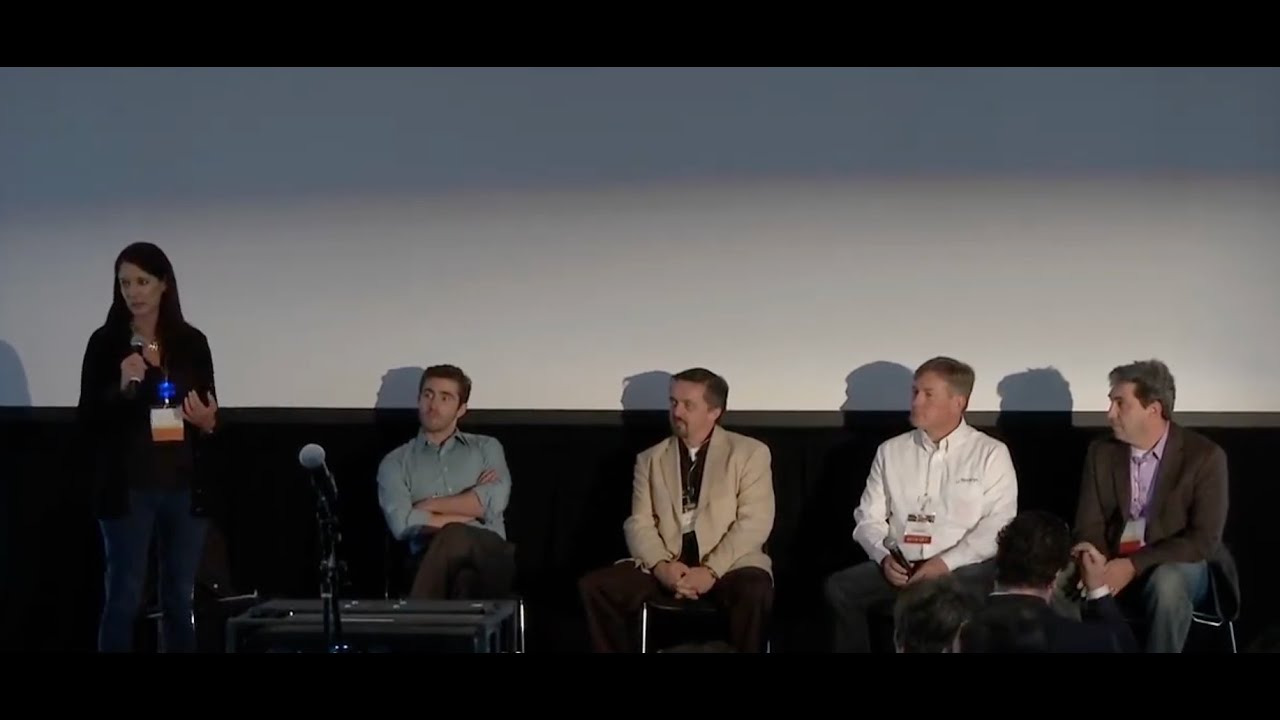
C Summit 2013 No, Really These Companies Transformed Their Businesses Using Cassandra

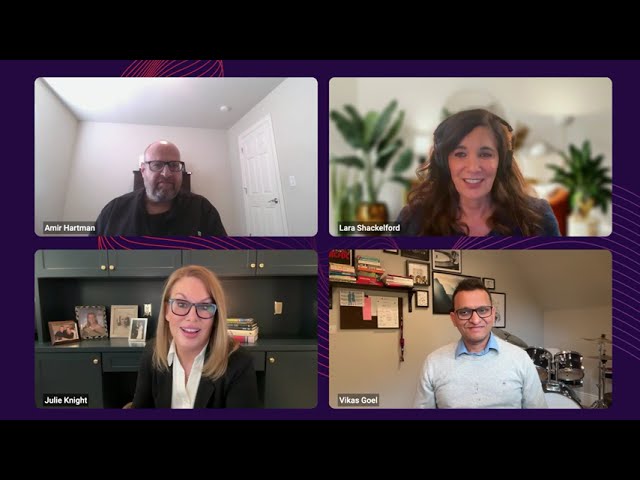

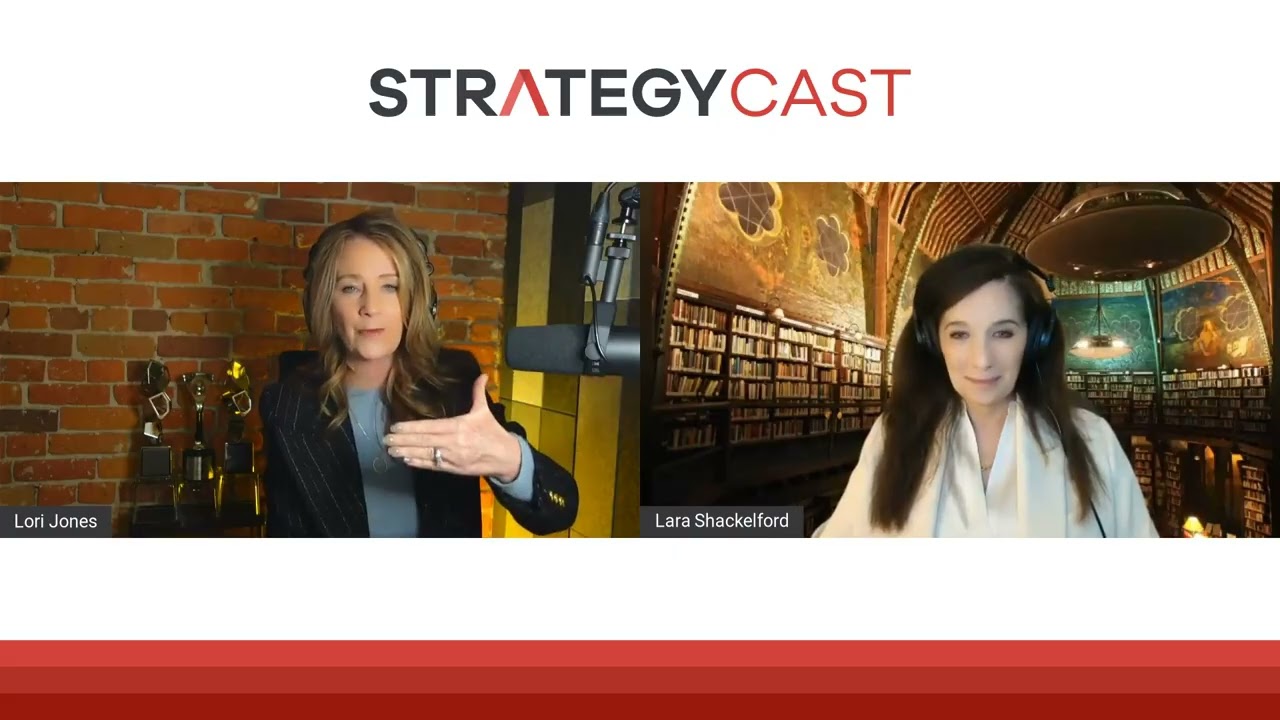
Strategy Magic: How to Leverage AI for Peak Efficiency with Lara Shackelford

AI Summit Forecast '25 Business Model Innovation & Growth Strategies led by Lara Shackelford