HumanX
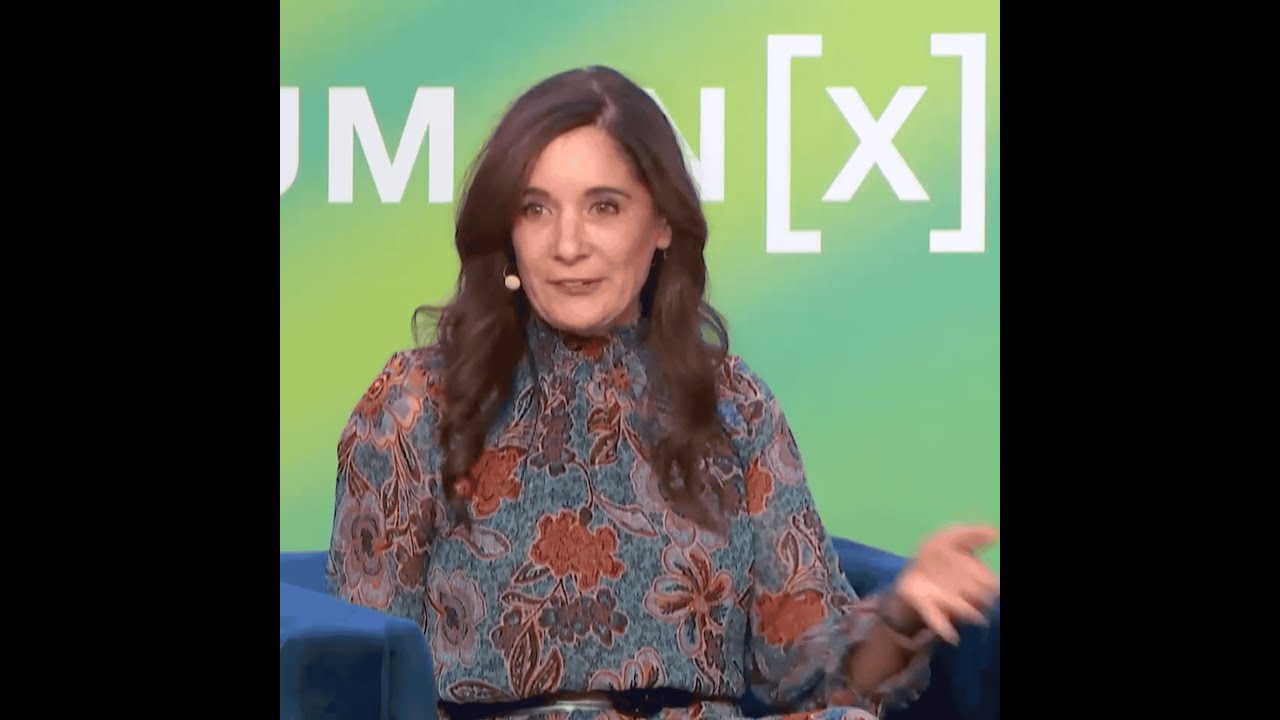
Blake Sabatinelli, Lara Shackelford, and Ben Parr discuss how AI is changing content creation and sales. Atmosphere TV uses AI to filter 75,000 hours of video before human editors refine it. AI-generated sales emails have tanked open rates, and organizations that don't adopt AI tools risk falling behind.
Chapters
We're going to be looking at generative AI transforming content creation. And to comment with and to bring their expertise to this particular topic, we're going to have Blake Sabatinelli of Atmosphere, Lara Shackelford of iCapital and Federi, Benjamin Parr of Octane AI and Theory Forge Ventures, And our moderator will once again be the inestimable Sarah Evans, partner at Zen Media. So please join me in welcoming our panel to the stage.
All right guys, we're ready to take on the afternoon. Um, I want to give an opportunity for everyone on the panel to introduce themselves. They all have tremendous backgrounds and we're going to learn a lot from them. So if we— you could kick us off, Blake, that would be great.
Absolutely. Blake Sabatinelli, CEO of Atmosphere TV. Uh, we do something that sounds pretty boring— we make TV for businesses— but we do it in a way that makes it super exciting so that, uh, venue operators can get people to stay longer with better entertainment, and advertisers can reach audiences in a meaningful way across bars, restaurants, gyms, and pretty much everywhere else that has television.
I'm Lara Shackelford, and I lead growth marketing and CRM for iCapital. And we are in financial services going through this amazing transformation. I've spent my career in B2B marketing, mostly for data analytics and AI companies. So I also founded an AI consulting company to help companies go to market using AI.
Hello, good afternoon everyone. Get a little bit of energy.
Bring that energy.
Second round of caffeine. Maybe you've already started doing the mimosas. You might fall asleep by 6 if you do that. Hi, I'm Ben, Ben Parr. My original claim to fame in the Valley as I was the co-editor and editor-at-large of Mashable, the technology news website. I wrote— thank you. I heard a woo from somewhere. Thank you. I wrote— I ran the West Coast. I wrote 2,446 articles in my 4 years at Mashable. So I did a lot of content things. These days I am both an AI investor and founder. I started an AI company in 2016, a decade ago, which is insane when I say it. Called Octane AI, backed by General Catalyst and Boost VC, powers the AI for over 4,000 e-commerce brands, product recommendations, quizzes, things like that. And last year my co-founder and I said that one job's not enough, why don't we also start a venture fund? So we started an AI-focused venture fund called Theory Forge Ventures, pre-seed, seed stage AI, active AI founders backing AI founders, writing $200,000 to $500,000 checks. We've done 14 deals in 10 months because we're insane all across the spectrum. So I have lots of opinions. We are—
we are going to get really into the weeds on this. And Ben, Matt, do you remember I used to write for Mashable back in the day?
I think I've known you for nearly— it's a long time.
A long time.
It's measured in decades.
It is. It's— and we're only 12. Okay, let's get into actually learning because we've got some great brains here on the stage. Today's all about AI and content creation, and there's a million directions we could go, but I do want to start with just AI and how it's transforming what we would consider traditional content creation. If someone's sitting here and they need to write a first draft, do a first draft, create the first point of something, and they're not using AI, what has changed and what should they know?
Blake, I'll just go with— okay, so Remember, does anyone remember the time before ChatGPT? Because I barely remember it at this point because now my workflow is like I have 3 different AIs. I have Perplexity, ChatGPT, and Claude open for different things, not to mention like the other AI, like workflow tools, but like your core 3 of like I have like Claude open to help me with writing and with coding. And then I have Perplexity to go and like do deep search onto things. And now I have— and ChatGPT to like go back and forth and be my brainstorming buddy or to do deep research. And if you're not like literally using deep research for something every single day, like you are missing out. Literally, I'm like figuring out real estate in Thailand. I'm doing all sorts of stuff like that. And so I just like— it's just such a transformation of what the workflow is. The hardest part isn't the technology now. It's changing your human behavior from doing what you were doing before and figuring out the little nuances of how can I use it to get started, like to just get started, to make enough content that— to just like use it every single day, honestly.
Let's, let's dig in on that maybe a bit more on the creative side of things. A lot of folks, CMO roles, marketing roles, creative roles, we are inherently good at writing briefs and doing what would be considered modern-day prompts. How does that change in our workflow?
Oh, it's, it's changed everything. So there's so many companies out there now, especially for marketers, that you can use a tool like Jasper AI. I used Jasper back at Intel years ago before GenAI had even come out, and it was not the same tool, but it was still helpful then. Now it's incredibly helpful. And I'd say for large organizations, it's especially helpful because you can load your brand standards. And your voice into Jasper, and then you can have— train your team on using it, train them on the use cases that you want them to focus on. And then you end up with your entire organization more aligned and using it in the right way versus if you're out there without a common approach, you've got your team members. And especially if you have a situation where you don't have an approved approach to AI, people are using it at home or on the side. They're all doing it, right? So Anyway, it's important to have a tool where you're able to standardize for the organization. And then one of the great things about Jasper, other tools like that, is you can use it to remix content. So I had someone I was talking to recently who said, you know, we're not doing a very good job of repurposing content. And that's hard to believe today, but it was a statement that was true for their organization. And I said, hold on, let me just grab that from you and push remix in Jasper, and you've got everything you need. So there's just, you know, we have to align our organizations and make sure you have a strategy, but use it, use the tools.
I do think it's important though, if you're not using these tools today, to level set what your expectations are of what they're going to be able to do for you. Yes, they are a force multiplier for everything that you're able to do in pretty much every function throughout your day, but it's not meant to do the entire job for you. It gets you 80% of the way there. The last 20% is up to you. So when we talk about the automation of jobs, especially on the creative side of the industry where I spend a lot of my time, it is not there to get rid of someone's job or to take away the entire task. It is there to allow the artist to be the artist, to apply their creative— the creative juice and their energy, and take away rote mechanical tasks That way we can really focus on making a great product instead of focusing on all the minutiae that comes along with creating that product.
So let's talk about human creativity because that's a lot of what we do in the marketing space and trying to reach our target market and our ICPs. Can you guys walk me through maybe how you are using some of these tools to enhance either your own human creativity or your team's human creativity, or maybe the way you're presenting your brand through the guise of using AI to, to reach consumers.
Yeah, I'm happy to hop in here.
Go for it.
One of the biggest things that we're focused on in video editing space is trying to identify what should go where, what's the best thing that we should be airing at any given time. And we're blessed to have been, you know, working with 3, 4, 5,000 content creators every single month. And we have a huge archive of content that we've licensed, something like 75,000 hours of content that we've licensed but we haven't used yet. What we're able to do is build a learning model and feed in what we have created and teach that model what looks like something we would want to use and what would look like something that's not, to be able to pull out the wheat from the chaff and be able to identify what really works for us. That way we can go back to exactly what I was just saying. Hey, can I— if we're doing a 3-minute compilation, can I be smart and have a machine identify that what that 3 minutes may be? Bring it into an editor so we can assemble it and then allow the artists to do their creative work, come in, edit, move things around and get it to a point where it is something we're willing to publish. But let's— the whole focus for us is to take out the tasks and take out the menial work so we can apply hours towards things that actually matter and exponentially increase the amount of true productive creative hours that we're delivering every day.
That's crazy. How much time do you think— you just said all of those steps and the number of videos and content. How many hours would that take a human without AI?
We've been in business for 5 years. We've been licensing content for 5 years. That library has only ever grown. So a very, very, very long time.
And what about you? Oh, sorry.
Oh, I had to jump in.
Okay, so we had— when I started my consulting firm, Federi, I spent hours and hours and weeks agonizing over the messaging. And back then, GenAI had come out. So I was working with ChatGPT and the other tools, Claude. And it was so helpful and infuriating at the same time, because I would be like, wait, aren't you tracking me? I was good at prompting, but it was just— it was early. The other day, I thought— I love Deep Research, by the way. I use it all the time. And it helps me be so much more efficient. And we can save so many hours with that. But anyway, I threw the problem into Deep Research, because I knew my website and my messaging needed to be updated. And I spent 20 minutes with ChatGPT, and I got the perfect rewrite of my entire website done. I haven't updated it yet, but I'm amazed now at how fast that is compared to— I feel like it was months that I spent on it before.
Ben, anything to add?
I'm— no, I don't think so. I think they actually covered most of it. I'm like thinking through just like my— I'm like in my head, like thinking through like the different AI workflows that I have. I'm at the point honestly now where I'm starting to use Cursor to build very specialized workflows for myself because like, you know, there are some limitations to these things, right? Like I really wish that ChatGPT and any of the others were good at like creating like specialized PDFs of like the— the style. Yes, I see nods and I'm like, please, like, like I have to write investor memos for all the investments that I make, you know, and like I have a format and I can write the content really well. I know what to put into it. It's the formatting that takes the time. And so I'm just, I'm writing a like in cursor just very quickly a program to like actually like do that part. But why does that not exist yet with like any of the open— if there's a specific tool anyone who loves that will make the perfect PDF for me, I'd love to hear it. It probably exists. It is so hard to go and track all of them.
And give us access when you finish it.
Please.
I will.
Lara, you said something about how You know, using AI gave you the perfect copy, the perfect result. And that's something we were talking about on a panel I was on earlier of this idea of kind of perfection or a super curated result. Are we going to reach a time where consumers are going to get discerning when something appears too perfect and people are going to have to modify and change it up? Or do you think that's never going to happen and we're not even close?
I'm so glad you said that because the truth is it wasn't perfect. It felt perfect to me. We need the human. The whole phrase of human in the loop is real. We need the human to spend time. You never want to take something that I threw into ChatGPT and 20 minutes later I have the answer. It felt really good, but I'm still going to spend hours going through it and making sure that it's relevant. I'm going to test it with my market. It's so much easier to test it now too. There are so many tools that you can use for that. But, but it felt really perfect in that moment.
It is a bit of an echo chamber, right? So if you're, if you're working on a creative process, especially with text, with ChatGPT, for instance, and you're prompting it to provide you with a set of results or a set of feedback around a project or help ideate with you, it does ask you questions. But in many instances, those, those questions can be a bit self-fulfilling and they can echo back a lot of what you're, what you're already asking. And so I think to your point, you really have to have a human in there to help pull that apart and separate you from the digital you that's answering questions back to yourself. So it's 100% agree. You must, must, must have more than one human in the loop right now.
The other, the other thing is there's— we all know our inboxes here are flooded with people who are using SDR, AI SDRs, right, to reach out to us. And they're flooded every day. And I even got to the point that I set up an auto-reply on my LinkedIn because I can't get through them anymore. And we were tired of it. And that is not the right approach either. So the fact that we can use AI to create volumes and volumes of content does not mean we should. We have to be discerning and we have to create content that is relevant, not just personalized, but relevant. And that's where this has fallen down a lot over the last year. And we're getting ready to get back. We're getting better.
The AI SDR point is interesting just because who's gotten an AI outbound email or email you're like, that had to be written by AI, like even in the last week and you probably don't know and you probably still did anyway. It's— I got— I've been pitched no less than 60 different AI SDR-related startups in the last year. It's probably lowballing it and we've invested in zero because I, my co-founder and I have no discernible way to tell which one of these is gonna go and work. And the other problem is that now that there's so many and it's so easy to use this for outbound, guess what's happening to outbound open rates and to outbound email response rates? It's all going down across the board when you like look at the numbers. And so you're already seeing some behavior change happen because of that. So you definitely are seeing more people check like, are there 5 fingers? Are there 6 fingers? Are there 7 fingers? On some of these things, but you can still fool a lot of people. And there's a lot of people who are not you and me or are literally at an AI conference. Like, I've heard more and more stories of grandmothers getting phone calls that were really, really realistic, like sounding like they were from the bank. It's so easy. Take an ElevenLabs, take one or two other things, and if you have no morals, you can scam a whole bunch of people too. And it'll take a long, a while to— for people to go and adjust. And by the time people adjust, it'll be another adjustment period because the AI will have gotten so much better. People figured out new vectors. It is an interesting problem that we have.
You brought up something that I wanted to hit a little later, but I'm cool, moderator. I'm going to switch and bring it up now. It's like the AI gauge that we have inherent inside of us because of what is happening. And when we're talking about how to build these creative campaigns, especially for folks who might be kind of newer to this, coming to these conferences, and then they go back and they've got 20 new tools, but those 20 new tools are already being overused by competitors and other people in the space. What should folks be looking at right now in the horizon if they're looking to build better campaigns instead of going big and using every tool? How can they be mindful of where consumers are also at in the AI journey?
Oh, asking the easy questions, right? Well, there's a— I don't know, I'm going to walk this into two is like, what do you like? Your end customer doesn't really care what tool you're using. It's just like, does it work well? Is it realistic? Is it like, you know, does it— you don't want to— okay, one, you don't want to ever trick them. It's okay to use AI, but don't be like, this is a real photo of like our real toothbrushes. Like that's where you go and kill trust. People are okay with like these ads like were made with AI. We tried to like explain something cool. We were trying something new or You know, we're trying to make it easier to explain our product or something like that. I have found most people are fine with that. They just don't want to be lied to or tricked. And then on the backend tool, you can like evaluate 100. It's got to just be as simple as, is it one that you're comfortable with? Does it fit your requirements? You know, some companies it's more about like the internal security requirements. Like we invested— I'm going to do a plug or two of my company, so I am not sorry about that. We did a deal with True Ventures called TeamGPT. It's just literally like a collaboration software for enterprises to collaborate with GPTs. Pick your model, has all the security features, has cool things like prompt libraries so that you can like share prompts across like your entire organization. And they like have big banks in that using it. But it's because that these banks and these larger ones need the security features. You can't just use ChatGPT out of the box, but you're a smaller startup, you could use something else specific, you go more cutting edge. It's got to be something that you're going to use as a habit more than anything. What will you use as a daily or weekly habit so that you're actually using it regularly? That's the number one thing when you're trying to pick out a tool.
The other thing people often think of— this is a panel on content, but they think of Gen AI or AI and they think of content and there's so much more to it. And I want to see people get out of this horrible rut that people are in, many people are in of, hey, we started using it. We're not aligned on use cases across the organization, so we're wasting effort and energy. And secondly, we're creating bad content and flooding people with content that they don't trust. It's eroding our brand. It's a terrible experience when that happens. And so I think a big opportunity for people is not just to think about it as content, but think about how it can help with engagement. So moving from this old world of marketing automation platforms, using instead of this MQL model that we have had in the past that is very broken, looking at how do we use intent signals. And there are so many great tools like Clay for enriching contacts, Bardine for automating it. They're great tools now that you can use in combination with these content generation tools to create this better, more relevant engagement experience with your customers and prospects.
Clay is awesome, by the way. I don't even use it enough and I need to go and do that more.
Great. Full disclosure, I use AI SDRs.
Um, as you should.
Yes. And they're incredibly valuable if you follow a couple really easy key rules. Limit your TAM. Really, really focus on the audience that matters and reach out to them in a very thoughtful way. Keep your message super, super simple. Clay's fantastic. It's a portfolio partner of ours. We use it, it's incredible. Ask a simple question, try to solve a simple need for the people you're reaching out to. And most importantly, bring a human into the loop immediately upon response. Immediately. Do not, do not pass go, do not do anything else. Bring a human in immediately, because if you think that someone's not going to suss out an AI-generated email on the first try, try the second one. It's going— it will Erode all trust instantly. So just be super specific, ask specific questions, solve specific needs. It's not hard. You just have to think about it a little bit. It's not scorched earth. Like I think we probably all get scorched earth, you know, AWS vendors, sorry AWS, we're a big client of theirs. AWS reseller groups that are coming in trying to sell something. That doesn't matter to me. Make it matter.
Who do you see doing this well? It doesn't even have to be a company. If you're thinking more industry, who's got some of this figured out? Who's doing it well? Maybe there's a use case or a case study you've seen just to give kind of that example of what's happening and doing well in the world. It could be campaigns, storytelling, tools.
A pause. There's a company in Singapore called Wreck-It, and they have this incredible— they're a large organization, very large company that many people have never heard of. And they were the first company that I heard of that had really advanced use cases for AI. They did this great job of getting their AI council in place. They got, um, not just an AI council, but then they appointed a group of influencers and early adopters and got those people to get excited and focus on use cases and bring others along. And then they focused on, again, engagement. How do we make our engagement really relevant? And so that we're looking at these intent signals that we can get instead of just flooding people with content.
I think there's two companies that— look, I sell ads, so I'll focus on ads. There's two companies called Waymark and Streamr AI that do a very good job of streamlining the creation process for advertising for small businesses. The reality is, is about 1% of businesses actually have the opportunity and the budget to go out and create meaningful creative content to deliver across whether it's linear TV or across connected TV in a dynamic capacity. These companies do a wonderful job of taking a GPT engine, putting a wrapper on top of it, and creating meaningful 15, 30, or 60-second spot advertising so that for the cost of nothing, you can build, customize, and deploy creative in a very thoughtful way. I've just been impressed with their growth and how they've approached, you know, to solve a problem that, you know, a lot of businesses I think have.
I'll go on like one at each end of the spectrum. Like, so like there's a group of companies I've met over time where they're finding interesting ways to leverage AI internally and externally. I can't remember the name. I'll remember it at some point. And they're just— they just— they provide coaching services to high schoolers for getting into college, but they went all in on like, we're going to have the entire team really understand how to leverage AI to like help our students be able to get into college. To like help analyze like their papers, to help understand what they're doing, to like help create the content marketing. They went really deep on like the ads. It's worked out really well for them. I will go and like find the name in a little bit in my head and like on the back end, like it's as simple as like you need to have more of the like automations that just like help get the step by step. So other portfolio company called Gumloop, it's like Zapier for AI or like Yahoo Pipes. You remember the early Yahoo Pipes days? You like connect a couple of your apps together and it's like really good at getting like an entire AI workflow together. I know entire companies where they automate their entire like backend accounting workflows using them, or they connect it to like take the information, put it in Google Sheets, analyze with AI like step by step. There's just some people doing some ridiculous stuff and none of us really like— you don't even know about it, but they are super, super streamlined as a result of using a few of these things. You won't have to code yourself. You don't have to go pay a ton of money for a tool. You just have to like tinker around for an hour with something like a Gumloop or Wordware to make these things work really well.
What would be your like wishlist workflow for a content person, a marketer, for advertisers behind the scenes? Like if you look at something that's truly broken in one of— in your industry, something that isn't working and you could hack together or have a wishlist flow, what is it and what would it be?
Mine? Oh, I'll go. So it's more of an overall workflow. So I think in general the way we're going to interact with software is going to fundamentally change. And so raise your hand, anyone here use Cursor? Raise your hand. Anyone who has used Cursor, raise your hand. Okay. This is not— everyone? You're like, you should go home and you should download Cursor and you should try Cursor because every single one of you can code anything you want. You could code an entire SaaS application, stick Stripe on it, and charge for things tomorrow and go run some ads and you will be shocked by how easy it is. And all you need to do is yell at the AI for a couple of hours and you are now a programmer. It's called vibe program. It's like vibe coding. It's a whole thing. Everyone should at least try it for a little bit because you are shocked by the power that you get when you go and do it. And when you do that, you're able to be like, I can literally build anything for myself at any time.
We already have our audience right here. Just stay in touch. We'll all be customers.
My point of that is like the interface is why it works so well. You just talk to the AI being like, I want to— my first one was like, I'm going to go and build a space laser game and here's all the parameters. And it made all the graphics and it did every step and it made an entire game using Cursor. And it took me under an hour. But that should be how all software works. I want to be able to just talk to an AI and be like, this is the workflow I want to have. I want to automate this thing and this is how I want to automate it. Give me suggestions on exactly how to do it and then go and implement. We're close. I know that some of like Wordware and Gumloop and even ChatGPT and OpenAI are working on these things, but that's where I think we're going to be getting to, not in like years, maybe in within this year. We're like really close to that. The way, like the idea of like you got to learn the interface and like click and there's a dashboard that'll be a thing of the past in a couple of years.
Yes. What else? Anything on your wish list or what do you wish existed?
I'll kind of build a little bit on what you were saying and seriously go download Cursor. Unreal. I agree 100% with how we interact with software is going to change, not because how we're going to build it, but The unification of all the different interfaces that we actually work in, whether it's Slack, Teams, email, your personal Gmail, and everything else, right now is a disparate set of interfaces and logins and places that you have to go to be able to communicate in a thoughtful way. And in order to actually manage your life effectively, I think all of us here have assistants. You have to have an assistant, you have to have this, you have to have all these tools to unify everything. I think there's going to be a point of unification that comes very soon where you're going to see all of the different communication sets come together, and it's gonna make it so I can just ask a question. Do I have a conflict, personal or work-wise, across any of the 9 calendars that I operate with? Or can you summarize my emails for me and send me a digest at 5:00 AM? I know that tool exists. Your company, I think, does it right now. There's gonna be a way to start moving towards that, and if someone could hurry up a little bit, and either give me access to Manus or provide that software in the next 3 months. It would make my life exponentially better and easier.
I can't wait to try it. I can't believe I haven't been using it already. But for me, one, I hope that marketers start spending less time— you mentioned campaign briefs earlier. Stop spending so much time on them. We can do, you know, keep the human in the loop, have your great input. But I've seen organizations spend so much time trying to get the right brief hours and hours in group calls of 12 people per call. And it's, it's a waste of time. We can be much more efficient now and move so much faster not doing that. And then I want to go back to, though, my ideal— I started to talk about my ideal flow. It is that intent-driven demand gen center. It is this growth center where we are responding to an individual based on where they are, meeting them individually where they want to be, versus going and saying, hey, we've built a new nurture stream. We now want you to follow this nurture stream and follow this journey because this is what we think you want. And so that time— we've been talking about a customer journey of one for decades, and the time is here. It's phenomenal what we could do. So my stack I mentioned earlier, Clay, Bardeen, I forgot Keyplay because they actually do dynamic ICP. So they're always looking to make sure that your ICP, that you're targeting the right people and not wasting effort on the wrong ones.
This is so exciting, and I already have a few new things that I have to go try. But I want to talk about authenticity because we are talking a lot about the technology, a lot about the tools, and how we can ensure authenticity in AI-powered storytelling or AI-powered anything that we're doing to reach folks. How can we make sure that we're both ethical in how we're using AI in terms of content creation, and then also making sure that it's authentic?
I think I'll run with that. So this is a personal one, not a— not based on a company, which is I used to post on LinkedIn much more frequently and I slowed down because there's so much noise out there and I don't want people to think something I'm writing has been potentially produced by AI or I want to always make sure that it's authentic. So for me, it's— it is that human in the loop and it's being sure that you, when you're writing and creating content, what are the stories and what are the human aspects of things that you can tell? And, you know, humans tend to— will share more anecdotes, will be a little bit vulnerable. Not everyone's comfortable doing that, but those are the things that help you to be authentic as an individual. And, you know, your individual rep— yourself and what you're putting out there represents your brand.
Just disclosure, there's 3 journalists sitting on the stage, right, or 3 former journalists sitting on stage. Disclose what you're doing. That's— it's as simple as that. If you're making a piece of video that's generated by AI, disclose that it was made by AI. If you're writing AI-generated content, you should be disclosing that you're leveraging AI-generated content in some way, shape, or form. It's the simplest ethical answer ever. Disclose.
I'm going to start with— and you can interpret whatever you want. I hope ethics are still a thing and still will be a thing in a year. And you can take that however you want. I will build on his point. My is like, don't lie. I said it already. Don't lie. If you lie, that's how you break the trust. If you don't lie, you disclose.
Works.
People are really happy with lots of things as long as you don't lie.
I think that's really simple, fair, but practical advice. What would you say is a good disclosure or is a good way to not lie? Do you have to put it on everything? Do you have to say in every email message that goes out, this was written with AI? Where do you see the boundary of how often you have to disclose, or is a simple disclaimer on your website enough?
I don't feel so. This— I think this is a little bit of personal preference in the industry that you're in for sure. Like, I write an AI newsletter, Benpar.com, on like the state of AI. And I think most people expect that I would at least be brainstorming with AI or maybe doing a skeleton of like a thing with AI. If I were writing the whole thing with AI, I'd disclose it. I never do because 80% of the way it can— like my articles, I get 50% of the way because I'm like trying to talk about the future of stuff and AI is still not good at talking about the future just by its very nature. But if you're like in a more regulated industry, you know, there's probably like it depends on how much of it is written, all that sort of thing. I don't think there's a hard or fast rule. I think it is industry specific. I think you would know like, hey, like I wrote none of this. You should probably at least be like, you know, we use AI to like assist us in creating our help documents or things like that. You know, it doesn't have to be a giant, like, giant sign is like written by AI, made by AI.
I'm in financial services and we have to disclose everything so that it's easy for us to disclose everything. But I agree, it is very industry dependent.
I work with a lot of financial services companies and those disclosures are the real deal. So sorry, the amount of disclosure work you all have to do. I think what you were saying, Sarah, is probably pretty applicable to most industries. Just have a statement on your website, or if you write a newsletter, occasionally make a nod to it. It doesn't have to be on every piece of video or every piece of content, but it should certainly be disclosed in some way, shape, or form.
I have a prompt question for you all. What is one prompt that you either use frequently or that has been really beneficial in the content or creative process for you? That you're like, oh, I'm so glad I use this one, or I get the best results with this one, or my life is better because of this one?
I have an entire prompt library that I keep. I keep it in Notion right now. I probably update it however I do it. I'll probably bring it into TeamGPT or something like that. And it has— there's a set of prompts that I use for context for different tasks because I have 2.5 businesses now because my co-founder for some reason builds viral AI apps. Like he built an AI app that went viral for auditing all the world's scientific research papers called YesNoError. And now I have to like, you know, a meeting with like scientists and it was just written about in Nature. And so I guess I have another business. My point being, I have prompts that like have all the context about like Octane AI, our AI company has like context on like Theory Forge. Has context on yes/no error, and I can plug them in whenever I'm like trying to ask like a specific thing. So it like has like the context of it. It doesn't have to like— you can have it try to crawl the web and get information, but I literally like use Perplexity, crawl the web about this, about my thing, write a like prompt of context, as much detail as you can. And then I use that in O1 Pro specifically. I pay for O1 Pro because it is so good to brainstorm with. For me, it's worth the $200 a month or whatever, hundreds of dollars a month. It just is much better at the back and forth reasoning. And I like, I just like have a structured set of prompts and it's the context, the amount of context that you have that really does help make a prompt go from like pretty good to freaking incredible. And you're not going to rewrite all the context about your business every single time. So just have that saved somewhere and you could write that part of the prompt using AI. Just spend a little bit of time, spend 20 minutes like having AI help you write that prompt in Perplexity and searching the web for that information and then add more context and then like put that in. And they have like— ChatGPT has great like the project system, like you can upload a bunch of like documents. I have a whole bunch of stuff for Theory Forge uploaded so that it has the context for my fun so that when I answer questions or when I'm trying to write something, it has all that context. It has like the past LP updates I've sent. You know, like I do the same thing with Octane. It has all the like, like past, like, decks that we've like used and sent out so it can like have more of that context. Save a bunch of prompts, context pre-written. You will be much more efficient.
You just took everything I was going to say. I'm so sorry. I too have a prompt library and— but what I really care about right now, of course, prompts are important and I like using AI too to like ChatGPT to help me iterate on prompts and make them the best they can be. But what I really love is projects. I have projects for all the important things that I work on and it's so great. My, in my personal content one, I have my tone of voice in there and it's constantly learning my tone of voice. So it just, it's brilliant. So if you're not using projects, I'd start today.
Yes and yes, but I use ChatGPT specifically for brainstorming. It's, I think it's a wonderful tool for that. And, you know, deep research isn't necessarily the right function for that. But there's a couple keywords that I found that really helped me. I asked it to think deeply or research thoughtfully. I also ask it to take contrarian points of view. That way it can pressure test my assumptions and actually help me think more broadly about something. So save your prompts. The context matters so much and ask it to prove you wrong. That's— sometimes it does.
I will even share from an agency perspective, one of the things we do have an AI council internally and we have a content team and we're able to now change the way we work with that content team because we've empowered everyone on our team to get to a better V1 draft of everything utilizing a whole prompt library based on what our top-notch writer wants. That goes in our prompt library, but we're looking at that creative process, the ground floor empowering everyone to do better and everyone has access to that. Have you done anything similar internally in your organization where you're like, listen, we can make this person's job better if we empower everyone or we teach everyone a specific prompt?
Again, it's not the prompt a lot of times I found is the problem. It's the habit formation. Like who here, raise your hand if you use AI every single day, literally every day. It's so more than, less than half of you. Every single day, even if it's just for something simple, the habit formation. And if that's less than half of the audience here, how, what's the chance that your teams are doing it? We had an exercise where every day we asked our team like what you used AI for and like we would go back to it every week just to like get them into the habit formation of like, I should brainstorm with it. I should like drop a deck in it and ask questions. I shouldn't go read through 100 pages of documentation. It's habit formation. That is the hardest part.
How did you start your AI habits?
Contract reviews. We're— we own a lot of commercial real estate and we've actually built a set of prompts and a whole project around commercial real estate law, which I did not know I was gonna know as much about by the time that I do now. But it's been incredibly helpful for us to get a cursory understanding of what's coming back and forth in terms before we send it off to our, unfortunately, wildly expensive counsel. So saves us a ton of money. There's 3 or 4 of us that use it on a regular basis, and it really helps us have a better understanding, even if we're not lawyers, a better understanding of what we're gonna have to do with our lawyers in order to make a process move forward.
For me, I ran marketing for a company called SPSS. And we were— we started predictive analytics. It was us— not only us. It was us, and it was SAS. IBM acquired us, and that really created this category. But at the time, no one thought predictive analytics was a thing. And we were stitching together these products to make it a solution. And I had to learn them. I had to learn how to use them. I had to learn how to model. I came from a non-technical background. And from that point on, every company I worked for, it was typically data analytics, AI companies. I would teach myself the product no matter how hard and painful it was to someone who's not, you know, who didn't get a degree in computer science. And for me, that knowing how it works, having a foundation like that, the minute that think tools came out, certainly with Jasper, but the minute GenAI tools came out, I just, I wanted to dig in. It was just like a daily thing that I had to know. And the more I learned, the more I wanted to learn.
So we talked a lot about kind of the origin of where things have come from, what people can do right now, what you're doing right now. But I'd be remiss to not talk about what's next, what we think is coming down the pipeline, what the future could be. And by future, I'm not talking years. I mean, this could be weeks or months. What do you think is next or upcoming specifically for creatives and content?
I, I think the evolution of agents right now is accelerating so fast that we're going to see a future. So if you take a specific use case like mine where I have folks who reach out to content creators on YouTube or Instagram or TikTok after they identify content that looks and feels like something we should be running. We then take that content, we license it, we bring it in, we edit it, and we deliver it. I think the first 60% of that for me is going to be completely automated. And that wasn't possible 2 weeks ago, and it might be possible 2 weeks from now. And it's, it's interesting because it— making predictions about AI like right now is like playing 52-card pickup. I haven't the slightest clue what the card that's face down is going to be because no one has any idea what the next evolution is going to be. But it sure as heck seems like an agent-driven ecosystem is going to help us rapidly accelerate pretty much everything that all of us are able to do and even further strip away those rote mechanical tasks that we work on every day.
I agree with the agents and they're transforming things so fast and will continue to do so. I also agree with the 52-card pickup about how hard it is to predict what's coming. For me, I think I see so many organizations where people are not using AI, or like I had mentioned earlier, you've just got employees who are using it on the side, but it's not approved at an organization. And a lot of places where people are not even really curious. And from what I'm curious about, and I don't want to see this, but I think there's going to be a big awakening at some point in the next 6 to 18 months where people all of a sudden go, what happened? I was doing this job and now— I'm not saying— I'm not trying to do the fear thing, by the way. Humans are always going to— I believe humans will always be needed, right? And you have to have the human in it. But we need to have training. People need to understand what AI is and be using it. And I think there will be this kind of awakening moment where people go, we're in trouble. Like, we fell behind and we never tried to catch up. And we'll see what that means for people if they're able to—, you know, maybe leapfrog and catch up fast. I don't know.
I'll go with a little bit of the fear thing because we're clearly starting to see those who aren't using the AI more and more often are starting to be left more behind. You're seeing it in the data of something like even Upwork where like content-related tasks are dropping a little bit because you like the basic stuff is straightforward. The straightforward stuff, the dry stuff is really easy to use AI with. More futuristic and specifics on agents. My one of our early investments for Theory Forge is a company called Payman. Instead of you paying the AI to work for you, the AI pays you to work for it. It's the payments layer between human— between AIs and AIs and AIs to humans. I see a world where AIs will start to be giving tasks to people and start to pay people for doing things that AIs can't do. There are lots of things that AIs won't be able to do for a long time. But never fool yourself into thinking like, oh, AI won't ever be able to do my thing or whatever. This is why I'm like telling people, go and like be using the tools. Learn Cursor. I'll give one plug for my co-founder. He built an entire site to teach people how to use Cursor called startupspeedrun.com. If you use the code MATBETA, you can get access, and it just literally teaches you step by step how to set up Cursor and like use the thing. Because if you're just using something like that, you're going to see what the future looks like. And the future is crazy. And the future is scary. And it is happening super fast. And you're at the right place to not be trampled on by the future.
I want to throw in another one, which is people talk about the decline of SaaS. And talking about Cursor is just, wow. Do we need SaaS organizations like we've had in the past? That's one. And that's a question that I don't know that we will. The second part is the— I think I just want to see, like, you know what, let me come back to it. I just lost my train of thought and you all saw it. Here we go. It was a big one, too.
This is like when your parents refused to start using a computer in the '90s, except they have 6 months to figure it out because the timeline is not 10 years, it's 10 days. Things are moving so ridiculously fast that, yeah, that is a little bit scary. All right, you don't keep up.
It is scary, but the good news is that you're all here, you're taking that first step, and you've got access to rooms full of experts and talks, everything else. Even though I'm up here as a panelist, I'm here learning the entire time as well. So no one has it all figured out just yet. Did you remember your last thought?
Okay, go for it. The minute you start talking, of course, pay per outcome, right? That's— we've spent so much money in the past paying for services and paying for projects. And in the future, it will— I'm sure it will be pay per outcome. And we're already there in many places. All right.
Well, Blake, Lara, Ben, thank you so much for sharing your knowledge today, your time, some humor and wisdom. And thank you all for listening. We hope to connect with you after this as well.
More from Lara


C Summit 2013 No, Really These Companies Transformed Their Businesses Using Cassandra


Strategy Magic: How to Leverage AI for Peak Efficiency with Lara Shackelford
AI Summit Forecast '25 Business Model Innovation & Growth Strategies led by Lara Shackelford