Commercial Lease Assistance Webinar (6-18-2020)
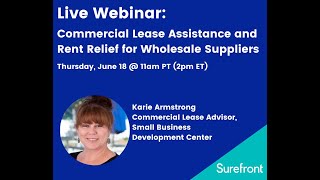
The SureFront weekly webinar, hosted by Director of Marketing Dylan Lowe, featured retail leasing specialist Carrie Armstrong (SBDC advisor) and SureFront Director of Product Doug Heckman. The session addressed how suppliers, showrooms, and sales reps can navigate commercial lease challenges during the COVID‑19 pandemic. Carrie explained rent‑relief concepts—abatement, deferment, percent‑rent in lieu of charges—and emphasized the importance of distinguishing needs from wants, maintaining transparency, and understanding the landlord’s business perspective. She provided a step‑by‑step rent‑relief calculator, sample Excel worksheets, and a template letter to negotiate with landlords, illustrating how to calculate occupancy cost percentages and propose deferments or percent‑rent arrangements. The webinar also covered federal and state financial assistance programs (EIDL, PPP, CARES Act grants, California iBank funding), how to apply, and typical timelines. Doug demonstrated SureFront’s virtual showroom platform, showing how to catalog products, bulk‑import items, and share interactive virtual showrooms with customers, offering a free sign‑up for attendees. The Q&A addressed practical concerns such as personal guarantees, force‑majeure applicability, collective tenant negotiations, and legal steps when landlords are unresponsive. Throughout, the presenters encouraged attendees to leverage free SBDC consulting, use the provided calculators and templates, and adopt virtual showroom tools to sustain sales while physical showrooms remain limited.
Chapters
Yes, we can.
Okay, great. Well, welcome to SureFront's weekly webinar series at 11 AM Pacific. I'm your host, Dylan Lowe, the Director of Marketing at SureFront. And for those of you who are new to this webinar series and are not familiar with us, SureFront is an all-in-one app built for suppliers, showrooms, and sales reps with a patented immersive collaboration technology. And that allows you to do a variety of things, including one that we find one of the most important for suppliers, which is giving you the ability and your sales reps to create virtual showrooms and showcase their product lines to retailers anywhere at any time. And we hold these webinars every other Thursday at 11 AM Pacific to provide valuable information to our retail community to help them get through this crazy time we're all experiencing. So today we're discussing commercial lease assistance and rent relief, which I know is applicable to many suppliers and sellers attending this webinar from our various Market Centers around the country, including Minneapolis, Atlanta, Dallas, Las Vegas, Los Angeles. I will also have a Q&A at the end, so please start asking any questions now in the Q&A icon at the bottom of your screen. And in addition to these webinars to help our community during this trying time, we're also providing a limited number of free seats on a first-come, first-served basis for the virtual showroom app provided by SureFront. And that's to all attendees attending this webinar today. So please look out for that email afterwards. We're trying to do everything we can to help our community during this time. We're also going to give a brief 3 to 5 minute demo of that Virtual Showroom App around the middle of this webinar. And our panelists today are Doug Heckman, SureFront's very talented Director of Product, and Carrie Armstrong, who has over 25 years of experience in helping companies with commercial leases. She's also an advisor with the Small Business Development Center which is sponsored, as you may or may not know, by the SBA, or the Small Business Administration, which is paid for by your tax dollars. So we're very excited to have them both here today. So thank you very much, Carrie and Doug. And Carrie, I will hand it off to you now.
Great. Thank you so much. And thanks for inviting me to be a part of your webinar series. Okay, we're going to go straight to it. So as Dylan said, I spent 25 years actually in the shopping center industry. Managing big malls and taking on rent relief requests. And, and so, as I've been with the SBDC now for 9 years, it's my role to be the retail leasing specialist also and help people figure it out, find new places to move into, negotiate their leases. And during COVID one of the biggest things has been the rent relief discussion. So We're going to go through it, and then I'm going to provide you at the end with actual worksheets that you can use in order to create your own rent relief scenario, along with a letter that you can populate with your own information so that at the end of the day, you can take action. So I think we can all agree that the common goal is for all of us to get our businesses back open safely, obviously. But at some point, we just want to be open, right? And so we can agree that that's a true statement. So we're going to talk about the conversation that needs to happen in order to get there. Rent relief— when you have to have a conversation like this, it can be really, really difficult. It's so emotional, and so everybody wants to avoid it. And we're going to talk about a way that we can all come to the table, sit there, and really make sure that everybody gets hopefully what they need— maybe not what they want, but what they need— and be able to have a productive conversation. So I'm Carrie Armstrong, like he said, and I will be available to you guys if you need to, and you will have a copy of all of this at the end that I think Dylan's gonna send out. So we don't need to talk about that, you already know. So let's talk about the terms of what rent relief really, really means. So when we talk about the word rent relief, it means any kind of help or assistance, right? So any way that they can help, that the landlord and you can come to the table and get you some assistance, that would be rent relief. Abatement is when they forgive a portion of your rent, either all of it or a portion. So abating rent means to get rid of it and you don't ever have to pay it back. Deferment would be that the rent is not required to be paid now, right? Not right this second. But you do need to pay it back at some point over a period of time. Percent rent in lieu of all charges would be the percentage of revenue that you bring in. So if you guys have showrooms, it's not necessarily that you're a retail sales, right, but you do have revenue coming in, orders coming in. So it would be a percent of of your gross revenue coming in that you pay to your landlord in lieu of any other charges. And that's important because then you can maintain your cost of occupancy. We're going to talk about that because it's really important to do that so your margins can be maintained and you have any hope of having any kind of profit to put back into your business. Now, you could do a percent rent in lieu of some charges and then have some of it either deferred or, in some cases, you may be paying base rent and some triple nets or some additional rents. And maybe you pay those, but you get your percent rent coming up against your base rent. So there's a lot of ways to skin the cat, so to speak. And these are the most typical. And we can always think outside the box and get to a different solution if that needs to happen for you. So let's talk about the things that we need to remember when we talk about the landlord themselves, right? We need to remember that the landlord is actually a business owner too. If there's a fallacy that they're just, you know, moneybags sitting around, kind of like that Donald Duck, you know, cartoon, and they have anything to lose. And, and, but it's not true, right? They are a business owner. Your, your landlord's revenue stream is actually your rent. Just like you have people that buy from you, you have your customers, you are actually the customer of the landlord. The landlord is not your bank. Got to remember that. And the landlord's not the first stop for help. And a lot of times when I was in the shopping center business, as soon as anything went a little wonky in the world, everybody wanted to come to me for the solution. And, and I wasn't the first stop. They needed to figure out where they were at first. Figure out what they could do and then bring the solution to me, not just the problem. And then you have to remember that there's almost no landlord on the planet that's just going to go ahead and say, oh, by the way, don't worry about it, don't pay me, and it's all good, right? So they want to wait and see what's going to happen so that they're not giving up more than they need to either. And during a crisis like this, just because they're the landlord, that does not mean that they know anything more than you do. They're getting the information real time just like you. So they're not necessarily going to be the subject matter expert on all things COVID, right? So you need to do your research and make sure that you are providing information for yourself. And most importantly, your landlord wants to lease that space. Whether it's you or somebody else, they've got to keep it occupied because that is their livelihood, right? Now let's talk about you, the tenant, right? Rent is usually one of your largest business expenses. And, and sometimes the landlord forgets that. So making sure that you're helping educate your landlord as to what your business model really looks like is super important. They have the genius of being a landlord, but they don't know know your business model. So without your space, there may not be a business, right? So keeping in your space, it could be very, very important to you. And so often with small business owners, your livelihood is at stake, is at stake, you're probably the only source of income maybe for your family, or it's your only personal source of income. And, you know, a tenant— we were seeing all kinds of rent relief requests coming from landlords saying, I want to see your bank accounts, and I want to see all of the things, and I want you to drain down your savings. And, you know, nobody, no tenant wants to deplete we seriously had this request from a landlord on their child's college account in order to maybe pay 3 months of rent and then not know what the backside looked like, right? So, so it's not reasonable to expect that you drain down everything to pay to your landlord. So we need to communicate that well. We know that as a tenant, you want to stay in business. And we know as a tenant, you don't have all the answers either. So when we start to agree on some of these perspectives, right, and they may, may not like them, but as long as we can understand them, we can kind of run around to the other side of the table and get there a little faster instead of staying on our side saying, well, I just want what I want. So a lot of times when I talk to my clients, I said, look, you know, there's a big difference between needs and wants, right? And during a crisis like this, or during, during a negotiation like this, when you really need to get down and dirty and negotiate, getting what you want may not happen. Getting what you need is the goal, right? Because wants are over here, they're extra, they're fluffy, but we need to really focus on needs. So right now landlords want to collect the full rent and you want to pay your full rent, but it probably may not be feasible right now. The landlord wants you to figure out all the solutions and bring it to them, and you want the landlord to do it for you, right? Both of you don't want conflict, right? That's a big thing. Just easygoing, let's get this done. And then nobody wants to have to call their landlord or their lender or anybody above them and say, look, I just can't do this, help me. So, and the landlord doesn't want to do it any more than you guys want to go tell your families, look, I think our business is going under. And so of course, as human beings, we all want to get what we want, right? What we really need— so if you, if you remember that the landlord really needs to maintain occupancy, that's how they value their properties, right? So they need that. That's important for you to remember, because you need to maintain your occupancy costs. It allows you for survival. That right there is where you start the negotiation process, because they don't want— right, what they need is to minimize that rental downtime. They don't want to have to prepare your space for somebody else and be down without rent for 6 months. And you want your landlord to— you need them to have a solution for you. So the landlord has to figure out whether or not you belong there, or they're going to just take your space back. But let's assume that they want you there. So we need to get to that point. And sometimes we have to very clearly and sometimes very strongly say, look, how much downtime do you really want? Do you want me to pay partial rent right now? Or maybe even no rent for 1 or 2 months? And then— or do you want to get no rent for 12 months? Well, you have to figure out how to lease this out during these uncommon times, right? We all need to minimize conflict because right now all of our stress and anxiety level is way over our heads. And so we need to make sure that we can breathe. And the thing is that we all need to really have transparency in this negotiation. So the tenant does not need for the landlord to overreach into all of their emotional business and their bank accounts and their child savings accounts and all this. That's, that's ridiculous, in my opinion, and I'm just me. But, um, But the other thing is that we need to be transparent with the landlord as well. They need that from you because they don't know what's going on in your world. The landlord needs to negotiate terms on their property, you know, that will buy them time also. That's what they need to do. They may have a lender that's being ridiculously difficult as well. So we don't know what's going on over there. We know that you need to keep your business open. And we know that these basic things are what everybody needs. So when we look at what's going on, I'm sure you guys have been, you know, talked to about this so much, and so I'm just going to breeze through it really quickly, but the EIDL loan is out there. If you did not apply for it before, it is back open to non-agriculture. It was closed to only agriculture, and it's now open again. So if you didn't apply for it, get on it. It's a 3.75% interest for 30 years, so, so apply. If you need help with that, the SBDC has a bunch of consultants that can help you do it. All of our services are no cost. Like Dylan said, you've already paid it through your, your taxes. So the PPP, banks are still accepting that loan. That's the Paycheck Protection Plan, and it has been extended out so that it is now instead of 8 weeks, it's now into 24 weeks or the end of the year, whichever comes first, and can be spread 60/40. I need to update that slide. It just happened. Rather than the 75/25 for payroll, if you don't know how to make sure that that gets forgiven or you need to talk that through again come to us, we'll work out— we will help you with your cash flow to make sure that the money that you've gotten, if you've gotten any of these disaster loans, can get you all the way through. Now let's say, for example, you didn't qualify for either one of those. There's— there is money coming out of the state of California through IBank. There's alternative funding that's out there. A lot of, um, business— a lot of cities, counties have now business grants coming out through the CARES Act. So make sure that you plug in with either an advisor with us so we can help you kind of navigate that, or just look on cities' websites through their economic development or ask them. Super important. There's a lot through Orange County. There's things happening up in LA, and it's coming fast and furious. So if you— especially if you didn't qualify for these other things. So I also know, based on what Dylan has said, that SharePoint has some opportunities for you too. So I want to go ahead and turn this back over so that Doug can talk about what he has for you before I go on to show you how to populate these spreadsheets. For sure, Fran, sorry.
Yes, thank you so much, Carrie. Really appreciate that. So Carrie has started discussing some great options for assistance for your business. What I'd like to do is take a moment to share some of the options we have available for you to continue conducting your business during these kind of uncommon times. So I'm going to share my screen and then this will start in just a second. The reality that we know now is, is your buyers and merchants aren't getting on planes and they're not flying to trade shows and they're not coming to your showrooms right now. And even when things start to reopen, it's probably less likely that they're going to go back to doing business the exact same way where they have to put on a mask for 5 hours on an airplane to get to your showroom or to get to a trade show to see what you have available. So we need to be able to adapt and encounter our buyers in the new ways that they're looking to receive the information you have to share with them, which might not mean an in-person interaction anymore. SureFront has a really nice tool for your team to be able to organize the products that you otherwise have in your showroom, to communicate with your team members, and to get those products in front of your buyers' eyes in a way that is much better than a PDF or Excel that your competitors might be using, where your buyers have to go through different thumbnail images. The better experience that you make for your customer at this time, the more likely it is that you're going to be where they choose to give their business. So what I'd like to show right now in SureFront is— this is the catalog option where you can manage your central repository of product data. Um, this is really great. We've been hearing from a lot of our customers that they're using this now instead of having to have their team members access maybe a shared or local drive within their office as their team is working remotely. You can keep your entire team on the same page of the new products that you're putting in here. And it makes it really easy for any of your team members to find the products that they want to get in front of your customers. As you can see, you have really great opportunities to look through high-quality visual images of each of your merchandise. You can drill down into individual item details with more specifics to keep your team on the same page. And then of course, you can use the tools that you're used to, like searching, sorting, filtering, tagging. To find the different products that you want to share with your customers. When you do find a set of products, maybe your new Summer 2020 line or your Spring 2020 line that you want to share with your customers, what Shorefront allows you to do is to take all of this product information that you've, that you've entered in, into Shorefront for your teams, and then quickly, with just a couple clicks of a button, share that with your customers. And this is how you build a virtual showroom to try to replace that in-person showroom interaction that you previously had. All you have to do is select the products you want to share with your customers, pick what customer you want to share that with. And one of the really cool things about SureFront is some of your customers may be on here already, some of them, um, it might be completely new to them. That's okay, you don't have to have already had all of your customers on SureFront. You can enter in, uh, just their email address, and I'll enter in a brand new one for today. And then as soon as you do this, what this is going to do is it's going to create an email to them that will link them directly to that virtual showroom in SureFront. So let me take just a quick second and show you what your customer is going to be able to see. So your customer is going to be receiving this email saying, hey, um, these new products have been shared with you, um, from Doug. In this case, Doug at Fairview. They're going to get this nice beautiful preview of all of these products. And then all they have to do is click on this email, which is going to drop them into your virtual showroom. And I'm going to open this in a new session since I'm already signed in the previous one. Give me a second here for this to load, make sure I'm not signed in still. So they're going to see all of these products that you've just shared with them. Again, um, they have a much easier experience of being able to see product information, which is really a whole lot, uh, more valuable, especially when you put these high-quality images on here. That they're not having to go through and pick through like an Excel line sheet or a PDF line sheet. And then they can come in and they can favorite the items that they like. You're going to be able to see which, which products that they're interacting with on their end. And then on those favorite items, they can select those and request a quotation so that you can get to the point where you're discussing specific quantities and deal terms. It makes it really easy for you to get this product information in front of your supplier, or in front of your retailers and your buyers, without having to have that in-person interaction that we know isn't presently happening. So with that, I do want to mention, like Dylan said, we are offering this at the present time for our webinar attendees currently for a free sign-up so that you can get started on here, put your products in here, and get in front of your customers right away. And with that, I'd like to hit it back over to Carrie to continue talking about some of the assistance options that are available.
Thank you, Doug, and we'll send a link for SureFront after this, a special sign-in link for anybody that's attending this webinar where they can sign up for free. So thank you very much for that demo. It's nice to see a, you know, a COVID, a safe COVID-19 way of still being able to show your products to your customers. So I really appreciate that demo. Carrie, I want to ask you a quick question. So, you know, this is big news with the EIDL loan opening back up, and I, and I think this was what, 24 hours ago, where it opened back up to non-agricultural, so all businesses. And I know that I think probably everybody attending this webinar right now would be surprised by that. Can you remind us how to apply to that again?
Yes, you're gonna go onto the sba.gov website and then /COVID-19. There's a big yellow banner that says the COVID funding, and if we have enough time at the end, I can, I can like walk you through maybe. But you just go sba.gov to the COVID banner and click on that, and it will start taking you through the portal. It's a very easy process to go through the portal and answer the questions. What you need specifically would be your— the number for your 2019 total revenue, your 2019 total expenses, and your cost of goods sold. So make sure that you know those numbers and don't guess at them because it really does affect your ability to get funded.
Which you can get off your tax forms, and if you haven't filed those taxes yet, since I know everybody had an extension to July, you can get those still off of your, you know, preliminary tax forms or draft.
Yeah, and if you get— and it's okay if you get overwhelmed with that, just contact your local SBDC. We have so many people nationwide that can help you. SBDCs are all over the United States, and it's— there's no charge, and there is somebody that can help you in your local area.
There's over 1,400 SBDC centers across the country, something like that. So there's many in every single state. So yeah, just Google SBDC your local area, you'll find someone maybe as amazing as Carrie that can help you, you know, get through this.
I've got great colleagues.
Before you resume, I also want to mention we do have that Q&A button. So anybody can hit that Q&A button and put your questions in there. We're going to be doing a Q&A section at the end of this for anybody that tuned in a little bit after I mentioned that. Um, so yeah, great. And then, you know, I had a question, uh, another before I forget, Carrie, back to negotiating with your landlord. What do you think is the best way? Because I was thinking this whole time, you know, I might be shy to approach my landlord. I might think if I approach them, they're going to want to immediately evict me thinking I can't pay my rent. What do you think is the safest way to approach a landlord? I know everybody has a different relationship with their landlord, but should I just call them on the phone and say, look, I might have difficulty paying my rent? Should I you know, work with a lawyer? Or should I have someone from SBDC contact them? How do I do it?
So at the end of this, we're jumping right into that. So that's a great segue. So the more information that you can give your landlord, the better off you can have that conversation. And if you're allergic to talking to somebody face to face or over the phone, sending them the letter along with the numbers to at least initially start a conversation and really spell out what your needs are and what your business model looks like will get you a lot further than just going and wringing your hands and saying, I think I need help. Because as soon as you say, I think I need, what you need to do is go and say, this is what I need, and here's why, right? Not because of things I can't control, or that I don't know, you can't, we can't get out there in the too far forward, right? We have to deal with what we know right now. So if you had a conversation in March with your landlord, and it didn't go so swimmingly, that's a whole different, that's a whole different planet in March than it is right now. Because now we're living it, right? It's not speculation about what's going forward. It's like what we're living through. And for some of you, You might not have been affected early on, and you may be feeling the dip now when your purchase orders are falling out, right? So maybe you had big orders, and now somebody's backing out of those, and you're sitting on merchandise that you've already, you know, that you're supposed to be routing, and it's got no place to go. It's sitting in a container somewhere. So this could be why now is the time to have a conversation from before. So my pre-done letter will have those places for you to put in your very personal story, and we'll go through that. Right.
Got it. Great.
Okay. All right. So let's get back to it. So the— and I'm not gonna spend a lot of time on this slide. But Mike, the biggest takeaway from this is being open and direct about what you need and spelling it out. Many times people will say, well, I don't want the landlord to know that I got the EIDL because I don't want them thinking I'm going to just pay them. And I said, yeah, but if you've got the EIDL, because then you got it when it was capped at $150,000 and your rent is $10,000 a month, you're not— and you're burn rate is $7,000 a month out of your— just for your regular business, it would be unreasonable for the landlord to think you're going to use all of that only for rent, right? That would only get you 15 months worth of rent or 10 months worth of rent. And that's not what it's for. So that's where we come in as consultants, where we can help you cash flow your future business to understand how you would spend down that money. But with that said, you also need to make your landlord whole on the backside when you can. I've had some people— I've got a guy, he got $500,000 on his EIDL. It was before they got capped. And, and he's like, why don't I pay my landlord? And I said, well, hold on a minute, you've got enough money there to get you through 55 months of expenses. Why would you not pay your landlord? That's not okay. You're a bad human if you don't do that, right? If you do that and just kind of stick your landlord. So if you can pay and you're making money, then do it. But being direct and open. And you know, the biggest other takeaway is talk to people that can actually do something for you. Talking to your neighbor about your rent issues isn't going to help you. Right? And talking to the wrong type of attorney isn't going to help you. You need to go back to your accountant, make sure you know your numbers, talk with your consultant, talk with the attorney if you need to once it gets to that point, and speak to your landlord. If they're dodging you and playing ostrich with you, then that's a different story. And you're going to need to put them in default for being unresponsive. But that's a whole nother thing. So let's keep moving here. Because what we're going to do now Oh, the other— the last thing is to remember things are changing fluidly, right? Every 15 seconds, it's a new bit of information. You need to act quickly. There are some people that are like, well, I just kind of wanted to wait and see if something was going to change. And it's like, well, the only thing that's going to change is that you're still going to not be in your showroom, and you're still going to be owing rent. And so that didn't change. So you need to get in front of this. This is not the time to be meek. This is the time to be professional and upfront about what you need and want and just act on it and stay focused on actually what you can control. We can't— we don't know if we're gonna have another shutdown. We don't know any of that. And I always tell people, like, my crystal ball looks more like a snow globe, right? I just, I don't know. It's fuzzy. I can't tell. But so let's not hyperfocus on that. So let's calculate this together, okay? Let's take a look at this handy-dandy, super easy— I say super easy— calculator. Now, it's Barney style down here, right? I've given you step-by-step understanding of how you're gonna calculate it down here. Step 1, step 2, step 3, you just go through it. And you can probably take this to one of your consultants at an SBDC, and they can probably help you with it. Or if they look at it and say, oh doggy, I don't even know what she's talking about, your SBDC consultant can contact me for a little tutorial also. So especially for those of you that aren't in California, because I can't always take on hundreds of new clients, but I am here to help if at all possible. So I'm going to walk you through this really quick.
We're sharing this calculator afterwards too. So I just want to remind people.
Yes. Yes. So super quick. Let's say that your, your last year's sales, just for sake of this, were $30,000 a month. Now you're going to put your actual ones in here, right? So you're going to just drag that out. And we're going to take 2019. And we're going to replicate them time, you know, twice over because we want to put this calculator clear out to the end of 2021. It's really important that we do that. Then let's say over here that your rent, all in, all of your, your base rent and your triple nets and everything that you're paying the landlord, not your overhead, but to your landlord, is $3,200. I'm just making this up, have no idea if it resonates with anybody, but I'm just going to show you the math. So let's pull that off. If you have a rent escalation, don't forget to calculate that in there. You know, at some point when it goes up, just drop that new number in there. The best you can. Alright, so then we're gonna come down here and we're gonna say, alright, for those— for actual 2020, January 2020, we were on fire. I can't tell you how many people were like, oh my gosh, 2020 was looking to be the best year ever. We were just killing it in the beginning. And so let's pretend that that's the case. We did 35 there, we did 37 there. And for some of you, if you were getting supplies out of Asia, you might have already started to fall off in February. And that's an important thing to relate to the landlord as well. So March, for the majority of the world, we all got put on timeout mid-March. And so, whoa, Nelly, there it goes, and it starts dropping. And then all of a sudden, maybe you're fulfilling some orders, but not a lot. And it's, you know, here we go. And it's a bad, bad spin. What we're looking for here, this percent of occupancy right here, Your cost of occupancy is the, is the relationship of your revenue coming in and all of your rent going out. And in a typical scenario, we would like to see it less than 10%, 10% or less. Now for you guys that are wholesalers and you're in your, in your very specific niche, that percentage may be different, but we want to see what you are used to living and surviving at. So if your cost of occupancy might have been 17%, it might have been 5%, it might have been 3%. We want to know that, right? So when we go into the landlord, we're going to argue that we need to get back to this percentage, right? We can't live at this because you've got— if you're marking up and you're only able to because you're wholesaling. So if your cost of goods sold is 50% or 48%, right, and your labor is 10% or 20% or 30% in there, your rent can't be much more than 10% either, or you have zero profit left over. So knowing your business model we need to communicate that back to your landlord, because that's part of educating them on understanding why you need help. So if we're coming in here, now, this is last year. So we know that you can get to $30,000, assuming that the world is back and happy. So we're, we're going to look at this, it will— we already know what May is, and maybe May dropped down to the $3,000. It was 10% because it was just a nosedive, everybody cut off their, their purchase orders. Back here in June, we saw a little bit of an uptick because we saw retail that was starting to open back up. And so your, your clients were asking for a little bit more and maybe it starts to grow here. We don't, we don't know right here. And I don't know what your business looks like yet, but I would sit with you or your, your consultant should be able to sit with you and really look at units out the door and what you have in the pipeline to understand what that should look like going forward. Because we want to, we're playing horseshoes and hand grenades here. We want to get close. It doesn't have to be a bullseye, but we have to understand at what point— because see, you're down in the valley of death here, right? You've got 100% occupancy costs, and we don't— we can't live there. So if we're looking here and we see this is where the crash and burn really was, this is where we would ask for deferrals, right? So we would say, okay, let's go ahead and defer this because this is where we can't live. Right, we can't make it, we're going to go ahead and line that out, zero that out. And then we're going to pay it back over 24 months, because it's $12,000. So if you only do it over 12 months, that's an extra $1,000, you might not be able to get there from here. But if we do it over 24 months, and we're going to ask the landlord to consider 24, they may tell you 12, and then we're gonna have to figure out how to either use your disaster loan to help pay that down, or give you some runway at least, right? To get, get going with better sales. So here we see, right, even if you're paying this down, if we're looking at line row, row 6 right here, that extra $533 a month, you can see that your cost of occupancy is tolerable, hopefully, right? That's what we're looking for. Can it be tolerable until you can get back to a sales level that really is comfortable for you? So that's one thing that's called a simple deferment. And I'm going to rush a little bit because I know we have a time issue. But the other one would be a percent rent in lieu. Remember, we talked about that. So let's put your— repopulate back here. And let's say you're normally running at 10%. That's occupancy to sales. But because of all of this, 10% isn't going to get the landlord anything. And he's going to say, well, you need to struggle a little bit too. So we're going to offer 15% of revenue or whatever that looks like. We're gonna look at your business model and get close to that. And if we offered 15%, right, during this rugged period, this is what you would be paying your landlord. And so the model is that you would pay the 15% in lieu of all charges, or your lease stated rent, whichever is less, right? So you can see here that November, based on our projections, the landlord could expect to see full rent back in November. Right? So then the landlord can say, okay, I like this, or I like this. I've got some clients where their rent is so extraordinary that it doesn't matter how long we defer it, they can never pay it back. Or maybe they don't have enough term on their lease. And so we need to— which you could just do a promissory note over time, but nobody wants to be on the hook for the next 5 years paying back rent where they're not using the space, right? So this may be your really only alternative. Or there could be something where you're deferring half of this and paying half. And we, we have to come up with that and we do that by sitting together. So I know we're ripping through this pretty quickly, but again, you've got all of this. And then— so this is what I was talking about. If we're looking at your cost of goods sold, you're looking at your labor, your occupancy, dump that in there to see where you're at and whether or not you have anything left for insurance, for marketing, to get your business back off the ground. And then the last thing I'll share with you is this rent relief sample. Right. Oh, I've got it up. Hold on. Pull it over. I love dual screens. I don't know about you guys. So this rent relief sample is everything that's in yellow. You're going to go ahead and put your information in here. And this is— so this is back to your point, Dylan, is how do we address this? So, you know, you state your case, you put what kind of business you are here, you state what your— how badly you are down, right, and continue to decline, or whatever that true statement is. Here you talk about everything you've tried to do, right, all the things you've tried to do in order to kind of stop the bleeding, right the boat, do whatever you need to do. Or in, in the case where now you're starting to see a dip that you didn't experience, just be honest about that. Early on we didn't have a dip, we're forecasting a big dip, we're already starting to see it. This is where you put in what kind of funding that you've already been approved for and have gotten, right? And then here, this is a big deal. We need to acknowledge that the lease requires us to pay rent, right? We just need to do that because it stops the fight about, well, you owe me rent. It's like, yeah, yeah, we got that. But what we don't want to do is pay it when it's irresponsible and going to take us out, right? What we want to do is pay it as we can with some, with some reasonableness behind it. This is where your recovery plan goes. Look, we're using, we're using everything that we possibly can in order to market our business to get back out there. We're using Surefront in order to, you know, put ourselves out there digitally so people can still, even though they don't, they can't come in, we're doing X, Y, and Z. And this is how we think it's coming. And here are the industry trends that we're hearing. That's what you would do here. Now, if in this part, all you're doing is giving up, then the landlord is probably gonna say, you know what, I don't think I'm gonna help you because I don't see you helping yourself. So you really need to talk about how you're gonna help yourself. If they've already sent you a proposal in the past, you could thank them for that and then say, look, it's not enough, maybe we need to keep extending it or do something else. You can send your two scenarios or one scenario, and you tighten this down, this language down here. We can help you tighten that down. And then you send this off, right? The other thing that happens is is it's not always the best idea to lump in all of your past grievances with the landlord in a rent relief conversation. That should be a default letter to the landlord saying, hey dude, you're not playing by the rules of the lease over here. But that does not negate the fact that you have to pay rent. So as long as you have rent that's not paid, you're technically in default. And we don't want to leave you in that position. We want an amendment that gets you out of that default position quickly. So you want it in an amendment as soon as you have an amendment giving you the ability to do whatever it is you need to do. You're no longer in default, and now you have leverage back on your side of the table to get other things that you need and want. So I'm going to stop there. I know we did like a marathon sprint through that, and then go to questions.
That's great.
Thank you so much. Really appreciate that, Carrie. That's very helpful. I know that one of our marks that is tuning in actually just had like a very long battle with their landlord, I think that lasted 4 years with all the showrooms. So now they have to go back and ask for rent forgiveness, which I know is incredibly uncomfortable. But, you know, this letter and that calculator I think will help a lot. We are going to start the Q&A session now. So, you know, if you have any questions, some have already been coming in, please ask it in that little Q&A icon at the bottom of your screen. Carrie, so can you tell us how this has gone in some anecdotal examples? Where they've sent the letter along with the— do they send the calculator, the whole thing? Okay, so they'll show the results of the Excel sheet.
And send it as an Excel, not a PDF, so that the landlord can go in there. We want to do the heavy lifting for the landlord. Because there's some landlords out there that you might think would be sophisticated that really don't know how to figure it out for you. And you need to let them know what your margins really are. It's super important that they understand that because when I was managing shopping centers, I believed people could survive at 15-17% cost of occupancy, because that's what I learned. And that's what people told me. And some of my clients can't, some of my tenants couldn't, especially small businesses, right? You don't have, you don't have multiple locations to offset that or multiple other revenue streams. So yeah, you definitely need to get that going. So anecdotally, to answer your question, I had, I had a huge win yesterday with one of my clients where they sent this off and the landlord said, look, we had no idea. Right? We had no idea. Thank you for educating us. And we think a path to keep you is let's reduce your rent by 50%. We will forgive— so go back to April, pay April through December at 50%. We will forgive that other, that other 50%. And then in December, we'll look at the scenario and see what we're going to do going forward. That was a savings of $18,000 for him.
Not just deferment, they actually forgave it.
They forgave it because we spelled it out, right? We showed that there was no way he could take that extra. His total rent was about 4 grand. And so they reduced it to 2 grand. And because otherwise, that extra 2 grand coming back over the top would have put him into like, you know, 30% occupancy cost when he's a yoga studio. Right? So the other thing too is making sure that you're really— if you've got a distancing issue, a social distancing issue, you have to spell that out and show pictorially what that does to the ability for people to come in, right? There are people that are getting nowhere with their landlord. There, there was one that they sent it to their landlord, and the landlord called me and said, who are you? And I said, here, let me walk you through it. I'm happy to help you understand what's going on and why. And that landlord actually became a client. So sometimes it's just a function of getting— if you had a conversation in March, it's moved, it's changed so much. Go back to the table. Try not to take it personally.
And as a group, you know, most, most people in this webinar are going to be together with many different showrooms, several hundred in some cases. How about negotiating together?
So I would suggest no, right? So if somebody— if your entire neighborhood showed up at your door with pitchforks and torches blazing to tell you that your dog is barking or that they want you to not put your trash can out so early in the day, I mean, where would that get you, right? Where— how would that play out? So actually, your leases are— you're not a union, first of all, so there's no joint collaboration to negotiate those and your lease probably has something in there that says that these are personal terms for you only and disallows you from collaborative negotiations. So I would be very careful about that. Now, if a landlord is in default, like in the elevator isn't working, and y'all band together and say, hey, we need to do this, or the CAM charges seem to be escalating at 20% year over year, that's not okay. That would be a great conversation for a group because it's affecting everybody universally, but your lease terms, I would not go in. You might get worse deal than if you went in on your own. Be careful about that.
Yeah, back to the EIDL loan, can you just— would you mind quickly just showing us again how to apply for that?
Sure, let me—
as a reminder, it's now open to everybody again, so it's not just agricultural. So I know a lot of people didn't get that loan on the initial application we had that problem with a lot of that loan money going to much larger businesses. So that is now opened up, and I think they're stressing to give that money to small businesses.
So sba.gov, disaster loan, we're gonna go here. So let me back up. So this is— so this is COVID-19. Let me do this. I am going to copy that. And I'm going to put it in the— should I put it in the Q&A or the chat?
And just make sure it says to all attendees. I think it says panelists and attendees. That's the one you want to press.
Got it. All panelists and attendees. There you go. And there's the link. So this is You just start in and you gotta, you gotta click through every single one of these before it'll let you continue. So, so there's your link and have at it.
Your tax forms out, you can finish it extremely fast.
Yeah, tax forms or your, or your P&Ls from— and in some cases it'll ask if you like for your numbers, it might ask through January 31st. So if you have your P&Ls, you can actually build it out. But if you do it just for $19, that would be okay too because it's a, it's a very close guesstimate at that point. Yeah.
Real quick, Doug, I know you had a hard stop in about 6 minutes or so yourself. We had a question come in about SureFront. Can you tell us about how to actually set up your lines and how that works? So how you get your entire catalog digitized on SureFront?
Sure, yeah, um, you do have, uh, I'll share my screen just briefly here and let me get that started. You do have a couple of options if you have just a handful of products you want to add, uh, to your, your catalog so that you can start sharing those with your customers. You can create a brand new product with this form, but what I would encourage you to do if you have a lot of products that you're putting on here, you're just signing up for Shorefront There is a bulk import tool. I'm happy to send out as a follow-up to this webinar some video tutorials of how to use this, but you can import dozens, hundreds, thousands of items and pictures and stuff into Shorefront at one time. And then once they're in your product catalog, you can use all of the nice tools within the catalog to find that merchandise and then share it with your customers. So happy to provide that tutorial as a follow-up resource.
Great. And yeah, we're gonna send an email about that later today, so with that link to sign up. Again, it's free to sign up for all these attendees. We want to try to do everything we can to help you all, so we're gonna send that out in a separate email after this, in addition to the email that we're gonna send out with all of Carrie's information. Carrie, so some more of the questions that are coming— thank you very much, Doug. And Carrie, some more of the questions that are coming in is— here's a rather large one, let me read it out loud. It says, we started negotiating the first week of COVID when everyone was forced home stores to close. However, one of four leases throughout the US, we have a personal guarantee in our lease and the lease just started in January for a 5-year term. So, we feel we have very limited negotiating power here. They've been very good tenants in the building but worry about consequences to their personal finances if they try to walk away. So, what have you just negotiated your lease?
So that happened to a lot of people. I mean, I had some clients that were— that hadn't even opened their doors yet. They'd built out their restaurant or whatever, and then— and the weekend we got shut down was supposed to be their grand opening weekend, or the weekend following. You're dead in the water, right? Walking away from the lease requires legal assistance. So if you have personally guaranteed your lease, they are going to look at not only assets that you have, but future assets that you're capable of getting. So that's it. It's not, it's not undoable, not, not doable, right? You can if there's the right reasons to be doing it. However, just because you just started the lease, there's some value to you. You're the, you're the customer of that landlord for the next 5 years. So the conversation needs to go, hey, how do you want to, how do you want to be married through this next 5 years? Do you want to be at each other's throats? Or can can you help me get some runway here in order to survive this? We just opened up. And I would use performance at other locations in order to fill out that rent relief. Like, our capacity to do numbers is X, and if we have the ability to, and this is what we're gonna try to do, and we need assistance in order to get there. If you're brand new, they may be able to just say, look, you know, take 2 more months of free rent or whatever. But you never have less power. I think the thing that creates less power is when you're rude, obnoxious, and not transparent. And if you're coming at it— and that doesn't mean that there aren't knucklehead landlords, you know, 2% of the entire population is going to be a knucklehead. So that includes landlords, right? But, but, but you need to start and you just need to keep stating your case. And like I said, March is a long time ago.
Yeah, I mean, most of the— we should recognize that landlords are also scared that they're going to lose all their tenants. They may have, you know, a group they answer to as well, or board of directors if they're a large organization, you know. So their tenant occupancy rates are what allow them to keep their jobs in most cases.
So, and if you're getting— yeah, and if you're getting weird, weird responses from people, it's fear-based. Under— if you can understand that it's not personal, it's fear. And it doesn't mean that you have to accept it, but say, okay, they're really afraid. That's why they're not answering. That's not why they're not saying yes to me. But if you can give them a really good packet to send up to their senior management, then the opportunity for them to forward your concise packet is way better than some property management on-site person thinking, I don't want to take one more request to my senior VP of asset management, he's gonna take my hat off, right? Because I don't know what to say. So that's why we want to do the heavy lifting.
If you're coming with good faith, I imagine that's— that gives you the best chance of of negotiating this too. Also, you know, something I almost forgot, which is on the PPP, I think another important thing to mention to people is, yes, 25% of that is meant for rent or other expenses, but you can use all of your PPP loan if you want. You just have to pay a 1% interest rate as a loan over the course of, what, 2 years, and the first 6 months are forgiven.
It's changed now. So it's a 60/40 split where 60% for the forgiveness factor. It just changed. So 60/40 payroll and then other. But to your point, and it's now 5, 6 years, I think. So they— so it's still 1%. So if, if that really needs to be a loan because you need to not just waste it on employees that can't come back right now, right? And you consciously— part of it could get forgiven and the other part maybe doesn't get forgiven, but that's really good terms. For a loan, right, is 1% for 6 years. Now, or 5 years. Sorry, there's something like that. Be prepared, though, to keep all of your documentation for another 6 years past that for audit purposes. They are, they're really investigating fraud. This is not to go purchase a new second vacation home or a house or a car or, or, or, right, it really is about labor costs. And it is about It is about your rent and your utilities and such, so on and so forth. The EIDL loan cannot be used to go open another showroom either, right? It's— this is about current costs, not about expansion. So make sure you read your loan documents very carefully. Make sure you read the parameters. And if you're unclear, most SBDCs are holding webinars on all kinds of— on all of this all the time. We— every day at 3 o'clock, we're doing one out of Orange County. So so that people can be up to speed.
Right. Another person asked, do you know anything about the California Bill 939 to force landlords to table or tenant can walk away from the lease?
So that's in its third or fourth or 75th iteration. I don't know how many rounds they're at right now. It was in front of the Judiciary Committee for the state. It was in conflict significantly with contract law. Whether or not that passes, it'll be interesting to see. I don't disagree that there needs to be teeth to bring people reasonably to the negotiating table. And with that said, the way it was originally written when I read it was way too soft for people to just break contracts and leave. Because the bottom line is we're not trying to crush the commercial leasing activity in the country, right? That would really take the economy out too. So I think that there needs to be a lot of effort put towards getting to a common ground that's reasonable and then going forward. So we'll see if that happens, but at this point it's still got a ways to go.
And another question, that's a good question, said, I'm assuming there are many or several of us negotiating with the same landlord. Is it wise to use the same form letter knowing the landlord could get duplicate letters?
So I have a lot of people that— the landlords are starting to recognize the letters. The thing is that it's not the same because you're putting your own story in there. You're putting your own margins, you're putting your own details, you're putting your own recovery plan in there. And so even though the boilerplate— I mean, heck, we've seen the same COVID letter from everybody over and over again, right, of the form that came out of, and we're closed, and this and that. So the letter itself, I wrote that letter based on rent relief packages that I would have approved. And those, those calculators were also written by me way back in the day that I just changed for purposes of going forward in this time of rent relief packages that I had to put together in order to upstream to senior management. And like the deferment and that in lieu, there are big landlords in the Los Angeles, Orange County area that that is what they are doing, right? Those are the terms that they're putting out to you. So people are— they're reasonable. The letter is very— says what it says very, very reasonably, and it's important that those things are in there. And then you add your story. So it would be okay. They're gonna look at it, go, oh look, they're getting some— they might even think, oh, they're getting some legal help. Oops, let me look at this a little tighter.
Right. And to that point, someone asked, you know, what if the landlord doesn't respond? But But I would imagine this is probably the best way to get them to actually to the negotiating table. But what if they don't? What if they refuse to even answer this email or letter?
Yeah. And those are the unfortunate ones, right? Because you're like, apparently I don't— I'm not of value to you. That's what you start feeling personally, right? And hopefully it gets them to the table. Hopefully silence sometimes means fear and overwhelm. And so you just keep following up over and over and over again. Hey, I really need to get to the table with you on this. We need to do something. If you have moratoriums in your area, either citywide, statewide, countywide, make sure that you are well versed in that as well so that you can, you can speak to that if you need to. And at some point, you might have to get an attorney involved if you really need to.
Got it. Another question says, it appears most commercial lease companies such as the Market Centers for wholesalers have lease structure to prevent use of force majeure, and this includes locations inside closed buildings. So is force majeure not applicable to having building closed for 6+ weeks?
We haven't been able to get anywhere with force majeure currently because it— the fight is that the virus, that the virus is the issue, not the closure by the government, and that's, that's the fight that's happening. Most states are having that conversation. I know California is, in order to say, wait a second, you should be able to do— just like business interruption insurance is being declined, make sure you file that no matter what, even though you're gonna get a decline, so that if later it gets rectified, you have a seat at that table. But force majeure is not coming in because most clauses, the force majeure says that it can stop all other issues of the lease performance of the lease except the payment of rent. So there, there you go. So it still says you got to pay the rent.
Okay, and then back to SBA approval, how long does it typically— I know this is really hard to answer because I know some people that still haven't gotten funds, some people got approved immediately, but what have you seen on average where, you know, after applying, how long typically takes to get funds in the bank?
From— for the SBA, for the EIDL loan, your guess is as good as mine. It's It's accelerating. Most of the people that I'm working with now have either been declined or are getting their portal invitation to set up and accept. The PPP goes quickly, and I would suggest going to smaller community banks rather than the big ones because the big ones are overextended with their other loans out there. And I've had people on the PPP that have been funded within 2 days, so, when they walked into a small community bank. The EIDL, you know, you can expect a couple weeks.
LA Lakers got approved in what, 48 hours? So some of the people that actually need the money took, you know, months.
The good news is, yeah, the good news is those people are giving it back. And that's one of the other reasons why the EIDL got opened back up is as they see that there's more funds available, they'll keep opening it back up. And that's why the PPP hasn't reclosed because they funded it pretty significantly. And now— oh, go ahead.
Try to adjust the way that, you know, they were treating small businesses before because they were obviously giving preference to, you know, much larger businesses.
Yeah, I think there— I think it was the intention of getting things out quickly might have maybe kept people from doing their due diligence on how to roll it out, and so the unintended consequences bubbled up pretty quickly.
Right, okay. Another one that says, what about bringing up the business loss during COVID-19 that cannot be recovered? Covered by the tenant. That's a good point. You know, what if, you know, what if they think that a section of their business or a segment of their business is going to be gone forever?
Well, that's one of the things, interestingly, is that we're working with our clients a lot on a recovery plan because there may be sectors that you have to pivot from that are never going to come back and revenue streams that are never going to come back. And so what does that look like? I've got you know, I've got fitness classes and Gymboree classes where you could usually put 18 people in a room, and now you can put 6. So that is not going to change for the next foreseeable future. So what does that look like? So in those extreme cases, there may be the need for a complete renegotiation of the base rent to get back down to a more doable rent. And if you are, you can always offer up— if you think that, like, look, I I don't know that I can continue to do this. As long as you're on some kind of a rent relief, let, let your landlord know, look, I would be amenable to a 60-day notice to vacate if you can find somebody to pay market rent and get me out of my lease. You know, there could be that too. So there's, there's a lot of nuances there. But I would strongly suggest that you put it pen to paper, or Excel, you know, type it in and, and look at your new I do forecasting workshops too, but your SBDC— there should be somebody through your SBDC that is good at forecasting that can help you look at revenue streams, projections, cost of goods sold, especially depending on whether or not— there's some people that can't get stuff out of certain countries anymore, right? So what are we going to do? How are we going to pivot?
How do we find our local SBDC center again?
Say that again?
How do they find their local SBDC center?
So all you need to do is Google Small Business Development Center or SBDC, and/or you go to the SBA and there will be a link. You can go to the ASBDC site also, America's SBDC, and put in your zip code. It'll come up. It's just that easy there. And if you are—
if—
well, right now we're all virtual, so that makes it really easy. But you need to become a member, a client, and then from there, and that's There's no charge to that, and then you start working with them. But you can be an SBDC client anywhere on the planet. So if you feel like maybe you're living in a place where— and that SBDC office can't service you, you can, you can go anyplace else. It's best to stay in your state though because of certain, certain rules and regulations statewide, right?
Covered by their tax dollars. So, you know, take advantage of it because, you know, someone else will if you don't.
Absolutely. And here in California, we've got the SBA backs us and pays through or supplies the grant money, and as does the state of California. So we all get paid. We all get paid through the grant. We're paid employees and not like some other places might have volunteers, but we're working.
So that's great.
And we want to help. That's what we do. And we don't just do disaster stuff. We do— we help people start, we help people sell their business, buy a business, marketing specialists.
Yeah, that's great. Last question was, uh, can you move to a different showroom if you have the EIDL? Uh, do you have to get permission? I think that also depends on if they have to technically add this cost or start a new lease or something along those lines. But as my understanding is, this is for pre-existing costs is what PPP loans and EIDL loans are for.
Yeah, it's not intended for— it's not intended for expansion. Now, if I would, I would look at that loan doc really carefully, because if you lost your lease in one place, and then needed to reopen in another because you lost your lease, that wouldn't be expansion. That's just recovery, perhaps. But I don't have a definitive answer on that. But what it's not intended to do is for you to start growing your your dynasty, so to speak. It's to pay off the existing stuff, and it's not intended to pay off old loans either.
Yeah, yeah, perfect. Well, on that note, the last thing— someone said, this is excellent info. I wish I had seen you many months ago. Very informative. Well done. Thank you. So with that, Carrie, thank you too. This was great. I know this is, you know, I— we always try to give something actionable you know, that, that our webinar attendees can use. This has probably been one of the most actionable things that we've ever given, provided by you. So I really appreciate that. We will share that calculator after this. Look for 2 emails coming to you, everyone. One will say follow-up email, and that'll have all of Kerry's information in there. So we'll also have a blog in there as well that we're going to write today. About this. We'll have that calculator in there, this webinar recording as well, and then we'll send another email that will be a signup email for a free signup link to Sure Front's virtual showroom. Since the other, you know, trouble is, you know, people aren't visiting showrooms right now, and for those that have just reopened, getting people to the showrooms is very difficult. And there's, and there's many that still haven't opened, so we're trying to do everything we can to help people stay in business and help our community. So Kerry, thank you so much. Really appreciate it. That's great stuff. Thank you for putting that all together. And, you know, thank you to the SBDC for continuing to provide great services to everybody. And thanks for everybody attending.
My pleasure. Good luck to everybody. Stay safe and let's get back to business.
Thank you.
More from Luke









THE COMPLETE GUIDE TO PLM IMPLEMENTATION I PART 1: SHOULD YOU INVEST IN PLM SOFTWARE? (4K UHD)

THE COMPLETE GUIDE TO IMPLEMENTATION I PART 2: HOW TO PURCHASE THE BEST PLM SOFTWARE (4K UHD)

THE COMPLETE GUIDE TO PLM IMPLEMENTATION I PART 3: HOW TO IMPLEMENT PLM SOFTWARE (4K UHD)