How to Obtain Forgiveness for PPP Loan - Live Webinar (5-12-20)
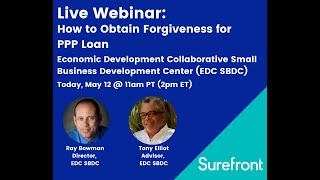
The webinar, hosted by SureFront moderator Dylan and featuring Small Business Development Center advisors Tony Elliott (CPA) and Ray Bowman, provides a comprehensive walkthrough of the Paycheck Protection Program (PPP) loan forgiveness process and the Economic Injury Disaster Loan (EIDL) program. It outlines the core PPP forgiveness requirements—75% of funds must be used for payroll, the remaining 25% for mortgage interest, rent, and utilities, and the need to maintain full‑time‑equivalent (FTE) headcount during the 8‑week covered period. The presenters explain best‑practice checklists: submitting written forgiveness requests to lenders, keeping detailed documentation (bank statements, payroll reports, 941s, utility bills), using a dedicated account for PPP disbursements, and coordinating timing of loan funding with payroll cycles. They contrast PPP with EIDL (direct SBA application, longer terms, a $10,000 grant component, and prohibitions on using EIDL funds for payroll during the PPP 8‑week window). Throughout a live Q&A, they address specific borrower scenarios—pre‑funding contributions, bonuses, home‑office interest, utilities, health insurance, unemployment benefits, and post‑period layoffs—emphasizing that many nuances depend on lender‑specific guidance and evolving SBA rules. The session also promotes SureFront’s free‑trial software for virtual showrooms and sales collaboration. The webinar concludes with promises of follow‑up materials and future sessions.
Chapters
And we are okay. Okay, great. We're going to go ahead and get started. Uh, again, sorry for the slight delay there in the beginning, but glad everybody is on. Um, we are going to do about a 30-minute webinar here and then have a 10 to 15 minute Q&A. We've had a lot of questions come in already for this. A lot of people excited about this webinar as it helps to answer a lot of the questions they have already on EIDL and PPP loans. So on that Q&A session that we'll have, you know, please start typing in your questions now into the Q&A little box you can see at the bottom of your screen. There's also a chat box at the bottom. Don't use that one, just use the Q&A one. And then at the end of this webinar, we'll go through all those questions there. So thank you very much. And I want to talk a little bit about SureFront before we start as well. As, as most people know and have tuned into our webinars, these are sponsored by SureFront. We're happy to host all these webinars for our supplier and retailer community to help them get through this crisis in these difficult times. And we've also extended for anybody that registers for these webinars our free trial on SureFront software as well. So you get 3 months of free SureFront software, which we hope that helps everybody with. And for those of you that don't know, SureFront is an all-in-one app built for showrooms and sales reps. It helps with a variety of challenges day-to-day being a supplier or retailer. Helps with creating virtual showrooms to showcase your product lines, your customers, which could be retailers. Allows you to do this anywhere, anytime, because everything is in the cloud. Also allows you to collaborate and chat with retailers on quotations, buying programs, purchase orders, and you never have to leave the app to do these things. So whereas you normally have to communicate to your buyers over email, Excel spreadsheets, image attachments, PDFs, all of that is done in the SureFront app. So it's a pretty incredible piece of technology. So take advantage of that. You just click on the sign-up button on our website. It's at the top right. There's another one at the bottom left, another one at the bottom. So Get in there, it gives you a little tutorial. If you have any questions, send them over to us. You can email support@surefront.com or me directly, Dylan, D-Y-L-A-N, @surefront.com. But it's a quick tutorial that's already automated, teaches you how to use SureFront and get your virtual catalog up immediately. Because I know the biggest challenge for a lot of suppliers right now is, how do I show my product to buyers? Obviously, this is no longer a tangible process. We're no longer physically meeting with people. So this is the way to do that instantly and very quickly. So take advantage of that. Also take advantage of our two panelists today, which are awesome. They did our first two webinars on this subject for the PPP loans and also the EIDL loans. They helped us inspire a number of videos that we posted to our YouTube channel, so check those out as well. Both Ray Bowman and Tony Elliott come from the Small Business Development Center Now that is sponsored by the SBA. So if you remember, Congress set aside a large amount of funds— uh, Tony, Ray, you might be able to speak to the exact number of those— for these Small Business Development Centers to help you guys. So, uh, take advantage of those taxpayer dollars that are being used to provide you free programs. And again, if— when you follow up, I hope you do, with both Ray and Tony afterwards, and we'll tell you how to, uh, get up on their program and start using them as a resource. This is all free. This is all included in what Congress recently allowed for everybody to help with this stimulus. So they're not trying to sell you on anything. Neither are we. These are all free programs to help our suppliers. So without further ado, I'm going to give the presentation over to Tony. I'm going to control the PowerPoint here. So let me move over to that. And help Tony flip slides here. So let me go into presentation mode. And can you guys see that? Can you see my screen now?
Yes. And Ray. Great.
Awesome.
So Tony, I will hand it over to you. I will stop talking and mute my end. And you tell me when to flip slides and I'll go ahead and do that.
Okay. Thank you, Bill and Ray. Will you proceed with the intro?
Yes. So hello everyone, I'm glad you could be here and it was great to have an invite to come back. My name is Ray Bowman. I'm the Director of the Small Business Development Center. I'm part of the Los Angeles network of Small Business Development Centers. So as Dylan mentioned, the Small Business Development Center Program is a program sponsored by the Small Business Administration of the U.S. There's over 1,000 service centers around the country, so I, I direct one of those 1,000. In the LA network, there's 9 centers, and I represent Ventura and Santa Barbara counties. I also head up all of our international trade import/export work throughout the LA network. Because of this crisis is so vital, we don't want to turn away anyone because you're not in our area. So all of the SBDCs around the country have just opened themselves up to taking calls from anyone and everyone. So there's, there's no wrong destination when you seek out an SBDC. So our center can meet your needs wherever you are. If you want to use a local center, that's great. If you want to use us, that's great too. So we're here to help you. As Dylan said, our tax dollars are directed, and what we do is we're not the lending side of SBA, we're the technical assistance side. So I have a group of advisors. They're all paid advisors, and what their job is, is to help guide you through a whole variety of different types of business topics. So marketing, you know, finance, pricing, lean manufacturing, marketing, e-commerce. So we're here for— we're here as a resource for you. So if you could go through the next two slides and go to Tony's bio. So Tony Elliott, he's one of our advisors. He's been with us for quite a few years now, I think since 2015. Tony is a CPA by trade, so he's, he's done a lot of work, especially in the area of forensic auditing, as well as helping clients with loan packaging. And during this crisis, where we've literally talked to thousands of clients who have applied for either EIDL loans, PPP loans, or other types of assistance, Tony's a great resource to have because he's literally worked with hundreds and hundreds of clients through, through this particular crisis that we're having. So I'm going to leave it for Tony to overview these programs and hope you enjoy the presentation.
Tony, thank you, Ray, for the intro and going to the particular And let's see, let's advance to the next screen, please.
Great. Tony, if you can use a— move a little closer to your mic too, it sounds a little distant.
Okay, is this better?
That's a bit better.
Okay, let's see the preview. Just go back one, please. Thank you. Okay, so the key topics that are going to be covered in today's webinar is how to ensure you're in compliance with PPP guidelines, spending your EIDL and PPP funds properly, and not yet approved, what's the next step. Just, um, a note. Please note that the SBA is— additional guidance is needed from the SBA in order to evaluate the full impact of PPP loan forgiveness. I want to make that statement. And Dylan, let's advance to the next screen, please. Thank you. General information, general requirements of PPP loan PPP loan forgiveness. The end goal of PPP loan program is about employee retention. PPP provides small business owners with access to forgivable loan product equal to, let's say, 2.5 months of your average payroll. Based on 2019. PPP proceeds can be used for payroll costs including benefits, interest on business mortgages, rent, and utilities. And we'll call what these categories of expense, we're going to refer to as covered costs. To qualify for forgiveness, the covered, covered cost disbursements must be made within 8 weeks of the lender's funding date. PPP will be forgiven provided that 75% of the loan amount is used for payroll costs and not more than 25% is used for non-payroll costs. Non-payroll costs being the interest on mortgage, rent, and utilities. Those limitations— to achieve full PPP forgiveness, the business owner must rehire or replace furloughed employees before June 30, 2020. That's it. That's based on the current SBA SBA guidelines. There have been changes in the SBA guidelines from time to time, so you'll need to be informed and, and review current updates from the SBA and the U.S. Treasury. The CARES Act ties of full loan forgiveness to the business owner's FTE, and FTE stands for full-time equivalent, so FTE employee counts, count and payroll costs during the 8-week period of compared to historical averages. And on the next screen, Dylan, please. Reductions in headcount or payroll costs during the 8-week loan disbursement period may impact PPP forgiveness. And the business owner, during that time period, the business owner must maintain FTE headcount and payroll costs during the 8-week disbursement period with historical averages from either the time period February 15th, 2019 through June 30th, 2019, or earlier period of 2020, January 1st through February 29th, 2020. To add this note, additional guidance from SBA is needed in order to evaluate the full impact of these reductions on PPP forgiveness. I'm going to add that to date the SBA has not published complete guidelines related to forgiveness. Business owners should consult consult with their lenders for further guidance. It's very important for the business owners, for those business owners having received PPP loan funding, that they need to consult with their, their lender to get full and complete guidance and instructions related to the PPP forgiveness process. Within 60 days after the 8-week period, you will communicate with your lender and go through a review process where you— it's requested that you provide your lender with certain documents for a review process to determine the dollar amount of PPP loan forgiveness. The entire dollar value of the PPP loan, if, if, let's be clear, the entire amount potentially may not be fully forgiven and a portion of that amount may be forgiven. And so there are various options and, and it's important for you to coordinate and discuss and have detailed dialogue with your lender as you're navigating through that process. I just wanted to take some time to emphasize that. If any portion of the loan amount is not forgiven, repayment is based on a 1% interest rate over a 2-year period. The first— there's a deferral on, on the principal amount for the first 6 months, and, uh, but the loan period itself is over a 2-year period. And Dylan, if we could advance to the next screen, please. Thank you. Okay, so how, um, here's a list of, of possible items, uh, checklists of best practices and considerations during the PPP loan forgiveness process. Business owners are encouraged to develop pre- and post-funding action plan with the goal of maximizing loan forgiveness. Start with submitting a written request by email to your lender requesting a complete loan forgiveness guidelines. That is so important, and during this time period, your main communication source with your lenders is through email, not through your relationship manager at your bank, but it's a separate unit of your lenders operations handling the PPP loan process, and business owners over the past, in the past, have expressed various challenges they're having with communicating with their lenders. It's very important to go on record, and the best way to go on record requesting guidance is in written form, and and that would be through email. During this process, consult with your attorney and CPA. Consider whether rehiring to pre-COVID-19 levels is feasible in this process. SBA guidelines require loan funding within 10 days of loan approval. To the extent you're able to, going forward for those business owners who have not received funding, attempt to coordinate with your, your bank to sync the loan funding date possibly with your payroll cycle. Consider dispersing covered expenses, and the covered expenses of course include payroll costs, interest on mortgage, rent, and utilities. Covered expenses for PPP are limited to those 4 categories of expense. Consider dispersing covered expenses through a separate bank account with, with only that, that bank account would be used to, for only PPP forgiveness disbursements. Consider this measure if this is something that works for for you. If you choose not to and deposit the money in your operating account, just make sure that you have— that you bring your accounting team in to provide and accumulate the associated documents to support your PPP expenditures. Now, this is— this subject, the matter of FTAs, FTEs and how it plays a role in the calculation of the PPP forgiveness amount. What you're going to need to do is compile and analyze historical FTE levels between February 15, 2019 to June 30, 2019 and the period January 1, 2020 through February 29, 2020. This is stipulated in the SBA interim rule information that you can access on the SBA website. So, and so it's, you're going to compare these periods with the related FTE counts during the 8-week covered period. The goal is for as much as possible for the FTE count during the 8-week period, if it's in sync or agrees with, as an example, let's say 5 employees during that 8-week period, and January through— of 2020 through February, your FTE count was 5 FTEs, then you're on par and there is no potential reduction in the forgiveness amount. However, if the FTE count during the 8-week period is less than that benchmark period, then there will be a possible— there will be a reduction in the forgivable amount of the loan value. I strongly recommend that you work with your accountants, your CPAs, going through those types of calculations and bring your loan— your lender in into this process as well, requesting additional guidance from them regarding this process because it's not fully stated in SBA and, and U.S. Treasury Department guidelines. So this— they are working, apparently working on additional information of a rollout of additional, additional information in this area. Okay, so, so then remember loan forgiveness will reduce if the FTE count is lower during the covered period. And advance to the next screen, please. Okay, thank you very much, Ellen. Uh, so as part of this best practices list and things to consider during this 8-week time period: monitor and reforecast weekly payroll costs, business rent, mortgage interest, utilities during the covered period. Consult with your accountant and payroll service provider for additional Tips on tracking expenses. Your payroll service provider, say ADP as an example, in their library of reports, can— are able to provide you with your FTE counts during those historical periods. So that's so important. So Good recordkeeping and expense documentation is critical. Uh, the documentation includes, uh, bank statements, canceled checks, payroll summaries, FTE reports, payroll tax filings, 941s and related state forms, invoices and supporting documentation related to your retirement benefit costs, health insurance costs during that 8-week time period. Uh, it's important that you're, you're as part of that, that review process that takes place, uh, more or less 60 days, within 60 days after the 8-week measurement period. It's be good to gather up all of these documents in support of, of your presentation to your lender for PPP loan forgiveness. Again, I think I recommend that you consult and contact your lender requesting additional guidance on this matter. Stay informed by reviewing lender, SBA, and Treasury, Department of Treasury's website content, as well as other documents including interim final rules offered through the SBA that are posted on the Federal Registry, frequent asked questions that And the SBA updates their— and provides information on frequently asked questions by small business owners and posts the questions and answers on their website. That's going to be an important source for gathering additional information to the many questions that small business owners have during this time period. And also keep newspapers and other business publications would be a good source of information. I'm going to caution business owners regarding accepting content provided on the internet. Some of the information at periods in the past, there have been changes and recent changes in SBA guidelines that make— can possibly alter the intent, and, and there's a need to, um, for, uh, to, to be updated regarding, uh, changes offered by the SBA. You may be looking at a webinar that was posted, say, the middle of April, that is no longer relevant, or the data, the information is no longer relevant because of SBA changes. Okay, and let's see, just so that you know, as part of the presentation to the, your lender, the lender is going to require a a statement of certification that the borrower's data and information provided is true and accurate. So keep that in mind. And let's advance to the next screen, please. All right, so that pretty much covers the PPP loan forgiveness process. These are key statements. There, there's more in additional information associated with the PPP loan forgiveness process, and it's going to be important for you to take, take a, a deeper dive into this, into your research and investigation regarding the requirements for PPP loan forgiveness. And keep in mind, the SBA, there are changes and apparent changes taking place to, to this process of So it's so important to keep informed. All right, so in the case that you are— your present situation, you have not applied for PPP or EIDL, just for a couple minutes we're going to take a— I'm going to just recap the PPP program and EIDL program. Here, here's a list of some of the key features to PPP. The interest rate is 1%, the maturity is 2 years, and the first 6 months principal deferment, and it's 100% guaranteed by the loan— it's 100% guaranteed by the SBA. No collateral or personal guarantee, and there are no borrower or lender fees payable. And advance to the next screen, please. Thank you. Okay, and so on, on the EIDL program, the Economic Injury Disaster Loan program, this program you're applying directly to the SBA. On PPP, you're applying and submitting your loan application to an SBA 7(a) lender, and it has been expanded to include non-SBA 7(a) lenders and various organizations including PayPal, Kabbage, and many other loan providers have been added. So, but to emphasize, for the Economic Injury Disaster Loan Program, You're submitting your application directly to the SBA, and it— the— this is a working capital. Okay, and so let's just go back for a second. Currently, the EIDL program is available to agricultural businesses. We understand that at a later date the SBA is going to open the— reopen the EIDL loan program to all classes of small business owners as it occurred earlier in April, March, April, and May. I think that's an important point. This is a working capital loan and The loan value is up to $2 million and up to 30-year payment term, 2.75% interest rate for nonprofits and 3.75% for all other eligible businesses. There's a waiver of the personal guarantee, and as part of this process, there is an upfront upfront grant of $10,000. It's calculated as at $1,000 per employee, capping at 10. And so that grant, this is money that will be funded through the SBA to your bank account. And this $10,000, up to $10,000 amount is— it's not— it's a grant and it's not payable or it has to be paid back by the business owner. And of course, the loan, the EIDL loan proceeds can be used for fixed debt, payroll, accounts payable, and other bills. Separate, slightly different from PPP, keep in mind that there is a provision that the loan proceeds, they cannot be commingling, or let's say payroll as an example. Your payroll expenditures during that 8-week time period to the extent the business owner has received a PPP loan and let's say may also have received an EIDL loan during that same time period. You cannot— the provision states that you're unable to and not permitted to use your EIDL loan proceeds for payroll purposes or rent or utilities during that stated 8-week period of PPP loan forgiveness. Okay, and let's see, advance to the next screen, please. Okay, and Ray, I'm going to turn it over to you.
Okay, great, thank you. So As I said before, the SBDC program, our charges are free of cost, or actually more accurately, your tax dollars pay for our services whether you use us or not. So please avail yourselves of our services. Again, in addition to finance, we do marketing, operations, legal, human resources. So we cover a variety of different topics. If you could go to the next screen. Also too, for your reference, we have a COVID relief page. So if you go on to www.edcollaborative.com/COVID19, this site, we have a guide in both English and Spanish. If you go through that guide, it gives some recommendations. It also gives updates We're updating this page literally daily, so I always tell people— I encourage them not to download the guide because it does change from day to day, but it's a good source of getting some up-to-date information on the various programs, including some of the unemployment programs, the PUA program. Next slide, please. So if you, uh, this just shows the link here, uh, once you get to the site on where to click for, uh, for a guide. And next slide, please. And our intake process, um, so what we're going to be doing is reaching out to you as attendees, um, to see if you'd like to sign up for our services. The way we're signing up, we're doing it virtually. So we send out an intake form and you'll get it in the, in the form of a DocuSign. Again, part of the DocuSign is our funding is activated only when we can sign you up as a client. So that helps, that helps drive our funds and allow us to pay for the consultants that work for you. Next page. When you get the doc you sign, if you're interested in signing up for our services, please fill out the highlighted area. And a note, this is also a confidentiality agreement, so we keep, we keep all of your information confidential. Sort of the only pay-to-play is that when you do get loans, when you do grow, we keep those statistics and report them aggregate out to SBA. So SBA wants to know that we're engaging with businesses that are growing and that we're helping you move forward. Next slide, please. Also too, if you'd like to contact us directly, we do have a hotline. That's 805-409-9159. And again, our website for COVID is edcollaborative.com/COVID19. And at this point, I'd like to open it up for questions for Tony.
Okay, great.
So I'll help guide the Q&A here and stop the screen share. Thank you so much, Tony. Thanks so much, Ray. Those, uh, you know, it's fantastic information. I want to reiterate that these services are paid for by the taxpayer. There's no direct cost, you know, so you have everything to gain to sign up for this. And, you know, this is not a service that anybody's trying to sell anybody here. This is paid for, you know, through Congress. This was through the stimulus, and this was set up, you know, intentionally to help businesses get along. So I know for our suppliers This is vital and extremely important. We have tons of questions that have come in during this time, so I'm going to try to consolidate these live. I wasn't able to read these during screen share, so I'm going to kind of read these and guide them at the same time. So I know one question that has come in a lot is a lot of our suppliers are sole proprietors, they may not have any other employees, they may have already applied for the EIDL loan but haven't heard back. Would you be able to speak to a few things that those suppliers should look for, maybe if they haven't been approved, when you've seen application approvals happen, and any other specific hurdles that they should be looking out for when wanting to be compliant?
Thank you, Dylan. Okay, on the EIDL loan program side, it's important to, to reach out to the SBA customer support 800 number as follow-up regarding the status of your loan application, and that phone number is 800-738-7262. (659) 2955. The SBA— so many business owners have contacted me regarding the process. They found monies deposited for their advance or the grant in their business bank account. Unfortunately, the SBA We did not send out an email to business owners giving them the heads up that their loan application process was underway and monies have been deposited. But regarding the status, after receiving the advance, or if you haven't received the advance, call the 800 number and do a follow-up with the customer service representative regarding the status of your, your EIDL working capital loan application process. You, if the, the first customer service representative, that they are designated as Tier 1 customer service representatives, they have and provide you with more limited information, and if you're wanting to, to know more about the status of your loan request, ask to be contact connected with a Tier 2 level customer service representative, as possibly it's been over, let's say, 30 days of your loan application submission and you haven't heard anything.
Perfect. And then one person asked, they received their PPP funding May 4th, and they asked, are we able to use our 25% for rent to pay for May rent, or will we have to wait until June?
Yeah, so that's a question. I'm first— I'm going to state that the business owner asking that question needs to coordinate with their lending, with their lender to get additional guidance. That disbursement, it sounds, it's a situation where the payment was made before the funding date. SBA has not provided full and complete guidance regarding these types of of transactions and exceptions because you're— during the 8-week time period starting with the loan funding date, you're to track and report expenditures. And an expenditure that occurred 2 days before, logically a portion of that should be included. I am uncertain as to the exact answer, and so that's why you're needing to go back to your loan officer or to your lender to get additional guidance.
[Speaker:DAVID] And I think that Tony makes an important point that where this is very different is that the different lenders have different criteria. And so even though the criteria is uniform, it differs enough from lender to lender that it's really important that, that the borrower comply with exactly what the lender's criteria is because that criteria is going to be used by SBA to determine forgiveness. So I, I again really get to know the terms and conditions of your particular PPP loan with your particular bank.
Got it. and are 2019 profit sharing 401(k) contributions for their employees considered forgivable?
Uh, 2019. Well, the question, during what time period would that disbursement be made? Um, and that's going to be a question that I think the business owner needs to direct to their lender more specifically, or we can have a further walkthrough of their scenario in an EDC SBD work session.
You're sounding a bit distant, Tony. If you're able to get closer to the microphone again.
Okay, yeah, yeah, I'm gonna suggest the that the business owner consult with their lender, and we could take the deeper dive in that type of question as the business owner becomes an EDC business client. We can spend more time taking a deeper dive into that type of question.
Yeah, I think that's key as well, and That's part of the importance of our program is a lot of the questions we get are such deep dives that we really have to spend some time, you know, with the client to understand their context. So that's, you know, there's some limitations to the questions, especially when we have limited information. So that's, that's what, that's part of the advantage of us being able to sit down with each and every one of you is to understand your situation.
I think on that one, that's a fairly specific question that can apply to a lot of people though. In regards to the person that asked this, they said that the contributions were due on March 15th. So they're just asking if that can be forgivable, those contributions.
Well, again, Dylan, the contribution with the disbursement occurred prior to the funding date. If it occurred prior to the funding date, it presents special questions. It sounds like a very direct question, but the SBA in their, their guidelines will address those types of questions more specifically. We're dealing with— you have to keep in mind that we're dealing with the time period an accounting period that starts with expenditures from the day of the funding. In, in the earlier case, it was May 4th. This, uh, transaction occurred in March, prior to that May 4th, uh, funding date. Um, a deeper dive into this matter is needed, and I strongly recommend that the business owner consult with their lender and take a deeper dive into the content that the SBA and the US Treasury Department has put out. And so that's what I have to say at this point.
Got it.
Another question: Are payroll taxes Payroll taxes, payroll taxes, it be employer payroll taxes for FICA, employer payroll taxes for FICA and Medicare. No, they're not taxes deducted from— well, the gross, it's the, the payroll calculation is gross pay payroll. So any withholding taxes related to the employee side, those are covered because we're dealing with— the calculation deals with the gross payroll, right? But the employer tax burden is not.
Got it. Another question: for the 25% non-payroll Can that apply to residential mortgage interest, or must it be commercial property interest only? So for someone, for instance, that works at home—
okay, uh, for someone that works at home and they're, um, uh, let's say on their Schedule C, there is a deduction for home office use, uh, it seems most likely that a portion— and I say most likely— that a portion of, of that interest component would be deductible. Again, this is a case where I, I strongly recommend taking a deeper dive into and further investigating the— this matter as the SBA rolls out further guidance. And for some business owners, but some business owners have received their, their PPP loan funding, uh, let as, as early as, um, say a month ago and have another 4 weeks to go. Uh, the challenge for some business owners is the matter of that they may, uh, that 8-week time period may have to concluded before the SBA rolls out additional guidance. That presents a particular concern, I think. And again, I'm not trying to alarm people, but it's important to contact and consult with their lender to get additional guidance as to what they should do in these Got it.
And how about bonuses? Are those forgiven?
Bonuses, as they are included in payroll, if the bonus provision, let's say, was included in the historical basis, 2019 payroll levels included a component of bonuses. And were included in that value, the value used to calculate average monthly payroll. So it could be, but again, the timing of those bonuses, when are they going to be paid out, that's important. Again, I wanted to tie back to further guidance, getting further guidance from your lender and from the SBA. VA.
Got it. And another question, uh, is the number of FTE prorated by working hours during the covered period?
Okay, by definition, FTEs— FTE, full-time equivalent— is, is based on hours, uh, the hours worked. Uh, historically, FTE valuations were based on a 40-hour work week. Additional guidance is required from the, from the SBA in this area. There is some discussion about FTBs being valued at 30 hours per week as per information provided in the ACA, the Affordable Care Act. Care Act 7 years ago changed the guidelines, at least for Affordable Care Act, to 30 hours. We're not clear. I'm not clear as to what approach the SBA has taken, if it's— if they've adopted the 30-hour time period. You may consult with your 8— your service provider for more information. Regarding FTE calculation.
Got it. And is the EIDL grant tied to PPP loans when counting the total forgiveness?
There was such a stipulation earlier, and it restricted to a particular time period. And related to this matter, I'm going to say I would suggest that the business owner consult with their lender regarding the specific deductibility of the EIDL advance from PPP loan forgiveness proceeds.
Okay. What I think part of Tony's comment too is, is that Some banks can be stricter than other banks in how they execute these guidelines. So that's why it's important, again, to go back to your lender, you know, to understand what rules they're, you know, how they're applying the reporting.
I think the problem with a lot of the lenders too is that they're not being responsive though. So in those cases where they're not actually responding to emails, I know that even Bank of America had, we applied for Bank of America had a, I think, a banner saying we're not responding to any EIDL or PPP questions.
And that's particularly concerning for a business owner who on a, let's say, 60 days after the 8-week time period is going to be submitting documents and applying for loan forgiveness. The, the So this matter needs to be dealt with, and I think I strongly— again, I strongly recommend that business owners in writing via email reach out to their, their lenders requesting guidance, and let's say a week later send another email requesting guidance. And, and, and, and, and during that time period, if you come up with methodology on your own, you can specify that this is the methodology that I've adopted, and it's important that, that I, I get additional clarity for clarification from you, uh, and express your concern about the forgiveness provisions you've taken the needed steps. You seem to be taking the needed steps to be proactive on this matter, and hopefully within a short period of time there will be guidance posted.
Yeah, that email trail that Tony mentions is really essential. You know, if you're not hearing from your bank tell them, okay, this is what I'm doing, here's how I'm applying the rules, you know, tell me if I'm right. And, and make sure you keep that email trail because I think that's going to be important going forward and, you know, pressing the issue of them replying to your request.
Here's another question: What if business does not start to come back after 8-week covered period and a decision has to be made to lay off staff following the covered period? Will that impact forgiveness?
Okay, so let me see if I understand this. So during the 8-week period, is this a situation where during the 8-week period the business is in a shutdown mode and may have already furloughed their employees?
It appears that— yeah, again, the question is, what if business does not start to come back after the 8-week cut covered period and a decision has to be made to lay off staff following the covered period, will that impact forgiveness?
Well, it matters greatly how the money during the 8-week covered period— did the business owner pay their payroll, pay their employees?
And sorry, she, she just clarified too, she said employees have not been furloughed during the covered period.
—So during the covered period, the business owner paid their employees on a going-forward basis. And so then after, I guess the question is, after the 8-week period, if they have to make a decision to furlough employees, will that have an impact on forgiveness? I am going to say It should not, but there are a number of moving parts to this, to this process of loan forgiveness. And I, I'm going to suggest in this case, if the business owner chooses to, we can have a further consult as an EDC. SBDC climate. And you should also— I strongly recommend as part of this process going forward that you engage with your CPA, with your financial advisors, as to the steps that you're needing to take. Take those steps now. Take the action to, to get answers to these questions now. Now before the end of the 8-week time period.
Is there anything that she can ask further right now to get a definitive answer right now?
Uh, Dylan, uh, I need to know more of the fact pattern. I, I don't want to speculate. And so I think you can understand that, uh, because we're also— keep in mind there are 54, now 53 other, uh, business owners on the line and if I speak directly to this particular fact pattern and they base their decision on that content and it does not apply directly to their situation, you can see where their concerns, right?
Yeah. What I think too, and I think too one of the things that we're still waiting on, and I believe as well as the banks, is looking at what that forgiveness process looks like between SBA and the bank. I mean, all we can assume at this point is it's going to be similar to any other SBA approval process where SBA will make sure that whatever is required by the bank is— and whatever backup is required by the bank is met by the borrower. But again, we're unclear as to what that looks like. So as is, you know, what the process is, what it looks like to have forgiveness, is what kind of documentation is that going to be. And that remains to be seen as far as, you know, we haven't had any instruction for SBA as to what that looks like. Got it.
Another question is, does the PP loan— what business taxes does the PP loan help cover? I know someone asked about payroll tax. Are there any other business taxes health coverage?
PPP loan proceeds, the covered expenses include payroll costs excluding the employer tax burden for FICA and Social Security. At the state level, the state unemployment tax, SUTA, is included. Included. And if there are individuals from other states other than California, I can only speak to California. But as far as taxes, the limitation is, it's very limited. The guidelines specify state unemployment. Tax, but it's more for payroll, payroll, rent and utilities and interest on mortgage. The overall goal of PPP was putting payroll money in the hands of paying employees their payroll. It's payroll Protection Program. So it's all about paycheck— and I said payroll, it's Paycheck Protection Program. So it's very limited.
Got it. And if they hire a new employee during the 8-week period, would that be covered?
It is most likely that that would be covered if let's say provided they— if they furloughed employees prior to this 8-week time period, the business owner is required to rehire those employees. And if the employee chooses to opt out, they have an option to replace. The guidelines It's, again, this is going to be a situation for the business owner to take a deeper dive into the guidelines to make sure that it applies specifically to their situation.
Okay, got it. And what about a defined benefit plan? So pension, for instance, can that be counted in forgiveness? So the specific question being, defined benefit plan pension funding be counted in forgiveness?
The answer to that question is yes. Again, we're having to tie this to the 8-week time period. Did that payment occur during that 8-week time period? And if it's a payment or disbursement that occurred earlier, it's important to to seek additional guidance from SBA regulations and through the lender. You know, in many of these cases, I'm making that statement because again, the guidelines are— have not been fully rolled out, and that's unfortunate, but this is something that we're dealing with in this situation.
Got it. And another person asked, they've applied for the EIDL loan and only received the grant but not the loan yet, same with the other people they know. Have you guys heard of people getting the EIDL loans yet that are already in the queue?
Yes, yes. And so I think if you, if you receive the grant It means that the SBA is working on your application. It's under review, and within weeks— keep in mind the SBA's dealing with millions of transactions and there is a backlog. I would suggest that the business owner, again, contact the 800 number. Speak to Tier 1 if they're not getting answers to their questions, request to be transferred to a Tier 2 SBA customer representative, and that the 800 number for customer service is 800-659-2955.
Great. We'll include a follow-up email after this too with those those numbers and the PowerPoint as well. I know some people also had audio issues during this time, not being able to hear some of it, so we'll include the recording of this as well and then talk about doing another one of these if I can convince Brandon and Tony to come back on. So here's another question: if we rehire our furloughed employees, can we wait until June 30th since retail is not in full swing? Swing yet, the later the better for them as, as their sales reps.
Okay. And with the question that I would raise, that I'm going to raise, is the June 30th date, is that within the 8-week time period, their window of PPP funding and 8-week time period? And if the hire, if it's after, then the funding and the payment cycle for PPP is for the next 8 weeks after loan funding. Business owners should be asking themselves the question, what am I going to do What, what, what, how am I going to reforecast my business and, and, and, and plan ahead for, for the months to come beyond that 8-week measurement period for, for, for PPP? That, that's the, that's a very important process going forward business owners are going to need to to take to review in detail.
Now, Tony, as I remember it, the bank has 10 days to fund after the approval of the loan. Is that correct?
Well, so, yes, after the approval of the loan, when the— there's 10 days. So Yes, they— the business owner could plan to try to plan, uh, uh, some somewhat to try to sync that up with their payroll cycle. Uh, that would be one thing that they could do.
Um, am I, um, yeah, so yeah, it just kind of highlights how tricky this is because you apply for the loan, you might get the loan approval, but then they have 10 days to get you the money. So let's say it's 10 days out, then on that day number 10 when you get the money, then the 8-week clock starts as far as the— that forgiveness period. So it can go beyond June, you know, if we're doing it right now.
Right, got it. And someone says they applied for the SBA loan, only received $1,000. Is that all they can expect? Many other people received large amounts. So I guess the question being, have you seen the SBA coming back with, you know, more that they applied for, or is the, you know, initial acceptance letter and what they give you all that you should expect?
Okay, so, and I think that the question— this question deals with the grant or the advance, I think, right? No, they said loan. Okay, well, there is a process. So if the business owner's EIDL loan, Economic Injury Disaster Loan, was in the amount of $1,000, and we're not talking about the grant part because the grant part there's up to $10,000 grant or advance calculated at $1,000 per employee the business owner reports on through their EIDL loan application process. But given— getting back to the working capital loan itself, if the— if a business owner is at the is approved for a certain amount and they feel that they need additional money, there is a process of reconsideration, loan reconsideration with the SBA, and it's recommended that the business owner engage— have additional engagement with the SBA on under what's called a reconsideration process. Yeah, and in fact, the EIDL loan—
we dealt with the EIDL loan quite a lot during the Thomas Fire and the mudslides and Malibu Fire, and, and that disaster loan kicked in then, and you can apply for additional funds. Although I would think that the $1,000 was the advance on the grant, because I haven't heard an amount that low, because the EIDL loan is like a 15 to 30-year loan. So I'm thinking that I would double-check to see if that was just the advance for one employee, and then they're still working on the processing of the loan.
Yeah, and also, Ray, the EIDL loan, it's a working capital loan. And based on the, the gross revenue and cost of goods or, and other expenses the business owner reports in the EIDL loan application process, the SBA makes a determination based on industry codes and size of the business. As I understand it, the goal is to provide— the loan value is a calculation of, let's say, 2 months' worth of working capital. And so that $1,000, most— it's— I agree with you, most likely it sounds like it's the advance and not the value of the working capital loan for 2 months' worth of working capital.
Got it. Great. And can you define what the SBA considers to be utilities? So is that cell phone bills, for instance, water, electricity, gas, propane? What, what all do they include into utilities?
According to various sources and publications on the internet, utilities may include electric, water, gas, internet, telephone, business, and all other business related to the business. And as far as the support for those expenditures during the lender borrower review process, The bank will most likely request copies, and you should provide copies of your utility bills, and those bills would need to be in the name of the business. Also providing copies of your lease agreements and things of that nature as well. So yes.
Great. We, we do have maybe 20 or 30 more questions, so I don't think we're going to be able to get through all of those. I don't want to go, uh, too much over time. Um, so maybe I'll do one or two more, and then, you know, Ray and Tony, if I can convince you to do another one of these pretty soon here, that would be great. Uh, I just sent you guys a message about that, and, um, we will announce that to our audience when we can confirm a time on that, that would be great. So let me do a couple more here and there. Also, any subsequent questions you can also email to us afterwards. We'll send you a follow-up email. But if we do do that subsequent webinar, just, just get into that one and we'll, you know, make all these questions here the priority. This one asks, as a sole proprietorship with no employees, is the following covered under PPP? They have 3 different categories they're asking about. Is— we just asked about phone, but is internet covered under utilities? They ask, is health insurance covered under PPP? And can unemployment benefits be collected along with PPP, or do they have to be stopped or postponed?
Okay, and we may be referring to pandemic unemployment benefits, perhaps. The question being whether or not a business owner who is during this 8-week period receiving a loan to pay themselves and at the same time collect unemployment. I'm thinking that to me that sounds conflicting. I'm not familiar, I'm unfamiliar with unemployment benefits, and I caution, I don't feel as though I can answer that question directly. The benefits, the expenses that would be included Sorry, just to bounce back on that.
I mean, my understanding is they can't collect unemployment benefits if you're also getting paid through the PPP. It's being employed, receiving salary, versus being unemployed and receiving unemployment benefits. So I would assume— I'm not a CPA, but I would assume the answer is no.
Well, I'm gonna say that it's not a question that a CPA would necessarily be equipped to answer. I, I have no specific knowledge, uh, and understanding of the pandemic unemployment benefits and whether or not there's a crossover. And so I, my response was I think the business owner needs to take, uh, to do some further investigation, uh, by contacting, uh, unemployment to find out and, and explain claim that they are receiving PPP loan proceeds during this time period and whether or not they are eligible for unemployment benefits as well. There are many moving parts to these scenarios.
[FOREIGN LANGUAGE] And we do have advisors that specialize in that, but I would think if you're looking at the spirit of the program, it's to keep people employed. You can't say you're keeping people employed and then collect unemployment insurance at the same time. That would be my reaction. But we can certainly clarify that. But if you just look at the spirit of it, those are two conflicting things for sure.
[Speaker:LUKE_WANG] It sounds like that would be perceived as double dipping. I would not imagine that would be allowed.
Yeah, I would, I would certainly get advice before you would do something like that than assume that that's okay, for sure. Right.
And is internet and health insurance covered then?
Uh, the question would— that I would raise is, were those expenses included on the Schedule Schedule C and included as a deduction in the value, uh, the pre-tax profit value on line 31 of the, uh, the Schedule C? That would be my question. And if they— if those expenses are included, then the base, uh, the base amount, uh, for the payroll that the business owners paying themselves reflects that.
Got it, great. All right guys, well I think that is all that we have time for. I appreciate you answering all the questions. Hopefully we're going to be doing another one of these in the next few days. We'll announce that to our entire audience. And again, for those that tune in later, SureFront's offering a a free virtual showroom right now. So all of our software is free. So go to SureFront.com. Anybody that participates in these webinars can have 3 months of the software for free. And take advantage of that because that's a great way to keep communicating to your buyers and staying in business. And if you have any questions about SureFront, you know, please email me at Dylan, D-Y-L-A-N, @surefront.com. You can also just reply to the email I'm going to send you later today or tomorrow morning, which is a follow-up. I'm going to include the PowerPoint to this, the contact information to both Ray and Tony, and also the video. And then hopefully in there I'll include a sign-up link for the next webinar that we'll have about both the PPP and the EIDL. So look out for that in your inboxes. Again, thank you so much to both of our panelists, Tony and Ray. Thank you for taking your time to do this. I know you're extremely busy right now. So thank you, gentlemen, and thank you to everybody for attending, and stay safe out there.
Thank you. Have a good day.
More from Luke









THE COMPLETE GUIDE TO PLM IMPLEMENTATION I PART 1: SHOULD YOU INVEST IN PLM SOFTWARE? (4K UHD)

THE COMPLETE GUIDE TO IMPLEMENTATION I PART 2: HOW TO PURCHASE THE BEST PLM SOFTWARE (4K UHD)

THE COMPLETE GUIDE TO PLM IMPLEMENTATION I PART 3: HOW TO IMPLEMENT PLM SOFTWARE (4K UHD)