Managing PPP Loans for Sole Proprietors and Sales Reps - Live Webinar (5-21-20)
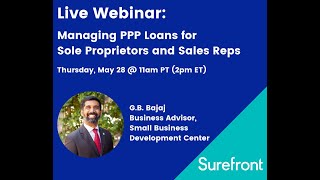
GB Bajaj walks through PPP loan rules for sole proprietors and sales reps, covering the $1,923 weekly compensation cap, the 75% payroll to 25% non-payroll spending split, and which expenses are forgivable. Forgiven PPP funds aren't tax deductible, and the loan carries a 1% interest rate.
Chapters
Okay, so we are live now, and I'll give everybody a minute or two to come into the webinar, and we'll get started at around 11:02. For— so for those of you that are already in, appreciate it. You can just be patient for a minute or two, and then we'll get going. Thank you so much. Alright, for those of you who have joined, we're still waiting a minute or two for everybody to come in, so appreciate your patience. Now it just turned 11, so we'll wait till about 11:01 or 11:02 to get started there. Actually, GB, if you want to stop your screen share right now so I can give a kind of face-to-face intro.
Thank you. Absolutely.
Hello everyone. All right, so just give it a few more seconds for everybody to get in, to be fair to everybody, then we'll get started, folks. Alright, great. So we'll get started right there. And welcome to SureFront's weekly webinar series at 11 AM Pacific. I am your host, Dylan Lowe, the Director of Marketing at SureFront. And for those of you who are new to this webinar series and not familiar with us, SureFront is an all-in-one app built for showrooms and sales reps that includes the ability to create virtual showrooms for your entire catalog. And we'll, we'll discuss that briefly towards the middle of this presentation. So we hold these webinars every Thursday at 11 AM Pacific to provide valuable information to our supplier community to help them get through this crisis. And we've done a few broad presentations about SBA loans for those of you who have tuned into those. You know, those were, you know, fairly kind of high-level, 30,000-view, uh, you know, type of presentations. And we got a lot of follow-up questions about those on how these loans affect sole proprietors and sales reps. So today we're going to dedicate an entire webinar to just that topic. We're also going to have a Q&A at the end. So I have a lot of questions people asked already for this webinar, so we're going to ask those. And any questions that you have throughout the webinar just use that Q&A icon at the bottom of your screen. You can start entering questions right now if you want. I'll sort through those as our panelist goes through his presentation, and then we'll get to those, uh, in about 30 minutes from now and spend about 15 minutes in a Q&A session. So our panelist today is GB Bajaj, who is the lead tax accountant for the tax accounting firm Life on Thrive, and he has been in the tax field for almost 20 years, with 10 years in his own practice in Long Beach, California. And since the COVID-19 crisis began, GB has been an advisor with the Long Beach Small Business Development Center, and remember that those centers are sponsored by the SBA through the CARES Act. So this is government-sponsored help, and we're going to provide his contact info after this presentation. So please reach out to him afterward with any further help that you may need. Don't hesitate to do that. Remember, this help is already covered by your tax dollars, so please take advantage of it. We're very excited to have him here today, so thank you very much, GB. I'll hand it off to you now.
Thank you, Dylan. I appreciate the introduction, and thank you very much for having me here this morning. I will take a moment to screen share.
I see your screen. Perfect.
Excellent. So PPP and being self-employed. A quick introduction to the program. This is designed as a— PPP stands for Paycheck Protection Program. There are people out there who take a paycheck, either you're self-employed and you pay yourself, or you have employees and you're paying your employees. The idea is if you and/or your business has been impacted negatively economically by the COVID-19, this is a government-sponsored program through the SBA, Small Business Administration, to help you weather the storm until your business is back on its feet, until the operations resume fully, so that you may have injury but you're not devastated by the current economic climate and the current healthcare climate. So I will talk about the program and I will— Dylan was kind enough to share some of your questions with me already. I want this presentation to be as targeted as possible But bear one thing in mind. This program, even though it's been in place for almost 2 months already, it is still developing. It is still changing. And I will be sharing with you what we in the industry know as of today. Some of you may be aware that there is a HEROES Act currently pending at the US Congress. That HEROES Act, depending upon what version of it is passed— the House of Representatives passed their own version last week. The Senate will take it up next. They will argue over it. They will negotiate. They will do what they usually do. They will come to some consensus, and then they will send it to the president. And if the president signs, then this program may change dramatically as we know of it right now. So what— first of all, let me tell you what PPP is not designed for. Some of you, most of you, all of you are perhaps self-employed. But if you are in a multi-level marketing business as a self-employed individual, you cannot get PPP. But beyond that, if you are in a traditional business, then the PPP is designed to replace, as a self-employed individual, your income that you reported on Schedule C of last year, of 2019, for you. So this is where I get a lot of questions. GB, I made money last year, but I took a lot of deductions, proper deductions. Maybe they were paper deductions such as depreciation. My Schedule C is not positive, it's not even zero, it's negative. Can I take this loan? The answer is no. The— because they do look at your taxable income. This is where they want to see how much money you have paid into the system last year how much money did you actually make, and do you have an economic injury that needs to be supported through this program this year? So if you had a zero profit, if you had a loss last year, you are not supposed to get the PPP. Now I know some banks have already issued loans to some individuals who gave their profit and loss statement. I always advise my clients your profit and loss statement may not be the same as your Schedule C on your tax return. And the reason is you may or may not have made actual money in your business. You may have made more money, but the government doesn't care about that. They tell you what income will be taxed and what expenses they will allow you to deduct. So this is where you want to be very careful in what documentation you're presenting to your banker, to your lender, to get this PPP. In my experience, 90% of the bankers out there don't fully understand how this program works. Now, one caveat: that's just my experience, the bankers I have dealt with. You may have a different experience. The industry may have a whole different experience. The banker— most lenders are overwhelmed right now. They're taking applications and they're just processing them, especially if you have a smaller loan amount, they may not give it proper care. But if you are deemed to misrepresent your numbers, you may be held liable. So this is where you want to make sure if you are submitting a draft tax return or your financial statements to your banker, you understand how that translates to your Schedule C. And the common example I use with my clients in my private practice Maybe I'm your client, maybe you are hoping to get my business, and maybe I'm worth $100 to you, just for simple math. And to get my business, you take me out for lunch and you spend $100 on that lunch. Why? Because you're thinking GB will spend $100 with you and I will spend $100 with you every year. So you are investing in that relationship. Because I'm paying you $100, because you're spending $100, your profit is a big fat zero. But the government only allows you to deduct $50 because meals and meals are actually only deductible up to 50%. So even though you have zero profit on paper, on your Schedule C, you have a $50 taxable income. And on the reverse example, maybe instead of buying me lunch, maybe you bought me a gift card. Well, proper gifts are deductible 100%, so now you have a zero Schedule C. So this is why you want to be very careful what your financial statements say and what your Schedule C says. The PPP loan is based upon your Schedule C. So I hope that answers a lot of your inquiries, and I'm happy to address that further in the Q&A section. The second thing is, are you just pure self-employed or do you have employees or independent contractors? If you have employees, that could be taken into consideration for the PPP loan amount that you may be eligible for. If you have independent contractors, that amount cannot be counted towards that equation. Your independent contractors maybe they're your web designer, maybe they're your workers, maybe they're your salespeople, they are eligible to get their own PPP on their own because as an independent contractor, they are self-employed working for you under contract. So if you have independent contractors, they have to get their own PPP. You cannot get PPP to pay them, and they may have been working with you for 10 years. They are not your employees. They don't take a paycheck from you. Do not count that. And even though your banker— and I've seen that common mistake where bankers have issued PPP. The challenge is later on, if you get audited, when you request forgiveness, you could be in trouble. You could be accused of what Lakers and what Harvard University and what Shake Shack were accused of, taking money from others who were trying to protect a paycheck and you were not eligible for a paycheck. So this is where when you apply for forgiveness, your banker will take about 60 days to review your forgiveness. SBA will take another 90 days. So that's 150 days of time that they're going to look at. But SBA has recently said that even after they had given forgiveness, there's a 6-year window where they may come back and audit you to see, did you properly borrow money and did you properly seek and sought and received forgiveness. So this is where you want to be very careful that you have your ducks in a row. You know if you have employees or independent contractors and do they qualify or not.
DB, beyond that, yeah, I just had a quick question. So on that, like, because many of the people on this call do have independent contractors that work for them, I know that, uh, you can use— what is it, 20— correct me if I'm wrong— 20% of the PPP loan for other expenses that are non-payroll, could they use— is it 20%? I believe it is.
So it's 25%. So you're very close.
25%. And could they use that portion for, say, independent contractors to pay them if they wanted to?
So there's two aspects here: what's allowable and what's forgivable. Is it allowed? Yes, it is allowed. But will it be forgiven? No, it will not be forgiven.
Got it, got it. Okay, yeah, thank you.
So that's a very good question. This is where, as you go through your P&L, as you go through your plan to use this money, you want to be careful what is allowed and what is forgiven. You can use this money for a lot more things, but very few things are eligible for forgiveness. So that's a very good question, Dylan. The other thing is, if you are self-employed and/or you have employees, the amount of money any one individual can take towards forgiveness is $1,923 or less per week. And the reason is this program is designed to allow you and your employees to be rehabbed from the economic injury up to $100,000 a year. So maybe your Schedule C showed $120,000 in profit last year. Maybe you have an employee who makes $150,000 a year. Can you use more than $1,923 per week of PPP money to pay them or pay yourself? Yes, you can. It is allowed, but only up to $1,923 per week will be forgiven. So that's about $15,000 and some change in that 8-week period. Because whatever money you get from PPP, you have 8 weeks to use that money for allowable expenses so you can seek forgiveness. Now this is where the HEROES Act that I was talking about earlier is trying to change that. The reason they put 8 weeks in this PPP program is that they want employers or self-employed people to get this money and put it back in the economy right away. They don't want you holding on to this money thinking, hey, I don't know how I will be doing in 2 months, in 3 months, in 4 months, maybe I should be careful. So this is what I tell my clients in private practice. If you borrow this money and if you're going to use this money, you want to make sure you have a proper business use for it. Otherwise, you're just going to take this money and give it to someone else and it may cause a tax liability for you down the line. And the reason I say that— IRS, at the end of April, gave a revenue ruling that if you get the PPP money and you get your loan forgiven, any and all expenses that you pay with this money, whether it's 25% of allowed— allowable business expenses or whether it's payroll, you cannot deduct those on your tax return. So what that means is, if you— let's say if you get $25,000 and you take $25,000 and you pay yourself or you pay an employee, well, that will be taxable income down the line for you. So you don't want to just take— go ahead.
I just had a question on that too, on that, because I know a lot of people ask questions about that 8-week period. So could you use that— you got to— so the rule is you got to spend it within the 8 weeks. Could you, if you don't— are unable to spend it all at once, say maybe you're using it for, you know, future expenses, could you use it for future payroll pay it forward for those payrolls during those 8 weeks, use it for retroactive payrolls. So it has to be during— has to be an 8-week payroll period occurring during that time.
This is actually going to be one of the points I was going to discuss in a later slide, but I'm actually— no, but this is— I'm happy to address it right now. It flows very well with what I'm discussing. You can— you are allowed to use this money for prepayment or for late payment, but it will not be forgiven. So you may have rent that was due in April and you haven't paid it yet and you get your PPP money in May and you're thinking, okay, I'll use this money to pay my April rent. Can you do it? Yes, you can. Will it be forgiven? No. You cannot pay late expenses with this money. Can you prepay your rent? Maybe your landlord is saying, hey, pay me all this money up front and I'll give you half of your rent, and you're very happy. Can you do it? No, you cannot. You cannot prepay expenses. What SBA said last week, and this is a brand new understanding as of right now, they were saying that you have to pay within 8 weeks. Now they're saying you have to incur those expenses within 8 weeks. If you need to pay it by your next invoice date, you can. So what that means is Maybe you have people working for you for the 8-week period, and maybe your payroll date falls outside of that 8-week window. As long as that payroll was incurred in those 8 weeks, you can pay them at the next payday. Maybe you have rent, maybe you have rent due, and the rent which is incurred, you can pay it by your next invoice date, but you cannot prepay that stuff. So these expenses have to be incurred within those 8-week period. And this is where the HEROES Act is trying to extend it to 24 weeks until end of December. I don't think that's very likely. We did have Treasury Secretary go on Fox News last week and said that there is enough consensus to extend this 8 weeks to 10, maybe 12 weeks. But as of right now, the PPP loan under SBA says you have to incur any and all expenses within those 8-week period. Speaking about rent, any and all expenses that you pay using this money, you must have those expenses already agreed upon by Feb— before February 15th, 2020. So for example, rent is an allowable expense. You take rent and maybe your landlord came to you 2 weeks ago, "Hey, you got more money? I tell you what." How about I double your square footage and you only pay me 25% of the rent? You are only allowed to seek forgiveness for lease agreements that were in place before February 15th. So think of Valentine's Day. Any and all lease agreements you signed on Valentine's Day or before, any and all fringe benefits that you are allowed to pay for using this money, you must have offered those to your employees on or before February 14th, 2020. You want to offer retirement benefits, you want to offer healthcare to your employees starting this month because you got a big loan? Cannot do that. You want to pay yourself? Cannot do that. All of those commitments must have entered by you before February 15th, 2020. So, Dylan, I hope that answers your inquiry.
That's perfect.
This is why there are a lot of intricacies with this loan package.
Got it, thank you so much.
My pleasure. So $1,923 is the magic number per week that you can pay in wages to someone. Okay, so how do you pay yourself? How do you pay yourself for a variety of these expenses that may be coming up? You could have a formal payroll. Even though you're self-employed, you may be using Gusto, you may be using ADP. If you have a formal payroll, that is the easiest way to document this money. Because the money that you have received, the idea is to use minimum 75% for payroll, because this is a Paycheck Protection Program, and no more than 25% on other allowable business expenses, such as rent, mortgage, home office, utilities, transportation costs. Do you have to do the 75/25 split? No, you don't. If you want to use the entire money to pay yourself or your employees, who are your employees, not independent contractors, you can use 100%. But that payroll portion of it, whether you're paying yourself or other people, cannot drop below 75%. If it does, what happens? You get partial forgiveness. So maybe you use half the money for payroll, half the money for other allowable business expenses, you get partial forgiveness. So it's not all or nothing, but that's something that you want to think about. And like I said, any and all expenses you pay for using the PPP money under the current IRS ruling cannot deduct them on your tax return, whether you file a Schedule C or you are a partnership. The HEROES Act, which is pending in Congress right now, they're trying to overrule the IRS. Whether or not they will, we'll see. But as of right now, understand, if you get $25,000 and you use it to make payroll, all of it, you cannot deduct those payroll expenses on your tax return. So what that means is if you are in the 20% tax bracket, you will owe $5,000 to the IRS in 2021 for tax year 2020. So be mindful of that unless Congress overrules the IRS.
GB, if— sorry, under the rent, mortgage, and outside payroll expenses, some of the people on this call I know work from home or were forced to work from home during this time. Could this include a home office? So if you were, say, you know, if you dedicated part of your mortgage theoretically to a home office, could you pay off that portion with the PPP loan?
Only the interest. So if you have a mortgage, only the interest. Now this brings up another tax question then, because if you— so this is where it depends on how you take the home office deduction. The IRS allows a simplified version where they say you can take up to $1,500 a year, no questions asked. We will not even audit you on that thing. That's the safe harbor provision they have. If you have taken that deduction last year on your Schedule C, or maybe you decided in January or February, before February 15th, that, you know what, I'm going to start using my home office, I'm going to start using my home as a home office, you can pay yourself $1,500 in home office expense using PPP, but then it will not be deductible and it will be taxable income to you. If you have a mortgage— now this is where you have to be careful. If you have a mortgage, if you say that you are subleasing or you are leasing your home to your business, you may have to file a Schedule E for rental income on your tax return. So can you do it? Yes. And if you do it, you can only pay the interest, not the property taxes, not your principal, not your insurance for homeowners. Only the interest portion that you have accounted for using the PPP money.
So if it's rent—
and that mortgage must have been taken by you before February 15th, 2020. So if you just bought a home in March, can you use it to— can you use PPP to pay that interest? Part of it, yes, you can. Will it be forgiven? No, it will not be.
That's a good point. So up to $1,500 if it's rent and then only interest if it's mortgage.
Correct. And this is the thing, the $1,500 safe harbor— if you use more than $1,500, again, you may have to report rental income on your personal income tax return. So this is where what I tell my clients is PPP does not exist in a vacuum. You still have to be mindful of the HR law, you still have to be mindful of the tax code, you still have to be mindful of the audit issues that may come up. You can do everything right under PPP, but you may be creating liability for you outside of PPP, which may come due next year. So this is why you want to be mindful on how you do it.
Makes sense.
Thank you, Phil. My pleasure. Now, if you don't have a formal payroll, get a separate bank account. This is where you may have heard a lot of people that get a separate bank account, get a separate bank account. If you, if you have a small business and typically you only have 5 transactions in your account, do you have to get a separate bank account? No, you don't. You may have 5 million transactions. Do you have to get a separate bank account? No. But if you have 500 transactions per month in your account, you may want to get a separate bank account for PPP if you don't have a formal payroll, so that if you get audited— now this is where not everybody will get audited Just because you're speeding on the 405 doesn't mean you will get a ticket. It's only if you are the unlucky one to be flagged. Some people will be audited at random. This is where you could end up holding the short end of the stick, and the SBA has 6 years to audit you. It may happen, but not everybody will be audited. But if you do get audited, if you have a separate bank account, you can say, look, I got $50,000. I paid rent, I paid utilities, I paid mileage to myself or other people, and this is how much I paid myself. These were my taxes. We're good. Simple, open and close audit. So this is where if you don't have a formal payroll, you don't get the 940s and 941s and W-2, all the other fancy tax returns out there, having a separate bank account will be useful. And this is where we talk about the other expenses. You can pay rent, whether you're paying yourself for home office or you're paying somebody else, only incurred. So this is where if you use a $1,500 rent, that's per year. So that's about $100 and some change every single month. So let's say maybe you say I'm claiming $120 in rent per month. That's only $240 worth of rent that you can pay yourself or someone else that may come up. Utilities include gas, water, electricity. Internet is also included. Phone is also included as part of utilities, whether you have a landline or you have a cell phone, that's also part of it. And transportation, whether you have company cars or you take mileage deduction, so maybe you're driving for your business and you're logging your miles, you can use PPP money to pay for that compensation. That's all part of it.
Nearly any business expense— FedEx payments, you know, internet, anything that I—
so only these expenses on this slide are subject to forgiveness. Can you use it to pay FedEx? Yes, you can. Will it be forgiven? No.
Got it. If it falls under the 25% of what you're using expenses for, still not forgiven or forgiven?
No, no. So for the 25%, only rent, mortgage interest only, home office, utilities, and transportation costs. These are the only expenses that are allowed to be forgiven. And the reason is, the reason why the logic behind this is, maybe you get the PPP money and you call everybody, hey, come back to work. And they show up and your landlord has evicted you, or your power has been turned off, can your workers earn their paycheck? No. So you need to have the basic tools for your workers to come back and have a place of work so they can earn a paycheck, so you can use the PPP money to pay yourself or other people. This is why these expenses are allowed. Can you use this to pay for other expenses? Of course you can. Will it be forgiven? No, it will not be.
Because we got a lot of questions on what does that category of utilities actually mean, and people are lumping in a lot of stuff in there. So the point of utilities is to keep the lights on, keep the internet running, keep the toilets flushing, and, you know, be able to have people work from the office. Nothing more than that.
Absolutely. And this is where we come to my next slide. You need to be careful taking this money because it— I always tell people It's not free money. This is how it's marketed. It's not free money. It's going to cause liabilities for you, whether they're tax liabilities or they are HR liabilities. So you want to make sure this money will serve a business purpose because your employees may not want to come back to work. So you have the power running, you paid your rent, you have your internet going, you have your phone going, you are paying people mileage or bus pass. To show up to work, but what if you don't have money to provide for PPE, which is the personal protective equipment? Maybe your employees are afraid to come back to work. If they catch coronavirus at your workplace because you didn't pay for a PPP— sorry, for PPE, well, guess what? They will sue you. There's already— I have clients who are lawyers, they already are working on class action lawsuits against mixed-size to large businesses, even if you're a small business owner, they can come after you that I showed up to your workplace, you didn't have hand sanitizers, you didn't have masks, you didn't have a COVID-19 compliant workplace. Because of you, I caught coronavirus, I'm suing you. So first of all, you have to ask yourself, are you allowed to open? If you are still in an industry, you know, the governor of California says Phase 1, 2, 3, and 4. If you are a Phase 4 business, you're not allowed to open. If you're a Phase 3 business, you're not allowed to open. So right now, many counties are only in Phase 1. If you're in Phase 2 in that county— LA County and San Francisco County are very strict right now— you're one of those businesses and you use PPP money to force your people to come back to work, you could be in trouble. But let's say if you do have employees and they don't want to come back to work, and this is where you may be self-employed, but you have employees also, You have to document, you have to document that you told them to come back to work, you were allowed to open, or maybe they're working remotely and they refuse to come back. Don't just take their word for it. Send them a formal letter to come back to work. Have a formal letter from them denying they're not coming back to work. Let them know that if you don't come back to work, your unemployment benefits may be taken away. And if they don't want to come to work, be polite, be respectful. You cannot force anyone to work. It's not allowed. But you are to notify EDD within 30 days of their refusal that, hey, I have employees, they're on unemployment, I have work for them, they're not showing up, and then let EDD do their job. They may stop— EDD may stop the unemployment benefits or they may not. But that's none of your business. Do not threaten your employees to come back to work. Physically or remotely. There are a lot of clients I have whose employees are making more money on unemployment. They don't want to come back to work, but document, document, document, because if you get the PPP money, your employees refuse to come back to work even though you're not allowed to reopen, your loan will still be forgiven. You can also hire other people.
Excuse me, I'm curious on that Have any employees, because, you know, there are many employees making more money right now on unemployment than they would be at that actual position or job. Excuse me. Have any of those employees, you know, said, you know, trying to come up with excuses not to come back to work with your clients, you know, saying it's unsafe work conditions, you know, afraid of getting COVID-19 while we're at work or anything like that? Do you think, you know, I know this is going down the EDD line and that's not what we're talking about so much, but You know, do you think that could affect business owners at all? Should they put in precautions, you know, telling employees, hey, this is a safe place to come back to, to work to, so they don't use that necessarily as an effective excuse not to work?
They can excuse themselves for any reason. They can just say, hey, I don't want to come back to work. Now, as long as you document, because you just saying is not good enough. You have to document and you have to document to your employees, look, look at the workplace. I have masks for you. I have hand sanitizers for you. I have one-way traffic down the hallway so you will not be facing each other. This is what my office has done. They have put a lot of one-way arrows with the exception if there's a fire, forget the arrows. But otherwise, you have to follow one-way traffic and I have to send those photos to my employees. Listen, I have done the best I could to make my workplace COVID-19 safe. This is the proof. If they still don't want to come back to work, they can just refuse to. And even though I have done everything, my building has done everything, If they catch Corona, they can claim they caught it at my workplace and I'm still susceptible to a lawsuit. So this is where I always tell my clients, be aware of your business risk. Don't just think it's free money. Otherwise you will take this money, give it to someone else, get it forgiven, and may have a lawsuit on your hand. So I have a good question on that.
Sorry, those are very good points. And sorry to interrupt you right there. Uh, if you are a sole proprietor and a business owner, and we've gotten this question several times before, and I think I know the answer, I just want to clarify it in front of everybody. But if you're taking unemployment benefits and you also get PPP, can you get EDD benefits and pay yourself on salary from PPP at the same time? I think the answer is no, but I just want to get it from you.
So the answer, it depends. It's a typical accountant answer, it depends. If you are self-employed, you are eligible for PUA, which is Pandemic Unemployment Assistance. That assistance is available to you effective February 2nd, 2020. Even though—
is that the federal $600?
The $600 kicks in later. I'm talking about the state. So the state is effective February. The IRS Sorry, the federal kicks in end of April. So it goes to the month of May, June, and part of July.
Got it.
So this is where the PUA is the state, the federal is separate $600.
And right.
So this is where— can you do both? Yes. If you apply for a PUA, if you claim on your application that because of coronavirus you were economically injured, that's a keyword they're using, that your income was effective— affected— effective February 2nd, EDD will retroactively give you benefits. So you may see a large chunk of money in your EDD account coming to you depending upon— now that also depends on how much income you're claiming on your Schedule C. So this is where it all ties in. If you're self-employed, your Schedule C, line 31 of your Schedule C What is your net income for the year? So you tell EDD, I made $17,000 last year. EDD will tell you, great, you qualify for $157 per week of the state money. When were you affected? And you claim February 2nd. They will give you $157 for the month of February, March, and April, and maybe part of May. Now, maybe in May you applied for and you got your PPP. You cannot double dip. You cannot continue collecting PUA and PPP. This is just like your employees. If they come back to work, they can no longer collect unemployment. So you can collect PUA from February 2nd until the day before your PPP loan kicks in. You can pay yourself under PPP. If you're still injured by the coronavirus, you can go back on PUA because PUA is available to you until December of this year. Excuse me, until December of this year. So you cannot do it at the same time, but you can collect it retroactively, get on PPP, and then once PPP money runs out, if you still hurt, go back on PUA.
That makes sense. And to clarify, there's a lot of attendees here that are not only from California but from Nevada, from Texas, Chicago, New York. So EDD is what we call unemployment benefits in California. I know different states have different agencies. But when we're talking about EDD, we're talking about UI benefits.
But the rules are the same. Whatever your state calls your version of EDD, the rules are the same. You can collect unemployment, get PPP, and go back on unemployment if necessary.
Perfect.
I think this is a good place to take a quick break. I know Shorefront is offering some free tools to help small proprietors out as well. So then I'm going to hand it off to you so you can take a few minutes to discuss what you have to offer.
That's great, I appreciate it. Yeah, so we wanted to take a minute to, uh, I'm going to share my screen to talk about, uh, the other tools that we're offering at this time. So, uh, GB, can you see my screen of, uh, women's apparel on there? Okay, perfect. So, you know, as, as people have known, that if this is your first time tuning into this webinar series or you've turned in multiple times, we're trying to do everything we can to help our supplier community. So most of the people on these webinars our suppliers from the Dallas Market Center to Las Vegas to Chicago to New York, as I mentioned, those various states, all from these showrooms. That's who most of our people are on these webinars. So we're trying to hold webinars that are pertinent to you guys. We also write a lot of blogs to help you as well. We send follow-up emails after this with help on, you know, how to, you know, do proper marketing, you know, how to apply for, you know, PPP loans and EIDL loans as we're doing now, or, you know, what does the future of retail look like? Another thing that we're doing too is anybody that registers for these webinars, we've made our tools free on SureFront for an extended time. So if you're tuning into this, that means that indicates to us these webinars and this information is important to you. So we're giving you even more, which is anybody that registers here, again, you're getting the SureFront tools for free. And the most important thing is, is during this time, I know, I think Vegas is still shut down, many of the showrooms are still shut down, and even those that have opened back up, it's gonna be almost impossible right now to physically meet with buyers. So I know everybody out there scrambling for some kind of virtual tools to meet with buyers right now. We have a virtual showroom ability on SureFront's app. So I'm gonna just show— we have many abilities on there. I'm gonna show you this one first and then tell you how to sign up for it, and I'll show you a little bit about our website. I'm not gonna talk more than 5 minutes because I don't want to interrupt GB's presentation too much. But SureFront allows you, if you look at my screen now, to digitize your entire catalog. So if you have tens of thousands of items— now I know I have apparel up here, but this could be anything, any kind of hard goods, soft goods that you have. This allows you to digitize your entire catalog. I'm in what we call the catalog view right now in the SureFront app, and this is very private too. I want to stress that we have a lot of security measures on the SureFront app because we know we don't want your fellow competitors to see what's up there. We know you don't want to show your entire catalog to all of your, your buyers. So this catalog right now would be private to me. I would only share those items in a virtual showroom that I want to share and to those buyers I want to share it with. So this is not a marketplace. This is a one-on-one chat function between you and your buyer, all occurring on the SureFront app. So this, after you digitize your entire catalog, you can sort through your catalog and pick those items that you want to show to your buyer in a few different ways. You can search through a search bar here, there's a lot of good filtering abilities here, and also you can tag your items anyway. So if I want to show my new summer collection, or, you know, a certain selection of apparel, or any kind of goods, I simply search for those items, bring them up, click on those that I want to show, and then I click on this button over to the right, which is— we call Showcase. This is your virtual showroom. And then you select those buyers that you want to send a showroom to. You simply enter their email addresses here. And this is great if they're not on the SureFront app, you can still send them a virtual showroom. So you're not requiring them to do any extra steps. In fact, you're taking away the normal steps of back and forth that you have to do because all this is occurring on a SureFront map even if your buyer's not on it. So after I send that to them, they're going to get an email in their inbox that looks like this. So those are the items that I presumably selected there. They're getting this email. This is their virtual showroom to start, and I click on Discover Products. As the buyer. I'm gonna do this in incognito window since we're already logged in as a supplier here. And then they're gonna drop down into the SureFront app without having to sign up, and they're gonna get your virtual showroom right away. So here they see those items, a lot of great tools here. They can select and look through product details, select different images, see those thumbnail images as well. And for those that they want to actually get a quote on they'll click on Request a Quote right there, and that drops you both into a— this page together. You want to call it your quotation page, which is really cool. So both you and your buyer are on this page communicating together. There's a very useful chat function here. No one else has that. You can chat looking at the items together, making any changes that you want together without having to, you know, share spreadsheets or PDFs or thumbnails or Excel sheets. And you can even look at more item details here, and they can make any edits that they want to on any one of those items. So SureFront has a lot of tools, but I know this is the tool that a lot of people, especially on this webinar, need right now. I want to highlight that virtual showroom tool and that ability to communicate with your buyer directly here. So again, this means you don't have to email back and forth You don't have to track down your buyers back and forth. Uh, you don't have to send image attachments, PDFs, Excel sheets, and then keep that all organized. You do that all on the SureFront app. So I'm going to send a follow-up email after this, uh, probably around 4 PM or so today Pacific time, and we're going to offer a number of spots that you can sign up again for free. We're not asking for any payment info. We're doing this to help you guys, uh And it's to anybody that's registered for this webinar. So you can't necessarily share this with someone else and have this. This is exclusive to you guys, and we have a limited number of spots to sign up for. So when I send that out today, please take advantage of it. Uh, you know, signing up doesn't mean you're committing to anything, doesn't mean you're signing any contracts. We're just offering this to help you guys out for this time being. So really appreciate you allowing me, uh, GV, a couple minutes there to show that. We're trying to offer as many tools as we can right now to our suppliers. So I'm going to stop sharing my screen, GB, and then allow you to continue with yours. Thank you so much.
My pleasure. Let me share my screen again. I saw one question in the chat while you were speaking, Dylan. And by the way, great product. It's really useful. I grew up in the clothing business, so I knew what you were talking about. And if my dad had a tool like this, I think you would have made a killing. So very good product that you're offering there. One of you asked a question in the chat room. That what if you haven't filed your Schedule C yet? That's okay. This is where you can submit a draft Schedule C to your lender and they are accepting it. Some lenders, depending upon whom you're working with, are accepting your P&L statement. But remember, with the P&L, just be careful that you have a tax profit and loss statement, not your financial profit and loss statement. This is where I always tell my, my clients, bookkeeping is bookkeeping, but bookkeeping is very different for financial purposes managerial purposes, tax purposes, and investment purposes. And one of you also asked a question: What if I'm collecting PUA, can I get commissions? The short answer is no. The idea is you need to have no income, and this is why you are getting unemployment assistance. If you're making money— and this is where it's a challenge— traditionally, EDD in California has said you have to certify every single week. Are you looking for work? Did you receive work? Are you making any money? Right now, there is no such thing. So when they will eventually catch up, the idea is if you got PUA money and you got commission, you're supposed to— there are some exemptions. Every state has a different exemption, how much money you can make while collecting unemployment. So whatever is above that threshold, you're supposed to pay back to the EDD. So you may be double dipping right now. It doesn't make you a criminal. It does mean that you may have to pay back eventually once they are all caught up. Right now everybody is behind. Everybody's behind. So any other questions that you saw, Dylan, before I wrap up this presentation?
Uh, not yet. We'll save them to the end.
Okay, so you can pay— what is forgiven, compensation is forgiven, wages, bonuses, commissions, severance pay, bonuses, anything, anything up to $1,923 per week, which is $15,000 and some change for the 8-week period. Group benefits for others, not for you. So you may have heard, you may have read in a blog post or on a podcast, you can use this money to pay for retirement accounts, you can use this money to pay for healthcare only for other people, only for group benefits. If you're a solo entrepreneur and you have Obamacare or you have some other private insurance, can you use PPP money to pay for it? Yes. Will it be forgiven? No. If you put money in your IRA or in your SEP IRA or in your solo 401(k), will it— can you do it? Yes. Will it be forgiven? No. So group benefits only for other people not for the self-employed. And we've covered this already— cannot prepay expenses and cannot pay deferred bills, which is the late payments. Real quick on the EIDL. Some of you may, especially those who have employees, may have received the advance grant of $1,000 per employee. That amount has to be deducted from the PPP for seeking forgiveness. So for example, you may be self-employed, you may have a partnership, You may have an LLC. You received maybe $3,000 because you have 3 employees. You received $3,000 in EIDL, which is the Economic Injury Disaster Loan. You received that from the SBA and you received maybe $30,000 in PPP money. And you use that $30,000 within 8 weeks to pay 100% of wages to other people and to yourself. you can only seek forgiveness for $27,000. Why? Because you got that $1,000 per employee advance grant. The only exception there is maybe they offered you an EIDL loan and you said, "Sure, I'll take the money," and you refinance that— the whole advance into that loan. Now it's not forgiven to you. You can still seek the full PPP forgiveness. So this is where the EIDL and PPP can intersect each other and may affect how much loan may be forgiven. Any portion of your loan which is not forgiven will be payable back within 2 years at 1% interest. So it's cheap money. The HEROES Act is trying to extend that payback period to 5 years. We'll see what the Congress and the president agree to for the small business owners. But as of right now, it's 1%, paid back in 2 years. You don't have to make a payment for up to 6 months. If you take that option, it means you only have 18 months, a year and a half, to pay back this amount. IRS is offering retention credit. So if you are not firing your employees and you're retaining them, they're giving you a tax credit. Any tax credit you receive will reduce your PPP forgiveness. And to seek forgiveness, you have to have full-time equivalent employees. Full-time equivalent is 40— somebody working for you 40 hours or more. This is where there's some math involved in the application. That's something I can help you with one-on-one. But ideally, it's your headcount should be the same during those 8 weeks that it was before. So if you fired some people, you want to bring them back, that will restore your workforce. You will get forgiveness. If you had 4 employees before you started and only 2 you hired using PPP money, you will only have half the forgiveness. If you offered employment to all 4, but only 2 showed up and the other 2 you documented that they refused to show up, you may— may is a keyword— may still have full forgiveness. So this loan is not as easy and shut as a lot of people say, but it is doable. It is in your favor, but you have to be a good steward, a good fiduciary for your business. You know the old saying, more money, more problems. Make sure this money solves your problems, doesn't create more problems. So be very mindful of that. Dylan did mention that I work with SBDC. I do have my own private practice. If you do come to work with me, it depends on how you show up. If you show up for my private practice, I'm not the cheapest around, but I add value and I charge a fair price for the value that I add. If you are in the Long Beach, South Bay area, which is in Southern California, then I work with my local SBDC chapter. If you are SBDC client, then you and I, we can never work together in private, but you being the SBDC client, me being the SBDC advisor, this is where your tax dollars pay for what you are doing. You may have a local SBA small SBDC chapter in your area, whether in Texas or in New York. There are advisors probably there as well who can help you. So this is where you want to be aware what help you're seeking from where, whether you're coming to me privately through my company, or you are in the local Long Beach, South Bay area, and you're coming to me through the SBDC, then your tax dollars will pay for my services. So keep that in mind. I work with everybody. It just depends, am I working with them in my private practice? Am I working with them as an SBDC advisor? And I know we are already over time, but I'm happy to stay a little bit longer depending on your schedule, Dylan. Maybe another 10 minutes, 8 minutes, if there are any follow-up questions.
That's fair. Thank you very much.
This is a big animal to deal with. Yes.
And there's a ton of questions coming through. And, you know, I do urge anybody to, you know, reach out to GB directly. He's very talented when it comes to this stuff. And, you know, this is the best presentation I've seen on it. Great one. So I really appreciate it, GB. And so let me just try to get through these questions and categorize them as quickly as I can. I think we've had, you know, 50 or so questions come in, so I'm gonna try to get through these fast. But, you know, I think the first thing I want to ask is, you know, what if I'm desperate for money, I don't care what's forgiven or not, I don't care about spending 75% on this and 25% on, you know, other expenses, Could I, within the bounds of legality, but not caring about forgiveness, just spend this on any business expense I want?
The short answer is yes, as long as you can document how did that help you support your income or future employment. There have been a lot of fraud already where people have bought Rolexes with PPP money saying, oh, I'm giving it as a business gift. Don't do that. If you're using it to pay for rent, if you're using it to pay for independent contractors, if you're using it to pay for allowable business expenses that are legitimate business expenses, and you don't care about forgiveness, you're saying, hey, 1%, that's cheap money, that's okay. Don't just use this money to pay off personal credit card bills unless you have used your personal credit card to keep your business afloat through this crisis. So it's not what you do, it's how you do it and what you do it for.
And so what is the interest that I get charged then?
1% per year. And if it's forgiven, then the interest is forgiven as well, right?
Okay, so I, yeah, I just, I guess I want to make that clear to everybody too, is, look, you know, if you don't care about what you're charged in interest, and as long as these are legitimate business, business expenses, you can spend it on those expenses. You know, what we're largely talking about here is how to get everything forgiven. So when they talk about 75% for payroll and 25% for other expenses, we're talking about what is forgiven. And the spirit of the PPP loan is to pay for payroll, and the spirit of that 25% is to support the ability to pay for payroll, like paying for utilities, you know, paying for home office expenses and rent and that kind of stuff. So under that category, you know, I think we had a lot of people asking about, you know, what falls under that 25% Again, we're talking about utilities, we're talking about rent, we're talking about, you know, keeping the lights on and ensuring that your employees have a place to work. Any other things that you want to lump in there that they could use it for? You know, someone asked about marketing materials. I assume that's a no. You know, anything else within that 25%?
No, the only 5 categories: rent, mortgage interest, utilities, transportation, telephone, stuff like that. Only those 5 expenses are allowed to be paid. And now this is where the other— some of the other expenses, because the retirement account for other people, other employees, and the group health care, that's part of the 75%. So don't confuse that with it, but the 25% are only the basic expenses to seek forgiveness. If you want to pay for marketing, Can you? Yes. Will it be forgiven? No. So 1% loan, that's cheap. Go for it.
Yeah, still cheap money, 1%. What if you have not yet filed a 2019 tax return, so don't have a Schedule C?
Draft. So maybe have your accountant or you yourself draft one, or some banks are accepting profit and loss statement with the understanding that when you will seek forgiveness that you will provide a proper tax return.
Okay, um, and this person said they heard that the 8-week window will be stretched, uh, end of year. So I guess that is what you talked about, possibly under the HEROES Act, that they're stretching that 8-week window. So what's it, possibly 10 weeks or 12 weeks?
Well, the HEROES Act said 24 weeks. I don't think it's going to happen 24 weeks under December. This is why the Treasury Secretary said that the current consensus that he has been hearing about— I mean, he's a Treasury Secretary, so he knows far more than I do— and he's thinking maybe 10 to 12 weeks, maybe, because remember, the House passed it. Yeah, good, but not yet. Yeah, right.
And any portion of the EIDL forgiven?
No, EIDL is a 30-year loan at 2.75% interest.
Okay, uh, and this person said, my tax accountant told me that because I'm an independent contractor 1099, that my PPP, uh, is my money and does not need to be used just for payroll. My losses will be more than my PPP. So I guess that, that goes back to the original points we made, so I don't think we have to stress on that. Um, and this was about— okay, we don't need to— let's see. Okay, um, if you're a corporation, if you had full, full-time employees and now you bring in only 3 employees, can you still be eligible for forgiveness? So partial, that's partial, and that's a good question too. Uh, what about letting employees go during this window or hiring during this window?
Very good question. And this is where, when you say corporation, it depends if it's a C corporation or an S corporation. Each one will be affected by PPP very differently. Now I'm telling my clients, don't let your employees hold you hostage. I've had some clients whose employees showed up and said, hey boss, you got PPP money. Well, guess what? Whatever I do, you can't fire me. Not true. If somebody embezzles money, there's sexual harassment, there's bullying, they are performing poorly because they think you can't touch them, you can still fire people for proper HR human resources violation. And if you document it properly, your loan will still be forgiven. You can hire more people. If your employees are refused to come back, you can find replacement. Maybe you cannot find replacement, document why could you not find replacement. And if you cannot legitimately, maybe you have a very, very— maybe you're an IT manager and you have a very keen or key skills are you looking for, and nobody's there, and your employee is not coming back, your money, your loan may still be forgiven because they refuse to come back. You did everything right. You tried to rehire someone else. You couldn't find somebody proper, and you may still be forgiven. But this is where, this is where I always tell my clients, whenever you're audited, you're not audited by an agency. IRS never shows up to audit you. An individual shows up. The funny story I share with my clients, one time I was representing a client in an audit at the IRS and the auditor was a jerk. After a couple of months in the audit, we were drinking one night after the close of the audit, the auditor and I were just having some bourbon. I said, in much more colorful language, why were you such a jerk? And he said, GB, your client reminded me of the man with whom my wife cheated. These are biased individuals. Maybe they don't like your tattoos. Maybe they don't like your color of the skin. Maybe they just don't like you. Maybe they had a bad day. So this is why your documentation is so crucial, that can you overcome somebody's doubt when they say, you know what, I don't think you did enough. So be mindful of that.
And maybe if you do let them go, let them go for a pretty good reason during this time. Yeah, and so what if those— how do you calculate number of employees though? So if, you know, I guess that they would only be working a few number of weeks during that 8-week period if you hired new ones or if you let go of others. How do you calculate the number of employees during that time?
So they compare how many people work for you the month of February, March, and April, and how do they compare to your 8-week period when you are seeking forgiveness. So let's say if you have 4 full-time employees— full-time equivalent. What that means is anybody working for you on average 40 hours or less. If somebody works for you overtime, that doesn't count for the forgiveness application, the draft application, which has been changed 3 times already in the last 1 week. The application says anybody who works for you about 40 hours a week is a full-time. So if you have 4 people working for you, were 4 people working for you during those 8 weeks or not? If 3 people, same thing, 3 people or more working for you or not. If you had part-time employees, people working for you 30 hours a week, 25 hours a week, 35 hours a week, then you divide their average number of hours per week in the last 12 months of 2019, divide that by 40, and you get a fraction. And you're supposed to round that fraction to the closest 1/10 of a percent. So if somebody worked for you 30 hours a week on average, 30 divided by 40 is 0.75. So were 0.75 or more people working for you during those 8 weeks? SBA has released this Tuesday a safe harbor where if you don't want to do the math, anybody working for you full-time counts as 1, anybody working for you less than full-time counts as half. Whether they work for you 30 hours a week or 10 hours a week or whatever. So you could say, well, I had 2 full-time employees, I had 2 part-time employees, so 1, 2, half and half, it's 3. Were 3 people or more working for me? Those 3 people could be 3 full-time people or 6 part-time people. That's how they look at the replacement.
That's a perfect answer. That answers all of that. Thank you so much. That was a question that's been asked many times. And so the $1,500 a month for rent, is that no questions asked?
So $1,500 a year. $1,500 a year.
Oh wow.
And no questions asked, it's $1,500 a year. And—
okay, got it.
Yeah.
Um, and so, uh, how can I document using PPP to pay myself without a separate bank account?
Write yourself a check. If your PPP— and this is where you have to be careful how much PPP you got, because PPP is your 12 months of monthly expenses, payroll expenses divided by 12 times 2.5. Now remember, 2.5 is what? It's about 75 days. So there will be some slack. So this is where if you were making less than $100,000 a year, you can give yourself a raise or you can use other expenses to pay for it. But it all boils down to how are you documenting it. Some of my clients who are there, they know they made money last year, they know they're going to make money this year, they just wrote themselves a check and they're going to make the estimated tax payment to the IRS in June and maybe in September just to document that I paid myself. I'm not on payroll, I wrote myself a check from my regular account and look, I paid my estimated taxes. Document, document, document.
Very smart.
Um, and only one thing there, if you do have— because some people, people are self-employed, they commingle, they use a personal account as a business account. If you are self-employed, whether you're 1099 LLC or whatever, if you don't have a business account, at the very least get a business account because you don't want the auditor saying, well, you've been comingling, how do I really know you paid yourself or not? Maybe you give yourself a gift, or maybe you reimburse yourself from past expenses. If you don't have a business account, at the very least get a business account. And a lot of banks right now are offering a free business account to small business owners, so it won't cost you anything.
Smart. And, uh, for the home office expenses, can you go briefly into that? How do I write off the home office expenses?
How do you write up for PPP purposes or for tax purposes?
Yeah, for PPP. Sorry.
So for that, write yourself a separate check. So if you're paying yourself for mileage, separate check. I'm paying John Doe $100 for mileage, so on the 4th, write mileage. I'm paying John Doe $125 for rent. I'm paying John Doe, which is just yourself, $2,000 compensation, separate check. So you can say 75% exclusion, 25% exclusion. Smart. Great, perfect.
Um, and let's see, this person asked, my loan was secured on May 6th and I have only taken $2,200. I take the weeks that I have not taken after the fact?
I'm— I think again, correct me if I'm wrong, they may be thinking when does the 8 weeks start?
I think that's what they're asking.
The 8-week starts on the day you receive the direct deposit in your account or the day you receive the check. If some banks have sent checks for PPP funding, especially for those who've got a lot of money, if you receive a paper check, document, take a photo of it, whatever, that when the check was mailed, when did you receive it? Because I always tell my clients in my private practice, your diary is, is —is a legitimate proof for what you're doing. So document, document, document.
Okay, so the 8 weeks starts when the check deposits in your account, and it's to cover— the check you receive. The check you receive, sorry. And that's to cover all the expenses that occur during that 8 weeks?
Correct. So if you receive the check today and you document it, your 8 weeks start today. So any and all wages, compensation, rent, utilities, transportation. So if you drive today to go to a meeting and you drive 100 miles, you can pay yourself for the reimbursement. Whether you pay yourself daily, weekly, whatever, if you're self-employed, it doesn't really matter that much as long as it is incurred and paid. If the direct deposit happens tomorrow, then your 8 weeks start tomorrow. So it's the day you receive the check. Why? Because— and you can maybe Say 1 or 2 days. If you receive the check on Saturday, your bank was closed, you opened your mail on Saturday evening, document that. Because they don't want you receiving the check and holding on to it, saying my 8 weeks haven't started yet. No, your 8 weeks started, buddy. So document, document, document. Got it.
Uh, we received a question about SureFront too. Does it handle multiple vendors? So yes, it handles all, all, all your— you can handle multiple vendors. It also handle multiple accounts on the other side. So it's not just yourself and one other person. Again, the information is private and how you want to share it. Um, but yes, you can have other people in your company, uh, using SureFront, and they can be dealing with their accounts, and they can be dealing with multiple accounts. But the information that is shared is only the information that you as a business owner want shared with those accounts, or you want shared with the other people in your company. Just answer that question. And then also, may I take one question real quick?
I saw one thing in the chat real quick that if I use the PPP money to pay my mortgage interest, the short answer is yes, you can do so. But remember, that may create a different tax liability for you because now you are a landlord, and the IRS says the moment you become a landlord, you are supposed to take depreciation expense, and they will tax you on that when you sell your home. So, and the IRS says even if you don't take depreciation, we will still tax you. So you may be compliant with PPP, but when you will eventually sell your home, if you get audited and they say, oh, you took this money and you took a deduction and you didn't take depreciation, we're still going to tax you. So be careful. This is why having a good tax accountant is important. You may be creating a tax liability for you down the line. So be mindful of that.
That makes sense. Uh, any other expenses that, uh, cover— people are asking, what about workers' comp? I assume that's covered under the 75%. Okay, it's not. Uh, liability insurance?
No. Okay, got it. But you can pay for it, but it will not be forgiven.
Okay. And if, if the 25% includes transportation, does that include a car lease?
Yes. Okay. For the business. So if you have a car lease which is 100% for business use Yes, if it's part business use, then you can pay part of the lease payment using PPP money.
Okay, and this person is asking about the schedule that they should pay themselves if they're a sole proprietor, no employees, income's on a 1099, they received a PPP loan. Should they pay themselves, uh, every 2 weeks for 4 payments? Should they pay themselves ahead what they're going to get paid for that 8 weeks? How should they schedule their payments?
You— if you're self-employed, no and you have no employees, you have a lot more leeway as long as you pay yourself within those 8 weeks. You can pay yourself the equal set of money for 8 weeks. You can just take one lump sum. It doesn't matter. The only time it does matter if you have employees, because again, PPP doesn't exist in a vacuum. The moment you hire an employee, you are now subject to DOL, Department of Labor laws, and California EDD laws. And this is where those laws say you have to pay everybody every 2 weeks or biweekly, or in some cases every week. If it's just you, you can pay yourself within those 8 weeks as you see fit. And still, did you give yourself a—
could you give yourself a raise?
As long as it is up to one— as long as your total compensation is up to $1,923. So if you only made on average $1,000 a week and you want to give yourself a raise, Go for it.
So as long as it's $1,923 per week? Yes, per week. Okay, so that's the maximum that you can pay an employee?
That's the maximum you can pay and seek forgiveness. You can pay more and seek forgiveness, will not be forgiven, right?
And if otherwise, you're paying that 1%. Uh, so we're back. We got a ton of questions here. Uh, you know, maybe we'll take a few more minutes, GB, if you have 5 more minutes or so.
5 more minutes. Yeah, I have to leave by 12:15. Yeah.
Okay, appreciate your time, uh, immensely. Um, so this person's asking, uh, how does Social Security income affect PPP?
Would it— Social Security benefits, if that's what they're referring, then that's a separate thing. That's not compensation. That's your essentially your pension fund. PPP money that you may take may make your Social Security income subject to taxes. So this is where the rough numbers are. If you make more— if your total compensation for the year, Social Security income benefits plus your wages, is more than $25,000 as an individual or $35,000 as a married couple, now you are paying— your Social Security benefits are now subject to income taxes. So PPP, if you take PPP compensation and you're receiving Social Security benefits, this compensation may push you over the threshold, which means now this Social Security benefit, which is generally non-taxable, may become taxable up to 85%. So that's a much more detailed tax question. So this is where— Okay, got it. May have an impact.
Maybe we'll see the last few questions. And sorry, I know we have more questions, guys, but, you know, so, so many, maybe 60 or so questions have come in. This person asked on commissions that I received commissions but significantly less, I cannot use for UI or PPP monies, correct? I guess they're asking if UI— can they still seek commissions even though they're less, and UI at the same time? Possibly that might be what they're asking.
So if they have received commission, and this is where you have to receive it, not just you have earned it. For PPP, it has to be earned because that's your own commission. Yeah, that's different. But for UI, for PUA or UI, if you have any income that you have received in that week, it reduces your benefits. So like I said, I've had clients who go onto the California EDD website to reduce their PUA benefits and the system just crashed and wouldn't let them. So I told them, put the money aside. Once EDD in California catches up, they will come looking for that money. And you can say, look, I tried to pay you back, your system crashed. I have your money. Have a nice day. No penalties, no issues. But Yeah, cannot double dip.
Okay, uh, last question of the day: is moving expenses forgivable?
No, moving expenses are not forgivable because they became non-deductible 2 years ago. So can you pay for them? Yes. Will they be forgiven?
No. What if I, uh, rent a moving van and cover that as transportation costs under the 25%?
You know, it's whatever. So this is— if you're moving your business, if you can document— if I was your tax accountant, I would seek forgiveness. I would deduct it on your tax return. But this is what I always tell my clients. They say, GB, do I have to prove this to you? You don't have to prove anything to me. I work for you. If IRS comes knocking, then we have to prove it to them that were they legitimate transportation costs or not, were they legitimate moving costs or not. —because yes, business moving costs, if you're moving your location, yes, those are deductible. Are they forgiven? No, they're moving expenses and not really transportation expenses. Transportation expenses, again, were included. This is the spirit of the law. If you pay your employees to show up to work, you have been paying them, you can use PPP money to have them show up. You use— you have— maybe you're in the flower business, You have a company car or your employees use their car to deliver flowers, transportation cost. Moving, workers' comp is an essential thing. It's not deductible, it's not forgivable. So it's not, can you pay for workers' comp? Yes, you can. If you have employees, you have to have workers' comp. Is it forgivable? No, it's not. Okay, great.
Well, on that note, so I'll send an email later today, folks, about signing up for SureFront. Again, that's for registrants only. So, you know, take advantage of that. We have a limited number of spots that'll be coming today. Tomorrow morning, uh, you'll all receive the follow-up email to this so that I'll have all of GB's information in it, uh, his slideshow, uh, this on YouTube, uh, and then, you know, how to contact us. Uh, we're gonna write a blog later today on this presentation too, so we'll also include that blog as well. So please look for that email, has all the follow-up information in there. Reach out to GB directly for any questions. You can see how smart and awesome he is at answering these questions and giving advice. So take advantage of that. He's here, folks. Ask him some questions, you know, take him on. You know, I really appreciate that, GB. You know, that's a wonderful presentation. You asked the question spot-on. You know, that's so many questions I have personally too that we've been getting from our suppliers, you know, for the past month. So thank you so much. I know you had a hard stop there a minute ago, so I'll let you go there and Thank you so much, everyone. My pleasure.
And one last thing, may I say one last thing? I ask for your grace. I'm getting a lot— I'm doing a lot of webinars, I'm getting a lot of emails, so it may take me 2 or 3 days to get back to you. I'm happy to help, but because of my license, you either have to be an SBDC client to work with me, or you have to retain me. But if you just have a generic quick question, I'll be happy to respond to you. I don't nickel and dime my line, but I'm getting a lot of emails, so please extend me some grace if I take 2 or 3 days to get back to you. I will get back to you.
Maybe watch this webinar again first and then, you know, see if there's any unanswered questions to ask them. Okay, all right.
Thank you so much, I really appreciate it.
Thank you for your time. Thanks everyone.
More from Luke









THE COMPLETE GUIDE TO PLM IMPLEMENTATION I PART 1: SHOULD YOU INVEST IN PLM SOFTWARE? (4K UHD)

THE COMPLETE GUIDE TO IMPLEMENTATION I PART 2: HOW TO PURCHASE THE BEST PLM SOFTWARE (4K UHD)

THE COMPLETE GUIDE TO PLM IMPLEMENTATION I PART 3: HOW TO IMPLEMENT PLM SOFTWARE (4K UHD)