Wholesalers/Sales Reps - EIDL & PPP - Webinar with SBA (4/8/2020)
Dylan, Luke Wang, Les Gold, Ray Bowman, and Tony Elliott walk through EIDL and PPP loans for wholesalers and sales reps. They cover eligibility, documentation, forgiveness rules, and how to use tax forms for calculations. Luke Wang shares his recent EIDL filing experience.
Chapters
Welcome everyone and thank you for joining us. I am Dylan from SureFront, which is the B2B app for retailers and suppliers to collaborate better together. We're very proud to sponsor this webinar today as we've been hearing from a lot of our customer community and understand how difficult it is during these uncertain times for many of these small and medium-sized businesses that we, that we have as peers. So we want to make sure that we do everything that we can to get our partners and peers answers they have been looking for regarding the EIDL and PPP programs, which is why we assembled this fantastic group of panelists today that I'll introduce very shortly and provide some guidance on both the EIDL and the PPP program. So the focus that we'll start with is, um, what is relevant within the EIDL and PPP programs for suppliers, wholesalers, and sales reps, which is the majority of the people are on this webinar today, how to apply, what happens after application has been submitted, and then we'll also do a 15-minute Q&A session to answer any additional questions that you may have. Uh, we'll give instructions on that Q&A section after we get through, uh, our introductions and our subsequent sections on both EIDL and PPP. Um, so you can also send us any follow-up emails that you may have after this. We'll also send out a follow-up email ourselves that gives a summary of some things that we discussed, some links that can help you, and some YouTube videos that we have created as well that can help everyone out there. And then I also urge you to please subscribe to our YouTube channel. We've created some content that is very useful. You can find us at SureFront, so just go to YouTube, type in SureFront, you'll see our channel there which is SureFront Official. And subscribe to that. We'll have content coming out that can help everybody during these times. And just a quick disclaimer, we want to make sure that you consult your own personal financial advisors before making any of your own financial decisions. We have a great group of advisors here today, but please make sure you do consult your own CPA or whoever that financial advisor may be. And with that, I'm very pleased to introduce our panelists, starting with Luke Wang, who is the president of JiaHome, a wholesale supplier of home decor to major retailers. And SureFront's advisor, Les Gold, from Mitchell, Silverberg, and Knupp, who will also introduce us to Ray Bowman and Tony Elliott from the SBA. So with that, Les, I will hand it off to you.
Good morning, or afternoon, as the case may be. When this matter first came up, when the virus first hit, we were inundated at Mitchell, Silverberg, and Knupp— that's MSK— basically because local jurisdictions, federal, state, They were all passing rules and regulations to keep people off the streets, and we were inundated with questions of what is an essential service. Since that time, of course, we know what happened with unemployment, the stock market, so on. And of course, the federal government has passed the CARES Act, and since then, of course, the banks, the SBA has been inundated with requests for assistance, service filings, and so on. From a legal standpoint, we have a group that's busy in all areas, but from the standpoint of how do you deal with the government and— my screen just went blank, but it came back on. We're very fortunate today to have two folks from the Small Business Development Center, Ray Bowman and Tony Elliott, I know they've been inundated and we are very, very fortunate to have them with us today to tell us really what's going on and how best for us to proceed. Ray, I'll turn it over to you.
Okay, thank you so much, Les. And you know, just as a side note, just to give you a scope of how things have been, so My name is Ray Bowman. I'm the Director of the Small Business Development Center. My center is in the LA region, and so I'm part of 9 centers that make up the LA region. And for those of you who don't know, the SBDC program is a program sponsored by the SBA. So we're sponsored by both the State of California GO-Biz, SBA, as well as public-private dollars. There's actually over 1,000 service centers around the country that see about 2 million businesses on a normal year. What that translates to is an office like mine will typically see probably, I don't know, 700-800 clients in a given year. In the last 3 weeks, we've talked to about 2,000 businesses. So you can imagine, you know, we often talk about scaling up your business. So I've had to scale our business by a factor of 4 within about 3 weeks. So the only way that's possible is to have some really dedicated, wonderful entrepreneur advisors like the person that I'm going to introduce shortly, Tony. But our program is paid for by tax dollars, so it's no cost to you. So when you call us, we'll set you up not only with information, but we'll set you up with an advisor for one-on-one advising on some of these loan programs. For those of you in California, we can speak to some of the unemployment programs since that's state-specific. We have advisors with backgrounds in supply chain logistics and marketing and finance and accounting, and so whatever that need is, we can help you with those needs. On another side note, I'm also a member of the U.S. District Export Council. So we're a group of trade professionals appointed by this U.S. Secretary of Commerce to promote U.S. exports and trade. And I myself have been involved in trade over 30 years and, you know, working 28 years for customs brokers, freight forwarders, and then having my own firm before I took this job 10 years ago. So So I very much sympathize with the audience that we have now because a lot of you are very dependent on our international supply chain. So hopefully— can everyone see my presentation?
Yes, we can see it.
Okay, great. Just— so let's make this a little bit larger here. Okay, so as I said, our services— there are SBDCs throughout the country. If you want to contact ours, we have a hotline: 805-409-9159. Or you can go to our website where we are updating. We have a COVID guide that goes over— now some of it is California-centric, the stuff that deals with employment, So if you're from a different state, you may have similar programs that you want to check out, but they'll certainly be different than ours. But the information regarding, uh, the lending will be, uh, similar because these are national programs. Um, I always urge people not to download our guide because literally we're updating that at least once a day, if not twice. So just shows you how often, um, all of these things change. So this graphic I want to share with you. So this was a survey that was done by the American Association of Exporters and Importers, and this just kind of gives a scope on, on how it's affecting the international supply chain. So this was a survey that was just conducted of the membership. So the American Association of Exporters and Importers is made up of about 600 members who make up some of the largest importers and exporters in the world, definitely in the country. So 67% of them were impacted by source country slowdown. So no surprises there. China, Italy made up the majority of that. 13% had sea transportation impacts. 82% had some sort of supply chain interruption since this started. 2% were affected by ground transportation. Another 62% responded that they experienced some kind of disruption on air freight. So if you can imagine all of these flights, domestic flights that were canceled, a lot of people not in the industry don't realize that Well over 51% of all air cargo travels on passenger airlines. So all of these disruptions have caused us certainly a lot of, a lot of uncertainty, but at the same time a lot of solutions. Not perfect solutions, but ones that businesses are having to adapt to. A lot of our membership, 33%, responded that they, they had to try to build up more inventory, that they had issues with working with suppliers. They're trying to find alternative manufacturing sources. They're drawing down on their, on their U.S. inventory. So we're hearing a lot of stories about inventories being down, about concerns when recovery happens, you know, what the container shortages will look like, the impacts of pricing. Tariffs. So all of these things are, are very much concerns to the international community. So some of the universal things that we're telling clients is get to know your insurance providers, what's provided for in those contracts, understanding those, looking at— and I know Les Deals a lot with this, but looking at force majeure clauses, looking at performance clauses, having good communications with both your suppliers and your customers, tracking your losses. So whether it's for a local or federal loan program, understanding what your losses are, sales from last year, what's going on now, but also projecting into the future how long it'll take to recover. Looking at your performance-based contracts again, understanding what's in those and, and where your relationships stand with your entire supply chain. Filing for unemployment. This is, I know, an area of frustration for a lot of businesses, but throughout the country there are all kinds of different programs that come into play. When you have a disaster. So it's very important that even if you don't see certain programs to go ahead and apply because that gets you into the system and as programs start to ramp up then, then you're already in the system. So that's very important. And understanding your cash reserves. You know, we always talk about in business that cash is king. But never has cash flow been such an issue as it is now. So we're working with a lot of clients on those issues. So I'm going to now introduce one of our advisors. So out of my office, we have about 40 advisors who— they're all professional advisors that we pay. So even though they're free to you, we pay them. And we have advisors that have different specialties. So we have a whole team of advisors just working on the financial issues, loan packaging in these programs. Tony's been with our team for quite a few years now, and he's one of our lead, one of our lead professionals who are working clients through this issue. I'm so glad Tony could be with us. Because as much as I'm the director of the program, Tony is the one in, in the battle lines dealing with clients. And so he's probably talking to well over a dozen clients a day since this started. So I— it's great for Tony to be here to be able to not only talk about these programs, but talk about from a practical side and what he's seeing clients are going through. So at this point, I'd like to introduce Tony and have him give the rest of the presentation. Thank you.
Thank you, Ray. Good morning. Again, my name is Tony Elliott, and I'm going to provide an overview of the SBA COVID-19 loan programs. There are essentially two programs. One, the SBA Economic Injury Disaster Loan Program, commonly referred to as EIDL, and then the SBA Paycheck Protection Program. I often refer to it as a Triple P. So if we advance to the next screen. Thank you, Ray. So first, let's talk about the Economic Injury Disaster Loan Program. That process started maybe 3 weeks ago, and to date, the SBA has modified their portals and loan application process 3 times. The, the present process initially takes maybe 10, 15 minutes to navigate through, let's say, 5 screens to to set up your, your application and request, submit a request for a $10,000 advance, up to a $10,000 advance that may be, that the advance may be forgiven at some point. But to go to, to access the SBA online portal. They're at the very bottom of this, this slide. It's the link. But here, let's, let's go take an overview of the program. This is a working capital loan program. It's for economic Damage, and it's designed to provide small business owners with working capital to navigate through this phase of the disaster. The loan amounts are up to $2 million, and the payment repayment plan is over 30 years. The interest rate, 3.75% for business and 2% and 3/4 for nonprofits. The loan, the working capital loan, can be used to pay fixed debt, payroll, accounts payable, and other bills. To access their online portal, again, you should go to this link, and I think this, the these slides are going to be provided at a later point. Oh, thank you.
Oh, Tony, Tony, I've got a quick question. So as I remember, uh, you don't actually have to start— if once approved, I think the payments don't start for about 11 months, is that correct?
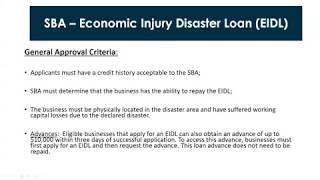
That is correct, that is correct. From the time of approval, the 11 months. So that's something to keep in mind. It's a very important a part of this, of this plan. Thanks, Ray, for bringing that up. Okay, and let's go to the next screen, please. Okay, so the general approval criteria: the business owner's credit score, the credit history, it has to be acceptable to the SBA. And the business owner, in order to qualify for the loan, must demonstrate the ability to repay and to service the debt. Business owners physically located in the disaster area— and this, of course, is the United States, across the United States, right? And then of course at the bottom, more about the advance. This is, this was an additional provision added to the Economic Injury Disaster Loan program after the signing of the CARES Act. That, and this, and here it was a case where business owners who had previously applied for the EIDL would go back to, to the online portal and navigate through 4 or 5 screens and check off the box for the receipt of the $10,000, up to, up to a $10,000 advance. And of course you have to provide your bank routing number and and your check account— checking account number. That's an important, important process, I think, because if a business owner is denied— if denied, okay, so the advance is to be funded within 3 days of application submission and review. So it's a— there would be a review process involved at the SBA. So within 3 days of that review process of your application, you will receive the advance. And in the event your loan application, for whatever reason, is, is not approved, you've received an advance that advance could be forgiven. And so, and just one point to remember or to know of is oftentimes business owners will— their initial— through the initial process, their loan application may be denied or they disapprove. The SBA has a a reconsideration process, and if in the event something like that occurs, I strongly recommend that you follow through with the SBA for reconsideration of your loan application. I think that's a very important step too for those whose applications are denied.
[FOREIGN LANGUAGE] And I think you make an important point, Tony. Because, you know, our office also went through the previous Thomas Fire, the mudslides, Malibu Fire. So unfortunately, we've had some practice bringing clients through this process. And I remember during the Malibu Fire, we had a client who applied for about $400,000 and they were turned down. And at that point, they thought they would give up because they figured, well, it's just like a bank, they turn you down and you're done. But then we told them about this appeal process and we were actually able to help them, you know, remedy what caused the turndown and then they ended up getting the money after all. So I think that's a real important point that you make, that this particular loan, not the PPP but the EIDL, is the— it's a direct loan from SBA, so you can't have an appeal process. So that's It's very different than the other loan process that we'll talk about.
Okay, and to the next slide, please. Okay, program. Okay, so now this is the, the second SBA program, Paycheck Protection Program. This is through— this lending program is through— well, it's of course, it's part of the CARES Act, right? And—
sorry, could I interrupt really quick? And I just want to make sure that we've covered everything in the EIDL as well.
Certainly. Great.
Could you just talk to really quickly about if you are a sole proprietorship and getting the $10K grant under the EIDL?
Yes, so if you're— if, well, for all business owners or business entity types, whether it's a sole proprietorship, an LLC, a partnership, or S or C corporation, those business owners are eligible to receive the $10,000 advance. And The manner in which to receive the advance is to navigate through the SBA website portal. Got it.
Understood. And two more things on that. I assume that people can also apply for both the EIDL and the PPP. Is that correct?
Absolutely. Strongly recommend that business owners apply for both. And there is also an SBA bridge loan. There are loans available through— at the state level. In California, there's through the IBank. And then of course, local government counties are offering— across the country are offering economic— injury disaster loans, and they are available as well.
Got it, that's awesome. And then a lot of the questions that we had come in before this webinar were many of the people that are attending right now have already applied for the EIDL and they want to know what happens afterwards. You get this application number, but then it just kind of sits there, and what can they expect to be the time that they'll hear back and who are they going to hear back from?
Right, okay, and so you The SBA loan officer will contact the business owner. I'm told that it would— it could take upwards of 3 weeks for that contact to take place. During that time period and before that, I recommend that business owners contact and call the 800 number to determine the status of their application. Once you're contacted by the SBA loan officer, additional documents may be required, and some of those documents would include personal financial statements. It's an SBA Form 413. Potentially, that will be a document requested. There is an SBA Form 2202, uh, Statement of Liabilities for the business entity. They may also ask and request an IRS 4506 request for income tax return transcript. My, uh, you can access these forms On the SBA website, they have them listed. I recommend in advance of hearing from the SBA loan officer that the business owner consider preparing those documents in advance.
Great. And just because you just mentioned it, and I'm sure we'll send a follow-up to everybody afterwards with this included, but that 800 number you mentioned, can you just say that out right now, and I'll be sure to include a link later on that as well?
Certainly. And hold on a second. It's— give me one second. I will provide that at a later point as I need to.
Yeah, no problem. Not to put you on the spot on that one.
Thank you.
And I do— just because we're trying to split this up in both an EIDL section and a PPP section, if I could just pause there. Tony, this is great information, but just pause there for your part And ask Les, is there anything that you want to add to this part of the section?
Well, there's only one question that I would have, and that is, is there any organization, you know, other than they don't qualify because of economics or so, what have you, that are specifically excluded from participating?
Yes, there, there are some organizations— lobbyists, as an example, are excluded. There are entities involved in illegal activities are excluded. On the SBA loan portal for the the EIDL loan, there are about 6 or so boxes to check where there are questions if you are asking whether or not you're involved in such activities. And if you're checking yes, then of course you can't proceed. Does that help?
Yes, thank you.
Right.
And then This would be super helpful as well. Luke, you are a small business owner and you have already applied for EIDL. Would you be able to speak to your experience on that?
Yes, thank you. We are a 20-year-old home decor supplier and our customers are mostly major national retail chains. For example, the off-price retailers, you know, TJX Company, HomeGoods, Burlington Ross, et cetera. And also specialty retailers, and also some of the larger, I would say, national chains, Dollar General and Walmart. So they perform very differently in this crisis. Off-price retailers, in a way, are shutting their door for this month, next month, potentially in June. So affecting big time, and also prolonging their payment for 90 days. Whereas the stores that provide essentials, meaning food, they are still going very strong, like Dollar General and Walmart. So we definitely have a very great downturn, you know, resulting in a lot of deal cancellation, roughly half a year worth of deal cancellation from many of the, I would say, the off-price retailer and specialty retailers. And it feels like it's worse than the 2008 financial crisis. Worse than the tariff when the tariff hit us about a year ago. And so the two programs are really very important. The EIDL program applied about last week. The process is relatively straightforward. The two programs, you know, are different in that the EIDL program you apply directly from SBA. So go to the SBA website to apply. In addition to the usual question about identity of the business, requirement. The two key questions, the two numbers, you know, in the EIDL program or EIDL are the top line sales number, the gross receipts, and the second number is your cost of goods sold. Those two numbers I find it very handy just to go to my tax return because on your tax return, for the business tax return, is the Form 1120. And 1120 on line C, line 1, it's really talking about the gross receipts of sales. So that's the number I directly, you know, put it in the EIDL program. And the line number 2 is cost of goods sold, which is the COGS, which is also the number that, you know, EIDL program asks about. So those are the two numbers I put it in, you know, for the EIDL program. The process took probably, yeah, like Tony said, maybe 15, 20 minutes. And after that, I received, of course, an acknowledgment, you know, about my application. But so far, I guess I have not heard back from SBA yet. Thank you.
If I may, you know, Ray had mentioned force majeure, and I just wanted to mention that, you know, that's something depending on what your contract says, but it may certainly give you an opportunity if there's an act of God to be relieved of obligations that you might otherwise have. But this is something that you really have to, you know, talk to your attorneys or your accountants about to see if you qualify. But it's a good idea to look at your contracts and your responsibilities and see if the force majeure applies.
Great.
Thank you, Les. And just as a reminder to all of our attendees, we will have a Q&A after we have the PPP section. So I know some people joined us late and are asking us some questions already, so if you could please hold your questions back until then, we'll give you plenty of time to ask that and hopefully get everything answered at that point. Uh, Tony, I'd love to pass it back over to you. Um, leave it back to you. Thank you. Tony, I think you're muted. Let me unmute you.
Oh, sorry about that.
All right, you're back on loud and clear.
Okay, thank you. The telephone number, the 800 telephone number for SBA customer support is 800-659-2955. 800-659-2955. I, I'm going to recommend, uh, for the, um, the EIDL, say 2 or 3 days after your submission and maybe once a week possibly, uh, phone the number, phone customer support. Um, I'm suggesting to people to call— we're on the West Coast to call early in the morning, say maybe 5 o'clock, or late in the afternoon. There have been occasions where I've called that number and a person answered immediately. So, but strongly recommend that, that you do some follow-through on that.
Okay. Yeah, I, I think especially now it's really important for anyone applying for these programs to self-advocate because We've seen policy changes literally, you know, midweek. The rules will be one thing and then all of a sudden they change. So it's really important to, to do that follow-up. If you get a denial letter, just keep on applying. So it's, you know, we've seen a lot of clients benefit from that self-advocacy for sure.
And also on the economic Injury Loan Program, we're aware of people having— receiving approvals. Individuals that may have applied, let's say, the third week in March, and so the approvals are beginning to come in. Okay, so let's move over to the Paycheck Protection Program. And so let's go back to the previous screen. Thank you. So PPP— PPP is— was designed to incentivize small business owners to keep their workers on payroll. Portions of that loan are forgivable— are forgiven, can be forgiven. Provided that they are used to pay for payroll, rent, mortgage interest, or utilities. PPP will be available through June 30, 2020. How can you apply? It's— you're submitting your loan application to SBA 7(a) bank— bank to banks, and it's for businesses that with less than 500 employees, including sole proprietorships, independent contractors, and self-employed people. Of course, nonprofit organizations, veteran organizations are also eligible. And to the next page.
Okay. Oh, and Tony, I would add too, I mean, we've gotten calls, many of our attendees right now probably belong to some kind of trade association, and many of them are 501(c)(3)s that would qualify under this, chambers of commerce, for example. So it's also good to get the word out on this. I I've seen chambers close because they assumed that these programs didn't apply to them.
Okay, and how to apply, again, through 7(a) lenders or banks that offer 7(a) loan programs. Okay, and next page. Loan details and forgiveness. So the program PPP is designed to keep employees on the payroll, and based on the calculation of payroll, there's a worksheet that's available. But essentially, you're including your payroll costs and related taxes and insurance— employee insurance-related costs together with your rent, the cost of rent and utilities. And the aggregate, 1/12 of that amount, that total, is the projected loan amount. Again, that process is that going— you submit an application to your banker, 7(a) lender, and they provide an application, and you're applying directly with banks in this case. And for the next 2.5 months, if you continue to employ your, your total FTE count, upwards of 75% of the loan amount can be forgiven. There is a 6-month deferral. There is no collateral or personal guarantee required. And there are no fees from the government or through the lender charged against the loan amount. Okay, and the next screen, loan details. And forgiveness. So forgiveness is based on the employer maintaining or quickly rehiring employees and maintaining the salary levels. Forgiveness will be reduced if full-time headcount declines or if the salaries and wages decrease. The loan matures in 2 years, and the interest rate is 1%.
Uh, and, and that, and that's an important feature, Tony, because as we look at the EIDL loan program, that's a 30-year program, whereas this program is a 2-year program. So it's really, really focused on the payroll part of your costs, um, and that's why a lot of clients are looking at both.
Yes, and of course the interest rate is extremely low. It's 1%. So the opportunity or situation where up to 75% of the loan amount could be— can be forgiven and the remaining— the interest rate on the remaining amount is 1%, that's good. To obtain additional information about the Paycheck Protection Program, I recommend that you go to the SBA website. The link is provided in this screen. Okay, and that's it. That's all that I have.
Yeah, well, and, and again, one of the things that we're hearing, because we get a lot of feedback from, from our clients who have applied to this, overwhelmingly most of the banks are loaning to clients that they already know So we always try to keep updated on which banks are looking for new relationships, new clients. So that list always seems to change because the majority of banks are looking at existing clients. We seem to find a bank that's looking for new clients and that those relationships, you know, they tend to get filled up quickly. So we're always trying to update our clients on that. But your first place to stop is definitely with your existing bank relationship.
Thank you, Ray, really appreciate that. And thank you, Tony, that's an excellent presentation as well. Les, do you have anything to add to that in regards to the PPP?
No, just, you know, a question: will these slides be available to the folks who are on this video?
Yeah.
Okay, great. Yeah, we will be providing a follow-up email after this, so So we'll include this presentation, some videos as well, and then we also have another webinar happening this Friday at 11 covering the same topics and hopefully answering any questions that have gone unanswered at that point. So please make sure that you register for that. The link will be included in that email as well. But I would want to make sure that— Luke, could you speak to your application process in applying for PPP? And what you went through there and anything that you suggest to people to help them out.
Thank you, Dylan. PPP program, the application is similar in terms of time and preparation to the EIDL program. In our case, we bank at Citibank and Bank of America, and I chose to apply from Bank of America. And Bank of America made it available on Friday last week. And the process is that first you have to log in to your current Bank of America account, which is a business account. And then they did some great programming, you know, linking to a lot of the information about the company already. They know what type of company we are, where we're registered, and tax ID number, and so on. So, and the— but, you know, the PPP program, it tends to ask a few more questions. For example, it asks about, you know, the payroll information, asks about the rent information. So I also find it very handy to use the tax return, which is 1120. You know, on line 13, it's listed the salary and wages. You know, on line 16, you know, listed the rents, and 17, the taxes and licenses. And '23, '24, it's about a retirement plan that's also covered by the program. So what I did is simply add all of those numbers of 2019, add them together and divide by 12, which arrived at a monthly average. And then, you know, 2.5 times is the amount of loan that I applied. And comparing to the EIDL program, I provided the two numbers, the total sales and cost of goods sold, but I don't actually know how much loan will be given, if any. Whereas the PPP program is different. The amount of loan is in a way defined if it is approved. So those are my experience. And also, after I applied, I received a notification. And also yesterday, I got an email from Bank of America requiring additional documents. And those documents, namely, are 940 for 2019, which is the payroll data, which includes the number of employees I had and total number of payroll and so on. And also, many of the participants today, I realize, that are independent contractors and sales reps, which we, you know, know many, many of you. And I heard from the peer groups that for independent contractor, very similarly, you potentially can use your Schedule C in your tax return 1040. Because Schedule C is very similar to a business tax return, including a lot of the, you know, gross sales and compensation, payroll data, you know, rent, et cetera. Of course, consulting with your financial advisor, legal advisor when you're putting all those numbers. But I think those are very handy in my experience to apply both programs.
Great.
Thank you, Luke. Really appreciate that. And, uh, Ray, one of the other big questions that we got for PPP is also in regards to what Luke just hit upon, which is sole proprietorship. Do you want to add anything to that and also maybe talk for a second about 1099 employees?
Um, I'm worried if you can address that, Tony.
Uh, yes, so sole proprietorship, Schedule C sole proprietorships, as well as, uh, independent contractors. Independent contractors, uh, also, uh, with, uh, pay— with tax return reporting, uh, their activity, business activity is reported on a Schedule C as well. Sole proprietorship, Schedule C. And so it's a fairly— it's a similar process for the two, sole proprietors and independent contractors. And it's a matter of applying for the Economic Injury Loan. You're providing gross sales and cost of goods. Or I, as I was explained to me by an SBA customer support representative, cost of goods is the term is for manufacturing environment. The question, what they suggested for service-related businesses is to include all of their expenses that add up to their pre-tax profit. So you're reporting your gross sales and your total expenses on those two lines, gross sales and cost of goods. And then of course the calculation of the— on the PPP loan side, that loan application, you're including— you would include the amount, let's say the amount of your pre-tax would be the basis for that calculation of the 2.5-month calculation of the loan value.
Great.
Well, uh, also, yeah, also real quick, I would add on the, um, I know a question came through on the EIDL loan, um, are they using a credit score for the EIDL Advance. So they won't tell us exactly what their criteria is, so we, we can't tell you it's this or that. But what we— what just by the experience we see of clients who have been both approved and denied, it seems that that first tollgate, as you were, it is decided, you know, on, on the credit score. Or it seems just, just because we, we see how fast they reply So I think credit score does influence it. We just don't know what that credit score is. You know, some have said, oh, it's 650, 660 or more, but we don't actually know what that exact number is. But I would say that your credit score would have a bearing on the approval of it. The clients that know they have the $10,000, they're told when they're called back that they have it. But I'm also told that might not necessarily be a $10,000 guarantee. It could be less than that amount. So, so as much as you don't have to, you know, get the ultimate loan approval to get it, that, that $10,000 is a maximum. Although I haven't heard any other numbers. Have you, Tony?
No, to date I have not heard an individual receiving a notification on the $10,000 advance.
Yeah, I've heard a couple, but I haven't heard someone say, oh, they got less than that. But I am told they have to tell you that you're getting it.
Right, and Congress is deliberating this possible fourth bill right now for the extra $250 billion, so maybe we'll hear more about that at that point if that passes.
Yeah, well, and the big question is too is that there still is money that needs to get deployed. And, and so there's, you know, again, in this whole process, it's really important to self-advocate. In fact, we're urging our clients that if they have certain difficulties or experiences, to send it to us or send them to SBA, because we are finding that SBA is adjusting and listening. You know, like the original loan process of the EIDL loan, you know, the EIDL loan, you know, it had all kinds of language on property damage, you know, because most of these EIDL loans when they're used are for a natural disaster, not a shutdown from a pandemic. So because of that feedback that it was too complicated, they simplified it. So, you know, again, this is a time to really as businesses reach out to your electeds, reach out to SBA, because there is a learning curve going on where we've seen adjustments.
That's great. And then, so we're going to open up to Q&A right now, guys. And so all participants, if you can see the bottom column of this presentation, there's a little button for Q&A. There's also one for chat. Ignore the chat one. Just focus on the Q&A. Please type your questions in there. I will be moderating those questions as they come through. So please type away right now, and I'll make sure to point those at the proper panelists to answer those questions. Also, I'd like to thank all of our panelists, Ray Bowman, Les Gold, Tony Elliott, Luke Wang, for sharing all that expertise. It's incredibly useful, and I'm sure it's going to be useful in this Q&A session as well. We just want to talk one second about SureFront. We are committed to helping business partners achieve their shared mission with the shared technology. So it's very important that our customers and our communities are taken care of during this difficult time. And we're happy to answer any questions or pass those questions on along to who we think may be able to best answer those, which is why we're hosting another webinar on Friday at 11:00 and also posting additional YouTube videos regarding these topics and hopefully posting some links in a follow-up email to this as well. So we'll continue to help our community on that and do everything that we can to stay committed to our partners. So I see a bunch of questions coming in through Q&A right now, and I'm going to read through these and talk about them at the same time. So bear with me if I make any mistakes, but hopefully I won't. First one comes from Michael Tell. He's a sales rep, works in wholesale apparel, is paid a monthly commission for multiple companies and that he represents and pays taxes on 1099. His local bank, Wells Fargo, has stopped giving PPP loans. So, and I know a lot of people have been affected by Wells Fargo shutting down that portal. And he, does he have other options for other banks? He'd like to know. And also, will that loan be forgivable as an independent contractor? Does, Tony, are you able to answer to that? What happens with Wells Fargo customers or other bank customers that maybe don't have that portal up yet, how do they apply for PPP?
Yes, so I would suggest that you search locally, communicate with your network to find independent banks that, that are offering and participating in this program. I'm thinking if you were to do a Google search, you could certainly identify a list of independent participating banks.
The other thing that I would recommend is, because I know a lot of our participants may not be in the LA area, might be in other states, but if you go on to your SBA's region's website, so for example, I'm in the LA SBA region. They usually have a list of top lenders. There's also an SBA resource guide that will list all the 7(a) lenders and who they are. So that list can be useful in identifying banks that may be participating. I was given a list earlier of banks that are participating and to what level they're participating. So I can, I can share that list with you as well.
Thank you very much, appreciate that. We got a lot of questions to get through, guys. I'm gonna try to get through these as fast as possible, and I'll try to keep my answers as well as brief as possible to get through them. Another question was about rent. So can you talk very shortly about how PPP can help people with rent or showrooms, how they can use that loan for that?
[Speaker:CHUCK] Yes, so 75% of the loan amount is allocated to payroll. The remaining 25% would go toward rent, interest on mortgage, and utilities. And this is, this of course is during the initial 2.5-month period. Right? So those amounts. And so keep in mind also that amounts available that you receive or loan, if you receive on the economic injury disaster side, you receive a loan, you're approved for a loan on both. There's a situation where they cannot both You cannot use both of the loan proceeds for payroll. There is no commingling. So maybe on the PPP side, any, any additional amount could, could go, could be paid, used to pay, to pay for your rent. And the, the EIDL payments for rent on that side, but, but on the EIDL, there would not be proceeds to be used to pay payroll. There is no crossover there.
Got it, understood. And another question is about credit scores and how those apply to both PPP and EIDL. Have you guys got any information of what might be some base credit scores? You have to have an amazing credit score to apply for these, and are they— is this for both?
Ray, do you want to talk about that?
Yeah, yeah, I can address that. Again, um, they don't give a criteria that say you have to be this credit score, that credit score. Anecdotally, um, we're seeing that, uh, it's probably got to be better than a 660. Um, you can't really quote me on that because that's just anecdotal. But we've seen some clients who had scores well below that who got denied, ones that were above that that got approved. So there is a credit score component in there, but there really isn't a stated credit score in it. And again, they'll look at every situation differently. And, you know, when you think about a 7(a) loan, when you think about even the SBA side, it's very important to self-advocate. So as much as you would negotiate and explain to a bank your situation, your financials, uh, you need to do the same with the EIDL loan with when you talk to the representatives with SBA. So, um, so I think that is a factor, but there are other factors involved that you want to be able to advocate for.
Great, understood. And then in regards to 1099 contractors, I believe they have to have a business checking account because that's what's provided for as a follow-up portable. So like, if you're applying with Bank of America, I believe you have to have a business checking account to apply for that loan. Is that correct? If you don't have a business checking account and you're a 1099, is there any way to apply? And that's for either Tony or Ray.
Yeah, I, I don't know the answer to that question. I, I would suggest that the, uh, the business owner contact their local bank and make that and present that question directly.
So talk to your financial advisor for that.
Yeah, I know, I know that the majority of banks— what we're seeing as a report is the majority of people who are applying with the banks, if it's not their bank, they're asking them to set up a checking relationship with that bank. So I think that's going to be part of it, just because if they're going to get a loan, there's got to be some way to to transact that loan. And I think for certain security purposes, they need to establish that client as some, you know, someone as a client through a checking or, or some type of account setup. So, so we are seeing that, that they're, they're asking for that.
Okay, that's great. Yeah, we have a lot of questions coming about 1099s for both PPP and the EIDL loan as well. Let me scroll through the questions here. Uh, another question here along the same lines: Is PPP for W-2 employees only? Can we apply for both 1099 employees and, uh, and for both loans? So can you guys just reiterate once again, because I think this is the bulk of the questions coming about 1099 employees and how they are affected by PPP and EIDL. Just, just a brief summary answer on that would be great.
Yes, so here on PPP, the payroll calculation seems to exclude 1099 payments. However, those individuals receiving— those independent contractors receiving those 1099s are able to apply separately for their own business under PPP. To receive a loan approval.
Okay, got it. That's great. And let's see more questions.
I'd like to also add, keep in mind some of the current policy or guidelines are subject to change. So I'm encouraging people to apply. Apply for both loan programs and present your questions, more specific questions that you may have, present them to your financial advisor, your CPA, the SBA customer service representative, or the bank. I'm encouraging you to take action, not to say, well, it doesn't apply to— this program doesn't apply to me. And based on the information that, that you, you're aware of, uh, just— I, I'm— it's, it's very important to apply.
Got it. And here's another question. Said, if we apply for both EIDL and PPP, will it affect our approval for either? It's my understanding that it does not. Uh, Ray and Tony, can you speak to that?
I get the impression that the two will be combined, could be combined for some purpose, although I'm not, I, I, I'm not completely clear on that. That, that would be more, um, uh, the, the SBA loan officer would provide more guidance on that, on that side.
Got it.
Yeah. I think too though, if— I mean, technically you can apply for both, but let's say if you accepted both, you can't have overlapping costs. So in other words, one loan might— would cover things other than payroll, and the PPP would probably be focused on payroll and then those 25% of costs. So, you know, you could, but you would have to separate those costs. They're not going to give you two separate loans to pay for the same thing under these programs. So there you have to know your costs well and, and, and be able to identify those. Um, one, one quick thing I wanted to add about independent contractors, 1099s. Um, we're encouraging all of our clients to apply for unemployment. Um, there are, um, depending upon the state and I know there are some unemployment benefits that may be coming with the CARES Act. Again, some of these things haven't been fully implemented and they're implemented differently from state to state, but during a disaster there are times when independent contractors, 1099s, can, can apply for unemployment insurance. So I would also try to get into your system even if you're denied, because again programs may come into effect that would, that would benefit you.
That's very helpful because another person actually asked, uh, will these programs interfere with them applying for unemployment compensation? So I imagine it does not.
Yeah.
Okay.
And then another person asked, on PPP, can you claim not only salary but commissions and distributions?
You're talking about the distributions to the sole proprietor? Yes, that would be— that would be included in the calculation as part of the base payroll amount, right?
Right.
And then commissions. Commissions— are these commissions to employees or commissions to independent contractors? You know, I do not know here, but I would say if it feels like two independent contractors, the independent contractor would apply for a PPP loan process. Those commissions paid to independent contractors as reported on 1099s would not be included in the base dollar amount for the loan calculation.
Okay. And what if— this is another question that came in— what if you are a 1099 and need to apply for the PPP but do not have tax records of 6 months or less? Imagine they're saying 6 months or more.
Tax— okay.
How many—
what do you think the breadth is of the tax records that they need to apply? I'm sorry, uh, what do you think the breadth is of the tax records that they need to apply for PPP?
Yeah, um, I— it is perhaps consistent with, uh, uh, the EIDL, um, the 2018. If the person has not filed a tax return for 2019, um, uh there may be a request for the 2018 tax return.
Okay, got it. So guys, we, we have still a lot of questions coming in. I think we're going to answer the bulk of them, uh, on Friday. But, you know, let's take maybe about 5 more minutes to answer some subsequent questions as we've been going a little over our time allotment and people might have other meetings they're trying to get to. So let me just scroll through. And let's see what else we have here. Again, this was about being a business owner. Can you also apply for unemployment compensation? A number of people are asking about calculating payroll, and I believe you guys have a payroll worksheet. We can include that in the follow-up email, is that correct?
I'm aware of banks providing worksheets. ADP is also providing their clients with a worksheet, and other payroll services are providing such worksheets. Yes.
Okay, and I'll— if I'll find a link to one and make sure to include that in the subsequent email. And we had some questions come in over chat, so let me just scroll through those quickly. Great. And can you, Tony, speak very briefly about— and Luke touched upon this— which is calculating the payroll. So you take the average monthly over a year and then multiply that times 2.5. Can you just tell us quickly how to do that calculation?
Okay. So you could go to the— your payroll, year-end payroll reports, and I think I heard Ray or someone mentioned— no, I think it was Luke. Luke mentioned that the bank within the last several days requested payroll reports to support his application. The gross payroll as shown on your W-2 transmittal, the total gross payroll, that would be a good figure to use. It's the total payroll to all employees. You'll need to make an adjustment for individuals whose W-2 wages are greater than $100,000. The maximum amount is $100,000. So there will be that type of adjustment. And so as an example, let's say the, the gross amount for maybe a business with 3 employees is $120,000 for the year, the gross payroll. So 1/12 of that would be $10,000, and Then to that, so it would be 2.5 times that amount or $25,000. I've also seen calculations or examples where the gross pay— an approach taken where gross payroll plus your annual rent plus your utilities or in the case of a mortgage interest, the interest for the year. So the aggregate of the, the wages, the rent, and the utilities— total those three amounts and get a 12-month average and up and multiply that, that total by 2.5 times. So I've seen both examples. I'm not clear about the actual example, what the— the basis. That would be a matter of working through with your bank.
Got it. And Luke, you have already done this. So in determining average monthly payroll— getting several questions on this— about including the rent, utilities in this number, or any other things that they should include in that number.
Yeah, correct me if I'm correct or wrong on this, Tony and Ray. My understanding is that for the PPP program, when determining the monthly average payroll cost, when I did my form, is that it uses a payroll a number of factors, including rent and everything. So the payroll is broad, and when that's forgiven, potentially in the future, it can be applied also to a broad spectrum, you know, including payroll and rent and mortgage interest, etc. Whereas in the EIDL program, in the EIDL program, the amount of loan as purely decided potentially by the SBA, which, you know, probably I will be asked for future questions. Yeah, and what that covers, it probably will not be the same line item as the PPP, right? Because if it is already covered, so that appears to me as a working capital, you know, how you keep your business afloat to have the cash flow.
Got it. And, uh, health insurance is included in that calculation as well, right?
Yes.
Okay, great. And I think I'm going to make this the last question, which is, um, they're asking in the application how many employees they have. Again, this is about 1099, so he says, I am a 1099 sales rep. Am I the employee? Should I put 1 or 0? Ray or Tony?
I'm going to say one, although I am going to suggest that you defer to your banker and with a follow-up question on that to the banker as well as to the SBA. Some of these questions and the guidance that's been offered to date, there are— there seems to be some gaps. For example, the employer tax burden associated with Social Security and Medicare. The employee, half of that amount is deducted from the employee's pay, but the employer also pays half or roughly 7.5% of gross payroll. The AICPA suggests that the employer tax burden should be included in the basis of this calculation. I'm not clear on that, and I expect that in days and weeks to come, the SBA and the Treasury— US Treasury as well as Congress is going to be offering additional and providing additional guidance and information as the program is fully rolled out.
Great. And this has been great, guys. The last thing I want to talk about is follow-up. And so I think, Ray and Tony, you mentioned that we can connect anybody here with an SBA advisor. We have the phone number as well. We're going to send a subsequent email, as I've mentioned a few times, and we also have the webinar on Friday at 11:00 AM Pacific again. Ray and Tony, could you speak quickly to that and about the SBA advisor?
Yes. So just to clarify that, We're the Small Business Development Center program, so as much as we're an SBA-funded program, we're different than the SBA reps that will be dealing with you directly on the loan matters. So what our role is, is to provide technical assistance, helping you look through your financial statements, helping you apply for these programs. So, so really our role is in the technical assistance area. So I often get a question that someone will say, well, 'You're SBA, can't you look at my loan number and see what the status is of my PPP?' But we're not that end of SBA. We're a funded program through the SBA through different host organizations. So, but to that end, where we, where we add value is we're a program that goes throughout the year. So we're not just here when a disaster happens, we're here day in and day out. So, uh, we engage— we have clients that we've engaged with for, in this office, over 10 years that, you know, we're helping them through the disaster, but we're going to be seeing them and helping them grow, you know, 5 years from now. So, um, so our role is, is making sure that we're pairing the right technical advisor to the right client. So whether that's, uh, understanding, uh, you know, where I am in California, unemployment issues or understanding these loan programs or just strategizing about how to deal with, you know, supply chain issues or marketing or e-commerce. So, so, you know, that's our role in this picture, but we're more than glad to help, help you, whether it's you, whether you want to deal with someone who's local to your area, we can provide provide the local number for that, or if you want to deal with my office directly, you know, again, during this COVID crisis, there's no borders here. I won't say, well, you're not in Ventura County, so I can't talk to you. We're helping all kinds of people, and we're glad to do it.
That's great.
And that phone number, again, we will send it in the follow-up email, but just to say it out loud, is 1-800- 1-800-659-2955. Again, 1-800-659-2955.
And also too, that's the SBA number. That's not our hotline, right? So that's the number for the loans. For our SBDC program, it's 805-409-9159, and again, that rings through our hotline. I would also invite everyone to look at our website, edcollaborative.com. So my particular SBDC is sponsored by the Economic Development Collaborative of Ventura County, and if you go onto our website, we have not only the link to our hotline, but we also have a link to our resource guide. And again, we're updating that resource guide literally daily, so Please use it as a resource if it's helpful to you.
That's great. Thank you very much. And Luke, Les, Ray, Tony, do you have anything else you want to add?
I had one question, but I think Ray answered it beautifully at the end. I just wanted to know what their relationship was to the SBA.
Perfect. Well, thank you very much for everyone attending. I hope we helped a lot of people out there. That's our goal to do so. Again, this is sponsored by SureFront, so please check out our YouTube channel. Just go to YouTube and go to SureFront. We have two videos we recently posted on how to apply for PPP and also how to apply for the EIDL loan program as well. We'll be posting subsequent videos, so make sure to subscribe. You can always go to our website, of course, at surefront.com. We are providing our services at SureFront for free during this crisis. So that we can help keep everybody connected in the retail industry. And we'll be having a subsequent webinar on Friday at 11:00 AM Pacific. We'll make sure that we send out an email with those details, with the details on how to follow up with SBA advisors and Ray and Tony, and then also, of course, on those videos as well. So really appreciate all the panelists today. That was very helpful. Thank you so much for taking your valuable time to come here and talk to everybody and help them out. And thank you for all the wonderful questions from all the participants as well. And thank everybody and stay safe out there.
More from Luke









THE COMPLETE GUIDE TO PLM IMPLEMENTATION I PART 1: SHOULD YOU INVEST IN PLM SOFTWARE? (4K UHD)

THE COMPLETE GUIDE TO IMPLEMENTATION I PART 2: HOW TO PURCHASE THE BEST PLM SOFTWARE (4K UHD)

THE COMPLETE GUIDE TO PLM IMPLEMENTATION I PART 3: HOW TO IMPLEMENT PLM SOFTWARE (4K UHD)