Wholesalers/Sales Reps - EIDL & PPP - Webinar with SBA (4/10/2020)
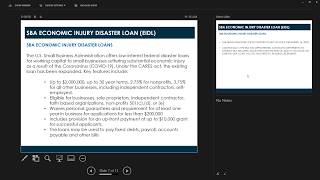
SBA panel explains CARES Act relief for wholesalers and sales reps. PPP offers up to $10M at 1% interest with 75% payroll forgiveness; EIDL provides up to $2M at 2.75-3.75% interest plus a $10k advance. Sole proprietors, LLCs, and independent contractors are eligible.
Chapters
Well, welcome everyone and thank you for joining us. I am Dylan with SureFront, which is the B2B app for retailers, retailers and suppliers to collaborate better together. And we're very proud to sponsor this webinar today as we've been hearing from our peers and partners and understand how difficult and uncertain these times can be for many small and medium-sized businesses. So we want to make sure that we can do everything we can to get all of our peers the answers that they've been looking for regarding EIDL and PPP programs, which is why we assembled this fantastic group of panelists today that can help provide some guidance. So I'll introduce them shortly. Uh, the focus on today is going to be fourfold. We're going to start with what is relevant in EIDL and the PPP programs for suppliers, wholesalers, and sales reps. That's the majority of our partners. How to apply, uh, then what happens after your application has been submitted. And finally, we're going to have a 15-minute Q&A session to answer any additional questions you may have. So please don't put any of your questions in the chat function that you see there, but all of your questions in the Q&A section that you can find down below, and we'll get to that at the end, and we'll give some nice time. If we get a lot of questions coming in, we'll extend that time a little bit too. Um, and we've had many questions about sole proprietorships, so we hope to answer all of those questions during the Q&A. And then I'll help, you know, get our panelists to angle maybe some of those questions towards sole proprietorships as well. So after the webinar is over, we're also going to send a follow-up email to all attendees with some related information and videos that I think you'll all find very helpful. And you can also find our content and our videos at our YouTube channel. If you just go to YouTube and enter Insurefront, We've been putting up videos every few days about this, about EIDL, PPP, about the CARES Act, and, and how to help all of our partners out there. Also, we've made our software free during this time, so I urge everyone to go to SureFront.com and just click on the sign-up button, and you can use our software for free. It is an incredible way to connect everybody in the retail industry And so I think you're going to find that very useful. So please, again, that's SureFront.com and just click on the sign-up button at the top right. As a brief disclaimer before we get started, please make sure to consult your personal financial advisor before making your own financial decisions. I myself am not a CPA and we're not your personal CPA, so we just want to make sure that we put that out there. With that, I am pleased to introduce our panelists today. Today, starting with Luke Wang, who is the president of Jia Home, a wholesaler supplier of home decor and major retailers. Also, Shorefront's advisor who will be joining us shortly, Les Gold from Mitchell, Silberberg and Knupp. And then I'd like to finally introduce everyone to Ray Bowman and Tony Elliott from the SBA, who are really the experts on all of this. So with that, I'm going to hand it over to Tony.
Good morning. So, and I'm going to hand it back to Ray because, Ray, you have some introductory— there are a couple of introductory slides that you're going to offer, right?
Correct, correct. So my name is Ray Bowman. I'm the Director of the Small Business Development Center for Ventura and Santa Barbara County. I'm part of the Los Angeles network. So the Small Business Development Center program, it's a program sponsored by the Small Business Administration, the US. There's over 1,000 service centers around the country, and our centers give free technical assistance to medium and small-sized businesses. Free assistance, it's almost a misnomer because actually it's prepaid by your tax dollars. So, so I lead a core of about 40 advisors out of my center. And we have centers like this all over the country that help clients, and especially in this time, navigate through questions that they'd have, not only concerning these programs but concerning a whole range of business issues from e-marketing, import-export, finance, QuickBooks. So we have all kinds of different experts that can help businesses navigate through whatever issues they may have. We're not just a, a program that's around just for disasters. We've been here for 35 years, we'll be here well beyond this crisis, but we're here for you. So before, during, and after. So with that, I want to preface that you can reach out to the SBDC in your area if you're not in the LA region. However, during this crisis, we're taking calls from any and all. We get— our center gets calls from out of state, and we realize that we don't want to delay a business just because they haven't called their local SBDC. So we're open and available to everyone. I just wanted to make a quick remark that a lot of those in the audience are sort of fall near and dear to me because I spent— I've spent over 30 years involved in import and export activity. I'm a member of the U.S. District Export Council. This is just a quick slide showing, you know, a survey that was done by the American Association of Exporters and Importers. And this just highlights— this survey highlights that especially those of us in retail who who are impacted by import and export disruption. You know, 62% of the AAEI members have experienced slowdowns in their transportation disruption and air freight traffic, you know, slowdowns in ground transportation. So this is hitting a lot of different sectors. One of the things that we're always recommending to businesses is one, Look closely at your insurance contracts, uh, contact your insurance providers, um, understand what those contracts cover and don't cover. And again, during this crisis, um, we have seen changes in the way, um, some of these, uh, insurance programs have been looked at from state to state. Tracking your losses in any disaster, it's important to know, um, how your sales, how your business activity is tracking against a normal year, as well as calculating how long it's going to take for your business to get back on its feet. So even in uncertain times, it's important to try to calculate what that looks like. And then looking at your performance contracts with both your suppliers and your customers. One of our panelists can address this, but force majeure clauses, or what we call Act of God clauses, it's important to understand those. Understand your performance liabilities as well as those of your suppliers. Filing for unemployment— there are a number of different programs, and again, this differs from state to state, so we're not presenting on this, but we are urging companies to look at the different unemployment programs that are available for both the employer as well as the employee. And there are special programs that even apply to independent contractors where they can apply for unemployment insurance under the CARES Act. And understanding your cash reserves, because, you know, whether these programs exist or not, the thing that remains true is that we're all battling cash flow because of decreased sales. So those are important things to look at and consider. So at this point, I'd like to bring on Tony Elliott. He's one of our senior advisors. He's a CPA. Seasoned professional, and he works a lot with our clients in helping them navigate through these programs. So part of— not only does Tony bring his talents in financial advising, but he also brings his talents in having helped many, many clients navigate through these kinds of disasters. So with that, I'd like Tony to give his give the rest of the presentation for us.
Thank you, Ray. Good morning. So there are— the SBA offers two loan programs for COVID disaster, including the Economic Injury Disaster Loan, referred to as EIDL, and the Paycheck Protection Program, PPP. So first we'll talk about the the Paycheck Protection Program. The SBA loan program may be accessed through any bank that currently issues SBA 7(a) loans. So you should— the starting point is to check with your, your local bank or your business banker to determine participation in, in the PPP program. And so, uh, okay, I'm on. Okay, uh, the PPP program is available through June 30th, 20 of this year. On April 3rd of last week, small business owners and sole proprietorships, and starting with April 10th, independent contractors and and self-employed individuals are able to apply for the PPP loan through their business banker. And Ray, if you'd advance to the next screen, please. Some of the key features of PPP. The eligibility includes— it's for small businesses including nonprofits. Veteran organizations, tribal concerns, sole proprietorships, and self-employed individuals, including and independent contractors with 500 or fewer employees. The maximum loan amount is $10 million. The loans— so there's a provision that where upwards of 75% of the PPP loan is up for to be forgiven provided that you rehire or continue to hire your employees over an 8-week period. That portion of the loan is stated to be fully forgiven. Details in the rollout— there will be further information provided as the loan program rolls out. And of course, with PPP, the disbursements are— the funds can be used for payroll costs, interest on mortgage, rent, and utilities. With, of course, if 75% of the loan amount is dispersed on payroll, that amount is available and can be forgiven. And if we advance to the next screen, Ray. Okay, so the interest rate is 1% with a 2-year maturity. The first payment is deferred for 6 months, 100% guaranteed by the SBA. There's no collateral, no personal guarantees, and there are no borrower or lender fees payable to the SBA. And information on payroll documentation for the last 12 months with a period February 1st of of 2019 through January 31st, 2020. And here to find a lender, if your lender is not a participant in the SBA 7(a) Loan Program, this is a link to gain access to a larger group of participants. And if we advance to the next screen.
Okay, and as I understand, Tony, um, I, I know one of the recommendations we give is for, for companies to first go to their existing bank because it seems like the, the banks have a preference for that. Um, and then the list, as we look at the list of, of, uh, of banks looking for additional clients, that really changes because we've had banks open up, say, we're looking for additional banking relationships, and then they get overwhelmed and then sort of the list changes. But I think the recommendation is to, to go with your existing bank first as far as your application.
Absolutely, that's a good point, Ray. Thank you. Okay, and so next, the, um, the Economic Injury Disaster Loan program, uh, coined as EIDL, The SBA is offering low-interest federal disaster loans for working capital to small businesses suffering from COVID And the key features to this loan program— and this is directly with the SBA, their banks are not The SBA through the, through the Treasury, U.S. Treasury, are funding these loans through the— and it's through the SBA. And the amounts are up to $2 million for a 30-year period, 2.75% rate for nonprofits, 3.75% for businesses, including independent contractors and self-employed. Eligible businesses include sole proprietors, independent contractors, faith-based organizations, nonprofits, and as well as— oh, it's interesting— as well as LLCs, C corps, and S corps. Who have employees under 500 employees. The SBA has waived the personal guarantee, and there is an upfront advance of $10,000 to business owners who have successfully completed the application process. What we're learning in, in recent days, uh, yes, as of yesterday, um, the SBA provided additional information, uh, and they will continue to roll out additional information and, and details on both programs, um, uh, in, in days and weeks to come. Uh, however, with respect to the $10,000 grant or the advance that you access by going to the online portal on the SBA website. You have an option to check a box, yes, I wish to receive a $10,000 advance. You provide your routing number, your bank account, right, routing number and bank account number, and the advance max at $10,000, and it is calculated based on $1,000 per employee, so up to a maximum of $10,000 for the business entity. The— so this is a working capital loan program, and the loan proceeds can be used to pay for fixed debt, payroll, accounts payable, and other bills. So with respect to the two programs, EIDL and PPP, there's a stipulation that there can be no commingling of— or maybe not commingling, but with respect to payroll, if you disbursed upwards of 75% of the loan, of the PPP loan, on payroll. The use of funds on EIDL— you cannot use EIDL proceeds for payroll. It has to be limited to the other categories, which include fixed debt, accounts payable, and other bills. Yes.
Can I ask a quick question there, Tony?
Certainly.
For those expenses, a lot of our partners have, for instance, retail showrooms and other expenses in there that they want to apply PPP towards. So say if they want to apply it towards rent, can you just speak a, you know, a little more about that?
Okay, so yes, for PPP, the categories available would be payroll, interest, interest on mortgage, rent, and utilities. So rent— and, and this was for showrooms— the payment of rent for showrooms would be covered in that category, right? Right. Okay, and it's also available, the business owners could also pay their, the rent through the EIDL loan as well. So there needs to be some planning, and as the business owner is funded, they're going to be additional documentation provided that more fully discloses the use of funds and how they can be directed. And there is going to be a review process between, as I understand it, between the borrower, the small business owner, and their bank, as well as SBA, with respect to verifying the use of funds on any debt amount that's forgiven. Given. So there is going to be a subsequent verification and a rollout of additional, more specific instructions and guidelines as to how the funds are going to be dispersed.
Got it. And then just back to PPP as well, so I can still apply for PPP if I'm a sole proprietorship, is that correct?
Absolutely. And, and so in the case of a sole proprietorship, so let's say their, their, their revenue is $200,000 and operating expenses are a total operating or expenses for the, for the sole, the Schedule C sole proprietorship to say $75,000, then the pre-tax for the business is $125,000 and that would be the basis for for the PPP loan payment to the employee, to the business owner, as I understand it currently. And there would be one adjustment for that. The maximum amount for per employee, it's $100,000. So as the individual, the business owner compiles the information for the PPP application And there's going to be coordination with the— with their bank with respect to adjustments of providing the gross salaries and then making adjustments for bringing— capping any employees who earn greater than $100,000 as it relates to calculating the average payroll. That is going to be reported on the PPP loan application.
Got it. And if I could take a second there too, I know Les just joined us. Les is a partner with Mitchell, Silberberg, and Knupp, and I'm going to go ahead and unmute him. Les, is there anything that you'd like to add in regards to PPP?
Well, I've listened to quite a bit of it. And, uh, there's really little I can add because these folks know a lot more about it than I do. The only thing I will suggest to you is that I did have a client, um, who, uh, filed and, uh, he got the— he got the money within 3 or 4 days, uh, and it was a fairly sizable amount, uh, but it was not in the PPP. So there's really little I can add.
Got it.
And then Luke—
in terms of Yeah, you know, the real question is, you know, who's eligible and how do you do it? You've got the two folks up there who are the best, so very, very little I can add.
Got it. Appreciate that. And Luke, as a small business owner, you yourself have applied for both of these. Would you be able to talk briefly to the PPP?
Yes, thank you. Yeah, actually Tony and Ray has been helping me with PPP. One of the questions I asked them recently is about the independent contractors because those expenses whatever paid for independent contractors now is no longer allowed to count as my expenses, payroll expenses. So my payroll expenses must be only whatever paid to my employees, not contractors. Whereas the contractor, of course, themselves, you know, for example, sales reps, can apply for the PPP. So my process on PPP program is that, you know, I bank at Bank of America and Citibank. and Bank of America appeared to be outreaching faster and had a better portal, so I applied from Bank of America. So what I did first is last week, you know, go online and log in. You have to log in to your BFA account, and then there's a link to file the PPP. And the good thing is that Bank of America already prefilled a lot of the information for me, knowing that after logging in, they know the identity. Know the business entity type and where it's registered and so on, to save some, you know, typing. And for the PPP, really, the number they asked in the first time last week was just purely the total payroll expenses average per month. So I fill in the number submitted, and then there's a follow-up email arriving just last Wednesday, right after the the webinar. And so in that email, they asked me to register to a new website called Intralink. And we— I registered, and in Intralink, there are actually 4 documents they provided to me. They asked me to fill out. And I'm actually going to jump in and share the screen just to show the audience what are those 4 documents. Ray, maybe can you give me the—
Oh yes, no problem.
All right, you can see my screen?
Yes.
All right, so this is the form that I got from Bank of America. You know, it's for me, you know, I'm an employer and I file tax at 1040. So the 4 documents is the Form 940 for 2019, which I have it here. It's an empty one. So 940 for 2019, and they actually need a number, total payment to all employees, right over here. And the last one is tax form 941, payroll processor record. So a blank form of 941 is this. I think the number they look for is the number of employee who receive wages in the recent quarter, meaning that you are in business in 2020. 940 is for 2019. And then the two additional forms One is called the loan amount template, which is this one. So this is the one that to just calculate the loan amount. First they ask about the salary. For example, you know, it's $1 million, and then subtract the amount paid to employees who's not living in the United States. So in my case, all of them are living in the United States, so still the same number. And then subtract the compensation paid to employee whose salary is exceeding $100,000. So for example, as a fictitious number, we put in $100,000 to subtract, so you have $900,000. And the next one, they ask you the payment to health benefit and retirement plan, assuming that's $200,000.
And then you add—
and then the next one is state and local taxes. So this one I got it from my, my payroll record and put in, for example, we can put in $100,000 and then you summation all of them subtotal is your $1.2 million, for example, and then you divide that by 12 to arrive $100,000 and then multiply by 2.5, so the amount is $250,000. And the next document they ask for is simply the $100,000 and $250,000. And then below there are some checkboxes, you know, which are pretty, pretty simple. So this is the refiling. So what I did is on Wednesday, you know, I received, you know, the invitation to Intralink at Bank of America, and I refiled, you know, those forms, basically uploading to Intralink. And down below here, you know, there's something for sales rep and potentially a sole proprietorship. So there are actually two documents required. One is the 1040 Schedule C, which I show an example. I'm sure when you file a tax return, then you will have that. Oh, actually, I don't have it, but it's a Schedule C for the independent contractors. And then the next one is a loan application addendum. It's simply this form. So very, very simple. Yeah, so that is my process.
If I can add, I'd like to add just a couple points. So this is the document request requirements from Bank of America. It's going to slightly vary from bank to bank. One of the things— could you go back to the calculation on the payroll? The starting with the gross payroll, uh, so, and, and then the additional items that are added, that should be added. So here's my understanding: the, um, the employer tax burden for— and they call it, refer to it as the tax burden for employers on Social Security and Medicare— my understanding is that that amount, the amount of additional taxes paid by the employer, the employer's portion is to be added. But here on Item 5, it states state and local taxes. So I'm going to suggest that, that as the business owners are navigating through this process with their banks, that they raise the question about the, the Social Security that employer who pays half of the Social Security and Medicare, roughly 15%, that that amount should be added. Because if it's not, then the employer bears the cost. And so I think that— and I've seen cases and information where it states that that expense should be included.
Oh, thank you, Tony. I may want to revise mine.
Well, you should raise the question, raise a question with the bank, with Bank of America, and say, hey, here's what I understand about, about the, the employer taxes. Okay, and, and the reason for the this not including the independent contractors to this, to this calculation, and it's for payroll, is that the whole, the emphasis of the CARES Act is to, for employers to continue to pay their employees during the initial 2.5-month period as we're as we're hopefully coming to an end of the virus time period. So yeah, so it's mainly for the employees. This particular program, the 75%, the payment of your payroll, it's payments to employees and And the federal government is underwriting that process, provided that the business owners follow certain terms and conditions that will be more fully disclosed as we navigate through this process.
Yeah, Tony, actually the federal portion, you know, the Social Security and Medicare, you know, employer actually pay on top of employees' tax. It's actually more than the state and local taxes over here. You know, these are example number, but the real number actually is larger. You know, the state and local is actually a small portion.
Yeah, well, my question is, why should state taxes be there and local taxes when those are amounts that are deducted from an— from the employees' paycheck and why should it be added? That's at least my question. So, you know, I just— I think that the— as the business owners are navigating through this process, they should engage with the bank and ask further questions. And in days to come, I'm sure more guidelines are going to be published by the SBA.
Thank you.
I get to the—
right, and just for clarification, every Every bank is different. This is Bank of America's portal. Of course, Citibank is going to have a different one, as well as Wells Fargo, which I know has been, you know, shutting down and then recreating and shutting down. So every bank is going to be different, and these were the subsequent documents that they asked of Luke after he applied through the Bank of America portal. So they sent him a separate email asking for these additional 4 documents to be filled out, completed, and uploaded into their Intralink. So just for clarification, every process is different, but you have to apply through the bank's portal and for that bank to then follow up with you afterwards asking for additional documentation, which of course changes whether you are a C-Corp, an LLC, or a sole proprietorship. They're going to ask for different documentation. In Luke Wang's case, they were asking for those forms 940, 941, but if you're a sole proprietorship, they're going to be asking for, you know, more Schedule C type forms. And I will hand it back to you, Tony, to continue with EIDL.
Okay, and so, uh, great. Let's advance to the next screen, please. Thank you. Okay, so the filing deadline is, as it is now, as it currently stands, is December 16th, 2020. And the SBA has implemented additional deferments on existing SBA disaster loans. So as an example, for a business owner who suffered financially during the Thomas fires of 2018— or no, it was 2017— and they have an existing SBA disaster loan, it would apply to them that there is a deferment to the end of 2020 or more or less what I think it's 11 months. And let's see.
Yeah, Tony, it is 11 months. So for example, we had a client who suffered through the Malibu fire They received a $400,000 loan. The payments were deferred for 11 months, but then all of a sudden COVID hits right when they were due to make their first payment. And, you know, the client called us, they were really panicked, but luckily that day we received notice that they were deferring the first payment on those original disaster loans, which, you know, as you can imagine, that's a huge relief to the client, right? I think one other thing to, uh, to add to this too is one of the big differences between these loans is if you have a bank loan and you get a turndown letter, that usually means that you don't resubmit. But through an EIDL loan, because that's a direct loan from SBA, if you get a turndown, you can actually appeal that turndown. So we've had many situations where clients had insufficient documentation or they had something that they could correct and we could appeal and resubmit. So that client that I mentioned that got that deferral, they originally had a turndown letter, a denial from SBA on a disaster loan, and we were able to appeal that and then they were able to get it. So I think that's a key thing to tell everyone too. If you, if you get a turndown on an EIDL loan, you can appeal and reapply, where that's very different from a PPP loan.
So, Ray, I wonder if there are possible appeal— a possible appeal process on the PPP loan, as this is a loan that's coming through the SBA. There may be some— that may be something that if a business owner is receives a rejection and they feel very strongly about it, there may be some sort of appeal process and they should consider speaking to the bank and maybe even for that matter contacting the SBA at a later point.
Well, Juan, I think you bring up an important point because whether it's the EIDL loan or the PPP, it's really important to self-advocate as someone who's applying for these because we have seen rule changes with EIDL, I'm sure we might see changes and adjustments, uh, in terms of PPP. So there, there may be that kind of situation. I, I think what's important, and one of the things that keeps us up at night as advisors, is, you know, most loans, you get a loan and they're not looking for proof of the use of funds. But in, in this situation with the PPP loan, that's exactly what they're asking for. So The bank is asking for that use of funds so that then they can go to SBA and get the approval for the forgiveness. So we're really watching our clients very closely and making sure that they can monitor and provide the information that will lead to the forgiveness of the loans.
Okay, and what's the advance To the next screen, please. Key considerations. The question being, of the two programs, EIDL or PPP, which one's best for you? I'm gonna recommend— it's gonna require a full review of your needs and evaluation of your needs. You can go to the SBA website and they provide some clear guidelines on both programs. You may decide to have a meetup with your CPA or your financial advisor, but it is recommended that business owners apply for both programs. Submit your applications, and you may decide at a later point that you're going to only opt for one, but— and you have that, you have the ability to do that as well. So if you are applying for the advance under the EIDL loan, you could receive the advance and, and, and, but yet choose to, to, to only consider the, the PPP as there's a difference in interest rate. The EIDL loan, the interest rate is 3, 3.75%. The interest rate on, on, on PPP is 1%. There's a difference in and number of years, uh, 30-year term versus a 2-year term. So there, there, there are a number of factors to consider, and, and strongly recommended that you consult with your financial advisors as you're navigating through this process.
Yeah, and, and that's so important, Tony. I mean, one of the questions we get all the time from, uh, companies that call us is Well, can you decide for me? Can you tell me what the ultimate solution is? And we really can't. It's really a personal decision for each business owner to decide. And so yesterday we heard that one of our clients received a PPP loan that was about $350,000, and then they received a half-million-dollar loan on the EIDL. And again, think of that. One of those loans is a 2-year note that requires you to show exactly what the use of funds are. The other one is a 30-year note at 3.75%. So you really have to track both closely and see which fits best for you.
Yeah, many times that I— on a daily basis I talk to and speak with— I— it could be more than 20, 30 business owners in the course of a day, and sometimes a business owner who's not really completely familiar with the process, they will ask me, well, what do you advise? And I— the role that I— my role is to provide assistance and guidance in providing the information as I know it currently about the programs And strongly recommend that the business owner consult with their financial advisors. Yeah.
Well, I think the other question that we get a lot too, just from all the different thousands of calls that we get, is we have some entrepreneurs that say, well, you know, I'm going to be able to ramp up fairly quick, right? So, you know, do I have a realistic picture of what my business is going to look like 3 months from now? Am I going to fully ramp up? And then I have others saying, well, I don't think realistically, you know, given the, the events, that I'm going to ramp up all that quickly. So I think it's really going to be business and industry specific as to how long you think it'll take you to, to ramp your business back up and And so a lot of these, a lot of these decisions are very personal to the business. And we try, we just try to help them navigate and understand these programs best that we can.
And we also offer guidance with and emphasize the importance of doing some finance, preparing financial projections of their profit and loss statements. So many have already developed financial projections for 2020. 2020. Some business owners, it's probably not part of their regular process, but developing financial projections over the next 6 to 12 months and longer, it's important. But— and caution that we really don't know when this process— when we're going to resume our move toward the levels of operation prior to COVID-19. So the financial projection process, looking at your cash flow, and as part of that process, it may include making some decisions to maybe shut down portions of the operation. Perhaps if there are multiple locations, making some decisions with respect to the less profitable units or product lines or— so it's going to— this— there's a matter of reevaluating your process going forward. And it's somewhat unknown where we're going. Hopefully it's going to move ahead fairly rapidly, but we just need to take a look at that, the financial projections.
Tony and Ray, if I may ask as well, just some points of clarification on EIDL. So as a sole proprietorship, you are eligible for the $10,000 forgivable grant, is that correct?
So—
go ahead, Tony.
So I'm gonna say As of yesterday, the SBA provided additional information with respect to the $10,000 advance stating that, that it's $1,000 per employee, okay, and capping at a $10,000 level. So there are 10 employees. In the case of a sole proprietorship or let's say an independent contractor who, who would also have a Schedule C business, it would be simply that business owner. And in the case presented, or the example presented earlier, $200,000 in revenue and say $125,000 in expenses, profit from the business $75,000, then, and then 1/12 of that amount times 2.5 months would be the amount of the PPP loan available to the sole proprietor to pay the themselves for a 2.5-month period. And then on— if they also applied for EIDL, they would have an option for the $1,000. But as I understand it, if they receive that $1,000, then that $1,000 is going to be deducted from the, let's say, the loan amount on the PPP side. Did I answer your question?
Yeah, no, that helps. And I think at this time we'd like to move into the Q&A section, but I don't want to cut you off before you finish those last slides. Is there anything you want to add to that last slide you have there? And you might have one after that as well.
Uh, yeah, just real quick, um, if, uh, we developed a guide. I always urge people not to download the guide because we're literally changing it daily. We just did our last update this morning. But if you go to edcollaborative.com/COVID19, we have a resource guide and it also gives a side-by-side comparison of the various programs. Yeah, now some of the unemployment information is relevant for California, but again, if you're out of the state of California, then that information is going to change and vary to your state. But I just wanted to let our audience know about, about those resources. We also have a hotline. It's 805-409-9159. So we do have people from 9 to 5 answering those phones, and we can not only try to help answer your questions, but more importantly, set you up for group advising sessions as well as one-on-one work. Great.
And then we'll also make sure that we send a link, a subsequent email with links to all this. So include that phone number, the website there. Also, we posted in our chat two videos and a link. So the first video is a video that we created at SureFront, how to apply for the EIDL loan, and second one is for the application for the PPP, and third one is our, our software, which you can find at surefront.com, which we're making free right now to everyone. And you can just click on the sign-up button at the top right of the website there at SureFront.com. So that's great, guys. If Tony, or I believe Ray, wouldn't mind clicking off the screen share, and then we'll get into the Q&A portion. And so before we start the Q&A portion, if everyone, all attendees can see, there is the Q&A button at the bottom right, so, or bottom left, depending on what screen you have. And you can click on that, put in any questions you want, I will funnel those over to our panelists and we'll hope to get all of those answered quickly. And I just want to really thank Ray Bowman, Les Gold, Luke Wang, Tony Elliott, all of our panelists for helping us. This has been tremendous. I know that all of our partners are anxious to get information on this. So I really, really appreciate that work, guys. And that was a great presentation as well. And so let's go ahead and get into the Q&A section. I also have some questions prepared ahead of time, mainly about sole proprietorships. So while that Q&A section fills up, let me go ahead and ask some of that. And I think some people came in late, so I just want to talk again to covering, uh, costs like, say, trade show costs or cost of merchandise or cost of rent and warehousing utilities, a lot of the, the costs that businesses that are our peers have. Um, Tony or Ray, could you speak to just a moment on how that is covered under PPP and EIDL? I know a portion of it's covered on PPP, which is meant mainly to cover employees and paycheck distribution, but if you can speak to that, that would be great. That's a great place to start.
Okay, so as far as showroom expenses, trade shows, those say sales and marketing types of expenditures, the EIDL loan would— it's a working capital loan. It's, I would say, it's designed more for those types of expenditures. And of course, on the PPP side, keep in mind the, the amounts for payroll are for the next 2.5 months only, right? So we're talking about a short period of time. It's the— but As far as general operating expenses, those are working capital-related expenses, and I'd say EIDL is more suited for those types of— those expense categories.
Got it.
And to be fair and just to distribute questions everywhere, Ray, this question is for you. Um, in regards to 1099 expenses, um, how can we include that into income? Or say contractors that we paid, can we include those expenses?
I'm gonna just defer to Tony, but I'll defer to Tony on that because he's more up to date than I am.
Yeah, so, uh, in the payments to independent contractors, so that will be more of a category of expense of consultants, business consultants, professionals, your accountants and marketing consultants and those in that category. And I'm going to— they would not— funds that are— have not been— do not seem to be earmarked for those types of expenditures on the PPP side, but would be and are included as routine working capital-related types of expenditures. So again, the PPP, as far as the calculation of the loan value, there are no provisions to include independent contractors, and, and that presents a challenge with some business owners who, who may have opted to, to go the independent contractor route, where in fact perhaps some of the, uh, the independent contractors are more in an employee kind of category. So this is— this, uh, there's some possible challenges there.
I guess the flip side of that is if I am an independent contractor or 1099, I can claim PPP.
Absolutely.
Similar to— yeah, similar to a— and in fact, you, you would be a Schedule— I would care if— and I prepare tax taxes for clients on a limited basis, but My recommendation to a client who is a consultant and receives a 1099 is that they should— they should prepare a Schedule C, report that activity on a Schedule C, and they're subject to self-employment tax. And in fact, they may— that independent contractor may employ independent contractors. Right.
And that goes back to, you know, when Luke was originally showing us applying for PPP. When you apply, say, through instance, through the Bank of America portal, it's going to ask you for the subsequent documents. And in Luke's case, uh, they asked him for a 940 and a 941. So if you're an LLC or a C-Corp— but again, if you are a sole proprietorship, you can apply. I want to make sure everybody knows that you can apply for the PPP They're just going to have you submit the Schedule C form rather than, say, a 940 or 941 that you would apply if you were a corporation or an LLC.
Well, I think this is what springs so many different questions. Like, for example, a good friend of mine, he has a trading company. He's an export management company. So he has 15 core employees that, you know, that he pays in payroll, works in his head office. But then he deals with all kinds of independent contractors. So, you know, he has an expense line that's professional services that represents all of these independent people that he hires that are different from his staff. So he could conceivably look at PPP for his operation and staff, but, you know, that wouldn't apply to all of those other expenses that go into, you know, professional services they would hire.
Got it.
And one of our attendees asked for some clarification. So this came from Charles, says, if I'm to understand, Tony, the EIDL $10,000 grant would be limited to $1,000 per employee. So if I'm a sole proprietor, I would only be entitled to $1,000?
That is correct. And, and so that— let's say that, that business owner's Schedule C sole proprietor business owner also is eligible for— under PPP receives a loan amount or is approved for, let's say, a $50,000 PPP loan. Well, as part of dispersing that and funding that loan, there will be a deduction of $1,000 from from the $50,000. So the individual will, will, will receive $49,000. So it's the, the, the advance under EIDL, uh, was a result of the sign-off on the CARES Act. Uh, the CARES Act was signed off on, uh, I think it was March 28th. So they reached back to, to provide some assistance, um, and disbursements to business owners who had previously applied under EIDL.
Got it. And I had another person, they asked us, um, which one— they're an independent sales rep via 1099— they want to know which one to apply for, EIDL or PPP. So I want to reiterate that if you're a sole proprietorship, if you're a sales rep via 1099, You can apply for both. So we want to make sure that people know that to apply for both— the, uh, EIDL application process is different from PPP, where you're going to go through SBA directly for the EIDL loan, but for PPP you're going to go through your bank, whether that be Bank of America, Citi, Chase. So the application process is different, but we want to make sure that people are applying for both of those.
Yes, one other thing I would add real quick too, and, and again, this is very new, so I don't have the details, and this program will look different from state to state, but under the CARES Act, there's a program called PUA, and PUA is, is unemployment insurance, but it applies— it can apply to self-employed independent contractors. So I don't have the details of the program other than knowing that it's there. And it's going to look different from each state, but, you know, usually if you're in business for yourself and you're an independent contractor, you don't think about unemployment insurance, but that's definitely something that I would look at. It's definitely something I'd apply for even if you get a denial because you want to get into the system. So just to throw that out there as well, that, you know, for our audience to keep their eye on that as well.
Great. And then A lot of people want to know, you know, what is the timing on this after I apply for PPP, after I apply for EIDL? I know it's different for everybody. There's different information coming in, but maybe at least anecdotally, could you guys speak to what you've heard after someone's applying? When have they gotten a follow-up, and maybe when have they gotten approved and got the funds?
Can you hear me at all?
Can you hear me? I can hear you, yes.
Yes.
I just want to say that, you know, we did have a client who applied last week, uh, and, uh, he applied the EIDL and got the money within 3 or 4 days. So that I find to be very, very encouraging. Uh, it's just that they are so inundated that those who haven't applied are probably going to be at the end of the line. Uh, but, uh, I would encourage people to go ahead and do it and don't be disappointed. If you don't hear from them. Um, the, the, you know, the other thing that I would mention, again, I don't know, uh, how many, uh, business owners we have online, but, you know, we have a doctrine of force majeure, and, uh, force majeure is a situation that, uh, really probably applies under the circumstances here. And of course, it would depend on a state-by-state basis, but if you're a business owner, there's an oblig— there's a possibility here that you could easily be absorbed of obligations that you may have, which may help you in keeping your business afloat. So I do mention that.
Thank you, Les, appreciate that. Ray, were you going to add something to that?
Well, with the force majeure, what's interesting too is— and again, this is preliminary— but we are seeing some states push their insurance industries within their states 'Cause a lot of the insurance companies, their position is our insurance policies aren't covering this pandemic. What a lot of states are arguing is that it's not the pandemic that shut their business down, it was a government order. Therefore, they should pay out on the, you know, on their policies. Again, this is just one of those dialogues that's in motion right now. But I think it's interesting that you are seeing some states make this argument that it's not the pandemic that's causing the shutdown, but the government mandates that are. So just something to kind of watch for and understand. And again, you know, part of the force majeure is also understanding your obligations under your contracts with your customers and also understanding how your suppliers are obligated to you. So it's really important to have a lot of dialogue because, you know, it's one thing having these loans, but we're also urging all of our clients to talk with their landlords if they're leasing or renting space. In a lot of cases, they're able to negotiate deferrals of that rent. So, so there's all kinds of areas within your supply chain where you could probably realize some relief. And you have to look at all of those things because, again, as much as PPP is sort of pegged to the end of June, we're getting awful close to that. So there's going to be a lot of disruption and rebooting of the economy, uh, well beyond that, that date. So we all have to look at our cash flow.
Appreciate that. And then Charles Bush asked, uh, for sole proprietorship or independent contractor using a Schedule C. Can 2018 Schedule C be used, or would he have to file his 2019? And it's our understanding that you can file a draft of your 2019 Schedule C if you have not yet filed your taxes. So, uh, Ray and Tony, is that your understanding as well?
Tony?
Yes. So I, I'm going to say that first, let's talk about EIDL. Early on, the requirement was to file— provide your tax returns. And this was in an earlier— earlier than how, how people currently submit their initial application. And so there was a provision that if you haven't filed your 2019 return, you submit your 2018 return. I'm going to— but for PPP, I'm going to encourage people to proceed with filing or preparing their— getting ready for their 2019 tax preparation. Provide the—
if—
provide the 2018, provide and have your 2019 P&L, possible preliminary copy of your Schedule C available for submission to the bank as they require it. And again, it's going to go back to the bank as far as what their specific requirements are. That, that information is not readily available because it's possible that individual banks may vary on, on this process.
Understood. And I want to mention too, we're going a little over time, so we're going to extend this about 10 more minutes or so. Zoom is not going to cut you off or anything. We're just letting you know that we can extend this a few more minutes. Then Mike Jackson also has questions. Most of our questions are coming in about sole proprietorships and 1099s. And he makes a good point. He says sole proprietorship is an option on the applications. If I choose LLC, the documentation required is for payroll. There is no payroll. So what do they do in that case when there is no actual payroll?
Okay, so, and I can only speak, speak to California. Within— no, no, no, no, correction. So there's— this would be a across all, all states. So for federal tax purposes, for an LLC, there's an option available. If it's a single-member LLC, they can make an election to be a disregarded entity. Okay, and, and so they, they would not prepare a federal LLC tax return, a separate return. And so I'm going to say that in those cases, it would be that single-member LLC may be considered— may follow the Schedule C sole proprietorship route. I'm not very clear on that. I have not seen anything to definitive. And so that would be an important question for you to raise with your, your tax preparer in advance of submitting the application for PPP.
Understood. Luke, I know you have information on this too, and I want to point maybe that question towards you. If I am a sole proprietorship, what is— what have you found on that?
First, I'm definitely not a subject expert. Yes, I understand that for individual sole proprietorship, you can— your LLC or your individual, you have two choices at least. You can file taxes, you know, entirely, you know, as a corporation, or you can file as LLC, like a partnership. so that was probably already set in stone, you know, last year, or hopefully this year, and in a way that you may have to go along with it, whatever that was set to go forward. Yeah, I wouldn't say too much more, you know, not as a professional in taxation.
Sure.
Les, do you have anything to add to sole proprietorships? Was your client that recently was approved, were they a sole proprietorship or?
No, they were, they were a corporation. They were a corporation.
That's fair.
They were a sub-S corporation. So that, I don't think it makes any difference though. It's just a question of how quickly they got in and how quickly the response was.
Yeah, I think it's important to mention too, as an independent contractor, and Ray, you had spoken about this before, is that make sure to apply for PPP, EIDL, and also unemployment under PUA, as you mentioned. I know there's been a lot of news about, say, gig workers that are now able to apply for unemployment and getting those benefits. And so that's especially going to apply to any sole proprietorships in the retail industry, as most of the people on this—
you know, it's kind of interesting because, you know, we raised this here and it's really not particularly relevant, but California just passed a bill called— it was AB 4 which really determines who is an independent contractor and who is an employee. And it's really created consternation really throughout the country because it's a question of who is an independent contractor. And they're trying to get everybody tied— the bill tries to get almost everybody tied in as an employee. So we have to be very, very careful there. But I don't think that really has any application here because it really makes no difference what your status is. You know, if you comply with the regulations for either type of loan, it doesn't make any difference.
Got it.
And yeah, most of the questions— I want to ask all of our panelists about this because most of our questions are coming in about sole proprietorships. Ray, do you have anything to add to say sole proprietorships and when they're, you know, claiming on payroll, what do they claim exactly on payroll if they are an independent contractor and their income is through 1099?
Well, I'll defer again the payroll question to Tony because he's actively working with clients on this, but as much as the PUA program is a new program, we have had some experience because our center was involved in the Thomas Fire, the Hill and Woolsey Fire, the mudslides in Montecito, And during that time, there was an unemployment program called the DUA program, the DUA program, which is through FEMA. And we literally walked the streets, you know, the main boulevards of Malibu because there were so many independent contractors, you know, from gardeners, hair salons, all of these different jobs. And they literally didn't realize that they could apply for these benefits and many of them got them. So, you know, I'm assuming PUA is going to be similar in how it works, but again, it's going to be different from state to state. But that can be, that can be a huge relief for our programs, you know, for our clients who are independent contractors. And I'll leave the second question to Tony.
And Tony, let me make that question a little more pointed because Mike has asked a few times, one of our attendees, on this, which is, so In his case, he's an LLC, and but his income is coming in on a 1099, so he wants to know what to put down for payroll.
Okay, so the 1099, if it depends, there could be— if the 1099 is payable, is the payee of the 1099 is the LLC, then it would be part of the— as doing business as an LLC. However, there are employees or individuals who have multiple business segments, and, and one may be under the LLC, the other could be under sole proprietorship, DBA. That would— more information, I'm gonna say, is needed. But if the 1099s are all directed and payable to— the payee is designated as the LLC, then the, the individual should most likely report as a business entity other than a sole proprietorship. There are two options on— at least on the EIDL loan, there is a question of whether or not you are a legal entity with less than 500 employees, or if you are— the next option is, are you a sole proprietorship? Uh, and so I, I would say that I need to have more information, and if he wants to sign up through the, the EDC, uh, Act to gain access, I'd be happy to, uh, provide some additional information on that. But it's a matter of having me to need to— I need more information in order to talk through this. Okay, I'm sorry about that.
You could probably also call the phone number, uh, 805-409-9159. Is that correct?
That would be correct.
And to register— oh, go ahead, Ray.
Well, and, and what will happen is we can, we can answer a lot of general questions. A question like this though, we would probably, uh, sign him up as, uh, as one of our clients, and then he would be assigned, uh, to one of our advisors like Tony or, or Tony. And work through that. And again, I can see, you know, I can see the concern with this because I remember the days when, you know, I was an international trade consultant and, you know, I had stacks and stacks of 1099s at the end of the year and I was a sole proprietor, you know. Later on, transition to an LLC, now I have all kinds of 1099s as a business. So I can see where that's you know, that's an area of concern.
Okay, and then to reiterate, we're going to send a subsequent email to everyone. Uh, Ray, I think you're going to share with me that slide deck so I can send an email to all of our attendees, and that'll have, uh, both your information, Ray and Tony, on there, and then some helpful videos that we can share with everybody there. So any more follow-up questions? I think we're going to try to keep this more broad. I'm also only going to do one or two more questions, but any follow-up, specific follow-up questions We're going to make sure that all of you have that information so you can ask those going forward. So let's do maybe one or two more and then end this off before we go too long. Let's see, Gary Johnson had a question which was, he said, so with PPP, 75% that is used for payroll only is— he said only is forgivable. So only 75% is forgivable. The other 25% would be a loan with an interest rate of 1%. That would have to be paid back in 2 years. So I think he's talking about if you use a portion of that for non-payroll expenses. Would you guys be able to speak to that briefly?
Yes. So, yeah, so the— in the case of, let's say, there's a loan of— a PPP loan of $10,000, 75% directed to or $7,500 directed to pay existing employees, and there's also a provision that you're rehiring people that may have been furloughed. Okay, there's some specific requirements there and guidelines, and so you have to, in order for those dollars to be forgiven, Okay, and so, and that, say, $7,500 would be directed to payroll over the next 2.5 months. I'm thinking it's going to— it would extend beyond June 30th, or depending upon the time of the loan funding, it would be from that time to 2.5 months. And you have the ability to go back and rehire people. This brings on an interesting situation. Let's say an individual is with the unemployment— increase in the unemployment amount. An employee may say, no, I'm going to proceed and remain on unemployment because I'm I'm— my cash flow is greater as unemployed versus an employee. I know you didn't ask that question, but there's a matter of rehiring employees in order to gain the forgiveness on the payroll provision. Again, more information is going to be provided as this program is fully rolled out.
Got it, understood. And Patrick asked, I'm sole proprietor and have 9 dedicated 1099 reps. Do I apply for PPP for them and myself as the owner of the company? And it's our understanding that he cannot apply for the reps.
That would be my understanding as well. So Here's the situation. It's a Schedule— he is a Schedule C business owner who pays 9 individuals as independent contractors, or those independent contractors cannot be reported as a Schedule C in any of his Schedule C activity and would have to submit a separate application for PPP on their, on their behalf, their individual behalf. It was not a collective matter here.
Got it.
Yeah, but yet some self-employed Schedule C business owners may also have employees, so Their process would include the amount of earnings that they receive, more or less their monthly— an average of their monthly draw or their pre-tax, plus the payroll, the gross payroll for those employees. I have not run into that situation, but I can see that happening quite often there. There are what, over 30 million small business owners in the United States, and I'm told that upwards of, say, 70% of these small business owners conduct business as Schedule Cs, as sole proprietorships.
Makes sense. And then the second and final question, Susan said she did a preliminary application for PPP through Wells Fargo. She's gotten 2 emails that she's still in the queue, but no application started yet. And she wants to know if she should apply through another firm. Now, again, it's our understanding that stick to one bank, apply to one, and don't apply to multiple banks for these loans. Is that your guys' understanding too?
I, I've seen no guidance or read any information coming from the SBA in general that, that speaks to submitting multiple PPP applications.
Okay.
And I— it may be possible that, that a person who does that, they may— it's possible that they could get approved on both. And I'm thinking it's possible, also possible, it could be a different amount. But it's as part of that, the document signing and the questions raised in the documents that will be forthcoming, there may— I'm going to say it most likely speaks to that. And my way of thinking, at least, I think it would probably be encouraged that an individual apply to one, or if they decide to apply to both, they may want to withdraw from the earlier one. And I don't know, Les, you could ask Les what his thoughts are on that as a lawyer.
Les, what are your thoughts on that? If someone were to apply for multiple now? I'm not a CPA.
Well, my experience has been, and the folks that I have spoken to said don't. And as a matter of fact, the way it stands now, unless you're a customer of a bank, you're probably wasting your time because they're getting so many applications that they're only dealing with their customers. So my sense is, if you have a bank you're dealing with, go after them. It doesn't hurt. I mean, if they, if they don't respond to you, go after other ones. But in the— for the few clients I've spoken to about it, they've said you know, go with a bank, your bank.
Got it.
Well, and again, and again, that's what we're seeing as well, that a lot of banks don't have the appetite to set up new accounts during this time. That doesn't mean there aren't, but SBA does have a— they took it down for a while, now it's back up— they have a bank locator. But again, you could spend a lot of time trying to find a bank that's actively taking taking applications. The other thing to remember too is they are doing hard credit hits when you're applying, so you want to be careful of that as well. I would also caution against a lot of these loan brokers online. There's a lot of loan brokers that say they'll find you a bank, but then again, they're trying to charge you for it. So I would also beware of that.
I, I agree with that 100%, and again, I've spoken to two of the largest banks here in Los Angeles, and they're both, you know, national or international banks. They both told me the same thing. If you're not a client, don't bother.
Makes sense.
Great.
And the final question that we had was, what is SureFront? So SureFront is a collaboration technology built for the retail industry. It's especially valuable and important during this time. So again, we're giving it away for free to use during this time. So you go to surefront.com. Go to the top right, there's a sign-up button there. Click sign-up, you're in automatically. And the reason it's so valuable this time is especially while people are working from home, SureFront is a way for you to share communication, to share documents, to share spreadsheets, and to place orders in the retail industry. You can do everything online and in the cloud and within our app. So this allows all of our partners to stay at home, to stay safe, and to keep staying productive during this time as best as they can. And again, we're giving that away for free. It's a very, very valuable piece of software. So please go to SureFront.com, go to the top right and click on the sign up button. I really want to thank all of our panelists, Ray Bowman, Tony Elliott, Lessing Gold, Luke Wang. Thank you guys for taking the time out of your day. I know this is valuable time for, for you to do this and providing this to all of our partners and peers Thank you very much. I appreciate that. Um, we also will be putting up new videos, uh, on this on our YouTube channel. So just go to YouTube, go to Sure Front. You can see a couple videos already up: how to apply for PPP, how to apply for EIDL. I also put those in the chat here, so you can find those through the chat. You can also find our website through the chat. And then finally, I'm going to send a follow-up email to all the attendees that'll have links, all this information allow you to connect to Ray and Tony through there. Go to our website and go to the YouTube channel. So we're trying to give you as much information as we can to help you guys, you know, stay safe during this time. We really want to help all of our partners and peers. We know how tough this is for all of you. So thank you very much to all of our panelists. We really appreciate your time. And to all of our participants, thank you for attending and stay safe out there.
More from Luke









THE COMPLETE GUIDE TO PLM IMPLEMENTATION I PART 1: SHOULD YOU INVEST IN PLM SOFTWARE? (4K UHD)

THE COMPLETE GUIDE TO IMPLEMENTATION I PART 2: HOW TO PURCHASE THE BEST PLM SOFTWARE (4K UHD)

THE COMPLETE GUIDE TO PLM IMPLEMENTATION I PART 3: HOW TO IMPLEMENT PLM SOFTWARE (4K UHD)