7 psychological webinar hacks that work so WELL... that they almost feel unethical
Maciek Lipa breaks down seven psychological tactics for webinar sales, from the Epiphany Bridge (reframing failure as following the wrong system) to the Invisible Swap Reveal (exposing why old strategies failed). Each tactic links to copywriting principles and real-world examples designed to boost conversion rates for online coaches.
Chapters
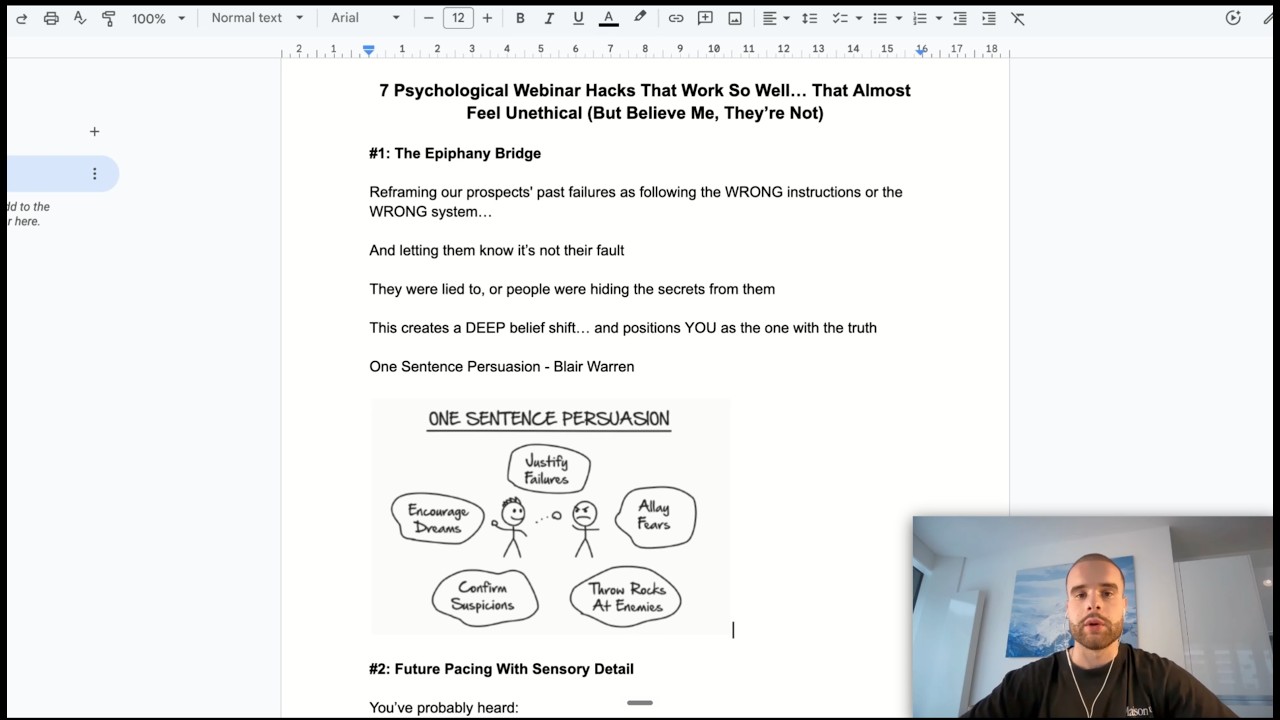
Okay, here are 7 psychological webinar hacks that work so well that almost feel unethical, but believe me, they are not. Now here are the 7 of the many psychological triggers that we apply for our done-for-you clients at Inforprofits. If you want more information about how we work, how we can help you, click the first link in the description and there'll be more information on the other page. When you click on that link, you'll also be welcomed by a short VSL walking over how we work, our deliverables, our offers, and previous case studies and existing case studies from clients who are scaling their online education businesses. On the other page, when you of course click that link, there's also some case studies and some video testimonials from happy clients who are now scaling consistently and profitably. Now without further ado, let's dive into the video. Now the first psychological webinar hack that we use across our done-for-you clients is the Epiphany Bridge. And the Epiphany Bridge is essentially reframing our prospects' past failures as following the wrong instructions or the wrong system and letting them know it's not their fault. They were lied to, or people were hiding the secrets from them. Now, what Epiphany Bridge does, it creates a deep belief shift and positions you as the one with the truth. Now, this comes down— well, this lesson stems from a great book that I read, one of the OG copywriting books that I recommend to every single offer owner or copywriter looking to broaden their skill sets, One Sentence Persuasion by Blair Warren. Now, there are a few principles laid out here But the one that this comes from is justifying the failures, right? Every single prospect and every single lead that enters your ecosystem, they've likely tried other things to get to a certain outcome, right? Let's say you're targeting middle-aged women over the age of 40 that want to lose fat, right? They've likely tried these diets, these training plans, and these skinny tea and all of these other fads, right? You need to let them know that these failures are coming into equation. The reason why they're not able to lose fat consistently is because These strategies that they've tried, they were just following the wrong instructions. Then we of course give a strong sales argument around that to let them know that, okay, you've tried this. The reason why it didn't work as effectively is because of these reasons. So we justify their failure. And then we of course create a gap to our solution. Let them know how and why our solution is superior. The key takeaway from the Epiphany Bridge is that it creates a deep belief shift and positions you as the one with the truth. To add extra credibility to the epiphany bridge, what I do with our clients is elaborate on the discovery story behind our unique mechanism. Anyone can say, okay, I learned this 3-step system and now I'm teaching to others. But for our webinar scripts especially, and across all the funnel messaging, like with that being said, we double down on the discovery story to let them know, okay, the client, he experienced this too, right? He ran into these hurdles, these struggles, but then he Came across this solution. He was skeptical at first, but now he tried it and now he's of course seen his dream outcome, right? You need to add credibility to it through a discovery story. So that's the first one, epiphany bridge. Next one is future pacing with sensory detail. Now this is a very important one, and this you can use ads funnel, webinar script, and all your pieces of copy, right? Now you've probably heard features don't sell, benefits do, right? To some degree, it's— there's some substance to it, but I beg to differ. I believe that features don't sell, benefits are okay at selling, but dimensionalized benefits are what truly sell. So what we do with our webinar scripts— now this doesn't have to be as dimensionalized in the webinar script, generally speaking, but we do instruct our clients to double down on these dimensionalized benefits. And during the live webinar presentation, we walk our prospects through experiencing the outcome that they want to achieve. Because if you're selling a make money online program, People at the end of the day, they want— they don't want to make more money, right? I mean, that's a benefit of the program, but what are the key reasons on why they want to make more money? They want to quit the 9-to-5. They want to have all the time that they never had with their children. They want to be able to go to the park on a random Tuesday with all their friends and family. They want to be able to do all the things that they've always wanted to do. They don't want to have time just for one vacation a year. They want 3 vacations a year, right? These are the dimensionalized benefits that your prospects Resonate with. This is what hits them deep into their emotions, right? For example, imagine 12 weeks from now you walk past the mirror and for the first time in years you don't look away. You see clear definition, your jeans fit, and when your husband hugs you, you don't tense up, you just smile, right? You don't take the feature and you don't sell the feature. You can of course double down on the benefits, but take that benefit and go as deep as possible. Possible with that benefit. 'Cause that's when of course that benefit is more vivid and a lot more real for the prospects that you are appealing to. And this is what truly sells. We've dimensionalized the benefits as deeply as possible and not magically our conversion rates have increased. Like people can picture the life that they're living. So that's the second one, future pacing with sensory detail. Now the third one is sunk cost activation. Okay? So in a nutshell, people hate wasting what they've already put in. So they keep going to justify it even when quitting or leaving would be the smart move. And this is the underlying idea of webinars. If someone spends so long with you, they are committing to you. They are committing to your methodologies and what you're going over in the webinar. So they don't necessarily want to leave because if they spend 45 minutes or like 60 minutes with you, right, they've already committed all that time and activates the sunk cost activation. Similar principle to like a movie. You go to the cinema and then you pay the tickets for you and your missus or your family, whoever it may be. The movie may not seem that exciting within 35 or 45 minutes or even like an, let's say like an hour potentially, but you don't necessarily want to leave because of course you've paid the price and you've also sat through the movie that long. This principle applies to your webinar funnels. So to do this, of course you need deep retention rate strategies with your webinar funnels. And this comes down to, of course, open loops, open loops. It comes down from selling the benefits deeply, It comes through giveaways, giveaways that, giveaways that you're offering. You can do this through demonstrating the consequences of not taking action or not finishing this. With your webinars, I know that a lot of people, they don't double down on the last point, especially is demonstrating the consequence of not taking action. Like, yes, during this webinar, I'm going to show you the exact system to make your first $10K month, whatever it may be, right? And then rather than just selling the benefit, let them know that if they don't attend, they're gonna miss out on these things. That activates the FOMO around it and it does increase your retention rates. Another thing is of course the open loops. You activate open loops with mentioning that, okay, if you stick with us until the end, you're gonna discover this exact system that reframes your beliefs or something of that realm. Open loops are powerful. Selling the benefits deeply as well. And retention rates, it also comes down from micro-commitment maxing. Now, micro-commitment maxing, not only in the form of comment ready if you're tapped in, but micro-commitment maxing with getting people to commit to their goals and like all of these things. So what we do with clients is like at the beginning of our scripts for some niches, like we let them know, okay, picture yourself 12 months from now. What is your ideal salary income? Or like, what's your ideal monthly monthly income with this business and why do you want to achieve it? And then we let them know, take your notebook out as we'll be, as we'll be coming back to this. You can also do micro-commitments in other forms. It's not only in the form of like, okay, comment ready if you're eager to learn about this, right? You get people to commit to their goals, to pick their lanes, etc. So disactivates the sunk cost activation and increases your retention rates to the webinar. And the more people you have a pitch, of course, the more calls you're gonna book. Third one, sunk cost activation. Fourth one is a takeaway close. Now with our webinar scripts, and when we work with these clients, right, we don't chase the prospects because this is a needy mindset. And neediness repulses, abundance attracts, right? This is a psychological principle that is applicable with everything, even if you're trying to sign that client, if you seem overly needy, they're gonna repulse. If you show internal abundance, then they're gonna attract it. So with our webinar scripts, we use something similar and activate the takeaway close. So we do this through pulling the offer back through disqualification and takeaway. We let them know that if they are this type of person and it may not be for them, don't even bother to book a call. This allows the offer to stop being a pitch and become something they have to qualify for. Now, a key thing to keep in mind, the person who feels chased pulls back. It's the cat effect. Do you remember when you're trying to chase a cat around and you run after it? Of course, it's gonna naturally run away from you as a byproduct, right? But when you're kind of in your motion, you kind of like remaining stagnant and you make the cat come towards you, then you're gonna bring the cat, of course, closer to you and you're gonna make that cat do what you of course want to do. Same thing with your webinar funnel. The person who feels filtered leans into you and starts selling themselves to you. And this is a different mindset, right? Rather than overly chasing that prospect, the prospect's coming into your world. So you're giving them the power to make the decision-making process, and this increases your conversion rates. So that's the fourth one, takeaway close. Fifth one is authority through demonstration, right? This is becoming incredibly important to activate because anyone, like any of owner, can say, trust us, we're experts, we've done all this money. We don't only say these things, right? We don't only say that we've made this amount of money or that we've helped this many people and stuff. You know, like anyone could do that. Anyone can go on Claude and create a fake testimonial, right? Or some fake story. But with every say, we demonstrate. So what we do with our clients' webinars is we do the thing live. We show the ad account, we create a sample ad, we write a quick resume from scratch live, and the list goes on. These demonstrations are going to depend on the niche that you're on. But adding live demonstrations to our webinar scripts, they have drastically increased our conversion rates. Like now the prospect is seeing our clients' competence in real time. These prospects and these webinar attendees, they watch it work and they know that we can do it live. In today's increasingly skeptical and sophisticated market, claims can get doubted. Anyone can say that they made $1 million a month with Shopify, or they can say that they've done $100K a month with the agency, right? Anyone can say that. But that's why these claims, they can get doubted. But your demonstrations get believed because you're showing them through demonstration on your webinar script. And there's this one psychologist, Albert, she argued that watching someone like you succeed at something raises your belief that you can do it too. Rather than saying, okay, this, we have this module for book niche research. We can show them how we actually do the niche selection process. Authority through demonstration. It adds a lot more credibility to your name. That's the 5th one. 6th one, very important one, is justified scarcity. I see this over and over and over again with webinar scripts. Everyone is doing fake scarcity plays. X number of spots left, spots running low and stuff. Like, your customers are becoming more immune to messaging like this. With our webinars, we always give them a real reason behind it. Okay, we are capped at 500 live Zoom attendees. Why? Because of this reason. Okay, we're only taking on 10 people for this webinar offer. Why? Because the client is the one that is performing the fulfillment and he can only take on 10 people because if he takes on more people, he's gonna minimize his attention to detail with his real business. So on, so on, so on, so on. This fake scarcity, as I said, your customers are becoming more immune. But when you justify the scarcity with a strong sales argument, you add into your credibility, people are gonna believe that scarcity play and they're more likely to take action. So with every Scarcity play or urgency play, give a strong reason behind it. Now the last one is the invisible swap reveal, and this is the betrayal moment. So with your webinar scripts, this is where you show them what was actually happening beneath the surface. While they thought that X was happening, while they thought that they were achieving this outcome because of implementing these strategies, behind the scenes, Y was quietly happening, right? For some examples, you thought a longer promo period would give you more time to sell, but it gave everyone more time to put it off. You thought you needed a better closer, but the sale was lost 40 minutes earlier when the belief was never built. So the invisible swap reveal or the betrayal moment, it does 3 key things. The first one is removing the shame from the prospects and the fact that they couldn't see it, right? Because at the end of the day, people, they don't necessarily like taking responsibility for their shortcomings. The second one, it creates anger at the old way and invalidates the old way even better, and it fuels desire for the new one. AKA your method. And the third one is position your solution as what stops the leak. Now, for example, let's say creating anger at the old way. You thought the key to financial freedom was starting this sort of business, but little did you know that this business was putting you deeper into poverty because of these reasons. The way that our business model works, it doesn't put you deeper into the rabbit hole. It doesn't put you deeper into poverty. It allows you to slowly and gradually Increase your safety net, make more money so you don't have to go back to where you were. As a byproduct, when you give a strong sales argument behind it, it positions your solution as what stops the leak. And this is the epiphany bridge. It kind of links back to the epiphany bridge. It makes your solution as the only go-to solution to achieve the outcome that they want. And once they see this, they can never unsee it. Seeking your solution becomes the next obvious step. So there we are, the 7 psychological webinar hacks that work so well that almost feel unethical, but believe me, they are not. Epiphany Bridge, Future Pacing with Sensory Detail, Sunk Cost Activation, the Takeaway Close, Authority Through Demonstration, Justified Scarcity, and Invisible Swap Reveal. As I said, if you are an online coach or you sell an online offer and you wanna scale with webinar funnels, you can click the first link in the description. There's a short VSL on the other page showing you how we work, our deliverables, and how we can help you scale consistently and profitably. Also in the description, there's also a link to join my private daily newsletter. Every single day I open up Google Docs and send addition to my list on direct response scaling offers, traffic funnels, offers, et cetera. Without further ado, this is the video and hoping that you found some real value in this. Let's get it.
More from Maciek

He Spent $100m On YouTube Ads, Hit $350k/mo, Then Shut His Agency Down (Brian Moncada)

The Simplest Meta Ads Creative Strategy That Actually Scales In 2026 (1 Winner Into 40)
The 4 pillars to scale your info agency with LESS ($1.7m/year in 12 months with first agency)

He Sent 920,000 Cold Emails Running Outbound For 110+ Clients (The Unfiltered Breakdown)