The only webinar SHOW RATE masterclass you need (35-40% on cold traffic)
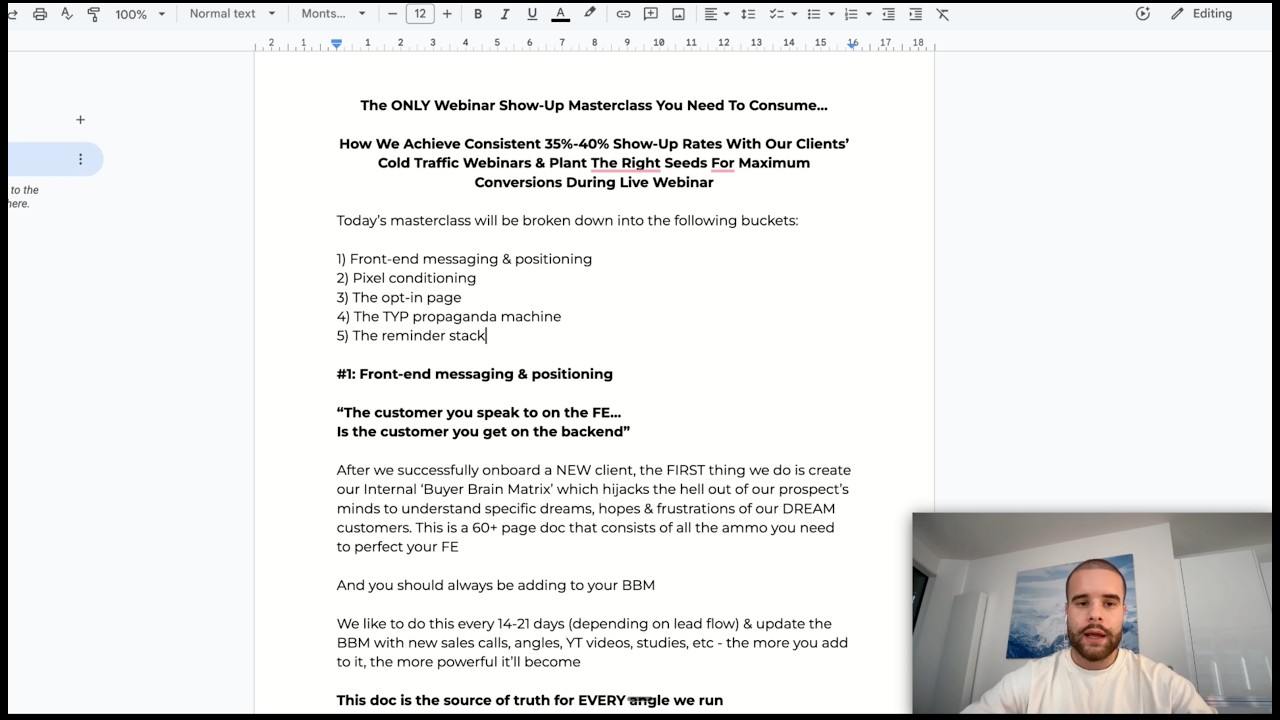
Maciek Lipa breaks down a five-part system for getting 35-40% of cold-traffic registrants to actually show up to webinars and convert them to sales calls. The framework covers messaging anchored to prospect language, pixel conditioning to train Meta toward high-value leads, opt-in page design targeting 20% conversion, a two-video thank-you sequence with micro-commitments, and a reminder stack of emails, SMS, and voicemails timed from 96 hours before the event.
Chapters
Okay, here's the only webinar show-up masterclass you need to consume to increase your show-up rates, get more highly qualified people inside your live room, put more highly qualified calls on your sales team calendar, and of course make a lot more money with live webinars. In today's video, I'm gonna be showing you how we achieve consistent 35 to 40% show-up rates with our clients' cold traffic webinars while planting the right seeds for maximum conversions during the live event. Now, before we dive into the value behind today's video, and it's gonna be a banger, so make sure you stick until the end. 2 quick things. One, if you are the offer owner wanting to scale consistently and profitably through cold traffic, click the first link in the description and there'll be more information about how we can help you scale. And 2, no matter if you are an offer owner, direct response copywriter, copywriter, agency owner, freelancer, or growth operator, whatever naming convention you'd like to go with, you also see a link in the description to join my daily newsletter where every single day I send an edition on ads, funnels, conversion mechanisms, scaling offers, and everything else in between. Those links are in the description. Now without further ado, let's dive into the value. Today's masterclass will be broken down into the following buckets. One, front-end messaging and positioning. Second one, pixel conditioning. Third, your opt-in page. Fourth, the thank you page propaganda machine. And fifth, the reminder stack. The first one, front-end messaging and positioning. Now you should already know this, but the customer you speak to on the front end is the customer you get on the backend. If you speak to a low-level ICP on the frontend, of course, naturally as a byproduct, you're going to attract low-level ICP and a customer on the backend, and you'll struggle to close deals. At In4Profits, after we successfully onboard a new client, the first thing that we do is we create our internal BuyBrain matrix, which is essentially a 60 to 80 page doc that hijacks our prospects' minds on a different level. With this buyer matrix, it allows us to deeply understand dreams, hopes, frustrations of our dream ICP 1 customers, the customers that we want to exactly appeal to with our ads promoting a live webinar. And with our BBM, even though that we created once when we onboard a client, this process is never-ending. And Our clients, they're going to have a lot more new sales calls on a calendar. They're going to be closing a lot more deals. They're going to be attending a lot more sales calls with prospects who have objections and limitations that we've never heard about before. So what we do every 14 to 21 days, of course, as I said here, depending on lead flow, we update our buy brain matrix and add new ammo inside it to hijack our prospects' minds even deeper. And of course, to invent new and better angles on the front end. If you want to see how we exactly create our buy brain matrix, you can click one of the links in the description and you'll watch a 1-hour masterclass that my copywriter done on crafting this exact process for your offer or your clients' offers. Now, the buy brain matrix that we create for our clients is the source of truth for every angle we run and every angle we test for our clients. And you'll be surprised at how many angles you can extract from this process. All it takes is one specific dialogue that a customer or lead said on a sales call to craft a new message on the front end. This is why I said that this process always has to be updated every 14 days. Just add as many new sales call transcripts and news articles and YouTube videos to this process, and you have a lot more angles to test on the front end. An angle in a nutshell is, of course, one reason a person would sign up to a webinar. And there are so many reasons why a person would sign up to a webinar, which I'm going to go over in just a moment. With the Buy Brain Matrix, we pull in specific frustrations, hopes, dreams, and exact words and dialogues of our dream prospects. And as I mentioned, every single dialogue, a specific dialogue, is an opportunity for a new and better angle on the front end. But every single angle It can get shot several ways with new hooks, settings, UGC characters, and faces of the brand, etc. This is even more important, as you know, with Meta's new update, right? It's rewarding the media buyer or the ad account that is constantly testing new creatives, new and better creatives. An example in the Airbnb biz op, right? These are just some foundational and fundamental angles, but I want to portray these so you kind of get a better grasp of them. First one, okay, we're teaching people financial freedom. My job pays the bills, but I will never get ahead. Okay, escape the 9 to 5. I cannot afford to buy a property. This is an example of an objection that may prevent someone from starting Airbnb. Well, okay, you don't need to buy a property. With Airbnb rental arbitrage, you can start without owning one. Or the third one: everyone online says it works, but I'm still stuck. A clear path provided. Every single one of these is an angle, but if we extrapolate even more. My job pays the bills, but I will never get ahead. Do you know how many angles are within this one bucket? That's with our clients. Of course, we have the underlying idea that we're looking to portray, right? Okay, escape the 9 to 5, but in how many different ways can this be portrayed? Okay, we can say financial freedom, and then we can also say no longer commuting to a job. No longer feeling like you're doing all of this work and still not progressing. You kind of get the idea. Within every single angle, there are so many micro angles that you can tap into to appeal to the customer that you want to appeal to on the front end. That's angles. Now messaging is you need to talk to the dreams, hopes, and frustrations of the majority of your qualified buyers from your buyer matrix. You need to use the exact words and what they say when nobody's watching them. Now, when we crafted the buyer matrix for one of our clients, they target Christian entrepreneurs. On a sales call, one of the customers said something about him entering his van and him not having the capability to put the belt over him in a seamless way. That's an angle that we would have never thought about or even considered testing. But because we crafted the buyer matrix and because we extracted that specific dialogue from that sales call, Now we have an angle. That one dialogue, it can be used as a hook and so on and so on and so on. The customer you speak to on the front end is the customer you get on the back end. Now, the angles that you double down on are more important than you think because like, let's say now, yes, we are appealing to someone making $100K a year and they want to get to $1 million a year as an agency owner. If we discuss foundational things to them, that angle is not going to resonate with them. So you need to think the ICP 1 that you're looking to target with your webinar funnels and what are they exactly experiencing that resonate with them? For example, a $100K a year agency owner, they may be appealed by delegation or crafting SOPs to escape from you doing all the work, right? Or personal branding. And signing high-value clients, so on and so on and so on. If I'm targeting people working at Wall Street, for example, I would find specific problems that this ICP of, let's say, Wall Street traders are experiencing and use those as angles. Because if you're looking to target a very specific person with your webinar funnels, your ads, you need to Use messaging and phrases that they're specifically resonating with. That's messaging. And here you, you use their specific, specific dialogue. Now I mentioned this in like another video as well, but the power of your terminology is a lot more important than you think. Speak their language. If I'm appealing to an agency owner making $100K a year and then they want to get to $500K a year or like a million a year, for example, I wouldn't necessarily use like get-rich-quick messaging because that's gonna repulse them and instead bring me in leads that I don't want. So don't neglect specific dialogue in your messaging because at the end of the day, the customer you speak to on the front end with your ads and organic content pieces as well is the customer you get on the back end. Now what we do with our clients' webinar funnels is we also judge ads by cost per live attendee. Now we go even more bottom of the funnel and we see which exact creatives are responsible for higher show-up rate, but also which exact creatives are responsible for driving the most applications, qualified calls, and even deals closed. Because what this would allow us to do is find which exact angle or creative is responsible for the highest show-up rate and is closing us the most deals. And when we understand what that creative is, we introduce variations of that one creative because yes, A creative or ad set that has a CPL of $6, yes, it may be bringing you all of these leads, cheap leads, cheap leads, but then you go bottom of the funnel, then you notice that they're not attending live or they're not filling in the application. That creative that you're testing is potentially just a click driver and it's feeding you leads that you don't want. A cheap lead who never shows is a very expensive lead. With our clients' webinar funnels, we track show-up rate and conversions per ad set and creative. And when we understand that, we scale what works and what buys— the most important thing— and we cut what only clicks. Back to the example of the Christian entrepreneur client, we noticed that one static was responsible for closing $6K deals through a low-ticket ascension funnel. We took that creative, took time to understand what that creative was saying, what was the messaging like, what was the positioning like, and and introduced variations of that one static, and that allowed us to appeal to even more customers that we wanted. So judge ads by bottom of the funnel events, cost per live attendee, cost per booking, cost per cash, et cetera. Now the second bucket is your pixel condition, and this is a lot more critical than you think. Your Meta pixel learns from the people you send it. If you send it standard registration complete, information of people that are not attending live or not booking calls, you're not gonna make money. So you need to feed this Meta pixel with registrants who look like your dream customer and are actually taking the action you want them to take. And as a byproduct, Meta will feed you more prospects like them. So to perfect this, the first thing that you need to do is pick the event. Now, if you're just getting started with webinar funnels I would recommend that you optimize for lead or complete registration first because it's a standard event. And Meta, of course, has a lot of internal data and backing behind a standard event, meaning that you don't need to be revolutionary with custom events now. And this sends plenty of data back to your pixel so you understand deeply what messaging works and what messaging doesn't. But what I would also recommend, even if you're starting from zero, even if you're testing a webinar with $5K spend for the week, right? I would still test on your thank you page and intake form. This thank you page intake form, it qualifies your prospects on a better level. And then with Zapier, you can fire back qualified registrant entries back to your Meta Pixel, allowing you to eventually optimize for these. And a qualified registrant is of course a lot more powerful than a standard lead, because what we do with our intake forms on the thank you page, we We collect qualification on 3 things. One, experience level. Second one, intent level. And third one, financial qualification. Experience level, okay, using the list below, which one best describes you now? And with Typeform, we've got a few options: complete beginner, I've looked at this, I've made a few sales, etc., right? Intent level, how soon would you like to achieve this outcome? ASAP, I'm just thinking about it, maybe in a few months from now, right? All these other questions. Third one, financial qualification. Okay. If you were to achieve this outcome in Y time, how much would you be comfortable in investing in yourself to make it possible? Then what we do with Zapier, new Typeform submission, filter by conditions from that Typeform and only feed a qualified registrant event or data point back to Meta if they are qualified on 3 levels: experience, intent, and financial. If they're qualified on all 3, then we send our data back to Meta— qualified registrant. And if we're getting 50 to 100 of these events every single week, then we can begin optimizing for these bottom-of-the-funnel events. Now, when you collect more data, you can also fire for purchase. Purchase— okay, someone opts into your webinar funnel for free, or even paid if you're going down that route, and then when they opt in, there's an optional VIP page, a $27 offer, $37 offer, $47 offer, depending on your ICP that sells a low-ticket offer. And when you collect 50 to 100 data points or events for this purchase of a bridge offer, then you can begin optimizing your webinar registration campaigns to purchase, allowing you to attract purchasing leads into your webinar funnel. And a purchasing lead is of course a lot more powerful than a standard lead. A standard lead, they just give you their full name, email, and phone number. A purchase, they gave you their full name, email, and phone number, but they've also made a transactional relationship with you. They've completed that financial transactional relationship, meaning that they are more likely to attend a webinar, to fill in the application form, and actually book a call. Now, the following event is a webinar schedule. Once again, aim for 50 to 100 events every single week. If you're getting 50 to 100 webinar schedules every single week, Once again, a really good data and event point to begin optimizing for, right? Now the third one is your opt-in page. Your opt-in page has one job and one job only. Your dream customers, they read a headline and they know exactly what they're getting and they register for your training. Now I've got a few examples of opt-in pages beneath, but foundationally on our webinar opt-in pages, We have a headline with a big idea, and then beneath the headline we have a subheadline which overcomes constraints and potential reasons why they may not opt in, a countdown to the live event, and then we have 2 to 3 scrolls of supporting text. We do test, and we've split this for clients. We sometimes do an embedded, embedded form on the opt-in, but what we like now, which has increased our KPIs, is CTA, open popup, and then the form. This is a better process for us right now and has increased our KPIs. I recommend that you test the same. CTA, open popup, and then we have the form, right? With the form, we always capture their phone numbers because what I'm gonna be showing you in just a moment is our SMS blast that we send to maximize these show-up rates. First name, last name, email, and phone number. And of course we show the event in one consistent time zone. You can also Claude code max this and make that event time auto-populated depending on their IP address. That's another hack that you can do to increase your opt-in rates and shop rates in general. But we always capture the phone number. You need to keep this fast and simple. 3 colors, fast load, and we like to use drag and drop HTML blocks. So we do this with Claude Or Manus is also good, another option. And then we use one section per element, meaning that the ICP callout, one section. And then you've got it above the, above the fold, which has your headline, subheadline, and then you've got your countdown timer, etc. This will be another section. And then you've got your bullets, fascinations. This is also another section. So in total you have 5, 6, 7 sections depending on how long form you decide to go. And you can craft highly converting HTML blocks with Claude. And bonus tip, if you use the Bybrand Matrix to assist you in crafting these HTML blocks, it'll make them a lot more powerful. Now what we aim for It depends on where you are getting traffic from. If you're doing organic for your webinars, you should be getting minimum 40% opt-in rates, like minimum. For some other client webinars, we had 50% opt-in rates. With cold traffic, the dynamics relatively change. You're not gonna get 40, 50, 60% opt-in rates, right? Because these prospects are hearing about you for the first time. But with cold traffic, especially when we are scaling up that ad spend, we like no less than 20%. If we're less than a 20% opt-in rate through cold traffic, we find the leak and fix that leak and diagnose to improve that opt-in rate. Now, some examples of opt-in pages that I found. Here is one that I done for a business acquisition offer back in the day. And if you read the headline, at last, $850,000 per year boring business owner is pulling back the curtains on everything he knows for a once in a lifetime 3-day masterclass. How to buy your first boring business that produces figures in annual cash flow for zero money out of pocket. For just 60 minutes a day over the next 3 days, join Serial Entrepreneur X to discover how to buy your first boring business without these objections. But now if we go back to the process of this, right, headline, subheadline, countdown, your opt-in page has one goal. They read the headline, they know what they're getting, and they register. With this, they know what they're getting. Okay, if I attend this 3-day masterclass, I'm going to know how to buy my first boring business that produces 6 figures in annual cash flow for zero money out of pocket. You need to make this process as stupidly simple for them as possible. Now, for this client, we want— we went slightly longer form, but the most important section of your webinar opt-in page is of course the above-the-fold section, because it's above the fold that customers see when they first click your ad. when they first click that link in the description. Once again, another example. This is speaking to established cleaning business owners, right? Above the fold, you see we call out the ICP. Free live masterclass for cleaning business owners. How to build a remote cleaning business that thrives without you. From the owner managing $140,000 a month across 3 regions in 5 hours a week. I'm a remote cleaning business owner. Okay, I want to escape the day-to-day fulfillment, make this thrive without me. Okay, I'm opting in, right? Very simple. Don't overcomplicate the process. With this one as well, how pre-retirees and retirees with $1 million plus saved can potentially add 6 to 7 figures to their lifetime retirement wealth. Once again, I know exactly what I'm getting. If I'm a retiree and I've got $1 million saved, and then I want to add more money to my portfolio, to my funds, to my personal net worth. I know that the outcome that I'm receiving. More examples here: the fastest path to earning 5-figure months with TikTok Shops by posting less videos that convert, that convert more sales. Here: sign your next 5 to 10 hard-to-get clients on autopilot leveraging AI agents. You know exactly what you're receiving. Another one: access a live breakdown on how we scale agencies and B2B owners to $100,000 a month with the Ascension Funnel. You know exactly what you're receiving. If you want more swipe files of opt-in pages, feel free to DM me on Instagram and I'll forward you over some more examples. Now the 4th one is your thank you page propaganda system. Congratulations, someone has opted into your webinar. You've now got their details, right? But that doesn't necessarily mean that they're going to attend your webinar. These things do help. These strategies do help. Pixel conditioning, speaking to the right ICP, etc. But when someone opts in and when they've registered, you've only completed half of the job. You still need to get that lead to attend. And one of the most neglected strategies that you can deploy to increase your show-up rates is your thank you page propaganda machine. That's like a naming convention I crafted, right? It's not confirmation page, it's a propaganda machine. Your thank you page is where they decide to actually show up. So what we do with our clients, and I've got an example of this visually below, the first thing is we acknowledge their action to let them know that they made the right decision. And then throughout the entire thank you page, we constantly hand them the feeling that they did the right thing. We resell them on the opportunity and our unique mechanism, and then flood them with proof, propaganda, and micro-commitment touchpoints to increase intent pre-webinar. With our clients' webinar funnels on the thank you page, we always add 2 VSLs to the thank you page. We don't only add one, like congratulations, you opted in, add to your event, add to your calendar, this, right? We don't do that. We add 2 videos, 2 videos, 2 jobs. The first video is the how video, and this is at the top of the page, which controls behavior. With the how VSL, we get them to shop on time and focused. Like there's 4 steps: add to your calendar, reply to the confirmation email, protect the time, arrive early, and so on and so on and so on, right? But this how VSL is logical. This is not necessarily reselling them the opportunity and flooding them with proof to let them know, yes, you've opted in and yes, you can achieve this outcome, right? So that's what the second VSL does, the why VSL. And this is embedded below the how VSL. And this why VSL, it controls the belief. It lets prospects know that the opportunity is real and it's happening now. It also shows them with proof that our mechanism works and that they can do this. And we also name our mechanism in like a little more detail. And of course, throw rocks at enemies and make our unique mechanisms seem superior. 2 VSLs, how VSL, why VSL, but both of these end on the same action, show up. With intent. If someone doesn't consume a why VSL, for example, if you're not controlling their belief systems before the webinar starts, they only know how to show up on time and all these other things, but that doesn't sell. Emotions sell and beliefs sell. Hence why we always add a why VSL for our clients' thank you pages. Now, every item on the thank you page is a micro-commitment. And as you know, if you've read Influence by Robert Cialdini, the more yeses you get someone to complete, the more justifiable the big yes makes sense. So each one of our thank you page steps, it makes the next one feel automatic. Okay, add the live event to your calendar, reply to the confirmation email, fill out this intake form for qualification, screenshot the confirmation page and tag the host on Instagram. Now, an important thing, your commitment tools depend on how your customers respond to information and what they need. For some clients, we add breakout videos and more social proof elements. For other clients, we don't necessarily add them because it doesn't appeal to the ICP. But the fundamentals which we always, always add is the how VSL, the why VSL, add to calendar, social proof wall, reply to email in exchange for free gift. Now what we do actually, because I know some people, they just ask registrants to reply this email to confirm your spot to help improve deliverability, which is a good strategy. But what we also do is let these registrants know that when they reply to the confirmation email, yes, they're confirmed, but then they also receive this bonus, which gives them a better chance at succeeding after the webinar, right? PDF SOP, something simple here. And then of course, beneath that, proof, short FAQ videos, that pull in from your sales calls depends on your ICP sophistication and awareness levels, but they are moving the needle for us. Testimonials and live-only bonuses, anything a replay can't give. Now for our clients' webinars, we don't put a lot of attention to the power of a replay because that gives prospects the feeling that they can skip the live and watch the replay, but we don't want this happening. We want them attending the live room because that's when our KPIs are going to be Even better, even more profitable. So put heavy focus on the live. Okay, if you stick with us live, here's what you're getting: X, Y, Z. Put a lot of attention to these live-only bonuses and also mention them inside your pre-webinar emails. Now just for a brief example for the like the thank you page, um, oh, that's the replay actually, my bad, that's the wrong image I added. But congratulations, you've sign up for the live training, how VSL, add to your calendar, why VSL, breakout videos, a bunch of proof, authority publication features, and so on and so on and so on. The key principle with your thank you pages is that someone has just opted in. They are by far the hottest that they're ever gonna be. So you need to resell them on your opportunity and let them know that they've made the right decision. Now the 5th one is the reminder stack. Your pre-webinar emails and confirmation emails and SMS, they are also propaganda elements. So don't only give your prospects basic reminders. Our emails, every email that we add to our pre-webinar emails, it overcomes a limitation, builds further belief, or gives them another reason to show up live, right? Don't add an email, okay, we're 24 hours away, here's your link, right? That doesn't move the needle forward. Especially with cold traffic. You need to overcome limitations and build deeper belief with them. You as well in your pre-webinar emails, this can be an email too, or subtly and briefly in your confirmation email, tell the story behind the mechanism, show client proof, and answer the questions from your replies. Now what we do is with every initial email, like the first 3 emails or so, we ask for a tiny micro-commitment. The first email, the confirmation one, is a reply email. Reply with I'm in to guarantee your spot and to receive this bonus only given to live attendees that will allow you to accelerate your success after the workshop. We also in our emails get people to add the training to their calendar to increase show-up rates. We also get people to watch a 2-minute video. What we've started testing is getting our client to record a selfie-like video that teases the workshop in like a little more detail. It's a different touchpoint rather than just plain text emails. We get people to vote in a poll. We get people to listen to voice memos and so on and so on and so on. The more micro-commitment plays that you activate with your pre-webinar emails, the higher your show-up rates will be. We also as well pattern interrupts get opened. This is why with our clients, we send emails from different faces of the brand. We be creative with our subject lines. We just maximize those show-up rates because I'm subbed. I have opted in to a lot of webinars and the subject lines are the same. Live in 60 minutes, live in 45 minutes, live now. Show variations so you're increasing those open rates. And as a byproduct of you increasing your open rates, you're getting more people opening your emails, viewing your emails, clicking your emails, and joining the live room. Now we have 10 to 13 emails between registration, and we're alternating between 2 senders. One is typically the host and another is a team member. But with that being said, we are now Adding more senders to the emails like successful clients and so on and so on and so on. An important thing with your reminder stack is to double down on what only happens live. The Q&A, the bonuses, the live room, and all of these things that are only provided to live attendees. Because as I mentioned, if you give people a strong incentive on watching the replay, there's not enough urgency and FOMO associated to attending the live. So don't overly sell the replay. Just tell them straight that the replay doesn't include any of it. So yes, you've registered. Yes, there's a replay. But if you watch the replay, you don't get access to XYZ, right? It will incentivize people even further to attend the live room. Now mention the live-only bonuses in 4 to 5 emails and push back to the replay in the last 2. Another important thing. Now the day of your webinar is where show-up rate is won. And you'll see our structure in just a moment. But on the webinar day, especially if your promo periods are rigid, let's say you're increasing spend gradually leading up to your live training, right? You're gonna get a lot of high-intent leads opted in within the last 24, before the 24 hours that your webinar starts. So here, that's where we send the most emails. We keep sending after we go live and while we're live. We also send a 15-minute email in the room. And then we also send a 15-minute-in SMS. Okay, we're 15 minutes in, we're just minutes away from going over this strategy, get in while you can. SMS, as I said, incredibly critical to collect with webinars in general. And in the first SMS, in a confirmation to improve micro-commitments and get more micro-commitments from customers, we get these prospects to reply with a simple I'm in. These texts, by the way, You don't need to have as many propaganda elements in place. These texts, they just remind people of what's happening and the time and date. Meaning what you can do with your SMS messages is point people back to their email inboxes. Yes, if you check your email inbox, you'll see how this person went from before situation to after situation, etc. Navigate people to their email inboxes because you're able to be a lot more long-form with your messages. With SMS, you're of course capped, otherwise your bills would be crazy. Another play that you can do with reminders is RVM, ringless voicemails. Now you can do this through Slide Broadcast. It's a great tool. You do this on credit-based pricing, or GHL also has an RVM tool. Haven't tested this too religiously. Slide Broadcast, I know that the deliverability is really good, but with RVMs, once again, another neglected strategy to increase your show-up rates. With RBMs, you don't need as many touchpoints. We just do confirmation 1 hour before and 15 minutes before. Now, the most important thing is, of course, the stack. How do we combine these email and SMS? So here's a quick preview of what our stack looks like. For email, we've got opt-in, 2 hours after the opt-in. This can maybe be 1 to 2 hours after, actually, because what we do as soon as someone opts in Well, 1 hour after opt-in, we sent another email re-acknowledging that they've made the right decision and overcoming more beliefs. Then we've got pre-events and we go up to 96 hours before. So we've got 96 hours before, 72 hours before, 48 hours before, 24 hours before, 10 hours before. Then we've got 3 hours before, 1 hour before, 5 minutes before going live, and 15 minutes And every single email, of course, serves a different purpose. In the first opt-in email, confirmation, logistics, story, reply, et cetera. Then we do sneak peek videos. Then we overcome key objections. Then we flood them with social proof, emotional stories, content preview, et cetera. Just feel free to take a screenshot of this and amend it for, of course, your clients. Now here is the full email sequence in full. Of what we do with our clients. So we've got the opt-in, as I mentioned, 96 hours before is typically identity-based. 72 hours before is the founder's story. With cold traffic, it's critical and vital to do this. So we tell a brief story around the founder and how he founded this unique mechanism and the fact that this unique mechanism and this solution has helped people like them achieve this outcome. Objection overcoming, we have the agenda proof, the fact that there's a live Q&A. 10 hours before, we do a recap of the stories, free instructions. 4 hours before, we like to do a voice memo from the client. Really neglected, but has increased our show rates drastically. 1 hour before, okay, here's what's happening. We're 60 minutes away, et cetera. Live, we're going live, and 50 minutes in. So that's the exact structure. Of course, I'm not gonna go over them line by line. I have got a full SOP that I have crafted. Want more information? DM me on Instagram. So that's the entire structure of email and SMS and RVM. And then of course the diagnosis, right? You can't fix show-up rate if you don't know which part of your webinar chain is leaking. For our clients, we set KPIs from the first ad click to the sales calls, and then we diagnose the one stage that's below benchmark. Here are some key metrics that we look for and the flaws that you should be optimizing for. If your KPIs are any lower than this, I would consider doing some deep conversion economic maxing and wondering why your KPIs are not where they should be. But here's some diagnosis and some KPIs that you should aim for. If you have got a low opt-in rate, but your ads are looking healthy, if your CTRs are good, if you're speaking to the right ICP, et cetera, you've likely got an opt-in page problem. You need to add a split test headline. You need to add more scarcity countdown and social proof widgets, right? And recheck the promise against the ad. Very vital. If someone is clicking an ad because of this reason, but then the landing page doesn't give them that reason, there's incongruency. If you have a good opt-in rate but low show-up rate, your expectations are all over the place. Your thank you page is not reselling them the opportunity. It's not overcoming their beliefs. It's not overcoming their resistance. It's not overcoming their objections. And you also need to check your reminders. If you get all of these people opted in and they're not joining the live room, You're not hyping them up enough. If your opens are fine and your show-up rates are still low, your emails aren't doing the right job. Overcome those beliefs a lot more, add more FOMO, increase that urgency and scarcity. If your show-up rate is fine but your conversions are poor and your script is solid, it's likely a front-end problem. You've just got the wrong people in the room, like simple. Go back to your front-end angles and your pixel conditioning. This is probably one of the biggest problems that I've seen with webinar funnels, and I've consulted on a very decent amount of these live webinars. They've got a decent show-up rate, they've got good opt-in rates, the ads seem to be calling out the right people, but in reality behind the scenes they're not. And then they've got this insane webinar script, but they're not closing deals because the wrong people are entering the webinar. So if your show-up rates are fine and your script is solid and it's speaking to the right ICP, but your conversions, but your conversions are poor, you're just attracting the wrong people into the room. And if you've got cheap leads and a weak show-up rate, you know, you need to begin judging by your cost per live attendee, not your CPL. You can get a lead now for $5, $4, but it doesn't mean anything if that lead is not attending or if they're not buying. Fix one stage at a time, because if you begin changing 2 things at once, you won't know which one worked. So that's the Webinar Shop Rate Masterclass on how we achieve consistent 35% to 40% shop rates with our clients' cold traffic webinars. Front-end messaging and positioning, pixel conditioning, opt-in page, the thank you page propaganda machine, and the reminder stack. Now, if you are an offer owner wanting to scale consistently and profitably through cold traffic, click the link in the description to apply to work with us. And 2, if you are the offer owner, copywriter, or direct response marketer, I have got a daily marketing newsletter where I send additions on traffic, ads, offers, scaling funnels, and everything else in between. Those links will be in the description. This is until the next video, and let's scale these offers.
More from Maciek
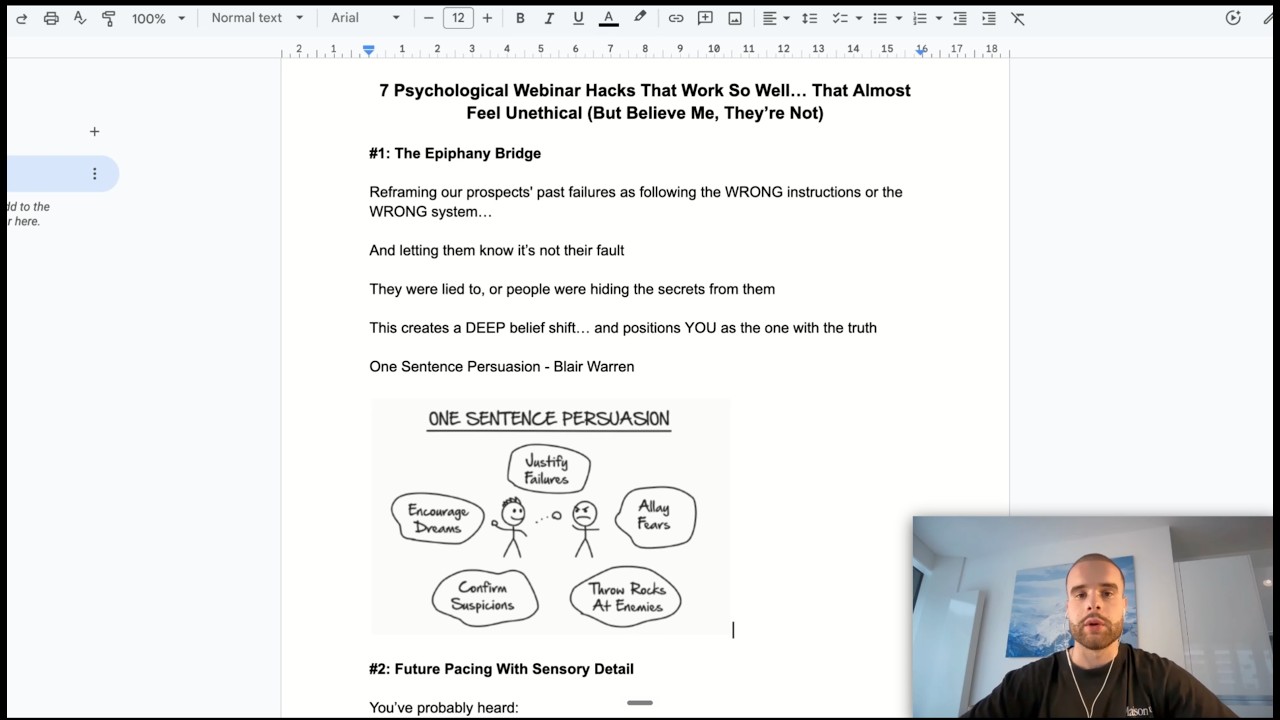
7 psychological webinar hacks that work so WELL... that they almost feel unethical
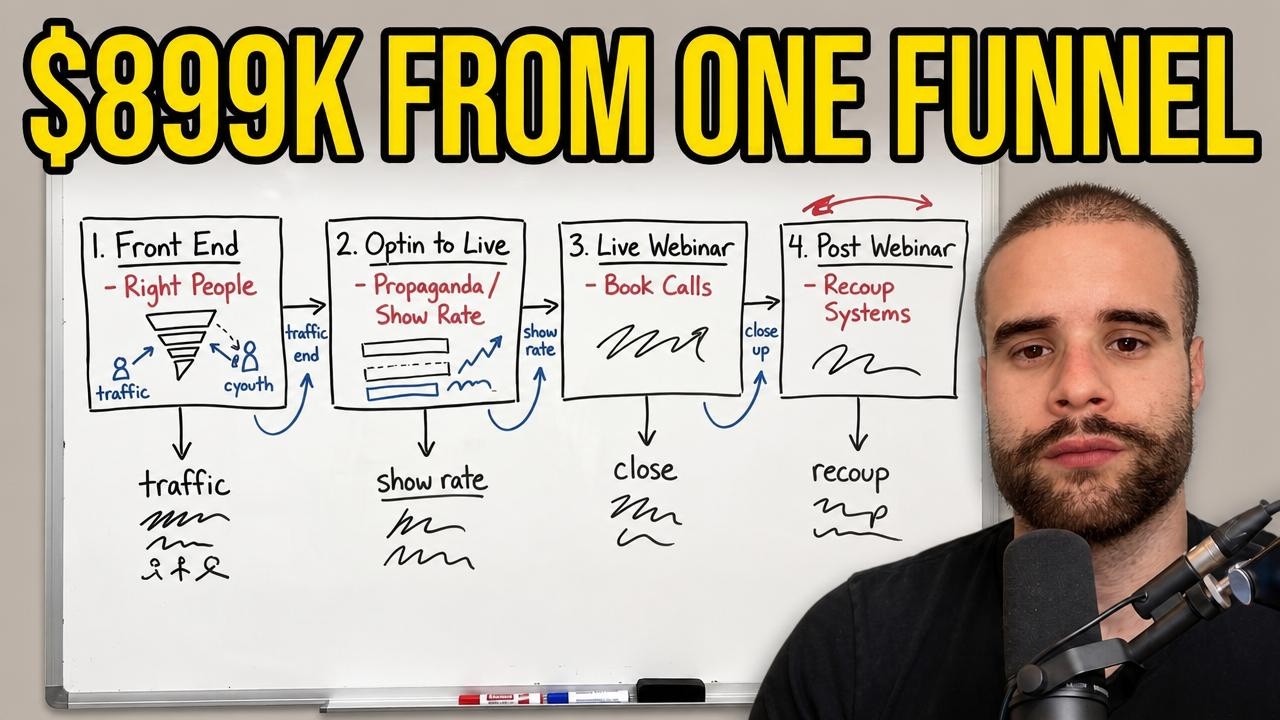

The Simplest Meta Ads Creative Strategy That Actually Scales In 2026 (1 Winner Into 40)
The 4 pillars to scale your info agency with LESS ($1.7m/year in 12 months with first agency)
He Sent 920,000 Cold Emails Running Outbound For 110+ Clients (The Unfiltered Breakdown)